
Summary
- Jan De Nul Dredging NV's durable pricing power does not come from selling connectivity. It comes from solving a narrow, expensive customer problem: executing marine works where port access, offshore wind delivery, subsea power-cable protection and coastal resilience depend on scarce vessels, crews, permits, weather windows and risk allocation.
- The cap on that premium is real. Carriers, satellite providers and cloud platforms can replace much of the digital-connectivity layer, while procurement teams can compare Jan De Nul with DEME, Boskalis, Van Oord, Great Lakes and specialist cable or installation partners. The premium survives renewal only if private data show superior vessel utilization, delivery reliability, bid discipline, change-order recovery and repeat awards after customers have seen rival prices.
The premium starts with a narrow problem: execution risk at sea
The customer problem that can justify a premium at Jan De Nul Dredging NV is not "connectivity" in the abstract. It is the cost of being wrong at sea. A port authority that needs a deeper access channel, a transmission-system operator that needs an export cable buried, or an offshore wind developer that needs foundations installed is buying certainty under constraints that are hard to fix once a vessel is mobilised. The weather window is finite. The seabed is uncertain. The vessel day rate is only one visible line in a much larger cost stack.
Delay can leave a client with idle turbines, delayed port revenue, exposed cable, claims between contractors or political pressure around an energy-security project.
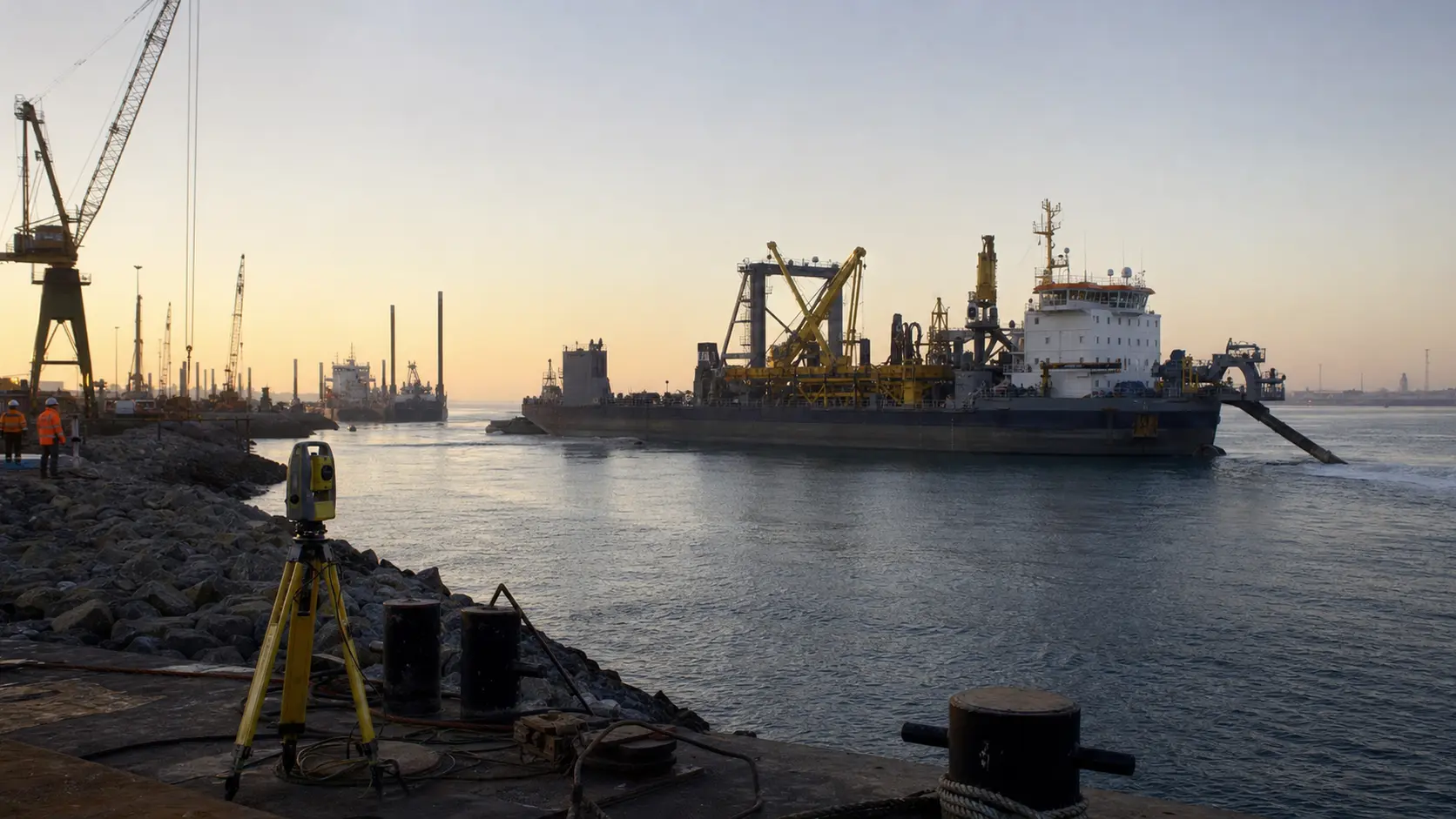
That is where Jan De Nul's premium can exist. The group sells an answer to the buyer's question: who can integrate engineering, equipment, crew availability, offshore execution and contractual responsibility without forcing the customer to manage each interface itself? In 2025 the group described four areas of expertise: Offshore Energy, Dredging Solutions, Construction Projects and Planet Redevelopment. The article's relevant boundary is the overlap between Dredging Solutions and Offshore Energy, because those units carry the hardest economic question. Dredging shapes ports, waterways, reclaimed land and coastlines.
Offshore Energy installs and protects wind-farm structures, export cables, inter-array cables and interconnectors. In the 2025 financial report, Offshore Energy and Dredging Solutions together contributed about 73.55% of net turnover, or roughly three quarters of the business mix.
The premium is therefore a risk premium, not a brand premium. A customer may pay more for Jan De Nul when the work requires a scarce vessel, proven offshore methods, a crew that has handled similar interfaces and a balance sheet strong enough to accept a large scope. It may not pay more for standard connectivity, generic IT, ordinary civil works, commodity subcontracting or a simple dredging job where multiple qualified bidders can mobilise similar equipment. The right starting point is to separate the scarce problem from the replaceable parts.
Jan De Nul can have pricing power over marine execution risk while still being a normal buyer of telecom, cloud, fuel, steel, shipyard capacity and subcontracted cable manufacturing.
Who pays is usually a public authority, port customer, energy developer, transmission operator or prime contractor. Who benefits can be a port user, energy consumer, coastal community, developer, grid operator or government. Who carries the downside depends on contract design. If Jan De Nul accepts more delivery risk, the premium has an economic basis. If the customer keeps most of the interface risk and the company mainly supplies equipment, the premium should be narrower.
The operating boundary is a dredging contractor with a serious digital footprint
The legal name in the public RIPE record is Jan De Nul Dredging NV, located at Tragel 60, 9308 Hofstade, Belgium. RIPE NCC lists the company as a member serving Belgium and Luxembourg. The RIPE database organisation record identifies Jan De Nul Dredging NV as an LIR, with country BE and registration number 0419.146.797. That matters because it shows the company is not just consuming retail internet access like a small office. It has enough internal network need to appear directly in regional number-resource governance.
The resource evidence is concrete. RIPE's public database shows an IPv4 allocation from 193.148.8.0 to 193.148.11.255 under netname BE-JDN-20180507 with status ALLOCATED PA. It also shows AS202495, named JDN, and AS210196, named DMM, assigned to the same RIPE organisation. Both autonomous-system records were created in 2018 and include import and export policy entries to upstream ASNs. Third-party BGP views show each ASN originating one IPv4 prefix and list Proximus as an upstream. The safest interpretation is operational self-reliance: a global marine contractor appears to manage some of its own public-numbering and routing arrangements.
That is not a reason to call Jan De Nul a telecom operator. The company evidence points the other way. Its own materials define it around shaping water, land and energy, not around selling internet access, cloud hosting, registry services or managed networks. The RIPE record is best read as supporting infrastructure for a company that runs offices, vessels, project sites, remote works, secure communications, enterprise systems and possibly cross-border network resilience. It is evidence that connectivity is important to operations. It is not evidence that connectivity is the product.
This boundary is important for the pricing-power question. If the subject were a carrier, the test would be subscribers, churn, coverage, wholesale rates, interconnection and traffic growth. For Jan De Nul, the test is different: vessel utilization, contract scope, execution quality, claims discipline, balance-sheet capacity and the ability to win repeat work when customers can see rival bids. The digital footprint can support the operating model, especially across vessels, sites and countries, but it cannot by itself defend a marine-infrastructure margin.
The public identity also has a group-level complication. The financial and operating data available in company reports are group-level Jan De Nul figures, not a standalone financial portrait of the RIPE-listed legal entity. That does not weaken the economic analysis, but it sets the right confidence level. The article can use group financials to understand the business model behind the public name. It should not pretend that RIPE membership alone maps every euro of group revenue to the Belgian Dredging NV entity.
The business model sells scarce assets, engineering judgement and risk transfer
Jan De Nul's business model is easiest to understand as a bundle of asset ownership, engineering knowledge and project-risk allocation. In dredging, the customer buys access to vessels and crews that can deepen waterways, reclaim land, create port capacity, reuse dredged material and protect coastlines. In offshore energy, the customer buys offshore lifting, cable transport, cable installation, rock placement, trenching, burial and protection. In both cases, the company monetises physical scarcity and the ability to sequence complex work.
The 2025 financial report shows why the bundle has economic weight. Group turnover reached EUR 4.235 billion. EBITDA was EUR 812 million, just under a 20% margin, and net profit reached EUR 458 million. The order book stood at EUR 7.85 billion at year-end. Europe generated 53.76% of net turnover; Asia, Australia and the Middle East generated 25.84%; the Americas 13.12%; and Africa 7.28%. That geographic spread gives Jan De Nul some resilience, because a weak procurement cycle in one region can be partly offset by port, energy or construction work elsewhere.
It also increases complexity, because vessels, crews, tax positions, local regulation and currency exposures move across borders.
The order book matters more than one year's revenue growth. Revenue growth shows demand, but value creation depends on whether signed work converts to margin after weather, fuel, subcontractors, claims, drydockings and project delays. The company reported EUR 4.001 billion of net turnover in 2024 and EUR 4.235 billion in 2025. That is a strong scale signal, but the premium test is not only top-line growth. A marine contractor can grow revenue by accepting poor risk, mobilising into congested work windows or absorbing supplier inflation. The better question is whether the order book was won at prices that compensate for risk.
Jan De Nul's premium is most credible where it offers customers a lower total-risk cost than coordinating a fragmented supplier set. The company can dredge a channel, prepare a seabed, install protection, handle offshore cable operations, provide engineering support and carry a portion of the delivery obligation. That integrated promise is useful when the buyer's alternative is to split work among a dredger, a cable installer, a civil contractor, a survey company and several equipment owners. Each split creates interface risk. A contractor that can reduce those interfaces can charge for the reduction.
The counterpoint is procurement discipline. Large customers know the supplier landscape. Transmission operators and offshore wind developers can run framework awards, prequalify multiple consortia and divide packages by geography, cable system, converter scope, nearshore works and offshore installation. A port can choose a dredging contractor by technical qualification and price. Jan De Nul's pricing power therefore reaches only as far as the customer's perceived risk reduction. If the buyer thinks a competitor can deliver the same package with similar risk, the premium collapses into a bid comparison.
Fleet commitments turn pricing power into a balance-sheet decision
The company's pricing power is inseparable from capital allocation. A marine contractor cannot claim a premium in 2026 unless it made vessel decisions years earlier. Jan De Nul's 2025 report shows a balance sheet built around that fact. The group reported 60% solvency, equity of EUR 4.238 billion, cash and cash equivalents of EUR 1.769 billion and a net cash position of EUR 1.295 billion at year-end 2025. Fixed assets were EUR 2.740 billion, and the company said its fleet represented about 70% of fixed assets, including vessels under construction.
That is a strong financial posture for a contractor facing large offshore-energy and dredging opportunities. It gives customers confidence that the company can mobilise, invest and absorb shocks. It also explains why pricing cannot be judged only against a vessel day rate. The group had EUR 557 million in assets under construction at year-end 2025, including several vessels under construction for EUR 452 million. It reported forward purchase commitments for vessels of about EUR 368.7 million. These are not optional marketing expenses. They are the capital base that lets Jan De Nul promise capacity when other contractors may be fully booked.
The specific investments point to where management expects the premium. Two XL cable-laying vessels, Fleeming Jenkin and William Thomson, are scheduled for delivery in 2026 and carry 28,000 tonnes of cable each according to company materials. A new rock installation vessel, George W. Goethals, is expected in 2028 with capacity up to 37,000 tonnes and the ability to install large rocks in water depths up to 400 metres. The company also ordered the trenching support vessel Isambard K. Brunel and is converting Henry Darcy for shallow-water cable burial.
For dredging, it is adding its first plug-in hybrid trailing suction hopper dredger and two 20,000-cubic-metre trailing suction hopper dredgers expected in 2028 and 2029.
Those investments are a bet that cable installation, cable protection, offshore wind and port dredging will remain capacity-constrained enough to reward specialist ownership. If the bet is right, Jan De Nul can sell scarce vessel slots into multi-year offshore grid and wind-farm demand. If the bet is wrong, the company owns expensive assets that need work regardless of tender pricing. That is the classic marine-contractor tradeoff: asset scarcity creates upside, but fixed capital creates pressure to fill the calendar.
The balance sheet reduces, but does not remove, the risk. A net cash position gives management room to be selective. The real value test is whether the company uses that room to avoid underpriced work. A contractor with a strong balance sheet can command a premium only if it is willing to leave bad tenders to rivals. If it pursues utilization at any price, asset ownership becomes a cap on returns rather than a moat.
Dredging demand is durable, but procurement keeps it honest
Dredging is a durable need because ports silt, vessels grow, coastlines erode and governments keep looking for land, flood protection and navigable channels. Jan De Nul's Dredging Solutions materials define the scope in practical terms: future-proof ports, safe and clean waterways, new land and reinforced coastlines. Those are not speculative software markets. They are physical works that have to be done when a port cannot accept larger ships, when an access channel is too shallow, when a city needs coastal protection or when a new terminal needs reclaimed land.
The 2025 report gives examples that show both the strength and the limits of the dredging franchise. In Senegal, the Ndayane port work includes dredging a five-kilometre access channel and reclaiming 89 hectares of land for a new terminal using dredged material. In Australia, the company reported dredging works at Rio Tinto's Amrun Port, including an additional berth and a departure channel for larger vessels. In India, it reported dredging and reclamation work connected to port development.
These are large, practical problems with measurable outcomes: channel depth, berth access, hectares reclaimed, terminal readiness and maritime capacity.
That practicality supports a premium when the job is complex, urgent or environmentally sensitive. A port authority may not want the cheapest contractor if a delay would block terminal revenue or create safety concerns. A government may prefer a contractor that can show safety systems, environmental controls, local hiring, material reuse and a record on similar works. The value proposition is not just moving sediment. It is making the customer confident that the project will proceed without creating a second problem.
But dredging has clear substitute pressure. DEME, Boskalis, Van Oord and Great Lakes all show sizeable work portfolios. Boskalis reported 2025 revenue of EUR 4.457 billion, EBITDA of EUR 1.336 billion and an order book of EUR 7.004 billion. Van Oord reported 2025 revenue of EUR 2.6 billion and an order book of EUR 4.4 billion. DEME remains a large Belgian competitor across dredging, infra and offshore energy, with its Dredging & Infra order book near EUR 3 billion. Great Lakes, while mainly a US reference, reported USD 763.2 million of dredging backlog at year-end 2025.
These companies are not identical substitutes in every geography or project class, but they are enough to give buyers a price reference.
The result is a bounded premium. Jan De Nul can price risk, complexity, mobilization certainty, technical methods and balance-sheet confidence. It cannot price a simple dredging package as if no other contractor exists. Procurement departments can delay awards, split packages, adjust technical scoring or wait for a competitor's vessel window. The more standard the dredging problem, the closer the price moves to market. The more the project combines schedule pressure, environmental constraints, engineering uncertainty and integrated offshore scope, the more room Jan De Nul has to defend a premium.
Offshore energy gives the stronger renewal case
Offshore energy is the stronger pricing-power case because the customer's cost of delay can be larger and the supplier pool is more specialised. Jan De Nul's report states that its Offshore Energy unit installs offshore structures, high-voltage stations, wind turbines, inter-array cables, export cables and interconnectors, while also placing rock and protecting cables. In 2025, the company pointed to Thor in Denmark, Dogger Bank in the United Kingdom, Vineyard Wind and Sunrise Wind in the United States, and Hai Long in Taiwan as examples of offshore work.
The order book also included the RWE vessel charter, TenneT 525 kV HVDC cable-system work, RTE Southern Brittany export cables and Nordlicht inter-array cable installation.
The customer problem here is not just construction. It is sequencing. A wind-farm developer needs foundations, turbines, cables, substations, burial and grid readiness to align across seasons. A transmission operator needs cable-system manufacturing, offshore installation, nearshore landfall, environmental restrictions and onshore connection to align. If one part is late, the value of the other parts is deferred. That gives specialist contractors with scarce assets a clearer way to charge for certainty.
RWE's long-term partnership shows the point. RWE chartered Les Alizes for more than five years and Voltaire for more than four years to secure next-generation installation-vessel capacity for offshore wind foundation and turbine construction. That is a buyer paying not just for a vessel, but for access. It wants to know that capacity will be there when its project calendar reaches offshore construction. The same logic appears in grid frameworks.
TenneT awarded 525 kV HVDC cable-system work to major cable suppliers and a Jan De Nul-LS Cable-Denys consortium for projects including BalWin4, LanWin1 and LanWin5, with the consortium portfolio described at almost 2,000 kilometres. National Grid's framework, where Hellenic Cables and Jan De Nul are one eligible consortium, has an initial five-year term and can extend by up to three years.
The demand backdrop is supportive. The European Commission's offshore renewable strategy set targets of at least 60 GW offshore wind by 2030 and 300 GW by 2050. North Seas Energy Cooperation countries agreed an ambition of at least 300 GW by 2050 and 120 GW by 2030. ENTSO-E's offshore planning work describes a future with radial connections, interconnectors and hybrid offshore infrastructure that connects generation while also supporting cross-border trade.
Market analysis from TGS 4C says installed offshore-wind cables grew from 9,000 km in 2015 to 55,500 km in 2025 and forecasts 117,640 km of additional cable installation between 2026 and 2040.
Those numbers do not guarantee Jan De Nul margin. They do explain why customers may reserve capacity early and why the company is investing in bigger cable-laying, rock-installation and trenching assets. The renewal case is strongest when a customer has already experienced the contractor's performance on a difficult offshore work package and faces another package with similar risks. If Jan De Nul can show fewer delays, fewer interface disputes and better burial or protection outcomes than alternatives, the customer has reason to pay again. If it cannot, the offshore-energy order book becomes a competitive tender pool rather than a moat.
Network-resource evidence supports control, not telecom revenue
The network-resource evidence matters because it reveals how a marine contractor thinks about control. A company with vessels, offices, project sites and cross-border operations has reason to care about resilient connectivity. Remote worksites need communications. Offshore crews need data exchange. Corporate systems need secure access. Survey data, engineering files, procurement systems and vessel operations can move across countries. RIPE membership and autonomous-system records are consistent with an organisation that wants more control over addressing and routing than a small domestic company would need.
The economic significance is still limited. The RIPE member page and database records show a number-resource footprint. They do not show that Jan De Nul sells IP transit, broadband, cloud services or managed networks. AS202495 and AS210196 show assigned autonomous-system numbers. The IPv4 allocation shows public address space. Import and export policy entries show upstream connectivity arrangements. BGP.Tools provides an independent public view of originated prefixes and upstream signals. These facts support the idea that Jan De Nul has an operational network layer. They do not justify any claim that connectivity is a revenue line.
This distinction prevents a common analytical error. A company can be technically sophisticated without being a telecom company. A hospital can hold IP space without selling internet access. A bank can operate an ASN without being a carrier. A marine contractor can manage routing because its business cannot tolerate fragile communications across vessels and sites. The economic moat remains the marine work.
The network layer may still improve unit economics in indirect ways. More direct control can reduce dependency on a single retail provider, improve routing resilience, support secure access between countries and make it easier to integrate offices, vessels and project sites. It may also help when projects require reliable exchange of engineering and survey data. But those benefits are supporting functions. They defend execution quality and continuity; they do not create pricing power in a public tender unless the buyer explicitly values the contractor's digital resilience as part of delivery reliability.
This is also where cloud dependency enters the analysis. Most large industrial contractors use cloud services, software platforms and specialist telecom vendors somewhere in their operating model, even if Jan De Nul's public reports do not break out the spend. Cloud platforms can standardise storage, collaboration, enterprise software, identity management and data processing. Carriers and satellite providers can supply last-mile and offshore connectivity. If those layers are commercially available from outside vendors, they cap the value Jan De Nul can claim for connectivity itself.
The premium belongs only where internal digital control improves the marine delivery outcome.
Carriers, satellite services and cloud platforms cap the digital premium
The nearest substitute price is most visible in maritime connectivity, not in dredging. Starlink Business Maritime publicly lists Global Priority 50 GB starting at USD 250 per month and 500 GB starting at USD 650 per month. KVH and other maritime-connectivity vendors package Starlink and managed onboard services for vessels. Those prices are tiny beside the cost of mobilising a dredger, a jack-up installation vessel or an offshore cable-lay spread. That contrast is the point. If a customer problem is "connect my vessel or site to the internet," the substitute is a carrier, satellite plan or managed service.
If the problem is "install and protect an export cable in a narrow weather window," the substitute is another specialised marine contractor.
Carriers also cap the premium. RIPE records and BGP views show upstream connectivity rather than independence from the telecom market. Public BGP tools list Proximus as an upstream for Jan De Nul's ASNs, while the RIPE aut-num records show policies involving several upstream ASNs. That means the company can manage aspects of routing, but it still uses carriers for reachability. In practical terms, the existence of carriers limits any claim that Jan De Nul has unique control over connectivity. It may manage its network intelligently. It does not own the global internet.
Cloud platforms cap another part of the value chain. A marine contractor can choose cloud storage, collaboration tools, engineering systems and cybersecurity services from global providers. Those services may be mission-critical internally, but they are not unique to Jan De Nul. The buyer of a dredging or offshore-energy project is unlikely to pay a separate premium because the contractor has ordinary cloud access. It will pay if the contractor's digital tooling reduces survey errors, improves scheduling, protects sensitive project data or speeds claims resolution. The value must show up in project execution.
This distinction also protects the article from overstating "cloud competition." Cloud platforms do not compete with Jan De Nul to dredge a port or bury a power cable. They compete for parts of the company's internal IT stack and for customer expectations around data transparency, reporting and remote collaboration. A transmission operator may expect digital reporting, document control, survey traceability and near-real-time progress visibility. Cloud and carrier vendors make those expectations cheaper and more standard. That caps the premium Jan De Nul can charge for administrative visibility.
It does not cap the premium for bringing the right vessel and crew to the right seabed at the right time.
The economic rule is simple. The more a capability can be bought from Starlink, Proximus, AWS, Microsoft, Google, a maritime IT integrator or a systems vendor, the less it belongs in Jan De Nul's price premium. The more the capability depends on marine assets, crew judgement, safety record, permitting experience and accountability for physical outcomes, the more pricing power Jan De Nul can defend.
Suppliers and partners take part of the spread before Jan De Nul sees it
Jan De Nul's premium is not pure gross margin. Suppliers and partners absorb part of the economics. Offshore cable work often involves consortium structures because one firm does not control the whole system. In the TenneT work, Jan De Nul is paired with LS Cable and Denys. In the Southern Brittany framework, Jan De Nul works with Hellenic Cables, which supplies large lengths of offshore and onshore 225 kV cable. In the National Grid framework, Hellenic Cables and Jan De Nul are again an eligible consortium. Each partner has its own capacity, margin targets, risk appetite and supply constraints.
Cable manufacturing is a clear upstream dependency. A cable installer without cable supply does not create a finished grid connection. The Hellenic Cables Bretagne Sud contract describes 390 km of 225 kV export cables, split between 150 km offshore and 240 km onshore. National Grid's framework names multiple HVDC cable suppliers, including the Hellenic & Jan De Nul consortium, LS Cable & System, NKT, Prysmian, Sumitomo Electric and Taihan Cable & Solution. This supplier list shows buyer discipline.
National Grid is not relying on one contractor; it is building a panel to secure access to global capacity and create tension among suppliers.
Shipyards and equipment suppliers are another dependency. Jan De Nul's vessel investments depend on newbuild delivery, conversion work, engines, cranes, trenchers, rock-installation systems, cable-handling gear and simulators. The 2025 report shows EUR 452 million in vessels under construction and EUR 368.7 million in forward vessel-purchase commitments. Delay or cost inflation at shipyards can reduce the return on a future charter or cable project. A contractor may have the right strategic thesis and still see margin squeezed by supplier timing.
Fuel and energy are a third dependency. The 2025 financial report notes that escalating fuel prices tied to conflict in the Middle East after the reporting date could affect project cost structures, although management said many projects were protected by hedging, escalation formulas or contractual protection. That language is important. It shows both risk and mitigation. If contract terms pass fuel increases to customers, Jan De Nul can defend margin. If not, fuel volatility can eat the premium. The same is true for steel, specialised equipment, insurance, crew costs and port access charges.
The supplier question also affects switching costs. If a customer believes Jan De Nul's consortium has unique integration with a particular cable supplier or vessel spread, switching is hard. If the customer can rebundle the package among another installer, another manufacturer and another civil partner, Jan De Nul's premium narrows. The most valuable position is not merely being a contractor in a consortium. It is being the party whose absence would make the package riskier, later or more expensive to manage.
Customers are large, informed and able to wait
Jan De Nul's customer base is strong but demanding. The most important customers in the relevant work streams are not retail buyers. They are governments, port developers, energy companies, transmission-system operators and offshore wind developers. They understand tendering. They can hire engineering advisers. They can compare vessel specifications. They can demand guarantees, local content, environmental commitments, safety plans and audited performance. Their scale helps Jan De Nul because the work is large. Their sophistication limits Jan De Nul because they know the substitute set.
The 2025 order book illustrates the mix. RWE's long-term vessel charter gives visible offshore-wind utilization. TenneT's 525 kV HVDC work gives exposure to German offshore grid connections. RTE's Southern Brittany framework connects Jan De Nul to floating offshore wind export-cable work in France. Vattenfall's Nordlicht awards give inter-array cable scope in Germany. Port and dredging work in Senegal, Australia and India adds geographic spread. This is not a customer base of small accounts with weak bargaining power. It is a project-by-project buyer set where each award can be large and each renewal must be earned.
Customer concentration is therefore best read through project concentration, not through a published top-ten customer table. The public reports do not disclose customer revenue concentration in a way that lets an outsider compute dependency precisely. But the project examples show that a handful of large awards can shape vessel schedules, revenue visibility and investor perception. If a TSO delays an offshore grid package or a developer postpones a wind-farm phase, the effect can be larger than losing many small clients.
Market dependence is also visible in geography. Europe accounted for 53.76% of 2025 net turnover, up from 42.26% in 2024. That is positive when Europe accelerates offshore wind, grid reinforcement and climate adaptation. It is less positive if European auctions disappoint, permitting slows, interest rates hurt project economics or grid operators push harder on framework pricing. Asia, Australia and the Middle East accounted for 25.84%, the Americas 13.12% and Africa 7.28%. Diversification reduces single-market exposure, but a global fleet still has to chase work where policy, port demand and energy investment are moving.
The customer's realistic alternatives matter most at renewal. A developer that has already used Jan De Nul may value continuity, lessons learned and vessel availability. But if the first contract had delays, claims or high variation costs, that same customer can reopen the market. A TSO that creates a multi-supplier framework is explicitly preserving optionality. A port authority can phase dredging or split civil works. The premium survives only if Jan De Nul has made the buyer's own risk lower than the next-best bid.
Competition is not generic; it is package-specific
The substitute set changes by work package. In capital dredging and land reclamation, DEME, Boskalis, Van Oord and regional dredgers are credible alternatives depending on geography, vessel availability and technical scope. In offshore cable installation, the substitute set includes marine contractors, cable manufacturers with installation partners, specialist cable-lay operators and consortium combinations. In foundation installation, heavy-lift and jack-up capacity matters. In rock placement and cable protection, fallpipe vessels, rock logistics, trenching systems and subsea engineering become the relevant comparison.
This package-specific competition explains why Jan De Nul can have pricing power in one tender and none in another. A port maintenance job in a competitive region may be priced tightly because several contractors can dredge the channel. A 525 kV offshore grid connection across sensitive nearshore conditions may favour a contractor with the right vessel, cable-handling expertise and environmental method. A long-term vessel charter may reward scarcity if the customer fears an installation bottleneck during a critical work season. The same company can be a price-taker on a standard package and a premium supplier on a complex package.
Competitor scale keeps the market disciplined. Boskalis has a similar order-book scale and strong profitability. DEME has deep dredging and offshore-energy overlap. Van Oord is investing in offshore wind installation and dredging equipment. Great Lakes shows that in the US market, large public dredging backlogs can create alternative capacity and pricing reference points. These companies do not always compete head-to-head for every Jan De Nul scope, but they give buyers bargaining leverage and intelligence about market rates.
Procurement design also caps the premium. Framework agreements look attractive because they provide planning visibility, but they can be double-edged. A framework gives Jan De Nul eligibility and relationship depth. It also gives the buyer a mechanism to call off work, compare eligible suppliers and standardise terms. National Grid's HVDC framework, for example, included multiple cable suppliers and converter suppliers. The economic aim for the buyer is not to make one supplier rich. It is to secure deliverability, reduce supply risk and preserve competition.
The best pricing-power evidence would be private bid data. Outsiders cannot see whether Jan De Nul wins by underbidding, by technical scoring, by negotiated scarcity or by accepting risk that competitors avoid. Public awards show demand and capability. They do not show spread. The article's judgement therefore has to stay conditional: Jan De Nul appears well positioned for premium work, especially in offshore energy and complex dredging, but the company has to prove that position in contract margin rather than press releases.
Regulation, geopolitics and operating friction define the downside
The downside is not theoretical. Marine contractors face regulation, permitting, environmental scrutiny, safety risk, sanctions screening, fuel volatility, vessel detention, weather, supplier delays and geopolitical disruption. The 2025 financial report disclosed a concrete operational risk: Mexican authorities detained the dredging vessel Zheng He under a disputed resolution. A first instance judgment in 2024 favoured the group, appeals continued through 2025, and the company reported that it reached an agreement with Mexican authorities in 2026, after which the vessel was released in March 2026 and left Tampico.
That episode is a reminder that a vessel can be technically excellent and still be trapped by legal or administrative conflict.
Environmental and climate regulation also reshape the cost base. Jan De Nul's 2024 annual report said marine fleet and heavy equipment make up the largest part of its carbon footprint. It targets a 40% reduction in scope 1 and 2 emissions by 2035 compared with 2019, and a 20% reduction in scope 3 emissions by the same date. The report also said fleet occupancy accounted for nearly 90% of scope 1 and 2 emissions in 2024. That is economically relevant.
Higher utilization supports revenue and margin, but it also raises emissions exposure unless the company can improve fuel efficiency, electrify suitable equipment, use lower-emission technologies or pass requirements through to customers.
Geopolitical risk can enter through energy prices, shipping routes, local permits and customer investment decisions. The 2025 report noted that escalation of conflict in the Middle East after the reporting date could affect fuel prices and cost structures for some projects, while stating that many projects had hedging, escalation formulas or contractual protection. That disclosure points to a key contract-quality metric: how much input-cost risk Jan De Nul keeps. A premium that disappears under fuel inflation is not durable pricing power. A premium backed by pass-through clauses and disciplined hedging has a better chance of surviving.
Grid and offshore-wind regulation adds another layer. EU and North Sea targets create demand, but projects still need permits, auctions, grid connections, environmental conditions, port upgrades and public acceptance. ENTSO-E's offshore planning work shows how complex the future grid becomes as radial links, point-to-point interconnectors and hybrid offshore assets interact. Complexity can help Jan De Nul by raising the value of specialist contractors. It can also delay work and move risk back into negotiations.
The operational downside is therefore a function of timing. Jan De Nul must invest before demand fully materialises. It must reserve vessel capacity before all permits are finished. It must contract with suppliers before every customer schedule is final. When the cycle works, the company earns a premium for being ready. When the cycle slips, the company owns capacity before the work arrives. That is why the balance sheet is central to the thesis.
Market signals are useful only when kept in their lane
Unofficial signals support, but do not prove, the premium thesis. Public BGP tools show Jan De Nul's ASNs as active and connected through upstream providers. Industry press repeatedly covers the company's cable-laying vessels, TenneT work, National Grid framework eligibility and offshore wind projects. Social and professional-network surfaces show an organisation seen by the market as a large maritime and offshore-energy employer. These signals help locate the company in the market. They should not be treated as verified revenue, margin or customer satisfaction.
The strongest unofficial signal is the pattern of specialist coverage around cable-laying capacity. Trade and offshore-wind publications pay attention to the Fleeming Jenkin and William Thomson launches because large cable-lay vessels are relevant to a constrained market. TGS 4C's analysis of rising cable demand and vessel bottlenecks supports the idea that offshore wind and interconnector work can create scarcity. That does not mean Jan De Nul automatically captures scarcity rent. It means the market is watching the same constraint that the company is investing into.
The weaker signals are still informative if they are labelled correctly. BGP views show active network resources, but they do not show telecom revenue. LinkedIn-style headcount ranges show employer scale, but not profitability. Industry-news award reports show market relevance, but not margin. Vendor price pages show the cost of satellite connectivity, but not how much Jan De Nul spends. A disciplined article uses these materials as supporting context, never as hard proof of economics.
The market-chatter question also cuts both ways. Positive coverage of new vessels can signal demand. It can also signal that competitors see the same demand and are adding capacity. Public enthusiasm around offshore wind can hide auction failures, grid delays and developer cost pressure. A long-term framework can look like a backlog when it is really eligibility to bid on future call-offs. The article's judgment should therefore be conservative: Jan De Nul has credible exposure to high-value marine work, but the proof of pricing power is private contract performance.
The article would become more bullish if unofficial signals were matched by hard evidence of repeat awards at higher margins, customer willingness to reserve vessel capacity early, fewer claims than competitors and measured schedule outperformance. It would become more cautious if the same sources showed aggressive underbidding, repeated delays, capacity additions by rivals, cancelled offshore-wind projects or buyer moves to split scopes away from Jan De Nul.
The premium survives renewal only if private metrics prove it
The public evidence supports a measured conclusion. Jan De Nul Dredging NV has a real number-resource footprint, but the premium case sits in marine infrastructure. The company's strongest pricing power is where a customer faces a high-consequence physical problem and wants one contractor or consortium to reduce execution risk: dredging a strategic channel, reclaiming land for a port, installing offshore wind foundations, transporting and protecting export cables, burying cables or placing rock around critical subsea infrastructure.
The weaker case is any layer that carriers, satellite vendors, cloud platforms, equipment suppliers or ordinary civil contractors can provide.
Private metrics would decide whether the premium survives renewal. The first is bid-to-award quality: does Jan De Nul win because it is cheapest, or because customers score its technical and risk package higher? The second is vessel utilization at target margin: are the new cable-laying, rock-installation, trenching and dredging assets booked at prices that cover capital cost and risk, or are they filling calendars at thin spread? The third is change-order and claims recovery: when seabed, weather, fuel or permits change the job, does the company recover costs or absorb them?
The fourth is repeat-customer behaviour: after a customer has full knowledge of Jan De Nul's execution, does it renew, extend or reserve capacity again without forcing a reset to lowest price?
The fifth metric is supplier pass-through. Cable manufacturers, shipyards, carriers, fuel suppliers, equipment vendors and subcontractors all have bargaining power. Jan De Nul's premium is durable only if contract terms and purchasing discipline prevent those suppliers from taking the upside. The sixth is operational reliability: lost-time incidents, vessel downtime, repair delays, weather-window misses, cable damage, burial defects and environmental non-compliance all reduce the customer's willingness to pay a premium next time.
The seventh is digital resilience: network uptime, secure data exchange, project reporting and cross-border communications matter, but only because they support physical delivery.
The eighth metric is capital timing. The company is investing heavily before some future demand is fully locked in. If offshore wind and grid work arrive on schedule, those investments can create scarcity value. If auctions are delayed, permits slow or competitors add capacity faster than buyers add projects, the same investments could pressure returns. A net cash position and high solvency give Jan De Nul more room than many contractors, but they do not make the cycle disappear.
The final judgment is therefore bounded. Jan De Nul has credible pricing power in complex dredging and offshore-energy execution, especially where scarce vessels and integrated risk transfer are more important than lowest bid. Its RIPE and BGP evidence strengthens the picture of an operationally sophisticated global contractor, not a telecom-service business. The premium reaches far enough to cover difficult marine work if customers believe Jan De Nul lowers their total risk. It does not reach far enough to escape carriers, satellite substitutes, cloud commoditisation, supplier bargaining power or disciplined procurement.
The proof will not be another headline award. It will be repeat work at protected margin after the customer has seen the job, the claim history and the rival price.