
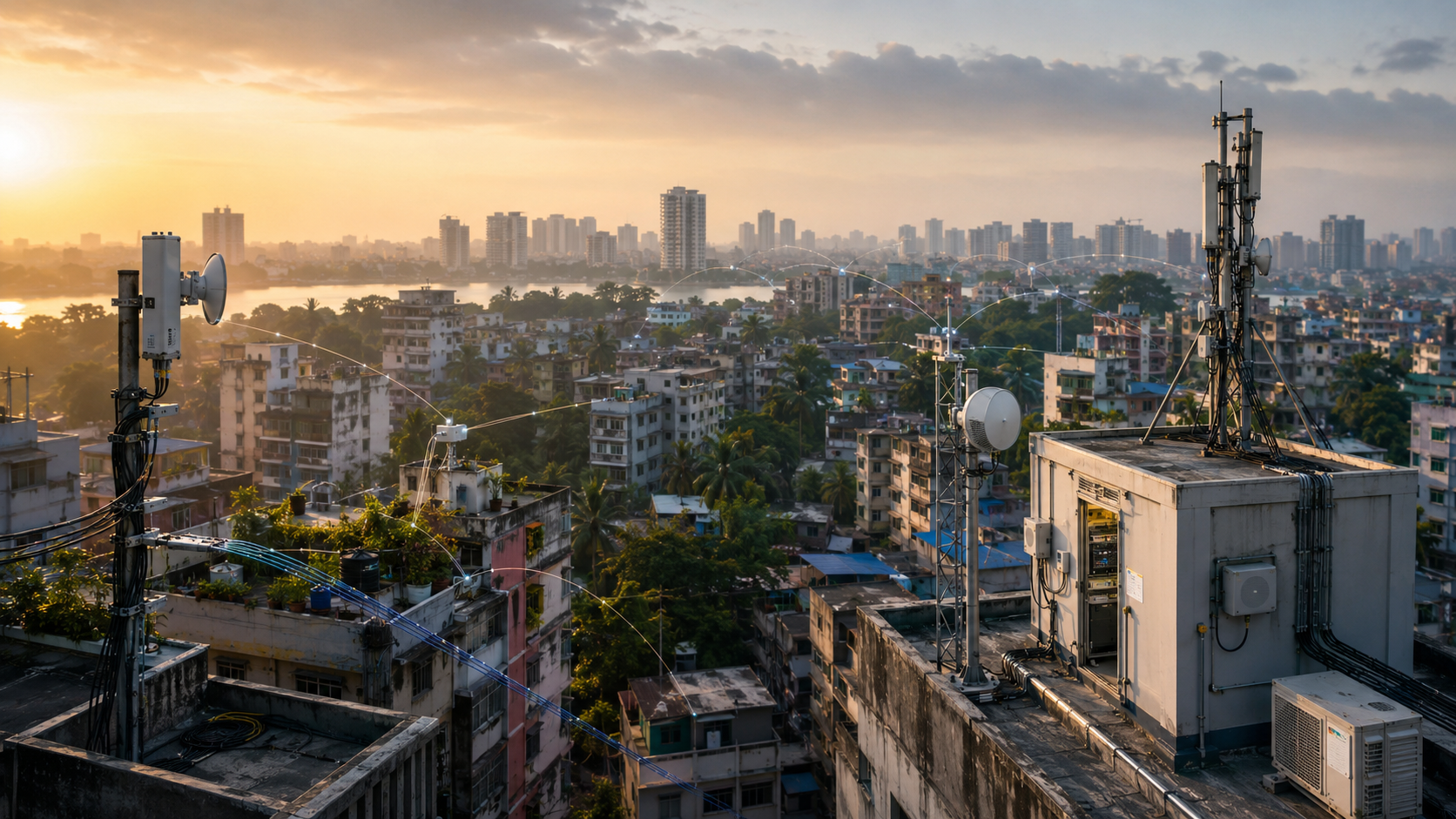
Help Line and the Economics of Small-Provider Connectivity in Bangladesh: An Infrastructure Intelligence Report on AS59340
Thesis
Help Line is not a large public telecom company, and its public footprint is thin by normal corporate-intelligence standards. That is precisely why it is analytically useful. The visible evidence points to a Bogura-based Bangladesh ISP operating under the “Help Line” / “HelpLine” label, registered in APNIC records as AS59340 and ORG-HL9-AP, licensed by Bangladesh’s regulator as “M/s Help Line” for the Rajshahi Division, and represented in ISPAB materials by Md. Zinnatul Rayhan as proprietor. The public record is not rich enough to reconstruct a full income statement, subscriber count, fibre map, or ownership chain. It is rich enough to show the economics of a small fixed-broadband operator positioned between low-price retail customers, licensed-infrastructure rules, upstream international gateway dependence, domestic exchange points, local trust, and tight operating margins.
The core economic finding is that Help Line’s strategic asset is not a nationally visible consumer brand. Its asset is a bundle of local access relationships, a formal licence, APNIC-registered number resources, an autonomous-system identity, and enough routing visibility to buy upstream service, peer domestically, and appear credible to local households and small businesses. Its constraint is that the same formalization that gives it legitimacy also fixes much of its cost base. Bangladesh ISP guidelines require licensed ISPs to lease transmission from NTTN operators, connect through IIG/NIX arrangements, operate within licence geography, and comply with customer-service, reporting, content-blocking, and renewal obligations. This creates a regulated-margin business: retail prices are visible and politically sensitive, while upstream, backhaul, power, support, and compliance costs are harder to pass through.
Help Line’s routing evidence suggests a small but real network. APNIC WHOIS identifies AS59340 as “MSHELPLINE-BD,” described as Help Line, Internet Service Provider, Bogra, Bangladesh, with abuse and administrative contacts under Help Line’s Bogra address. bgp.tools lists Help Line as active, registered in April 2014, with visible IPv4 and IPv6 prefixes, a website at helpline.com.bd, a visible upstream relationship to AS58717 Summit Communications Ltd, and exchange-point presence at ISPAB-NIX, BDIX, and BTCL IX. PeeringDB describes the network as a Cable/DSL/ISP network with 5–10 Gbps traffic, mostly inbound, selective peering policy, and public peering entries at those same Bangladesh exchange points.
The most important interpretation is negative as well as positive. The public evidence proves Help Line is a formal, routed, licensed ISP with a Bogura/Rajshahi regulatory anchor. It suggests a retail broadband provider serving local residential and SME users, probably using a Dhaka interconnection layer for upstream and exchange access. It does not prove the full legal registration history, exact ownership capital, subscriber count, physical fibre ownership, current paid transit contracts, customer churn rate, or whether any similarly named entities are successors, affiliates, resellers, or merely directory artifacts. Those unresolved facts matter economically because they determine whether Help Line is a durable local access franchise, a proprietor-led ISP with constrained growth, an acquisition candidate, or a route-visible edge of a wider local-provider cluster.
Canonical identity: the evidence converges on “M/s Help Line,” not a clean corporate profile
The canonical operating identity is best described as “Help Line,” also rendered as “HelpLine” in the consumer-facing web footprint and “M/s Help Line” in Bangladesh regulator material. APNIC’s WHOIS record for AS59340 gives the AS name as MSHELPLINE-BD, the description as Help Line and Internet Service Provider, the location as Bogra, Bangladesh, and the organization handle as ORG-HL9-AP. The same APNIC record lists the organization name as Help Line, organization type as LIR, country Bangladesh, and address at Kabi Nazrul Islam Road, Jhowtola, Bogra/Bogura.
Bangladesh’s regulator adds the licence identity. The BTRC divisional ISP list dated 23 December 2024 includes “M/s Help Line” under Rajshahi Division, at Kabi Nazrul Islam Road, Jhowtola, Bogura, with licence number 14.32.0000.702.45.516.22.209 and validity/renewal dates listed around 18–19 September 2026. That record is important because it converts the APNIC routing identity into a regulated access-market identity. It also clarifies geography: Help Line is not merely a route object or a dormant registry handle; it appears in the current BTRC divisional ISP population.
The best available management/control signal comes from ISPAB. A 2021 ISPAB voter list names Help Line, membership ID M-ID-G-189, and identifies Md. Zinnatul Rayhan as proprietor, with the same Bogura address and contact email ronee@helpline.com.bd. An ISPAB member listing similarly associates Help Line with membership number G-189, a divisional licence category, the same address, and contact channels. A later Scribd-hosted copy of an ISPAB voter list for 2025–2027 repeats the same proprietor name and Help Line membership identity, though because that copy is not as authoritative as ISPAB’s own PDF or BTRC’s licence list it should be treated as corroborative, not primary.
The naming ambiguity is commercial rather than fatal. “Help Line” is the registry and licence label; “HelpLine” is the website brand; “M/s Help Line” is the BTRC form; “MSHELPLINE-BD” is the AS name. These are consistent with a small Bangladesh ISP whose administrative records, web presentation, and routing records were created at different times for different audiences. The evidence does not show a publicly listed company, a detailed Companies Act filing, audited financials, or a corporate group page. That absence matters because the economic unit is likely a local operating franchise rather than an externally financed national telecom platform.
A local ISP with route visibility
The public network record gives Help Line an unusual degree of visibility for a small local ISP. AS59340 was registered in April 2014 and is active under APNIC allocation. APNIC WHOIS places the AS under Help Line, with route maintenance through MAINT-MSHELPLINE-BD and abuse contact support@helpline.com.bd. The abuse contact was validated on 9 February 2026, which is a small but relevant compliance signal: stale or unvalidated abuse contacts are common in weakly maintained networks, while a validated contact suggests the registry object remains operationally maintained.
The address resources are not trivial, but they should not be overread. bgp.tools shows visible prefixes including 103.229.44.0/24, 103.229.45.0/24, 103.229.46.0/24, 103.229.46.0/23, 103.229.47.0/24, 116.204.220.0/22-related routes, 203.190.32.0/22-related routes, and IPv6 2400:d980::/32. IPLocate lists 28 IPv4 prefixes and one IPv6 prefix, but its headline count of 12,288 IPv4 addresses includes overlapping less-specific and more-specific route entries, not necessarily unique usable retail addresses. The cleaner economic reading is that Help Line controls or originates several meaningful Bangladesh IPv4 blocks plus an IPv6 allocation, enough to operate a routed access ISP but not enough to resemble a national incumbent.
RPKI and routing hygiene appear generally positive in the current public route view. bgp.tools marks Help Line’s listed visible prefixes with valid RPKI indicators, while third-party route-monitoring sources such as Ping0/BGPv6 show mostly clean current posture with some historical or more-specific IPv6 invalidity signals in their copies. The prudent interpretation is not that Help Line has perfect routing operations; it is that its main visible route-origin posture is materially better than an unmaintained small ISP. For an upstream, content network, or enterprise customer, valid ROAs and coherent route objects reduce the probability that Help Line’s address space will be filtered, hijacked, or treated as a routing-risk outlier.
PeeringDB reports Help Line as a Cable/DSL/ISP network, with 20 IPv4 prefixes, 32 IPv6 prefixes, traffic in the 5–10 Gbps range, mostly inbound traffic ratio, and a selective peering policy. It lists no interconnection facilities, but it does list operational public peering at BDIX, BTCL IX, and ISPAB-NIX. The absence of facility entries is not proof that Help Line lacks colocation; PeeringDB is a self-reported, user-maintained interconnection database. But the absence is still economically informative. It suggests the company’s public interconnection story is exchange-port and upstream centered, not facility-brand centered.
Geography: Bogura retail identity, Dhaka interconnection dependence
Help Line’s legal and operating address consistently points to Bogura, in Bangladesh’s Rajshahi Division. APNIC uses “Bogra,” while BTRC, ISPAB, website snippets, and local social media use “Bogura.” This is a spelling and transliteration issue around the same city rather than evidence of separate operators. The regulatory footprint is divisional, not nationwide: the BTRC list places Help Line under Rajshahi Division, and the ISPAB listing categorizes it as divisional.
The network footprint, however, cannot be only local. Bangladesh’s traffic-exchange and upstream ecosystem is concentrated around Dhaka and national infrastructure operators. Help Line’s PeeringDB exchange points are BDIX, BTCL IX, and ISPAB-NIX, each associated with Bangladesh interconnection fabric rather than neighbourhood-level access. PeeringDB records Help Line’s ISPAB-NIX port as 1 Gbps and its BDIX/BTCL IX entries as 100 Mbps; bgp.tools reports the same exchange-point pattern. ISPAB-NIX itself is a Dhaka-based exchange, active, managed by the Bangladesh Internet Service Provider Internet Exchange Trust/ISPAB, and listed in PeeringDB with more than 100 peers and 1.5 Tbps total capacity.
This produces a standard small-ISP topology: local access and customer service in Bogura/Rajshahi; upstream, national exchange, or data-center interconnection likely in Dhaka or via a national transport partner; and a dependency on licensed transmission providers to bridge the two. The BTRC ISP guidelines make this dependency structural by requiring ISP licensees to lease or sub-lease transmission from NTTN operators and to connect through IIG and NIX arrangements for international and domestic traffic routing.
The economic consequence is that Help Line’s retail market is local, but its cost stack is national. A Bogura household may experience the provider through installation speed, WhatsApp/Facebook support, bill collection, and outage response. Help Line’s gross margin, however, depends on Dhaka-facing exchange fees, upstream transit or IIG charges, NTTN backhaul, route filtering, cache access, power stability, and equipment procurement. This split is central to the small-ISP model: the customer relationship is hyperlocal, while the cost structure is exposed to national infrastructure bargaining.
Services and channels: broadband first, support as product, web footprint as trust layer
The active consumer-facing footprint is consistent with a retail broadband ISP. Search-visible content from helpline.com.bd describes HelpLine as an internet provider, lists a Kabi Nazrul Islam Road, Jhowtola, Bogura address, gives telephone numbers including +8801711 317151 and +8809613 405060, and advertises an “Unlimited” 10 Mbps package at Tk 500 per month, excluding VAT, with claims of reliable/fast service and 24/7 support. The website itself intermittently timed out or returned errors when opened through the browsing tool, so the report should treat search-indexed website content as evidence of market presentation, not as proof of real-time site availability or service uptime.
The existence of an “apps.helpline.com.bd” portal branded as Online Business Systems and a Help Line forgot-password page pointing to the same Bogura address and contact identity suggests internal billing, customer management, or reseller/agent operations. That matters commercially. A local ISP’s defensibility often depends less on a glossy website and more on operational software: billing cycles, installation tickets, support logs, payment reconciliation, bandwidth-package provisioning, and local agent accountability. A functioning portal also implies switching frictions. Customers may not be contractually locked in, but they become embedded in a local billing and support routine.
Semi-public channel signals show local recognition rather than national brand scale. A public Facebook page for Help Line in Bogura describes the page as a broadband internet service provider, with a few hundred likes and local posts. A local Facebook group search result asks about Help Line’s service quality in Bogura, and another user-community result places “Helpline” among local provider choices such as Smile and Amber IT. A PinkBazaar local service listing identifies “HELP LINE” as a WiFi/internet setup provider in Bogura, with a small review footprint. These sources are not high-quality proof of service performance; they are useful because they show the provider participates in the local retail comparison set.
The service mix visible from public records is therefore mainly fixed broadband/access, with possible SME services enabled by public IP space and route control. There is no public evidence that Help Line operates its own data center, national fibre backbone, international gateway, submarine cable, or tower infrastructure. The regulatory and routing evidence points in the opposite direction: a licensed ISP that leases upstream and transmission inputs, originates its own AS, peers domestically, and sells local access. That is a coherent business even without vertically integrated infrastructure.
Counterparties and dependency surface
The direct routing counterparty that stands out is Summit Communications Ltd. bgp.tools lists AS58717 Summit Communications Ltd as Help Line’s upstream for IPv4 and IPv6, and also shows Summit-related AS-set membership. PeeringDB does not list a large multi-upstream facility posture for Help Line. IPLocate’s route view records one upstream, AS58717. These records should not be treated as complete contractual proof, because BGP visibility does not expose every commercial arrangement. But they strongly suggest that Summit is a major, and possibly primary, visible upstream path for Help Line’s global reach.
Summit’s own public materials describe it as a major Bangladesh fibre-optic network infrastructure company offering NTTN, ITC, IIG, ICX, and NIX services, with nationwide fibre coverage and clients including major ISPs, mobile operators, and call centers. That makes Summit a plausible high-leverage supplier to a Bogura ISP: it can supply national transport, international gateway, and domestic exchange-related services in ways a small local access operator cannot economically replicate.
Coronet Corporation Limited is more ambiguous. The user-provided relationship clues include CORONET CORP LTD / Coronet Corporation Limited. The visible routing evidence does not show Coronet as Help Line’s current direct upstream in the same way Summit appears. Instead, bgp.tools shows Coronet-related AS-set material, including an APNIC AS-set labelled around as149765:as-coronetiig-bd, among route-set relationships for Help Line. Separately, Coronet’s PeeringDB and website materials describe Coronet as an IIG/IP transit operator, and bgp.tools identifies AS149765 as Coronet Corporation Limited with upstreams including Bharti Airtel, Reliance Jio, Hurricane Electric, BSCCL, and Fiber@Home Global.
The economic interpretation is that Coronet is part of Help Line’s route-policy neighborhood, not necessarily its proven paid supplier. In Bangladesh, where IIGs and transit aggregators propagate many customer routes through IRR/AS-SET mechanisms, appearing in a Coronet-related route set could mean a direct commercial path, an indirect relationship, a backup arrangement, route filtering preparation, or a stale policy artifact. If Coronet becomes a visible upstream in live BGP, the inference would change: it would indicate supplier diversification and stronger bargaining leverage against Summit. If Coronet remains only an AS-set clue, it is more a signal of route visibility and optionality than of current traffic economics.
APNIC is not a supplier in the retail sense but is a critical institutional counterparty. It provides the registry context for the ASN, organization handle, routing contacts, and IP resources. For a local ISP, APNIC resource control is an intangible asset. It supports portability between upstreams, reputational legitimacy with other networks, and route-origin independence. Without it, a small provider becomes a reseller of another operator’s address space and loses bargaining power.
BTRC is the dominant regulatory counterparty. Its guidelines define the licence categories, eligibility, permissible services, renewal period, transmission leasing rules, NIX/IIG interconnection obligations, reporting obligations, anti-competitive restrictions, and PoP/last-mile conditions. For Help Line, BTRC is not a background regulator; it is part of the unit economics. Licence renewal, compliance cost, reseller enforcement, and tariff policy can directly change the cash margin of a local ISP.
Bangladesh’s licensed ISP model makes small providers formal but dependent
The BTRC ISP guideline states that no person or business entity may build, maintain, or operate ISP systems or provide internet services without a licence. It also divides ISP licences into nationwide, divisional, district, and upazila/thana categories. Divisional licence scope is limited to a particular administrative division, and the guidelines separately address conversion from older zonal categories to the newer licence structure.
The same guidelines make vertical integration difficult for a small operator. ISPs are authorized to provide internet/data and IP-based services, but the transmission network must be leased or sub-leased from NTTN operators. The guideline also states that entities with NTTN, IIG, IGW, ICX, submarine cable, or ITC licences must surrender either that licence or the ISP licence in specified circumstances, reflecting a policy separation between access and infrastructure layers. In economic terms, this is a structural separation model: it preserves space for local ISPs, but it prevents them from internalizing the most valuable bottleneck assets.
For Help Line, the upside is legitimacy. A licensed local ISP can advertise openly, connect to exchange points, maintain APNIC resources, join ISPAB, and build customer trust. The downside is a stack of externally priced inputs. It must buy or lease upstream internet, transmission/backhaul, pole/fibre permissions or access routes, power, customer-premises equipment, routers, billing tools, support labour, and compliance capability. If retail broadband prices are politically capped or market-compressed, margin is absorbed by those input costs.
Bangladesh’s market evidence supports that pressure. BTRC’s uniform-rate directive reported by The Daily Star set maximum monthly broadband prices of Tk 500 for 5 Mbps, Tk 800 for 10 Mbps, and Tk 1,200 for 20 Mbps, and it tied extended outages to bill waivers. HelpLine’s search-visible web offer of 10 Mbps at Tk 500 is below the earlier reported maximum for 10 Mbps and consistent with intense price competition in retail broadband. Whether this exact package remains available to every customer is not proven by the search snippet, but it is enough to show the price corridor in which Help Line markets itself.
The pending or proposed regulatory-fee environment could make the margin problem sharper. A SAMENA/Daily Star-republished report says BTRC proposed a new fixed telecom licensing framework requiring broadband and fixed-line providers to share 5.5% of annual revenue with the regulator and contribute 1% of gross revenue to the Social Obligation Fund; it quotes ISPAB’s president as saying ISPs operate on roughly 5–6% profit margins and that the levies could eliminate profit for smaller providers. This is industry advocacy rather than audited economics, but it is directionally consistent with the cost structure visible in Help Line’s model.
Revenue logic: low ARPU, high contention discipline, service labour as margin leak
Help Line’s visible retail proposition implies low ARPU. A 10 Mbps unlimited offer at Tk 500 per month, excluding VAT, leaves little room for unmanaged cost. In a simplified broadband-ISP model, gross margin equals monthly access revenue minus upstream bandwidth, NTTN/backhaul, exchange, equipment depreciation, installation subsidies, power, repair labour, payment leakage, and support cost. The difference between a profitable and unprofitable customer is often not whether the advertised plan sells; it is whether the provider can manage contention, local loop reliability, and support tickets without triggering churn or bill-waiver obligations.
Small ISPs manage this through oversubscription and local knowledge. Not every household uses 10 Mbps continuously. The provider can sell many nominal Mbps over fewer upstream Mbps if traffic peaks are predictable, caches and IXPs offload popular content, and domestic video traffic is served locally. PeeringDB’s “mostly inbound” traffic ratio for Help Line is typical of a consumer ISP: customers download far more than they upload. This makes upstream cost and cache/peering strategy decisive. Domestic peering at ISPAB-NIX, BDIX, and BTCL IX can reduce cost and improve latency for local traffic, but it does not eliminate the cost of international transit, global CDN reach, or Dhaka-to-Bogura transport.
Installation economics are also central. A new home connection may require fibre drop, splice work, ONU/router, cable routing, field labour, and customer education. If the customer churns after a short period, the provider may not recover acquisition cost. If the customer stays for several years, the same local loop becomes a stable cash-generating asset. That is why small ISPs often defend territory street by street, building by building, and landlord by landlord. The switching cost is not always contractual; it is embedded in installation inconvenience, service familiarity, in-building wiring, router configuration, and the perceived risk that a different provider’s local technician will be worse.
For SMEs, switching costs are higher. A small shop, school, clinic, or office may depend on static IP service, CCTV remote access, payment-terminal reliability, cloud tools, or after-hours technician availability. Even if another ISP offers a lower package price, the expected downtime and reconfiguration cost can outweigh savings. This gives a local provider some pricing power in the SME segment. But the same segment demands faster repair and clearer accountability, increasing labour cost.
The support function is not ancillary; it is part of the product. HelpLine’s public snippets emphasize 24/7 support, and its local Facebook/page footprint reinforces a neighbourhood-provider identity. In a market where national brands may not respond quickly to a local fibre break, a known local office can be a trust asset. But support is also a margin leak. Every outage, router reset, payment dispute, content-filtering issue, abuse complaint, or speed complaint consumes labour. A low-ARPU ISP can survive only if the local service model prevents churn more cheaply than national-brand marketing would.
Upstream bargaining: route independence helps, but visible single-upstream dependence weakens leverage
Owning an ASN and registered IP resources gives Help Line bargaining optionality. It can, in principle, move prefixes between upstreams, advertise routes at exchanges, maintain ROAs, and avoid being technically captive to another ISP’s address pool. This is economically different from being a reseller using a larger provider’s private addressing and NAT. The former has a tradable network identity; the latter is operationally dependent.
However, visible routing records still point to upstream concentration. bgp.tools and IPLocate both identify Summit Communications as the main visible upstream path. If Help Line’s live traffic is materially dependent on Summit, Summit has supplier power. It can influence transit price, capacity upgrades, route quality, backhaul terms, and repair priority. Help Line’s credible threat is to add or move traffic to another IIG/transit provider such as Coronet, Fiber@Home, BSCCL-linked suppliers, or another national carrier. But a credible threat requires physical interconnection, commercial approval, routing configuration, and potentially customer-impacting migration. That is not costless.
Domestic exchanges improve but do not solve the bargaining problem. Help Line has operational public peering at three Bangladesh IXPs, with the largest listed port at ISPAB-NIX. This reduces paid transit for reachable domestic peers and content networks and gives the ISP performance benefits for local traffic. But the port sizes shown—100 Mbps at BDIX and BTCL IX and 1 Gbps at ISPAB-NIX—are modest against PeeringDB’s 5–10 Gbps traffic range. The difference implies that much of the traffic still depends on upstream paths, private caches, or unlisted arrangements. Exchange presence is therefore a margin stabilizer, not a full substitute for upstream bargaining power.
Coronet’s role is the key unresolved supplier question. Coronet positions itself as an IIG/IP transit provider; PeeringDB says it operates as IIG AS149765 and nationwide retail ISP AS138640, serving more than 3 Tbps of live traffic capacity. If Help Line has or develops direct commercial connectivity to Coronet, it could benchmark Summit pricing and improve resilience. If the Coronet clue is merely AS-set inclusion or stale route policy, then Help Line’s bargaining position remains weaker. The difference would be visible in future BGP upstream changes, traceroutes, PeeringDB updates, and route-set maintenance.
Route visibility as commercial infrastructure
For a small ISP, route visibility is not just a technical matter. It is a credibility mechanism. A provider that appears in APNIC, BGP tables, PeeringDB, and exchange membership lists can be evaluated by upstreams, peers, enterprise buyers, regulators, and security teams. This reduces counterparty uncertainty. Help Line’s APNIC LIR status, AS59340 identity, route objects, abuse contact, PeeringDB listing, and RPKI-valid current prefixes all help it look like a real operator rather than a cable reseller.
This matters especially in Bangladesh’s crowded ISP market. The Financial Express reported in 2023 that BTRC warned ISPs against illegal resale, that ISPAB’s secretary general said some 2,700 ISPs were operating, and that the market was overcrowded. The same report says BTRC rejected 301 licence applications due to oversaturation in particular areas. Separately, The Daily Star reported that BTRC cancelled 228 ISP licences for failure to convert under the newer licence categories. In that context, formal route visibility is a screening device. It helps distinguish licensed, resource-holding ISPs from unlicensed agents, resellers, or operators with fragile compliance status.
Route visibility also lowers switching cost for the provider itself. If Help Line wants to change upstreams, add backup transit, or peer with a content network, having its own AS and ROAs allows it to preserve customer addressing and network identity. If it wants to sell to another ISP or merge operations, AS59340 and its address resources are part of the asset package. If it loses routing discipline or lets contact records decay, the same visibility becomes a liability: invalid ROAs, stale route objects, or abuse concentration can cause filtering and reputation damage.
The strongest version of Help Line’s economic position is therefore a network-asset thesis: local customer relationships plus formal routing assets plus licence continuity. The weakest version is a thin-margin retailer dependent on a single upstream and exposed to churn. The public evidence supports both readings, with the balance depending on facts not visible in public records: subscriber density, backhaul pricing, actual number of upstream contracts, and operational service quality.
Retail trust and customer switching costs
Help Line’s name itself is revealing. “Help Line” is not a high-tech brand; it is a service promise. In local broadband markets, trust is built around whether someone answers, whether the technician comes, whether the bill is understood, and whether streaming works at peak time. The public website snippets emphasize 24/7 support and local contact numbers. The Facebook presence is small but local. Community-group search results show Help Line being discussed among Bogura ISP alternatives. These signals suggest the company competes in a trust-and-response market rather than a pure speed leaderboard.
Switching costs are moderate for households and high for certain small businesses. A residential user can often switch if another provider offers cheaper or faster service. But switching requires arranging installation, possibly paying a new connection fee, reconfiguring devices, tolerating downtime, and trusting a new local support team. In Bangladesh’s local ISP market, physical last-mile access can be path-dependent: once a cable is pulled through a building or lane, the incumbent provider has a practical advantage until service quality deteriorates enough to justify replacement.
For SMEs, the switching cost is more economic than psychological. Static IPs, CCTV, POS systems, online classes, small office VPNs, and backup links create operational dependency. The ISP that knows the customer’s premises and has already solved local wiring and router issues becomes sticky. The product is not simply “10 Mbps”; it is “connectivity that someone local will fix.” This is where a small ISP can preserve margin despite weak national brand power.
The same local-trust model creates downside risk. If an outage is prolonged, if upstream congestion is visible at night, if a provider is slow to repair fibre cuts, or if billing/support becomes inconsistent, reputational damage spreads through the same local social channels that created trust. Broadband users often evaluate ISPs through peer recommendations; the public existence of Bogura internet-user groups shows how service quality becomes communal information. For a provider with limited marketing budget, retail trust is both moat and fragility.
Competition and substitutes
Help Line competes against four categories of substitute: other licensed local ISPs, national or regional broadband brands, unlicensed resellers/agents, and mobile broadband. BTRC’s own licensing categories create many possible local competitors, while market reports describe the Bangladesh ISP market as overcrowded. Local search results place Help Line in user comparisons with other Bogura providers, including larger recognizable brands. This means Help Line’s retail pricing power is probably limited in residential broadband.
Mobile broadband is a partial substitute but not a perfect one. AMTOB’s industry statistics, sourced to BTRC, list 134.07 million total internet subscribers at the end of May 2026, of which 119.12 million were mobile internet and 14.95 million were ISP+PSTN. BSS reported BTRC data showing fixed-line internet subscribers at 1.475 crore in March 2026, while The Daily Star reported that broadband rose to 1.49 crore in April 2026. Mobile is therefore the dominant access technology by subscriber count, but fixed broadband is the segment where households and SMEs buy stable high-volume connectivity.
National and regional broadband brands can pressure Help Line in two ways. First, they can advertise higher speeds or bundled services. Second, if they have better upstream economics, they can price aggressively. Help Line’s counter is local responsiveness and existing installation density. Where a national provider lacks lane-level technicians or fast support, a small ISP can win. Where national providers establish dense local operations, the small ISP’s moat weakens.
Unlicensed resale is a special competitive threat because it attacks formal operators from below. BTRC’s warning against illegal resale indicates a market where agents may sell internet service without proper licensing, undermining price discipline and confusing customer accountability. Formal ISPs can lose customers to cheaper informal providers while still bearing licence, reporting, and infrastructure-compliance costs. This creates a policy-dependent margin: enforcement helps licensed providers; weak enforcement subsidizes grey-market competitors.
Regulatory constraints and compliance economics
The BTRC licence structure creates both market order and operating friction. Divisional licensing limits geography. Renewal obligations create date-specific risk. The Help Line licence list shows validity and renewal around September 2026, making that a concrete watchpoint. If the licence renews smoothly, formal continuity is preserved. If renewal is delayed, reclassified, contested, or folded into a new fixed-telecom framework, the economics could change materially.
Customer-protection rules also alter incentives. The BTRC outage-billing directive reported by The Daily Star says that if internet is down for one full day, 50% of the monthly bill is waived; for two consecutive days, the customer pays 25%; for three straight days, no monthly bill can be taken. This forces local ISPs to internalize outage risk, at least where customers enforce the rule. In theory, this improves service quality. In practice, it raises the value of backup upstreams, better local fibre maintenance, and reliable power.
Content-blocking and security obligations also impose cost. BTRC guidelines require licensees to comply with regulatory directions, including blocking pornography with bandwidth providers and reporting subscriber complaints and quality-of-service information. These obligations are manageable for larger operators with compliance teams; they are more burdensome for proprietor-led local ISPs. The cost may show up not as a line item but as management attention, router configuration, support complexity, and regulatory risk.
National shutdown risk is not company-specific but matters for every Bangladesh ISP. Cloudflare reported that during the July 2024 Bangladesh shutdown, broadband ISPs began restoring connectivity on July 23 after a full shutdown had started five days earlier. OONI later reported that the nationwide connectivity shutdown between 18 and 23 July 2024 was visible across independent data sources, including IODA, Cloudflare Radar, and Google traffic data. For Help Line, such events are exogenous shocks: local service quality cannot overcome national orders or upstream-level blocking, but customers may still associate outage experience with their retail ISP.
Security, abuse, and reputation signals
No credible public source found in this review indicates a major litigation event, breach, regulatory sanction, or named security incident specific to Help Line. The visible security signals are routine for a consumer ISP: registry abuse contacts, reputation-list entries, and occasional spam reports. APNIC and AbuseIPDB-style WHOIS records show abuse contact information for Help Line’s routed space, with validated contact details. CleanTalk lists AS59340 in spam statistics and identifies several IPs in Help Line space with spam reports, including 103.229.47.120 and several 203.190.34.x addresses.
These abuse-list entries should not be treated as proof of intentional misconduct. Residential and small-business broadband networks often produce spam, malware, open-proxy, compromised-router, or NAT-abuse reports. The economic meaning is operational: abuse reports consume support time, can affect IP reputation, and may force the ISP to manage customer education, port filtering, dynamic addressing, or takedown responses. For an ISP with limited IPv4 inventory, reputation damage is more expensive because clean address space is scarce.
The website availability signal is similarly weak but relevant. The public website is indexed with current-looking package and contact content, but attempts to open the site through the browsing tool returned timeouts or server errors. That is not proof customers experienced an outage, because website hosting can be separate from access service and browsing tools can fail for reasons outside the target network. But for trust analysis, a poorly reachable website or portal can matter. Retail customers increasingly expect online package information, payment, and support. A small ISP can survive with phone and local office workflows, but web unreliability makes it look less institutional to enterprise buyers and upstream partners.
The “Easy Net” / prefix-description ambiguity
One unresolved issue is the appearance of names other than Help Line in some prefix descriptions. IPLocate and bgp.tools show some originated routes with descriptions such as “Easy Net” or “Internet Service Provider-BOGRA-BD,” alongside Help Line/MSHELPLINE entries. Prefix descriptions are not ownership records by themselves. They can reflect customer assignments, legacy registration language, reseller history, reallocated blocks, trading-name usage, or inherited route objects.
There are four plausible interpretations. First, Easy Net could be a related operating label or predecessor, meaning Help Line may have consolidated local address resources or brand fragments. That would suggest a small-provider roll-up or proprietorship expansion. Second, Easy Net could be a downstream or customer block originated by Help Line, implying Help Line sells wholesale or managed connectivity to smaller local operators. That would improve economics by adding B2B revenue but could also create abuse and service-quality risk. Third, it could be stale registry language that no longer has commercial meaning, in which case it tells us only that route objects have accumulated history. Fourth, it could represent resource-sharing between local providers, a common pattern in crowded ISP markets where formal and informal network boundaries blur.
Which hypothesis is true matters. A pure retail Help Line is more exposed to household churn. A Help Line with downstream/reseller relationships has more revenue channels but higher regulatory and reputational complexity, especially given BTRC’s concern about illegal resale. A Help Line that has absorbed predecessor resources may have a defensible local cluster. Public records do not resolve this, so the right analytical stance is to watch route-object updates, BTRC licence changes, and local channel material for signs of consolidation or separation.
Ownership, financing, and control
The strongest public control signal is proprietor identity in ISPAB records. The ISPAB voter list names Md. Zinnatul Rayhan as proprietor of Help Line. The same ecosystem of records associates the ronee@helpline.com.bd email with Help Line. APNIC administrative records list older role and administrator contacts under the Help Line address.
No public evidence found in this review proves a parent company, private-equity sponsor, bank financing, acquisition, merger, or successor entity. The legal form implied by “M/s” and “proprietor” is consistent with a proprietor-led or closely held local ISP, but not enough to identify ultimate beneficial ownership beyond the public ISPAB naming. There is no public financial disclosure, no subscriber count by company, and no audited revenue figure.
This absence has economic meaning. A proprietor-led ISP can be efficient because decisions are local, technician relationships are close, and overhead is low. It can also be capital constrained. Upgrading from 1G to 10G exchange ports, buying redundant upstream, improving billing systems, acquiring cleaner IP resources, or expanding into adjacent districts requires capital and management bandwidth. If Help Line remains small and locally owned, its economics depend on density and cost discipline. If it becomes part of a larger ISP group, the economics change toward procurement leverage and standardized operations, but local trust may weaken if service becomes less personal.
What Help Line reveals about Bangladesh local-connectivity economics
Help Line reveals that Bangladesh’s fixed-broadband market is not simply a story of national penetration growth. It is a layered market in which national subscriber numbers depend on many small access operators that translate upstream bandwidth into neighbourhood service. As of early-to-mid 2026, public industry data show fixed broadband/ISP+PSTN subscribers around 14.75–14.95 million, while mobile internet remains far larger at more than 119 million. Fixed broadband is smaller but economically distinct: it carries heavy home and SME traffic, video consumption, remote work, online education, and local business continuity.
The second lesson is that route visibility is a bargaining asset but not bargaining power by itself. Help Line’s AS, APNIC identity, route objects, ROAs, and exchange memberships give it optionality. But if live upstream dependence is concentrated in Summit, the company remains exposed to supplier pricing and service quality. The ability to multi-home, add Coronet or another IIG, or upgrade IXP ports would materially alter its economics.
The third lesson is that local trust is a substitute for scale. Help Line’s public brand footprint is modest, yet local ISP economics do not require national mindshare. They require enough trust in a specific geography to sign up customers, collect bills, and respond to repairs. A small provider’s moat is often a local reputation graph: technicians, building owners, customer referrals, and community comparisons. That moat can erode quickly if service quality slips.
The fourth lesson is that policy can compress small-provider margins faster than competition alone. Uniform tariff expectations, outage bill-waiver rules, licence renewal, reseller enforcement, proposed revenue-sharing, and infrastructure-separation requirements all shape margin. A national infrastructure supplier can spread compliance over large traffic volumes. A local ISP must absorb it through a thin retail bill.
The fifth lesson is that unresolved facts are not peripheral. Subscriber density, actual upstream price, the presence or absence of a second transit provider, the physical cost of Bogura-Dhaka backhaul, and the status of any reseller/downstream relationships determine whether Help Line is economically robust or fragile. Public records prove the skeleton. The cash flow lives in the missing details.
Evidence ledger
- APNIC WHOIS for AS59340 / MSHELPLINE-BD. Verifies Help Line as AS59340, Internet Service Provider, Bogra, Bangladesh, org handle ORG-HL9-AP, APNIC-maintained route and abuse contacts, and validated abuse mailbox.
- bgp.tools AS59340 Help Line. Verifies active ASN, registration date, website reference, visible prefixes, upstream relationship to Summit Communications, exchange-point entries, and AS-set relationships including Help Line, Summit, and Coronet-related route-set clues.
- IPLocate AS59340. Verifies third-party ASN summary, prefix list, AS type as ISP, APNIC allocation date, one visible upstream in its database, and route descriptions including Help Line/MSHELPLINE and Bogura-related blocks.
- PeeringDB AS59340 / MSHELPLINE-BD. Verifies network type as Cable/DSL/ISP, reported traffic range, mostly inbound traffic ratio, selective peering policy, and public peering at BDIX, BTCL IX, and ISPAB-NIX.
- PeeringDB ISPAB-NIX. Verifies ISPAB-NIX as a Bangladesh exchange with more than 100 peers, Dhaka location, active status, and significant listed total capacity.
- Packet Clearing House Internet Exchange Directory for ISPAB-NIX. Corroborates ISPAB-NIX as an active Dhaka Bangladesh internet exchange managed by ISPAB.
- BTRC Divisional ISP License List dated 23 December 2024. Verifies “M/s Help Line” in Rajshahi Division, Bogura address, licence number, and renewal/validity timing around September 2026.
- BTRC Regulatory and Licensing Guidelines for Internet Service Provider. Establishes licence requirement, licence categories, divisional scope, NTTN leasing requirement, IIG/NIX connectivity obligations, renewal and compliance framework, and restrictions relevant to infrastructure separation.
- ISPAB voter list PDF, 2021–2022/2023. Verifies Help Line membership ID M-ID-G-189, Md. Zinnatul Rayhan as proprietor, Bogura address, telephone, and ronee@helpline.com.bd contact.
- ISPAB member listing search result. Corroborates Help Line’s ISPAB membership number G-189, divisional licensing category, Bogura address, email, and contact channels.
- HelpLine website search-indexed content. Provides consumer-facing evidence of helpline.com.bd, Bogura address, package promotion, telephone contacts, and 24/7 support language.
- Help Line online business/admin portal search results. Suggests billing or online operations infrastructure under apps.helpline.com.bd and reinforces address/contact continuity.
- Facebook public page and local group search results. Provide weak but useful local-channel evidence that Help Line is recognized as a Bogura broadband provider and appears in local ISP comparison discussions.
- PinkBazaar local listing. Provides low-confidence local-market corroboration of HELP LINE as a WiFi/internet setup provider in Bogura with a small review footprint.
- Summit Communications website. Establishes Summit as a major Bangladesh fibre infrastructure, NTTN, ITC, IIG, ICX, and NIX service provider serving major ISPs and national clients.
- bgp.tools and related public records for AS58717 Summit Communications. Corroborate Summit’s BGP scale and role as a major routed network in Bangladesh.
- Coronet Corporation Limited website and PeeringDB. Establish Coronet as an IIG/IP transit provider and network operator in Bangladesh, useful for interpreting the Coronet route-set clue around Help Line.
- bgp.tools AS149765 Coronet Corporation Limited. Verifies Coronet’s AS149765 identity, APNIC organization context, upstream list, and originated resources.
- CleanTalk AS59340 spam statistics. Provides unofficial automated abuse/reputation signal for Help Line’s routed address space; useful as operational-risk evidence, not misconduct proof.
- AbuseIPDB/APNIC-style WHOIS records for Help Line IP space. Corroborate APNIC registration, abuse contact, and resource records for specific Help Line IP ranges.
- Daily Star report on BTRC broadband tariff and outage bill-waiver directive. Establishes tariff ceilings and customer bill-waiver rules that shape ISP retail economics.
- Financial Express report on BTRC warning against illegal resale. Establishes reseller enforcement risk, market overcrowding, and industry claims of roughly 2,700 ISPs.
- Daily Star report on 228 ISP licence cancellations. Establishes BTRC enforcement around licence conversion and the risk of non-compliance.
- SAMENA/Daily Star-republished report on proposed BTRC revenue-sharing framework. Establishes proposed 5.5% revenue share, 1% Social Obligation Fund contribution, and ISPAB’s margin-pressure argument.
- AMTOB industry statistics sourced to BTRC. Provides May 2026 total internet, mobile internet, and ISP+PSTN subscriber figures.
- BSS report on BTRC Q1 2026 subscriber data. Provides March 2026 mobile and fixed-line subscriber levels and confirms fixed-line ISP/PSTN scale.
- Daily Star June 2026 report on April 2026 internet-subscriber growth. Provides updated subscriber growth context and BTRC methodology statement for ISP subscriber data.
- Cloudflare and OONI reports on Bangladesh’s July 2024 internet shutdown. Establish national outage/shutdown risk as a macro operating risk for local ISPs.
- Archived/secondary older BTRC zonal-list mirrors. Indicate Help Line’s older North-West Zone ISP licensing history dating to 2008, useful as a legacy signal but less authoritative than current BTRC and APNIC records.
- PeeringDB background source. Provides caveat that PeeringDB is user-maintained interconnection data, useful but not equivalent to regulator or registry evidence.
Watchpoints
- September 2026 licence renewal. Help Line’s BTRC divisional ISP record lists validity/renewal timing around 18–19 September 2026. Smooth renewal preserves formal continuity; delay, reclassification, cancellation, or conversion into a new fixed-telecom framework would directly change the company’s economics.
- Addition of a second visible upstream. A new BGP upstream beyond Summit, especially Coronet or another IIG/transit provider, would improve bargaining power, resilience, and route quality. Continued single-upstream visibility would preserve supplier concentration risk.
- Coronet clue resolution. If Coronet moves from AS-set/route-policy adjacency to visible transit, the commercial reading changes from optionality to active supplier diversification. If the Coronet reference disappears, it likely was stale or indirect policy metadata.
- IXP port upgrades. Moving BDIX/BTCL IX ports from 100 Mbps or ISPAB-NIX from 1 Gbps to materially larger capacity would indicate traffic growth, better domestic offload, and stronger margin control.
- PeeringDB traffic-range change. A move above 10 Gbps would suggest subscriber or usage growth; a drop below the current 5–10 Gbps range would suggest churn, route restructuring, or data-quality changes.
- RPKI or route-object degradation. Invalid ROAs, stale route objects, or route leaks would weaken Help Line’s route credibility and could increase filtering, outage, or upstream-management costs.
- BTRC fixed-telecom revenue-sharing decision. Adoption of the proposed 5.5% revenue share plus 1% Social Obligation Fund contribution would materially pressure small-ISP margins unless retail prices or upstream costs adjust.
- Enforcement against illegal resale. Strong enforcement would help licensed operators such as Help Line by removing grey-market price competition. Weak enforcement would leave formal ISPs carrying compliance costs while competing against informal sellers.
- Retail tariff revision. Any change to Bangladesh’s uniform broadband tariff policy, package ceilings, or outage bill-waiver rules would directly affect ARPU, service obligations, and churn incentives.
- Ownership or membership changes in ISPAB/BTRC records. A change from proprietor identity, membership number, address, or licence holder would indicate sale, succession, restructuring, or regulatory cleanup.
- Evidence of downstream/reseller relationships. Clarification of the “Easy Net” and other prefix-description ambiguities would change the model from pure retail ISP to possible local wholesale/access aggregator.
- Abuse concentration in Help Line address space. Rising spam, botnet, or abuse reports would create IP-reputation costs and could force stricter customer controls or new address-management practices.
- Website and portal reliability. Persistent failure of helpline.com.bd or apps.helpline.com.bd would weaken institutional trust and digital billing capability; modernization would improve customer retention and operational discipline.
- Local customer-sentiment shift in Bogura. Repeated community complaints about speed, downtime, billing, or technician response would threaten the local trust moat. Strong positive local sentiment would reinforce switching costs.
- National shutdown or gateway-blocking events. Bangladesh-wide internet shutdowns, gateway blocks, or emergency regulatory orders remain exogenous risks that can damage customer trust even when local ISP operations are not the root cause.