
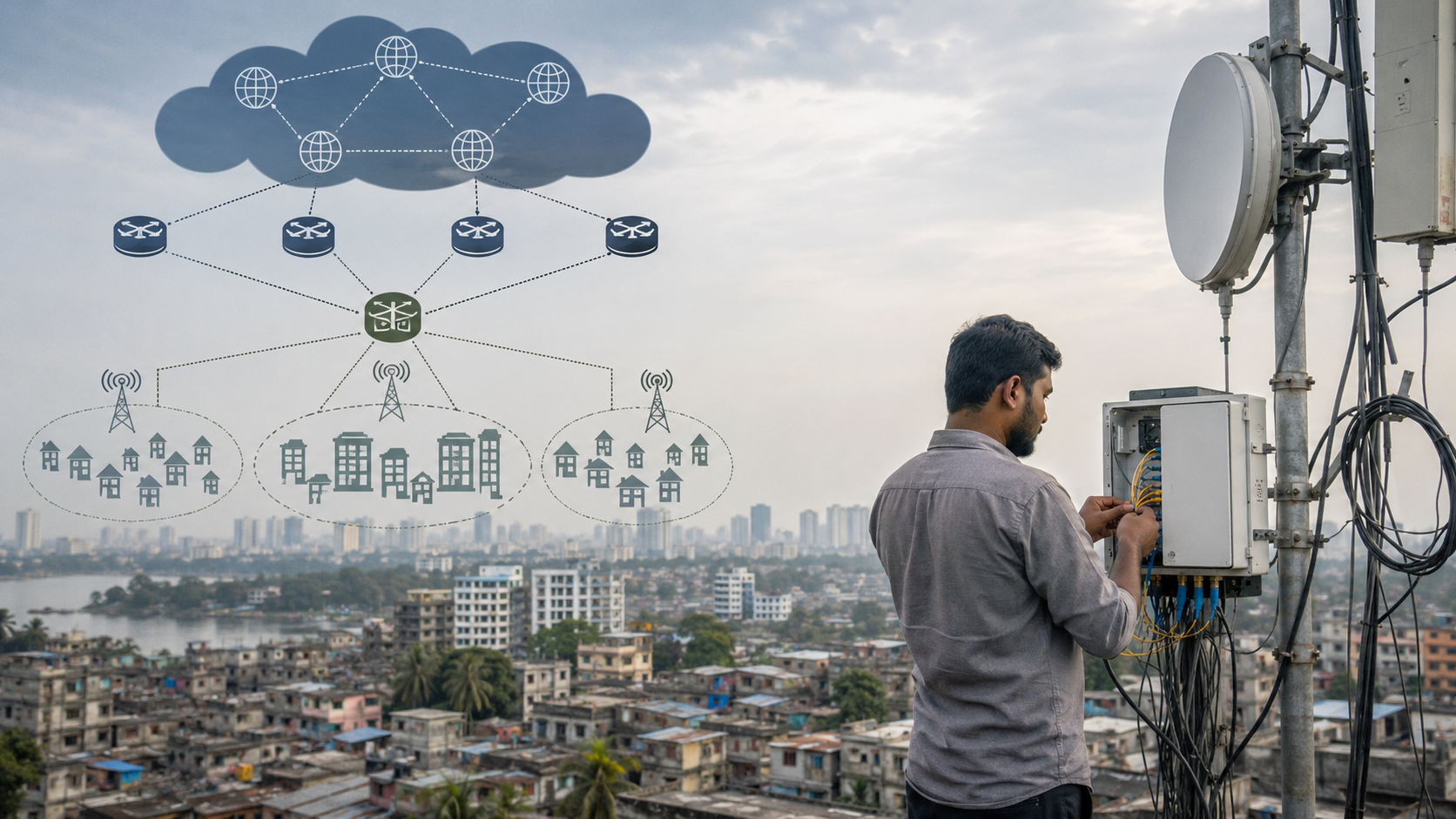
Hello Vision Dot Net and the Unit Economics of Bangladesh’s Local Broadband Edge
Thesis: a small access network as an economic instrument
Hello Vision Dot Net is not analytically important because it is large. It is important because its public footprint shows, in compressed form, how Bangladesh’s local fixed-broadband economy works at the edge: a small BTRC-licensed Upazila/Thana ISP, operating from Fatullah in Narayanganj, with its own APNIC/RDAP identity, one autonomous system, two visible /24 IPv4 routes, a retail package book built around low monthly prices, BDIX/local-content promises, and a dependency surface that appears to run upward through a larger network supplier rather than through deep vertical ownership. The firm is best read as a last-mile access intermediary whose bargaining position is created locally and constrained nationally.
The core intelligence finding is that Hello Vision Dot Net reveals a broadband market where the formal cost of entry is not the main barrier. Bangladesh’s ISP rules allow small geographic licences; the published Upazila/Thana licence fee schedule is modest compared with the cost of field technicians, drop fibre, power backup, routers, upstream bandwidth, lease charges, support, and churn. BTRC’s own framework obliges ISPs to connect to licensed International Internet Gateways for international bandwidth and to a National Internet Exchange for domestic traffic, while last-mile and transmission construction are constrained by licensing, network-layer separation, and reliance on NTTN or shared infrastructure. That gives small retail ISPs a narrow economic task: acquire local trust, keep installation and support costs under control, buy upstream capacity intelligently, and reduce international bandwidth exposure through domestic exchange, cache, and CDN-heavy usage.
Hello Vision Dot Net’s hard public identifiers are consistent across BTRC, ISPAB, APNIC/RDAP-derived records, IPinfo, AbuseIPDB, and BGP views. The BTRC Upazila/Thana licence list identifies “Hello Vision Dot Net” in Fatullah Thana at House-54, Block-A/Blok-A Road-1, Post Office Kutabail, Fatullah, Narayanganj, under licence number 14.32.0000.702.47.682.22.219, valid to 30 May 2027. ISPAB’s public member entry gives the same operating name, membership number C-528, BTRC licence type Upazila/Thana, website hellovisionbd.net, establishment date 31 May 2022, trade licence 669, BIN 005458692-0204, TIN 429449719158, and names MD. Harun-Or-Rashid Shawon. RDAP/RIR-derived records identify AS150705 as HVDN-AS-AP / Hello Vision Dot Net, with ORG-HVDN1-AP and a 103.62.148.0/23 IPv4 range.
The public evidence does not prove that Hello Vision Dot Net is part of Coronet Corporation Limited or CORONET CORP LTD. The Coronet clue is commercially meaningful but legally unresolved. Coronet Corporation Limited is visible as a Bangladesh IIG/IP-transit network with AS149765, a PeeringDB profile describing it as “Coronet BD IIG,” and its own public claims around IIG, MPLS, DIA, and IP transit services. However, observed AS150705 routing data points to Summit Communications Ltd as Hello Vision Dot Net’s visible upstream, not Coronet. Therefore Coronet should be treated as a possible directory adjacency, alternate supplier, market-channel clue, or false positive—not as a parent, acquirer, or proven upstream absent stronger evidence.
The economic question is thus not “how big is Hello Vision Dot Net?” The better question is: what does a visible, small, licensed Bangladeshi access ISP have to do to survive? The answer is that it must convert local trust into monthly revenue while operating with limited procurement leverage, scarce public addressing, tariff pressure, and customer expectations set by larger national brands and mobile broadband substitutes. Its route visibility improves formal network status, but its supplier dependence and limited address resources keep bargaining power weak.
Canonical identity and naming ambiguity
The most reliable canonical label is “Hello Vision Dot Net.” It appears under that name in the BTRC Upazila/Thana licence list, in ISPAB’s official member directory, in RDAP/RIR-derived records, in AS databases, and in abuse/BGP intelligence platforms. The ASN string HVDN-AS-AP is consistent with the initials of the operating name. The APNIC/RDAP-derived entity handle ORG-HVDN1-AP is the strongest registry-level anchor, while the BTRC licence number is the strongest Bangladeshi regulatory anchor.
There is domain ambiguity, not identity ambiguity. ISPAB lists hellovisionbd.net as the website. IPinfo associates AS150705 with hellovisionbd.com, and public search results show live pages under hellovisionbd.net, including homepage, pricing, speed-test, media-server, contact, privacy, terms, and exploration pages. Earlier public search snippets for the .com domain also describe a Bengali-language broadband provider claiming ISPAB, APNIC, BDIX, and BTRC-licensed status in Kath-er Pul, Shibu Market, Fatullah, Narayanganj. The practical reading is that the operator has used or been indexed under both .net and .com branding, while formal member records now point to hellovisionbd.net.
This domain split matters economically. A small ISP’s website is not only a marketing asset; it is a trust instrument. It gives customers a public surface for plans, bill payment, speed tests, and legitimacy. Where a small ISP’s direct site is thin, intermittently indexed, or split across domains, the credibility burden shifts to licences, local reputation, Facebook pages, referrals, technicians, and visible service in a neighbourhood. Hello Vision Dot Net’s ISPAB/BTRC records therefore matter more than polished corporate presentation. They reduce the customer’s perception that the firm is merely an informal reseller.
The identity should not be conflated with similarly named Bangladeshi providers. ISPAB’s “H” member directory shows separate entries for Hello IT, Hello Net IT, Hello Tech Limited, and Hello Vision Dot Net. The BTRC licence list also shows Hello Net IT in Siddhirganj and Hello Vision Dot Net in Fatullah. The shared “Hello” naming convention is not evidence of common control. It is a local-branding hazard in a fragmented market.
What the public record proves
The public record proves four things with high confidence.
First, Hello Vision Dot Net is a licensed Bangladeshi fixed-broadband operator at the Upazila/Thana layer. Its licence is tied to Fatullah Thana and valid to 30 May 2027 in the BTRC list reviewed. The licence’s geographic specificity is economically material: the company is not a national access platform in the public record; it is a local operator with a bounded service geography.
Second, it is an ISPAB member with a published member record. ISPAB lists membership number C-528, BTRC licence type Upazila/Thana, hellovisionbd.net, establishment date 31 May 2022, trade licence, BIN, TIN, and no director information on file. That profile is not equivalent to audited ownership disclosure, but it is a formal market-channel record that reduces identity uncertainty.
Third, it operates or controls a visible autonomous system, AS150705. IPinfo identifies AS150705 as Hello Vision Dot Net in Bangladesh, allocated in January 2023, with ASN type “ISP,” 512 IPv4 addresses, two routed /24 ranges, RPKI-valid status, and one visible peer/upstream: AS58717 Summit Communications Ltd. AbuseIPDB likewise identifies AS150705 as HVDN-AS-AP Hello Vision Dot Net, country BD, with one IP range and 512 IPv4 addresses.
Fourth, the network has some live traffic and route observability. IPinfo’s ProbeNet traceroute from Dhaka to 103.62.149.25 reached AS150705 with roughly 1.5 ms local latency in a June 2026 measurement, and IPinfo classifies the activity pattern as consumer ISP traffic with day/night rhythms and heavier weekday activity. This does not prove subscriber count, revenue, or quality, but it does support the conclusion that AS150705 is not merely a dormant registry object.
What the public record does not prove
The public record does not prove audited revenue, subscriber count, ownership structure, financing, management depth, exact fibre plant, tower/wireless footprint, real customer satisfaction, or the economics of any individual upstream contract. It also does not prove that Coronet Corporation Limited owns, manages, funds, or supplies Hello Vision Dot Net. The visible routing evidence points to Summit as the current observed upstream; Coronet is a separate network object and possible industry clue.
The public record also does not prove whether Hello Vision Dot Net’s advertised “Only IPv6 public IP” package language corresponds to active, globally routed IPv6 for customers. IPinfo’s AS150705 profile shows zero IPv6 addresses, while IP2Location search results have shown an IPv6 allocation associated with the ASN. That discrepancy is itself economically meaningful: small ISPs often market public IPv6 or use IPv6 as a response to IPv4 scarcity, but public route visibility and actual customer delivery can diverge. The safe conclusion is that IPv6 is a watchpoint, not a settled fact.
Finally, the public record does not prove chronic abuse, litigation, or regulatory sanction. AbuseIPDB shows the ASN and one IP range, with a last-reported field, but the record does not establish a pattern of repeated serious abuse. Cloudflare Radar has routing-anomaly pages for AS150705, but no specific high-confidence leak or hijack incident was identified from the reviewed extracts. The absence of visible incidents should be read as “no high-signal public incident found,” not as proof of a clean operational history.
Services and customer proposition
Hello Vision Dot Net’s public-facing proposition is a local broadband service. Search-visible website pages describe the company as an internet service provider in Narayanganj, Bangladesh, offering high-speed and uninterrupted internet. The older Bengali-language homepage snippets claim membership in ISPAB, APNIC, and BDIX and describe the firm as a BTRC-licensed broadband provider serving Kath-er Pul, Shibu Market, Fatullah, Narayanganj. This is a geographically narrow, trust-heavy retail pitch, not an enterprise-carrier pitch.
The retail product appears to be structured around low monthly packages, domestic traffic advantages, and support. Search-visible pricing snippets include a 15 Mbps package, “BDIX Bandwith - Unlimited,” “Youtube & Facebook - Unlimited,” “Only IPv6 public IP,” and “24/7 Support (Online & Offline).” Another pricing snippet shows “Package Two” at 600 BDT per month. The product language is economically revealing: the ISP is not simply selling raw international throughput. It is selling a mix of local exchange reachability, cache-heavy application performance, social/video experience, and neighbourhood support.
That product mix reflects the cost structure of small broadband. International bandwidth is more expensive and supplier-controlled than local traffic. BDIX, local caches, and domestic paths can improve perceived performance without linearly increasing international transit cost. YouTube/Facebook language is a proxy for “the services you actually use will feel fast.” In a price-sensitive market, a 15 Mbps plan can be more attractive if cache-heavy traffic is smooth than a nominally faster plan with poor international routing, congested upstreams, or weak evening capacity.
The self-service pages also matter. Public search results show pay-bill, speed-test, media-server, contact, privacy, and terms pages under hellovisionbd.net. For a small ISP, these are not decorative features. Bill payment reduces collection friction; speed-test pages turn technical performance into a customer-service conversation; media-server pages point to local content economics; contact pages route trust and complaints.
The likely customer base is residential and micro-business: households, shops, small offices, cafés, and local users in Fatullah/Narayanganj. IPinfo’s activity classification as “Consumer ISP,” its day/night usage rhythm, and the retail package structure support that interpretation. Nothing in the hard public record suggests a large enterprise WAN, data-centre, or wholesale transit business under the Hello Vision Dot Net label.
Geography: Fatullah as a market boundary
The geography is not incidental. BTRC’s licence list places Hello Vision Dot Net in Fatullah Thana, Narayanganj. ISPAB’s member directory gives House-54, Block-A, Road-1, P.O. Kutabail, Fatullah, Narayanganj. The company’s public homepage snippets mention Kath-er Pul and Shibu Market in Fatullah. The service economy is therefore neighbourhood-scale: density, building access, lane-level cable routes, repair travel time, and technician reputation matter more than national advertising.
The BTRC ISP guideline reinforces this geographic interpretation. It defines Nationwide, Divisional, District, and Upazila/Thana ISP categories, and an Upazila/Thana ISP is authorised to provide services within a particular Upazila or Thana. The guideline also constrains last-mile length—approximately 3 km in metropolitan areas and 6 km elsewhere—and requires network arrangements through licensed infrastructure layers. A local ISP’s economics are therefore bounded by both demand density and regulatory geography.
The result is a local natural-franchise effect, but not a legal monopoly. A provider that already has drops, splitters, support staff, customer accounts, and informal access rights in a neighbourhood has cost advantages over a newcomer. But customers may still switch if service is poor, a larger ISP enters the building, or mobile broadband becomes good enough. The switching cost is practical rather than contractual: a user may have to pay installation again, wait for a technician, replace or reconfigure a router, lose prepaid balance, accept downtime, and rebuild trust with a new operator.
Local density can improve margins. A cluster of customers on the same lane or building reduces incremental drop cost and technician travel. Sparse expansion destroys margins because each added user requires more cable, more fault exposure, and more time. Hello Vision Dot Net’s Fatullah focus should therefore be read as economically rational: a small ISP survives by being locally dense, not by spreading thinly.
Network layer and infrastructure evidence
The strongest infrastructure evidence is AS150705. IPinfo reports the ASN as Hello Vision Dot Net, country Bangladesh, ASN type ISP, with 512 IPv4 addresses and no IPv6 in its observed profile. It shows two IP ranges, 103.62.148.0/24 and 103.62.149.0/24, both RPKI-valid, and identifies AS58717 Summit Communications Ltd as the visible peer/upstream with no downstreams.
Hurricane Electric’s BGP pages show the /24s as route objects originated by AS150705, with APNIC route-object descriptions referencing Mohammad Harun-Or-Rashid Shawon and the same House-54, Block-A, Kutubail/Fatullah address. The 103.62.148.0/23 aggregate appears in delegation context, while the two /24s are the economically relevant public routes. HE’s pages also show some route-visibility ambiguity, including real-time “bogon” markings in places despite route-object visibility. That ambiguity should not be overread as an outage; it indicates that small ASNs can be visible unevenly across public collectors and registry-derived displays.
The AS is small. A 512-address IPv4 pool is not enough to give a unique public IPv4 address to a large customer base. If APNIC Labs’ modeled customer-population estimate of roughly 4,536 is directionally right, the implied pressure on IPv4 is severe, though that estimate should not be treated as paid subscribers. The likely operational response is carrier-grade NAT, private addressing, selective public IP allocation, and IPv6 marketing where possible. Scarce public IPv4 is not a technical footnote; it shapes customer service, gaming complaints, CCTV access, business-router needs, abuse management, and the economics of selling static public IPs.
RPKI-valid status is a positive signal. For a small ISP, valid ROAs reduce the probability that upstreams or route filters reject its prefixes. That improves route reliability and professional standing in wholesale discussions. But RPKI does not create bargaining power by itself. A two-/24 customer of a large upstream still has limited leverage unless it can multi-home, demonstrate traffic volume, or credibly switch suppliers.
The network’s lack of visible downstreams means Hello Vision Dot Net is not, in public BGP terms, a transit provider for other ASNs. It is an eyeball/access network: traffic flows from retail users upward to an upstream and sideways through domestic exchanges or caches. That topology places the firm at the margin-sensitive end of the internet supply chain.
Upstream dependence and bargaining power
Hello Vision Dot Net’s most important public counterparty is Summit Communications Ltd, because IPinfo identifies AS58717 as AS150705’s sole visible upstream/peer. A single visible upstream does not necessarily mean a single commercial supplier for every service, but it does mean the public routed internet path depends heavily on one larger network relationship.
This dependence is structurally expected in Bangladesh. BTRC’s ISP guideline requires ISP licensees to connect to licensed International Internet Gateways for leased internet bandwidth and to connect to a National Internet Exchange for domestic inter-operator traffic. The same guideline says ISPs must lease or sub-lease transmission network from NTTN licensees, or use infrastructure sharing where appropriate. The access ISP is therefore legally and economically separated from the full upstream stack.
That separation is central to margin pressure. The small ISP sells retail service at a monthly price customers can compare, but buys critical inputs from larger, more concentrated infrastructure layers. It has limited ability to force lower IIG pricing, lower transmission costs, or better service-level terms unless it has scale or alternative suppliers. Its negotiating tools are traffic volume, payment reliability, local market position, and the credible threat of changing upstreams. AS ownership improves that threat relative to an invisible reseller, but the threat is incomplete if there is only one visible upstream and limited technical capacity to multi-home.
The bargaining asymmetry also explains why local ISPs emphasize BDIX and domestic content. Domestic exchange traffic and cached content reduce dependence on international transit. A local ISP that can keep YouTube, Facebook, game updates, streaming, and Bangladeshi content close to the user can improve perceived quality while limiting expensive upstream usage. The firm’s retail claim of unlimited BDIX bandwidth and unlimited YouTube/Facebook is therefore a margin-management signal as much as a marketing claim.
Coronet Corporation Limited: clue, comparator, or counterparty
The live directory relationship clues naming CORONET CORP LTD / Coronet Corporation Limited should be handled carefully. Coronet is a real Bangladeshi network actor. PeeringDB lists AS149765 as Coronet Corporation Limited, also known as Coronet BD IIG, network type NSP, with 1–5 Tbps traffic level, heavy inbound ratio, IPv4 and IPv6 prefix counts, and Asia-Pacific scope. Coronet’s own website describes services including MPLS, IPLC, Global Ethernet, DIA, and IP Transit. bgp.tools shows AS149765 registered to Coronet Corporation Limited with multiple originated prefixes and valid RPKI indicators.
Coronet is also visible in industry-payment reporting. The Daily Star reported that BTRC had instructed 30 local IIG providers to clear Tk 220 crore in payments, and that only Coronet Corporation Limited had completely cleared its small dues amount among those named in that passage. That does not bear directly on Hello Vision Dot Net, but it confirms Coronet’s presence in the IIG regulatory layer.
The economic interpretations are threefold.
The first interpretation is a supply-chain clue. If Coronet supplies bandwidth, transit, caching, or a route to Hello Vision Dot Net outside the observed AS path, then Hello Vision Dot Net may have more supplier optionality than the single visible Summit upstream suggests. That would improve bargaining power and resilience, especially if Coronet can offer better CDN reach, pricing, or payment terms.
The second interpretation is an ownership or control clue. If Coronet were a parent, funder, reseller platform, or management counterpart, Hello Vision Dot Net would be less a standalone local operator and more a retail edge of a larger infrastructure business. That would change the analysis: margins could be protected by internal transfer pricing, better procurement, shared support systems, or roll-up economics. The evidence reviewed does not prove that.
The third interpretation is directory noise. In fragmented ISP databases, co-listing, cached directory relationships, shared channels, or naming proximity can create false associations. Given that observed AS150705 upstream evidence points to Summit and not Coronet, the third interpretation remains plausible. The analytically disciplined position is to mark Coronet as a watchpoint rather than a settled relationship.
Retail pricing and gross-margin pressure
Hello Vision Dot Net’s visible package clues place it in Bangladesh’s low-ticket broadband economy. A package at 600 BDT per month and a 15 Mbps package with unlimited BDIX and application-heavy marketing fit the broader market, where consumer broadband is sold as an affordable utility and where headline speed is not enough to differentiate.
Comparable public offers show how competitive the price environment is. Link3, a much larger and more formal ISP brand, publicly lists plans such as 20 Mbps at 525 BDT, 30 Mbps at 650 BDT, and higher tiers including 50, 80, and 100 Mbps packages, with installation/OTC charges depending on plan. Vision Technologies publicly lists packages from 32 Mbps at 525 BDT to higher tiers, notes installation and advance-payment terms, and references a shared-bandwidth ratio. These competitors show the benchmark customers can use when judging local ISP value.
Price ceilings and affordability policy further compress upside. Bangladesh introduced the “One Country, One Rate” broadband tariff in 2021, with reported maximum monthly fees of Tk 500 for 5 Mbps, Tk 700–800 for 10 Mbps, and Tk 1,100–1,200 for 20 Mbps. Later industry reporting in 2025 described further tariff reductions, including 5 Mbps from Tk 500 to Tk 400, 10 Mbps from Tk 800 to Tk 700, and 20 Mbps from Tk 1,200 to Tk 1,100, linked to BTRC’s review of the supply ecosystem from submarine cables to ISPs.
For a small ISP, price regulation can be double-edged. Lower retail ceilings expand addressable demand and make fixed broadband more attractive relative to mobile data. But they also reduce the operator’s ability to pass through rising upstream costs, pole/local charges, power costs, taxes, repairs, or customer-support intensity. The retail ISP can respond by oversubscription, domestic-cache optimization, selective package design, installation fees, lower-cost CPE, tighter payment discipline, or service-quality tradeoffs.
The most direct margin warning comes from the proposed 2025 fixed-telecom framework. SAMENA’s report of Daily Star coverage says BTRC proposed a 5.5 percent annual revenue share from broadband operators plus a 1 percent Social Obligation Fund contribution, and quotes ISPAB leadership saying ISPs operate on roughly 5–6 percent margins and that the new levy would eliminate profit. The Daily Star opinion piece similarly argues that applying revenue-sharing and SOF burdens to small and mid-sized broadband operators could harm investment, service quality, IPv6 adoption, and local content delivery. These are not Hello-specific figures, but they are directly relevant to a small operator like Hello Vision Dot Net.
The firm’s margin formula is therefore simple but unforgiving:
Revenue is monthly household and small-business ARPU, plus possible installation fees, public-IP fees, media/local-service upsells, and business packages. Costs are upstream bandwidth, domestic connectivity, NTTN/transmission or shared infrastructure, access switches, routers, fibre drops, splitters, power, technician labour, customer care, payment processing, licence and tax compliance, bad debt, repair visits, and churn. Profit depends on keeping many users on the same local plant, avoiding high truck-roll frequency, and minimizing expensive upstream usage during peak hours.
Customer switching costs and retail trust
Customer switching costs in this market are not mainly legal. They are operational, social, and time-based. A customer switching from Hello Vision Dot Net to a competitor may face a new installation visit, possible activation fee, router or ONU compatibility questions, downtime, cable rearrangement, local permission issues, and uncertainty about whether the new provider will respond during evening congestion or storms. These frictions are small individually but meaningful for a household or shop that needs continuity.
Trust is therefore a productive asset. A local ISP can retain customers despite similar headline prices if its technicians answer calls, fix faults quickly, provide credit or flexible billing, know the building wiring, and maintain relationships with landlords or shop owners. Conversely, a single prolonged outage or poor evening performance can induce churn because contracts are usually monthly and substitutes exist.
Hello Vision Dot Net’s public language—24/7 online and offline support, pay-bill page, speed-test page, contact page, and local Narayanganj positioning—maps to this trust economy. The firm is not selling an abstract national broadband brand; it is selling the expectation that someone nearby will fix the connection.
The switching-cost story cuts both ways. It gives the incumbent local ISP some pricing and retention power within a lane or building. But because retail tariffs are visible and competitors can offer similar packages, the power is limited. A customer with mobile data as backup can tolerate a short switching period. A building with multiple available ISPs can negotiate informally. A user who mostly consumes mobile-first content may downgrade fixed broadband if household income tightens.
Competition and substitutes
Hello Vision Dot Net competes at three layers.
The first layer is nearby local ISPs. ISPAB’s public member list shows many Upazila/Thana providers across Bangladesh and nearby Narayanganj/Fatullah entries such as Netland Web System in Bhuighar, Fatullah, and other local or district providers. This is not a concentrated national market at the access edge; it is a dense population of small licensees and member-directory operators.
The second layer is larger fixed-broadband providers. Link3 and other formal brands set customer expectations for package speeds, installation fees, online support, and service levels. A local ISP can win on proximity and response time, but larger providers may win on brand trust, backbone quality, customer portals, and upgrade paths.
The third layer is mobile broadband. Bangladesh’s internet market is still dominated by mobile access. AMTOB’s industry statistics, citing BTRC, show 134.07 million internet subscribers at the end of May 2026, including 119.12 million mobile internet subscribers and 14.95 million ISP + PSTN subscribers. BSS reported first-quarter 2026 BTRC figures showing fixed-line ISP/PSTN users around 14.75 million and mobile internet users around 114.85 million in March 2026. Mobile is the fallback, substitute, and price anchor for many households.
Yet fixed broadband has a distinct economic role. BTRC-linked broadband reporting shows fixed broadband penetration remains much lower than mobile, while fixed broadband is important for stable, high-capacity, low-latency use. The Bangladesh Broadband Connectivity Report discusses fixed-broadband limitations, subscriber growth, minimum speed rules, many ISP licences, service-quality issues, and affordability constraints. This supports the view that small ISPs occupy a productivity-critical but structurally fragile segment.
Recent subscriber dynamics are mixed. Daily Star coverage in 2026 reported a decline in total internet subscribers driven by mobile, while fixed broadband was stable or slightly growing in that period. This means the macro demand signal is not simply “everything grows.” Local fixed-broadband ISPs may benefit from households needing stable connections, but they also operate in a household-budget environment where mobile data, SIM rules, and economic pressure influence connectivity choices.
Ownership, financing, and control
The most visible individual associated with Hello Vision Dot Net is MD. Harun-Or-Rashid Shawon. ISPAB lists “MD. Harun-Or-Rashid Shawon” on the member page. APNIC route-object descriptions visible through BGP pages reference “MOHAMMAD HARUN-OR-RASHID SHAWON” at the same Fatullah/Kutubail address. Social-media search snippets also associate the name with CEO language, but social snippets should be treated as weak corroboration, not legal proof.
The likely operating model is founder/proprietor-led or closely held. BTRC’s ISP guideline allows proprietorships, partnerships, and companies to apply for ISP licences, and ISPAB’s Hello Vision Dot Net profile shows no director information on file. That absence does not prove proprietorship; it means public director-level corporate control is unresolved in the sources reviewed.
No high-confidence evidence was found of venture financing, bank project finance, acquisition, merger, or formal roll-up involving Hello Vision Dot Net. The public record instead resembles many small access ISPs: licence, trade registration, tax identifiers, APNIC resources, a local office/address, public packages, and a founder/operator contact trail. If a larger IIG or ISP has a commercial or control relationship, it is not established by the visible records reviewed.
Economically, this matters because a standalone small ISP has less procurement leverage and thinner working capital. A roll-up-backed ISP can centralize billing systems, CPE procurement, support, monitoring, upstream purchase, and legal compliance. A standalone ISP must finance improvements from monthly cash flow, installation receipts, and informal credit. The difference determines whether margin pressure leads to consolidation, service degradation, or disciplined local growth.
Hosting, DNS, and non-retail traces
The AS150705 footprint includes small hosting-like traces. IPinfo reports 32 hosted domains across three IP addresses, with most domains concentrated on 103.62.148.43. Hurricane Electric’s prefix pages show domain/PTR/A records associated with 103.62.148.43 and 103.62.149.80, including multiple Chinese-language or China-oriented domain names.
This evidence should not be over-interpreted. A few domains on a residential/access ASN can mean many things: small hosting customers, parked domains, reverse-DNS residue, third-party hosting, proxy/VPN endpoints, local servers, or misattributed geolocation. It does not prove that Hello Vision Dot Net runs a material hosting business. But it does reveal a common small-ISP temptation: scarce public IPs can be monetized beyond household NAT pools if customers want hosting, CCTV, gaming, VPN, or business access.
IPinfo also marks at least one address with a VPN-related tag in its AS profile. A single tag is not enough to characterize the company’s business or abuse posture. But if public IPs are used for VPN/proxy services, the commercial implication is higher abuse-management burden and possible reputational risk with upstreams and security platforms.
Service quality, outages, abuse, and regulatory risk
No strong public evidence was found of major outages, litigation, procurement disputes, BTRC penalties, or severe abuse events involving Hello Vision Dot Net. The most relevant security/reputation record is AbuseIPDB’s AS150705 page, which identifies the ASN and its 103.62.148.0–103.62.149.255 range and shows a last-reported field, but does not by itself establish a severe abuse pattern.
The better risk model is structural. A small ISP with 512 public IPv4 addresses, likely NAT, one visible upstream, and local field infrastructure is vulnerable to several classes of failure: upstream congestion, fibre cuts, power interruptions, CPE faults, customer-router misconfiguration, NAT reputation problems, address blacklisting, and inability to respond quickly to evening complaints. None of these requires a public scandal to be economically damaging.
Regulatory enforcement is also structural. Bangladesh has thousands of ISP licensees, and BTRC has previously instructed IIGs to disconnect non-compliant ISPs that had not converted licences into new categories. Daily Star reported in 2022 that BTRC directed IIGs to disconnect 286 ISPs for failing to convert licences, while ISPAB leadership said many of those were not operating or were operating only at limited scale. This is relevant because it shows that regulatory compliance can be enforced through upstream disconnection rather than only through fines.
Hello Vision Dot Net’s BTRC licence validity to May 2027 is therefore a material economic date. Renewal failure or licence-category disruption could impair supplier relationships, ISPAB standing, and customer trust. Compliance is not administrative overhead; it protects upstream access.
Alternative hypotheses and what each would change
The first and strongest hypothesis is that Hello Vision Dot Net is an independent local access ISP serving Fatullah/Narayanganj households and small businesses, with its own ASN and address resources but limited upstream bargaining power. This hypothesis is supported by BTRC, ISPAB, RDAP, AS, prefix, and retail-package records. It implies thin but real local economics: recurring monthly revenue, field-support cost, limited address resources, and dependence on larger upstream/infrastructure layers.
The second hypothesis is that Hello Vision Dot Net is a retail edge or channel partner for a larger network supplier, possibly one of the IIG or transit actors appearing in directory clues. Coronet is the named clue, but Summit is the observed upstream. If this hypothesis is true, the economics improve: Hello may receive better bandwidth rates, shared technical support, more stable routing, CDN access, or financing. It would also mean customer acquisition and local trust are the scarce assets, while the upstream partner supplies scale economies. Current evidence does not prove this relationship.
The third hypothesis is that Hello Vision Dot Net is more of a formal licence/ASN shell around a small reseller-style access operation than a deeply built fibre operator. This is possible because public records show no PoP list on ISPAB, no director information, no visible downstreams, and a small address pool. If true, margins are more exposed to upstream wholesale terms and less protected by owned plant. It would also make service quality highly dependent on leased infrastructure and local troubleshooting.
The fourth hypothesis is that Hello Vision Dot Net has a small side business in hosting, public-IP rental, VPN/proxy support, or local media services. The evidence is weak but not irrelevant: hosted domains are visible on AS150705, and the retail site has media-server and public-IP language. If true, the company may be using scarce address resources to diversify revenue. The risk is abuse complaints, address reputation damage, and customer-support complexity.
Bangladesh market structure and what Hello Vision Dot Net reveals
Bangladesh’s connectivity chain creates a hierarchy. Submarine cable and international terrestrial capacity feed IIGs; IIGs and NTTNs sit upstream of retail ISPs; retail ISPs serve end users. Daily Star’s 2025 reporting, citing BTRC data, described 4 submarine cable licence holders, 34 IIGs, 6 NTTNs, 7 ITCs, and 2,715 ISP licence holders, not all operational. That ratio—few upstream infrastructure entities, thousands of access licensees—is the basic source of asymmetric bargaining.
Hello Vision Dot Net illustrates the downstream side of that hierarchy. It has enough formalization to have an ASN and APNIC resources, but not enough visible scale to be an upstream price-setter. It can improve its position by maintaining clean routing, paying suppliers reliably, aggregating local demand, using BDIX/cache traffic efficiently, and preserving customer trust. It cannot easily escape the input-price structure of the national network stack.
This is why small-provider margin pressure should not be interpreted as simple inefficiency. Some costs are endogenous—bad support, poor oversubscription discipline, weak billing, unnecessary truck rolls. But many are structural: wholesale bandwidth, infrastructure leasing, public-address scarcity, licence compliance, tariff ceilings, revenue-sharing proposals, and competition from mobile and larger fixed players. A small ISP’s operating skill lies in managing these constraints, not removing them.
Hello Vision Dot Net also shows why route visibility matters. An ISP with its own ASN can be seen, filtered, measured, and potentially multi-homed. It can create RPKI-valid route objects, appear in abuse and routing databases, and present itself as a real network operator. That visibility improves professional credibility. But it also exposes the firm to external measurement, reputation risk, and route-quality scrutiny. In a market with many informal or lightly visible operators, formal route visibility is both an asset and a burden.
Twelve-to-thirty-six-month economic outlook
The next 12 to 36 months will likely be shaped by five forces.
First, licensing reform may change small-ISP economics. BSS reported that BTRC proposed restructuring Bangladesh’s licensing framework, including merging fixed broadband ISP licences into a single fixed telecom service licence while allowing smaller ISPs that do not meet new requirements to register as small ISPs through an enlistment process. Dhaka Tribune later reported that a major BTRC licensing overhaul draft had been sent for prior government approval and could increase foreign ownership limits in several licence categories. If implemented, the reforms could professionalize the market, but they could also raise compliance burdens or accelerate consolidation.
Second, tariff and levy policy will pressure margins. If low retail tariffs remain while revenue-sharing or SOF obligations expand, small operators face a squeeze. The most likely responses are consolidation, underinvestment, service-quality degradation, informal reselling, or increased reliance on installation/public-IP/value-added charges.
Third, upstream procurement will determine resilience. A move from single visible upstream dependence to credible multi-homing would improve uptime and bargaining. Conversely, upstream disconnection, nonpayment, degraded Summit routes, or failure to maintain RPKI/route hygiene would materially weaken the business.
Fourth, IPv6 will become more than a marketing phrase. With only 512 observed IPv4 addresses, Hello Vision Dot Net’s ability to deliver public addressing, gaming compatibility, CCTV reachability, and business-grade service depends on NAT policy and IPv6 execution. If the advertised public IPv6 is real and routable, it could improve customer experience and reduce IPv4 pressure. If not, IPv4 scarcity remains a service-quality constraint.
Fifth, local trust will remain the competitive moat. A small ISP can survive against larger brands if it is locally responsive and technically competent. It cannot survive if customers perceive evening congestion, poor repair response, billing friction, or repeated outages. In this segment, customer trust is not soft reputation; it is the economic substitute for scale.
Evidence ledger
- BTRC, “ISP(Upazila/Thana) License List as on 18-12-2024,” official PDF. URL: https://objectstorage.ap-dcc-gazipur-1.oraclecloud15.com/n/axvjbnqprylg/b/V2Ministry/o/office-btrc/2024/12/29e9f4bf494145f5bfee76bd1a384ddc.pdf. Verifies Hello Vision Dot Net, Fatullah Thana, address, licence number 14.32.0000.702.47.682.22.219, validity to 30 May 2027.
- ISPAB member page, “Hello Vision Dot Net.” URL: https://ispab.org/member/hello-vision-dot-net. Verifies ISPAB membership C-528, BTRC licence type Upazila/Thana, website hellovisionbd.net, establishment date, trade licence, BIN, TIN, and MD. Harun-Or-Rashid Shawon.
- ISPAB members directory, H page. URL: https://ispab.org/index.php/members/H. Verifies Hello Vision Dot Net as separate from Hello IT, Hello Net IT, and Hello Tech Limited; gives address and contact fields.
- RDAP / APNIC-derived AS150705 record. URL: https://rdap.org/autnum/150705 and APNIC RDAP endpoint https://rdap.apnic.net/autnum/150705. Verifies HVDN-AS-AP / Hello Vision Dot Net, entity handle ORG-HVDN1-AP, contacts, APNIC source, and 103.62.148.0/23 context through RDAP-derived mirrors.
- IPinfo AS150705 profile. URL: https://ipinfo.io/AS150705. Verifies ASN name, country, domain associations, allocation/update dates, IPv4 resources, RPKI-valid prefixes, hosted-domain count, consumer-ISP traffic pattern, Dhaka traceroute, and visible upstream AS58717 Summit Communications Ltd.
- IP2Location AS150705 profile. URL: https://www.ip2location.com/as150705. Provides independent ASN summary and an IPv6-allocation signal that differs from IPinfo’s zero-IPv6 observation; useful as an IPv6 watchpoint rather than settled operational proof.
- Hurricane Electric BGP Toolkit, 103.62.148.0/23. URL: https://bgp.he.net/net/103.62.148.0/23. Shows APNIC delegation context and limited aggregate visibility; useful for route-visibility ambiguity and hosted-domain traces.
- Hurricane Electric BGP Toolkit, 103.62.148.0/24. URL: https://bgp.he.net/net/103.62.148.0/24. Shows route object origin AS150705 and route-object description tied to Mohammad Harun-Or-Rashid Shawon / Fatullah address.
- Hurricane Electric BGP Toolkit, 103.62.149.0/24. URL: https://bgp.he.net/net/103.62.149.0/24. Shows second /24 route object origin AS150705 and same maintainer/address context.
- AbuseIPDB AS150705. URL: https://www.abuseipdb.com/check/AS150705. Verifies ASN name HVDN-AS-AP Hello Vision Dot Net, country BD, one IP range, 512 addresses, and no IPv6 block in AbuseIPDB’s view.
- APNIC Labs AS/customer-population estimate. Provides a modeled population signal for HVDN-AS-AP; useful only as directional evidence of user reach, not as a subscriber count.
- Cloudflare Radar AS150705 routing-anomaly pages. URL pattern: https://radar.cloudflare.com/routing/as150705. Useful as monitoring surface; no high-confidence specific incident was established from reviewed extracts.
- Hello Vision Dot Net website homepage. URL: https://hellovisionbd.net/. Search-visible public site describes a Narayanganj ISP offering high-speed internet.
- Hello Vision Dot Net pricing page. URL: https://www.hellovisionbd.net/pricing. Search-visible package language includes BDIX bandwidth, YouTube/Facebook, IPv6 public-IP phrasing, support, and 600 BDT package clues.
- Hello Vision Dot Net media-server, speed, contact, and pay-bill pages. URLs include https://hellovisionbd.net/mediaserver, https://hellovisionbd.net/speed, https://hellovisionbd.net/contactus, and pay-bill pages. These support the retail-service and customer-channel analysis.
- BTRC ISP regulatory guideline PDF. Verifies licensing categories, Upazila/Thana scope, IIG connection requirement, NIX requirement, NTTN/transmission dependency, last-mile constraints, eligibility, renewal, and fees.
- Daily Star, “BTRC directs IIGs to disconnect 286 ISPs” coverage. Verifies enforcement mechanism through IIG disconnection and licence-category conversion context.
- Daily Star connectivity-chain coverage, 2025. Verifies Bangladesh’s upstream-to-ISP chain and counts of submarine cable licence holders, IIGs, NTTNs, ITCs, and ISP licence holders.
- AMTOB industry statistics citing BTRC, May 2026. URL: https://www.amtob.org.bd/home/industrystatics. Verifies current mobile and internet subscriber counts, including ISP + PSTN.
- BSS, first-quarter 2026 telecom subscriber report. Verifies mobile, mobile-internet, and fixed ISP/PSTN subscriber counts in early 2026.
- Daily Star, 2026 internet-subscriber decline coverage. Verifies mobile-driven decline and fixed-broadband relative stability/growth around early 2026.
- Bangladesh Broadband Connectivity Report. Verifies fixed-broadband penetration, subscriber growth, minimum speed context, service-quality concerns, ISP count, and affordability analysis.
- Financial Express, 2021 BTRC broadband price ceilings. URL: https://thefinancialexpress.com.bd/national/btrc-fixes-ceiling-on-broadband-internet-connection-fees-1622985964. Verifies One Country, One Rate ceilings.
- SAMENA Daily News, 2025 Bangladesh broadband price cuts. URL: https://www.samenacouncil.org/samena_daily_news?news=105784. Verifies reported tariff reductions and BTRC supply-chain review.
- SAMENA Daily News, “BTRC wants 5.5% of revenue from broadband operators.” URL: https://www.samenacouncil.org/samena_daily_news?news=108067. Verifies proposed revenue share, SOF contribution, and ISPAB margin-pressure comments.
- Daily Star opinion, “Fixed broadband at risk.” Verifies expert/industry concern that proposed levies could pressure small and mid-sized broadband providers, investment, service quality, and IPv6 adoption.
- Link3 public package page. Verifies market-comparable retail broadband pricing and installation/OTC structure.
- Vision Technologies public package page. Verifies market-comparable broadband pricing, installation/advance-payment terms, and shared-bandwidth language.
- PeeringDB AS149765 Coronet Corporation Limited. URL: https://www.peeringdb.com/net/32178. Verifies Coronet as AS149765, also known as Coronet BD IIG, network type NSP, traffic level, protocol support, and PeeringDB profile.
- PeeringDB Coronet organization profile. URL: https://www.peeringdb.com/org/34428. Verifies Coronet Corporation Limited / CCL-BD organization details and network-positioning notes.
- Coronet Corporation Limited website. URL: https://coronetbdiig.com/. Verifies Coronet’s public claims around IIG, IP transit, MPLS, DIA, and other connectivity services.
- bgp.tools AS149765 Coronet. URL: https://bgp.tools/as/149765. Verifies Coronet’s ASN, APNIC context, originated prefixes, and RPKI indicators.
- Daily Star, IIG dues article. Verifies Coronet’s appearance in IIG payment/regulatory context.
- BSS, BTRC proposed licensing framework restructuring. Verifies proposal to merge fixed broadband licence categories and enlist smaller ISPs.
- Dhaka Tribune, 2026 BTRC licensing overhaul coverage. Verifies 2026 draft-overhaul context and potential foreign-ownership changes.
Watchpoints
- Licence renewal before 31 May 2027. Failure to renew or a forced migration into a new licence category would directly affect customer trust, upstream contracting, and legal continuity.
- Any change from single visible upstream dependence. A new upstream route, multi-homing, or visible Coronet/Summit/other IIG path change would alter bargaining power and outage resilience.
- Coronet relationship clarification. Evidence that Coronet is a supplier, parent, reseller platform, or unrelated directory artifact would materially change the control and procurement analysis.
- IPv6 becoming visibly routed and customer-real. Active IPv6 route visibility would ease IPv4 scarcity, improve public-address economics, and support the company’s “public IPv6” package language.
- Loss of RPKI-valid status or route-object hygiene. Invalid ROAs or stale APNIC route objects would raise filtering, reachability, and credibility risk.
- BTRC fixed-telecom reform implementation. New revenue-share, SOF, licence-fee, enlistment, or foreign-ownership rules could accelerate consolidation or push small operators into thinner margins.
- Tariff-cap revision. Lower retail ceilings help affordability but compress gross margin; higher ceilings could improve investment capacity but increase churn risk if customers perceive price hikes.
- Upstream bandwidth-price changes. Wholesale reductions would improve small-ISP margin; upstream price increases or discriminatory pricing would weaken local operators.
- BDIX/cache performance deterioration. If domestic exchange or cache performance weakens, the main retail value proposition—fast local/social/video experience at low price—loses credibility.
- A visible increase in abuse reports from 103.62.148.0/23. Repeated proxy, spam, malware, or VPN abuse would raise upstream scrutiny and address-reputation costs.
- Local competitor entry in Fatullah buildings or lanes. A larger ISP entering the same physical micro-markets would lower Hello Vision Dot Net’s local switching-cost advantage.
- Customer-service complaint clustering. Public Facebook comments, local forum complaints, or repeated speed-test disputes would be an early signal of churn pressure.
- Installation-cost inflation. Higher fibre, router, ONU, power-backup, or technician costs would hurt the economics of low-ARPU customers.
- Mobile broadband quality and pricing changes. Better mobile value would raise substitution pressure; mobile deterioration would strengthen fixed-broadband demand.
- Evidence of financing or acquisition. New capital, merger, or roll-up participation would change Hello Vision Dot Net from a thin-margin local operator into a possible consolidation node.
- Hosted-domain or public-IP monetization growth. More hosted services could diversify revenue, but would increase abuse-management and support complexity.
- ISPAB profile completion or director disclosure. Added directors, PoP lists, or representative details would reduce control ambiguity and improve market credibility.
- Website consolidation between hellovisionbd.net and hellovisionbd.com. A single stable domain with clear packages, support, and payment channels would improve retail trust and reduce identity friction.
- Subscriber-density evidence in Fatullah. Real lane/building density would be the strongest positive unit-economics signal; sparse coverage would imply high maintenance cost per customer.
- Regulatory enforcement through IIG disconnection. Any BTRC compliance issue that reaches upstream providers could disable service faster than ordinary litigation or fines.