
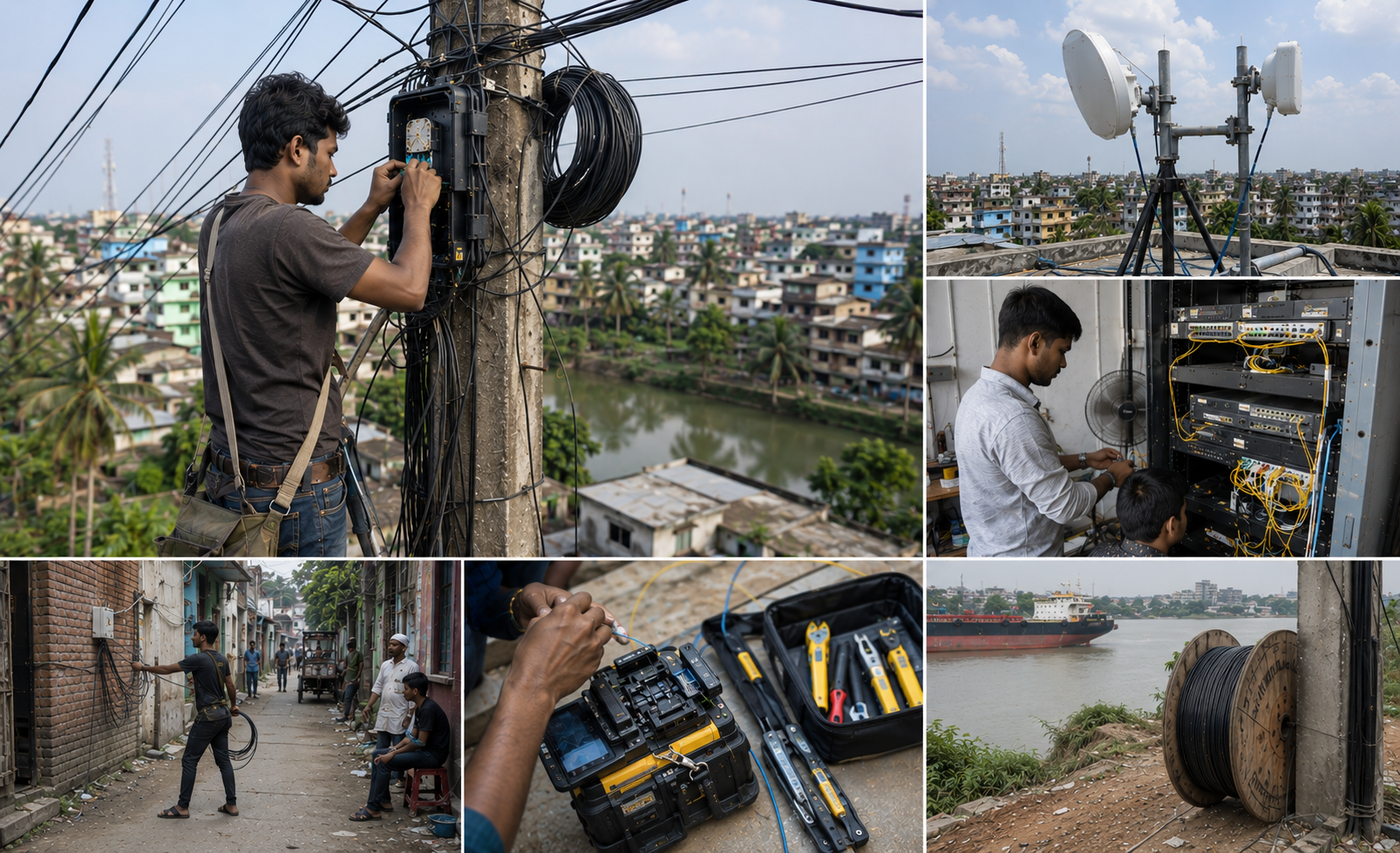
The Visible ISP With the Thin Corporate Shadow: FNB Network, Route Economics, and Legal Opacity in Dhaka’s Last-Mile Broadband Market
The most interesting fact about FNB Network is not that it appears in Internet registry data. Many small access providers do. The puzzle is that FNB is unusually legible as a network while remaining commercially opaque as a company. Its autonomous system, IPv4 block, IPv6 allocation, RPKI authorizations, tariff approval, public price pages, payment instructions and address trail all say that a real operating network sits behind the label. Yet the same evidence leaves unresolved questions that matter to buyers, wholesalers, lenders and competitors: who ultimately controls the business, how formal its renewal status is after the latest public license-list date, whether “multiple upstream” marketing language matches routed redundancy, what the relationship clues to Coronet Corporation Limited actually mean, and how much of the customer base is owned directly rather than reached through neighborhood distribution.
That tension is the core of the intelligence problem. In legal due diligence, thin filings often look like absence. In Internet infrastructure analysis, however, small operators leave a different kind of audit trail: route objects, ASN records, contact handles, tariff documents, payment portals, local address reuse, AS-set membership, RPKI scope and public service menus. These artifacts do not prove the same things as a corporate registry extract or audited accounts. They do prove that the operator has passed through several gates of infrastructure legitimacy. They also expose the economic shape of the business: a small Bangladeshi access ISP in the Dakshinkhan/Azampur edge of Dhaka, selling regulated home broadband and higher-ARPU business plans, dependent on wholesale connectivity, constrained by IPv4 scarcity, and competing on installation, local trust, content access, bill collection and support rather than on pure bandwidth alone.
The resulting thesis is simple: FNB Network appears to be a genuine localized broadband operator whose Internet-number resources and public service pages reveal more about its economics than its corporate narrative does. But the same route evidence that validates operational presence also highlights concentration risk, governance friction and unresolved ownership or counterparty questions. For a business and infrastructure reader, FNB is best understood not as a fully transparent corporation, nor as a mere directory listing, but as a neighborhood access network that has become partially institutionalized through APNIC resources, BTRC tariff approval and public ISP-association visibility.
From legal opacity to network visibility
The starting point is the RDAP/WHOIS trail. APNIC identifies ORG-FN18-AP as FNB Network, an LIR-type organization in Bangladesh, with an address at House #635/1, Hakim Mantion, Chalabon, Matir Mashjid Road, a phone number matching FNB’s public contact trail, and the email info@fnbnetworkbd.com. The APNIC organization record was last modified in September 2023. A related RDAP-style record for AS149831 identifies the network as FNBNETWORK-AS-AP, managed by FNB Network in Bangladesh, with status shown as active and with a registration date in May 2022.
That is more than a soft business-directory clue. An autonomous system number and portable IP resources are control points in the public Internet. They require registry interaction, contact handles, maintenance objects and routing authorization. They also create reputational and operational obligations: abuse contacts, route-origin validation, upstream acceptance and, in practice, coordination with transit providers. FNB’s public registry position therefore makes it visible in a way that a small sole-proprietor ISP would not necessarily be visible in corporate search alone.
But the legal-company picture is thinner. FNB’s own website contains service pages, tariff references, package menus, payment methods and contact numbers, yet its “About Us” page is essentially under construction, not a meaningful corporate profile. Its footer and page copy show operating continuity language — including “FNB Network” and, on one pricing page, a footer label reading “FNB Group” — but those labels do not establish a holding-company structure. The public trail supports the existence of an operating label and network organization. It does not, by itself, answer who owns the asset, how equity is financed, or whether related labels are branding, legacy names, billing aliases or separate legal vehicles.
This distinction is economically important. A customer buying a Tk500 home line may care mainly whether the connection works and whether a technician answers the phone. A corporate customer buying a real-IP package cares more about continuity, escalation and contractual accountability. A wholesale carrier cares whether bills are paid and routes are clean. A buyer or lender cares whether the customer base, fiber drops, ASN, bank accounts and license can be cleanly transferred. FNB’s evidence is strong on operational presence and weak on transferability.
Canonical identity: one operating label, several documentary shadows
The most defensible canonical identity is FNB Network, a Bangladesh-based ISP operating from the Dakshinkhan/Chalabon area of Dhaka and associated with ASN AS149831. That identity appears consistently across APNIC, BGP tooling, the company’s own website, tariff approval material and ISP-association listings. APNIC’s organization record names FNB Network; BGP.tools identifies AS149831 as FNB Network; the BTRC tariff approval document is addressed to FNB Network; and public ISPAB search results identify an FNB Network member entry with the same license number visible in the BTRC license list.
The ambiguity begins at the edges. The APNIC and company-website address trail points to House #635/1, Hakim Mansion, Chalabon, Dakshinkhan, Dhaka-1230. FNB’s website repeats that address on its home and contact pages, with hotline numbers and the email fnbnetwork2016@gmail.com. The BTRC Upazila/Thana ISP license list and ISPAB result, however, place FNB Network at House #693, Chalabon, Matir Masjid Road, Azampur, Dakshinkhan, Dhaka-1230. This may be mundane: a relocation, spelling inconsistency, nearby premises, a license address versus an operating office, or local address transliteration variance. But in a fragmented access market, address inconsistency is not meaningless. It affects service-area confidence, notice delivery, license verification, bank KYC and the ability of counterparties to distinguish one neighborhood operator from another.
There is also naming ambiguity in the payment trail. FNB’s payment page tells customers they can pay through bKash, Nagad and bank accounts. It instructs bKash users to find “Friends Broadband Network” in the bill-pay menu, while the same page lists one Dutch-Bangla Bank account under the personal name Md Shahadat Hossain and another Standard Bank account under FNB Network. This does not prove impropriety. In small ISP markets, founder accounts, legacy biller names, reseller names and formal operating labels often coexist. But it does create a commercially relevant identity stack: the routing identity is FNB Network; the retail website is FNB Network; the bKash biller instruction uses Friends Broadband Network; and bank settlement appears to include both a personal and a business-named account. For an acquirer, auditor or enterprise buyer, that stack would require reconciliation before revenue could be treated as cleanly attributable.
The social footprint reinforces the operating identity but not the ownership story. A public Facebook page describes FNB Network BD as a BTRC-approved ISP and says it has provided Internet service from 2016 onward; a related public group uses similar language and points to the FNB website. The website footer also carries a 2016–2024 continuity marker. That suggests the commercial service brand predates the APNIC ASN allocation in 2022. The likely sequence is that FNB operated first as a local access provider or reseller, then acquired greater network independence through its own ASN and IP resources. That sequence is common in access markets: a neighborhood operator begins by reselling bandwidth under upstream numbering, builds a subscriber base and collection system, then formalizes routing and registry control once scale or credibility justifies it.
The public product is regulated broadband plus local service convenience
FNB’s product pages are unusually useful because they reveal both the retail promise and the margin constraints. The company markets family broadband, deluxe packages and corporate packages. The family page says FNB provides Internet connections through cable/Ethernet and lists monthly home plans from 10 Mbps at Tk500 through 60 Mbps at Tk2,500, with setup charges, no real IP, “BDIX connected” language, gaming and social-media features, and 24/7 support. The corporate page lists higher-priced business packages from 15 Mbps at Tk2,000 through 55 Mbps at Tk6,000, with lower-end corporate tiers including “real IP” and all tiers emphasizing duplex connectivity, support, BDIX and multiple-upstream claims. A separate deluxe page shows mid-to-high speed plans from 35 Mbps at Tk1,499 to 70 Mbps at Tk2,999.
The product logic is that of a local fixed broadband operator, not a pure hosting provider or backbone carrier. The retail proposition combines bandwidth, local content, gaming latency, support and neighborhood availability. FNB’s home page advertises unlimited usage, gaming, “18 hours double speed and 24 hours speed,” BTRC “Ek Desh Ek Rate” shared-line language and 99% uptime. It also lists links to movie, FTP, live-TV and software resources. The package pages repeatedly mention BDIX connectivity and local content conveniences, while the navigation includes private-address or local-resource style links and third-party torrent-index references.
Those content and BDIX signals matter economically. In Bangladesh’s fixed-broadband market, headline international bandwidth is not the entire customer experience. Users compare YouTube performance, Facebook reliability, game latency, local cache speed, FTP/media-server availability, outage response and whether the provider can repair a drop line quickly. Local content reduces perceived bandwidth cost because traffic may stay domestic or within local exchange/cache ecosystems. Low latency matters for games and video calls. A provider that can make popular traffic feel fast can defend a retail package even when raw international transit is constrained.
The corporate product is a different margin instrument. A Tk2,000–Tk6,000 monthly package has higher ARPU than a Tk500–Tk800 family plan, but the buyer is more likely to demand uptime, real IP, escalation and documentation. FNB’s corporate tiers list real IP for the 15 Mbps, 25 Mbps and 35 Mbps packages, but the 45 Mbps and 55 Mbps corporate tiers show “Real IP: No.” That pattern reveals IPv4 scarcity. FNB has 512 IPv4 addresses in its allocated /23; not all can be assigned to paying end-users because routers, infrastructure, reserves, CGNAT design and business customers consume space. A real public IPv4 address is therefore not a throwaway feature. It is a scarce monetizable input for SMEs, CCTV users, remote-access needs and small offices. The lack of real IP on some higher-speed tiers is consistent with a provider rationing address space rather than bundling it automatically.
Revenue logic: prepaid discipline, low-ticket subscriptions and support-heavy margins
FNB’s revenue model appears subscription-driven, with monthly broadband payments collected through mobile financial services, bank transfer and an external billing portal. The website instructs customers to pay current-month Internet bills by the 15th and warns that the connection will be disconnected without notice through automated billing software if payment is not received. This billing rule is economically revealing. In low-ARPU access markets, collections discipline is not administrative detail; it is the difference between positive and negative cash conversion. A Tk500 home customer can become unprofitable quickly if support visits, delayed payment, bKash fees and wholesale bandwidth costs are not controlled.
The listed payment channels — bKash, Nagad, Dutch-Bangla Bank, Standard Bank and an online bill portal — show that FNB is trying to reduce collection friction while keeping local flexibility. That mix is rational for a neighborhood ISP. Door-to-door cash collection scales poorly and creates leakage risk; purely digital collection may exclude some households; bank transfer is useful for business customers; mobile financial services are the natural middle ground. The external portal reference also suggests that billing is at least partly formalized through third-party software or white-label ISP billing infrastructure.
The gross-margin pressure is structural. The company sells home broadband at regulated mass-market price points. It must buy or lease upstream Internet capacity, domestic transport, NTTN or last-mile inputs, switches, OLTs, ONUs, routers, power backup, poles or building access, splicing labor and support. It must also absorb customer education, service calls, fiber cuts, payment chasing and local disputes. Bandwidth costs may fall over time, but the support burden does not fall at the same rate. The economic question is therefore not only “what is the Mbps price?” It is “how many paying accounts can be supported per field technician, per OLT port, per upstream commit and per billing collector?”
The product menu gives clues about the operator’s answer. FNB’s low-end plans track the BTRC “one country, one rate” structure, while deluxe and corporate plans create ARPU ladders. The company advertises free optical-fiber connection promotions and 24/7 support. Free installation can accelerate subscriber acquisition but converts customer growth into upfront cash burn. If churn is high, free installation destroys margin. If local trust and drop-line control keep churn low, free installation becomes a rational customer-acquisition cost. The profitability of FNB’s model therefore depends heavily on tenure: the same Tk500 subscriber is unattractive at two months and valuable at two years.
Switching costs are modest legally but real operationally. A household can change ISP, but doing so may require a new fiber drop, an ONU or router reconfiguration, a service visit, settlement of dues and coordination with building access or neighborhood cable paths. The incumbent also benefits from habit and local trust: customers know which number to call, which technician covers the lane and which payment reference works. FNB’s public emphasis on phone, Messenger, WhatsApp and 24/7 tele-support reflects that the service channel is part of the product.
The ASN is small, real and economically meaningful
AS149831 is the hard infrastructure anchor. BGP.tools lists FNB Network’s ASN as registered in May 2022, active under APNIC, classified as an eyeball network, and originating two IPv4 prefixes: 103.187.124.0/24 and 103.187.125.0/24. It shows no originated IPv6 prefixes, one upstream and one peer, both visible as AS10075 Fiber@Home Global Limited in the IPv4 table.
This says several things at once. First, FNB is not merely a website or reseller brand with no routed footprint. It has its own ASN and originates address space. Second, it is small: two /24s equal 512 IPv4 addresses. Third, it is an eyeball access network rather than a transit network; BGP.tools shows no meaningful downstream transit role for FNB. Fourth, its visible upstream dependency is concentrated. If Fiber@Home is the only globally observed upstream, FNB’s Internet reachability depends materially on that relationship, even if some domestic, private, backup or non-BGP arrangements exist offstage.
The RPKI record strengthens the “real network” conclusion. A Route Origin Authorization authorizes AS149831 for 103.187.124.0/23, the component /24s and an IPv6 block 2001:df0:bcc0::/48, with validation shown as OK and validity extending to August 2026. RPKI is not a revenue statement, but it is a control signal. Operators who do not control or coordinate their number resources usually do not maintain valid ROAs for both IPv4 and IPv6. In practical terms, valid RPKI lowers route-hijack risk and makes FNB’s prefixes more acceptable to upstreams and networks enforcing route-origin validation.
The IPv6 position is especially interesting. APNIC data shows FNB with assigned portable IPv6 space, and the RPKI record authorizes AS149831 to originate the /48. Yet BGP.tools shows zero IPv6 prefixes currently originated by FNB. That gap is not rare among small ISPs, but it is commercially meaningful. IPv6 would reduce pressure on scarce IPv4 and improve long-run scalability, but deployment requires customer-premises support, router configuration, helpdesk readiness and upstream IPv6 transit. The unused IPv6 resource is a latent asset and a watchpoint: if FNB begins announcing IPv6, it would indicate operational maturation and could reduce dependence on public IPv4 scarcity as a product constraint.
There is one governance weakness in the registry data: APNIC-derived abuse-contact records include a remark that bidduth@fnbnetworkbd.com is invalid, with the abuse role last modified in January 2026. For consumers, this may be invisible. For upstreams, security teams and corporate customers, it matters. An invalid abuse contact can increase friction during abuse complaints, route-security incidents, blacklisting disputes and upstream compliance reviews. It is a small administrative failure with outsized reputational leverage.
The upstream problem: marketing redundancy versus visible concentration
FNB’s own packages claim “multiple upstream” connectivity. The BGP-visible picture is narrower: BGP.tools shows FNB with one upstream, Fiber@Home Global Limited, and no visible IPv6 upstream path. This discrepancy should not be overread, but it should not be ignored.
There are several possible explanations. FNB may have private domestic transport, BDIX access or backup capacity that does not appear as a separate global BGP upstream. It may receive Internet through Fiber@Home while using local caches, exchange fabrics or reseller arrangements for domestic content. It may have had multiple upstreams at some point but not at the time of observation. Or the package text may be generic marketing language copied across plans. The commercially conservative interpretation is this: the routed global-Internet dependency surface visible from public BGP is concentrated, regardless of whether the local access network has other operational redundancies.
Fiber@Home is a major Bangladesh connectivity provider. BGP.tools identifies AS10075 as a Bangladesh carrier network with multiple upstreams, including Bharti Airtel, Tata Communications, Reliance Jio, Hurricane Electric, BSCCL, Lightstorm and others; it also ranks Fiber@Home highly within Bangladesh by AS cone and peer visibility. That makes Fiber@Home a credible upstream for a small ISP. It also means FNB can outsource much of the complexity of international reachability to a larger wholesale network. For a small operator, that is economically rational: a single strong upstream reduces procurement complexity and may be cheaper than building diverse transit relationships before scale justifies them.
The downside is bargaining power. A small access ISP with one visible upstream has limited leverage on price, outage escalation and route quality. If the upstream’s economics change, if settlement terms tighten, if a compliance issue arises, or if FNB needs more capacity during peak hours, the operator has fewer credible alternatives. In BTRC tariff economics, this matters because retail price flexibility is constrained while wholesale costs and service-quality expectations remain live. A regulated retail ceiling plus concentrated upstream dependency compresses margins.
The Coronet clue sits in this same wholesale layer. Public directory data associates FNB with Coronet Corp Ltd / Coronet Corporation Limited, but the public network evidence does not prove parentage. Coronet’s own website presents the company as an IIG and IP-transit provider in Bangladesh, offering DIA, IP Transit, MPLS, IPLC and Global Ethernet services. BGP.tools identifies Coronet Corporation Limited as AS149765, an active Bangladesh network with multiple upstreams and many downstreams/peers, and shows an AS-set named AS149765:AS-CORONETIIG-BD. FNB’s BGP.tools page lists membership in several AS-sets, including Coronet’s AS-set, Fiber@Home-related sets, Summit-related sets, BSCCL-related sets and others.
This is evidence of routing-policy adjacency, not corporate control. AS-set membership can reflect customer propagation, route filtering, inherited policy records, prior relationships or third-party route management. It does not automatically mean Coronet owns FNB, operates FNB, invoices FNB or controls FNB’s customers. The stronger inference is that FNB sits inside a wholesale-routing ecosystem where larger IIG/carrier networks manage or import customer routes. The weaker, unresolved hypothesis is that Coronet may be or may have been a commercial counterparty. The evidence supports the former more than the latter.
Licensing and tariff economics in Bangladesh
FNB’s public regulatory record is meaningful but requires careful reading. The BTRC tariff approval document dated July 2022 grants tariff approval in favor of FNB Network and reproduces the “Ek Desh, Ek Rate” price table: 5 Mbps at Tk500, 10 Mbps at Tk800, 15 Mbps at Tk1,000, 20 Mbps at Tk1,200, 25 Mbps at Tk1,400 and 30 Mbps at Tk1,600, with a maximum shared contention ratio of 1:8. The same document sets service-quality and tariff conditions, including complaint-record retention, downtime-related billing relief and grade-of-service requirements involving upstream redundancy, NTTN path redundancy, NOC capability, uptime targets and mean-time-to-repair standards.
This framework changes the economics of a small ISP. In an unregulated market, an operator might freely widen the gap between headline speed and actual service, raise prices in constrained neighborhoods, or impose opaque downgrade penalties. Under the BTRC tariff framework, at least on paper, retail price and contention are bounded and service-quality obligations are formalized. The operator’s profit pool therefore comes from execution: better utilization, lower truck-roll cost, efficient upstream procurement, good churn control, local content routing, and enough customer density to spread fixed costs.
The public license-list trail introduces a sharper uncertainty. BTRC’s Upazila/Thana ISP license list, dated as a public document in December 2024, includes FNB Network in Dakshinkhan with license number 14.32.0000.702.46.782.20.577, original date 19 January 2022, and a license-validity date shown as 3 September 2024; the same row visually shows a next-renewal date around early September 2024. ISPAB’s public result for FNB Network shows the same BTRC license number and identifies the operator as an Upazila/Thana licensee.
The commercially important point is not that FNB lacks a license. The record supports a licensed history. The issue is that the public list available here does not by itself prove renewal beyond the September 2024 validity marker. Public lists can lag; renewal may have occurred outside the visible extract; or the operator may have continued while administrative renewal records were not reflected in the version reviewed. But for due diligence, this is a hard watchpoint. A corporate customer, acquirer or upstream provider should verify current BTRC license status directly, not infer it from the website’s “BTRC approved” language or from historical tariff approval alone.
The same BTRC list also reveals local competitive density. Around the same Dakshinkhan area, the license list includes multiple other small ISP names, such as AK Network, AR Network, Arafat Siam BD.ISP, Diplomat Online BD, Samin’s Network and SMP Network, each with its own validity trail. This is not a monopolistic market structure. It is a fragmented local-access environment in which neighborhood operators compete alongside national carriers, mobile broadband and informal reseller channels. Fragmentation limits price power but can also protect incumbents through micro-geography: lane-level access, technician familiarity, building relationships and existing drops matter.
Competition: the market is local even when the Internet is global
FNB competes in two markets at once. Upstream, it buys connectivity from larger carriers and sits inside national and regional routing structures. Downstream, it competes street by street. The downstream market is not simply “Bangladesh broadband.” It is closer to “fixed broadband for households and small offices reachable from FNB’s local plant in Dakshinkhan/Chalabon/Azampur.”
The substitutes are heterogeneous. A household can choose another local ISP, a cable/fiber reseller, mobile broadband, a national fixed operator where available, or a neighbor-recommended provider. A small office can choose FNB, a larger ISP, mobile backup, DIA from a larger provider or a local reseller offering a cheaper but less formal package. Each substitute attacks a different part of FNB’s value proposition. Mobile broadband attacks installation friction and backup reliability, but may be weaker on unlimited fixed usage. Larger ISPs attack credibility and scale, but may be less responsive at the lane level. Other neighborhood ISPs attack price, installation speed and personal support.
FNB’s defense is therefore not only network engineering. It is embedded distribution. The company publishes multiple phone numbers, Messenger, WhatsApp and Instagram contact options, and promises ticket response and 24/7 tele-support. It markets gaming, BDIX, local content and unlimited usage, which are precisely the features that consumers feel without reading a service-level agreement. In this market, a fast repair by a known technician can matter more than a theoretically superior upstream.
The economics of competition are also shaped by the BTRC tariff table. When low-end package prices are standardized or publicly constrained, providers compete on quality, freebies, support and promotional bandwidth. FNB’s home page language about free optical-fiber connection and double-speed periods should be read in that context. These are not random marketing flourishes. They are ways to create perceived surplus without formally breaking the tariff architecture.
But support-based differentiation has a cost. Every added customer increases potential fault tickets, router resets, payment questions and outage complaints. Local ISPs are often squeezed between customers who experience broadband as a utility and economics that resemble a small field-service business. If FNB grows beyond its support capacity, churn and complaint costs rise. If it stays too small, it cannot amortize upstream, staff and equipment investments efficiently. The profitable zone is dense, locally trusted and operationally disciplined.
The ownership question: why unresolved control still matters
Public evidence does not currently establish a parent company or successor entity for FNB Network. The strongest canonical label remains FNB Network. The Coronet clue is best treated as a wholesale/routing-policy or directory-relationship clue, not proof of ownership. The payment-page presence of personal and business bank accounts is a local commercialization clue, not proof of legal structure. The “FNB Group” footer is a branding clue, not a corporate-group proof.
This unresolved control question matters because access ISP assets are bundled across several layers. The value of FNB is not just its ASN. It is the customer book, local plant, billing relationship, field staff, neighborhood permissions, routers, ONUs, upstream contracts, tariff approval, license status, bank settlement channels, brand reputation and route objects. If those layers are owned or controlled by different people or entities, commercial risk rises. A buyer could acquire the brand but not the customer contracts; lease the network but not control the IP resources; obtain the customer book but inherit unresolved bank-biller ambiguity; or rely on an upstream relationship that is personal rather than transferable.
The BTRC tariff document adds an important ownership clue without solving the issue. The submitted approval copy is signed under a Proprietor, FNB Network label. A proprietorship structure would be consistent with personal-bank-account use and local ISP formation. It would also mean that continuity, succession and financing may depend heavily on the proprietor rather than on a deeply institutionalized company. If FNB has since incorporated, reorganized or transferred assets, that would materially change the risk profile. The public artifacts reviewed here do not prove such a transition.
For lenders and wholesale counterparties, the practical due-diligence questions are straightforward. Who signs the upstream contract? Who owns the last-mile plant? Who controls APNIC maintainer credentials? Who receives bKash and bank settlements? Whose name is on the BTRC renewal? Are customer contracts assignable? Are technicians employees, contractors or reseller agents? The answers would change recoverability, bargaining power and enterprise-sales credibility. The public route trail validates the network, but it does not answer these legal-control questions.
Competing hypotheses about FNB Network
The public evidence supports several competing hypotheses. They are not mutually exclusive, but they differ in commercial implications.
Hypothesis one: FNB is a locally originated ISP that matured from reseller to ASN holder. This is the most likely reading. The social and website trail claims service continuity from 2016; APNIC resources and ASN registration appear in 2022; the BTRC tariff approval is also from 2022; and the public package pages look like a real household and SME broadband operator. Under this hypothesis, FNB built a local customer base first, then formalized as it scaled. The economic implication is positive: local trust and existing drops may be valuable, while governance systems may still be founder-led.
Hypothesis two: FNB is operationally independent but commercially nested under larger wholesale and billing ecosystems. This is also plausible. FNB’s visible upstream is Fiber@Home; BGP AS-set membership points into larger route-policy ecosystems including Coronet, Summit, BSCCL and Fiber@Home-related sets; the payment portal appears external; and the bKash biller instruction uses a different broadband name. Under this hypothesis, FNB owns the customer interface but depends heavily on external platforms and carriers. The implication is mixed: low capex and fast deployment, but weaker bargaining power and more counterparty exposure.
Hypothesis three: FNB’s legal record is valid historically but administratively unresolved in the latest public list. The BTRC list shows a September 2024 validity marker, while the website and routing data remain active beyond that point. This may simply reflect list lag or renewal-document timing. But if renewal were actually unresolved, it would affect enterprise sales, upstream compliance and transaction value. The commercial implication is binary enough that current license verification should be treated as mandatory.
Hypothesis four: Coronet is more than a route-policy clue. This remains unproven. Coronet is a real IIG/IP-transit company with a visible network, multiple upstreams and an AS-set into which FNB appears to be included through BGP.tools’ AS-set reporting. But no public evidence reviewed here establishes ownership, management control or direct parentage. If Coronet were a direct upstream, reseller principal or acquisition counterparty, FNB’s economics would change: it might have better wholesale pricing, stronger redundancy options and a more institutional control layer. Without evidence, this should remain a watchpoint rather than a conclusion.
What the evidence proves, what it suggests and what remains unresolved
The evidence proves that FNB Network is not merely a directory artifact. It appears in APNIC organization records, holds an ASN, has IPv4 and IPv6 resources, maintains valid RPKI authorization, originates two IPv4 /24s, is visible in BGP as an eyeball network and has public retail and corporate service pages. It also has BTRC tariff approval history and appears in a BTRC Upazila/Thana ISP license list with a license number that matches ISPAB’s public result.
The evidence suggests that FNB is a small, local fixed-broadband ISP serving households and small businesses around Dakshinkhan/Chalabon/Azampur. Its economics are those of a dense last-mile operator: low monthly ARPU at the household edge, higher ARPU for corporate customers, scarce real IPv4, dependence on wholesale transport, a support-heavy operating model, and differentiation through local content, BDIX claims, gaming latency and customer service.
The evidence also suggests a maturation path from informal or reseller-like service into formal network operation. The 2016 service-continuity language on social and website pages predates the 2022 APNIC and tariff-approval milestones. That is commercially plausible: local ISPs often acquire customers before acquiring independent number resources.
The unresolved facts are commercially consequential. The current license-renewal status after the public list’s September 2024 marker needs direct verification. The legal identity behind bank settlement and bKash biller naming needs reconciliation. The actual redundancy architecture needs confirmation because public BGP shows only one upstream while package pages claim multiple upstreams. The ownership or counterparty meaning of Coronet-related clues remains unproven. The invalid APNIC abuse email should be corrected or explained. IPv6 resources are authorized but not visibly originated, leaving scalability potential unrealized. Each of these uncertainties changes the risk premium applied to the business.
Evidence ledger
Canonical operating identity and registry standing. APNIC identifies ORG-FN18-AP as FNB Network, an LIR-type organization in Bangladesh, with address, phone and email details matching the operator’s public web footprint. This is high-confidence evidence that the operating label exists in the APNIC resource system. A separate RDAP-style ASN view identifies AS149831 as FNBNETWORK-AS-AP, active and based in Bangladesh.
ASN and routed resources. BGP.tools identifies AS149831 FNB Network as an active APNIC ASN registered in May 2022, classified as an eyeball network. It shows two originated IPv4 prefixes, 103.187.124.0/24 and 103.187.125.0/24, and no visible originated IPv6 prefixes. This is high-confidence evidence of operational Internet visibility, but it does not reveal subscriber count, profitability or ownership.
RPKI authorization. The RPKI record authorizes AS149831 for the IPv4 /23 and component /24s, plus IPv6 2001:df0:bcc0::/48, with validation shown as OK and validity extending to August 2026. This is high-confidence evidence of route-origin control and resource hygiene. The commercial meaning is that FNB’s routed resource position is more mature than a purely informal reseller.
IPv6 gap. APNIC and RPKI evidence show assigned and authorized IPv6 resources, while BGP.tools shows no visible originated IPv6. This is a high-confidence operational gap. It does not mean FNB lacks IPv6 resources; it means public routing does not show IPv6 deployment.
Upstream dependency. BGP.tools shows FNB with one visible upstream and one visible peer, both listed as AS10075 Fiber@Home Global Limited for IPv4. Fiber@Home itself is visible as a larger Bangladesh carrier with multiple international and domestic upstream relationships. This is high-confidence public BGP evidence of concentration in globally visible routing, though it may not capture private domestic backup or local-exchange arrangements.
Coronet relationship clue. Coronet Corporation Limited publicly markets itself as an IIG/IP-transit provider in Bangladesh, and BGP.tools identifies Coronet as AS149765 with multiple upstreams and an AS-set named AS149765:AS-CORONETIIG-BD. FNB’s BGP.tools page lists membership in several AS-sets, including Coronet’s. This is medium-confidence evidence of routing-policy adjacency or wholesale-market relationship. It is not proof of ownership or parentage.
BTRC tariff approval. A BTRC tariff approval document dated July 2022 grants approval in favor of FNB Network and reproduces “Ek Desh, Ek Rate” packages, contention ratio and service-quality conditions. This is high-confidence evidence of regulatory interaction and tariff approval history. It should not be confused with a current license-renewal certificate.
BTRC and ISPAB license-list trail. The BTRC Upazila/Thana ISP license list includes FNB Network in Dakshinkhan with license number 14.32.0000.702.46.782.20.577, original date 19 January 2022, and a September 2024 validity/renewal marker. ISPAB’s public result for FNB Network shows the same license number and Upazila/Thana category. This is high-confidence evidence of licensed history, but not sufficient by itself to confirm current post-September-2024 renewal.
Public product and pricing pages. FNB’s website lists family plans from Tk500 to Tk2,500, corporate plans from Tk2,000 to Tk6,000, and deluxe plans from Tk1,499 to Tk2,999. The pages emphasize cable/Ethernet or FTTH-style service, BDIX connectivity, gaming, support, duplex connectivity and, selectively, real IP for corporate tiers. This is high-confidence evidence of market positioning and revenue logic.
Payment and billing evidence. FNB’s payment page instructs customers to use bKash, Nagad, bank accounts and an online portal, includes a pay-by-15th disconnection rule, and contains identity ambiguity through “Friends Broadband Network” bKash instructions and both personal and FNB-named bank accounts. This is high-confidence evidence of collection mechanics and medium-confidence evidence of identity complexity. It does not prove ownership by any named person.
Contact and support surface. The website publishes a Dakshinkhan office address, hotline numbers, email, Messenger, WhatsApp and Instagram contact options, plus ticket-response language. This is high-confidence evidence that FNB presents itself as an active customer-facing ISP, not just a passive ASN holder.
Social and continuity signals. Public Facebook search results identify FNB Network BD as a BTRC-approved ISP and state service continuity from 2016, with a related group pointing to the same website. This is lower-confidence than APNIC or BTRC evidence, but it supports the hypothesis that the retail service brand predates the 2022 ASN/tariff milestones.
Governance friction. APNIC-derived abuse-contact records include a remark that an FNB email address is invalid. This is high-confidence evidence of a registry-contact problem. It is not evidence of network failure, but it is commercially relevant for upstream compliance, abuse handling and enterprise credibility.
Watchpoints
Current BTRC license renewal. The single most important 12-month watchpoint is whether FNB’s Upazila/Thana ISP license is publicly updated or directly verifiable beyond the September 2024 validity marker in the BTRC list. Historical approval and active routing are not substitutes for current licensing in enterprise or transaction due diligence. A clean renewal would lower regulatory risk; an unresolved renewal would raise the cost of capital, weaken enterprise sales and potentially affect upstream willingness to carry routes.
Upstream diversification. Public BGP currently shows Fiber@Home as FNB’s only visible upstream. A second visible upstream, especially through Coronet, Summit, BSCCL or another Bangladesh carrier, would materially improve resilience and bargaining power. Continued single-upstream visibility would keep FNB economically dependent on one wholesale relationship, even if local backup arrangements exist.
Coronet signal becoming explicit. The Coronet clue should be monitored for conversion from routing-policy adjacency into explicit commercial evidence: customer lists, route-policy changes, invoices, press, website claims, PeeringDB updates or BGP downstream visibility. If Coronet is only an AS-set artifact, the business remains local and independent. If Coronet becomes a direct upstream, partner, acquirer or operating principal, FNB’s wholesale economics and institutional credibility change.
IPv6 announcement. FNB has IPv6 resources and RPKI authorization but no visible IPv6 route origination in the reviewed BGP source. IPv6 deployment would indicate network maturation, reduce long-run IPv4 pressure and improve technical credibility. Continued non-deployment preserves scarcity economics around public IPv4 but may limit future scalability.
Abuse-contact remediation. The invalid APNIC abuse-contact remark is a small but visible governance defect. Correction would improve operational hygiene and reduce friction with carriers, security teams and corporate customers. Non-correction increases the risk that abuse tickets, blacklists or routing disputes become harder to resolve.
Real-IP monetization and IPv4 scarcity. With only 512 IPv4 addresses, FNB’s public-IP policy is economically important. Watch whether real IP remains limited to selected corporate tiers, becomes a paid add-on, or is replaced by IPv6 and CGNAT-heavy consumer service. Public-IP scarcity can support SME ARPU, but it can also frustrate power users and increase support burden.
Billing identity normalization. The coexistence of FNB Network, Friends Broadband Network, personal-bank settlement and FNB-named bank settlement should be watched. A cleaner biller identity would improve auditability and transaction value. Persistent ambiguity may be tolerable in retail broadband but problematic for corporate procurement, financing and M&A.
Address and brand consolidation. The difference between the House #635/1 and House #693 address trails should be reconciled in future public records. Address consistency is not cosmetic; it affects license verification, customer trust, supplier contracting and legal notice. A single, updated address across APNIC, BTRC, ISPAB and the website would signal institutional housekeeping.
Local competitive churn in Dakshinkhan. The BTRC list shows multiple small operators in or around Dakshinkhan. FNB’s economics will depend on whether it can defend dense customer clusters against nearby ISPs, mobile broadband and larger fixed players. Watch for price promotions, free-install offers, customer complaint spikes and visible neighborhood expansion.
Service-quality enforcement. BTRC tariff terms include uptime, downtime compensation, complaint-record and redundancy expectations. Stronger enforcement would favor operators with better NOC processes and redundant upstream/NTTN paths. Weak enforcement would preserve the current local-trust model but keep quality uneven. FNB’s claimed 99% uptime and BTRC grade-of-service obligations should be tested against outage traces and customer complaints over time.
Website and portal modernization. A more complete corporate site, updated “About Us” page, current tariff approvals, clearer legal name and integrated payment portal would indicate institutionalization. Continued under-construction corporate pages alongside active service pages would reinforce the current pattern: operationally real, commercially useful, but legally thin.
Route-origin and prefix stability. FNB’s two /24s and valid ROAs should be monitored for withdrawals, invalid RPKI states, origin changes, new prefixes or deaggregation. Stable route-origin behavior supports continuity. Route instability, unexplained origin changes or expired ROAs would be early warning signals for operational stress, upstream disputes or control changes.