
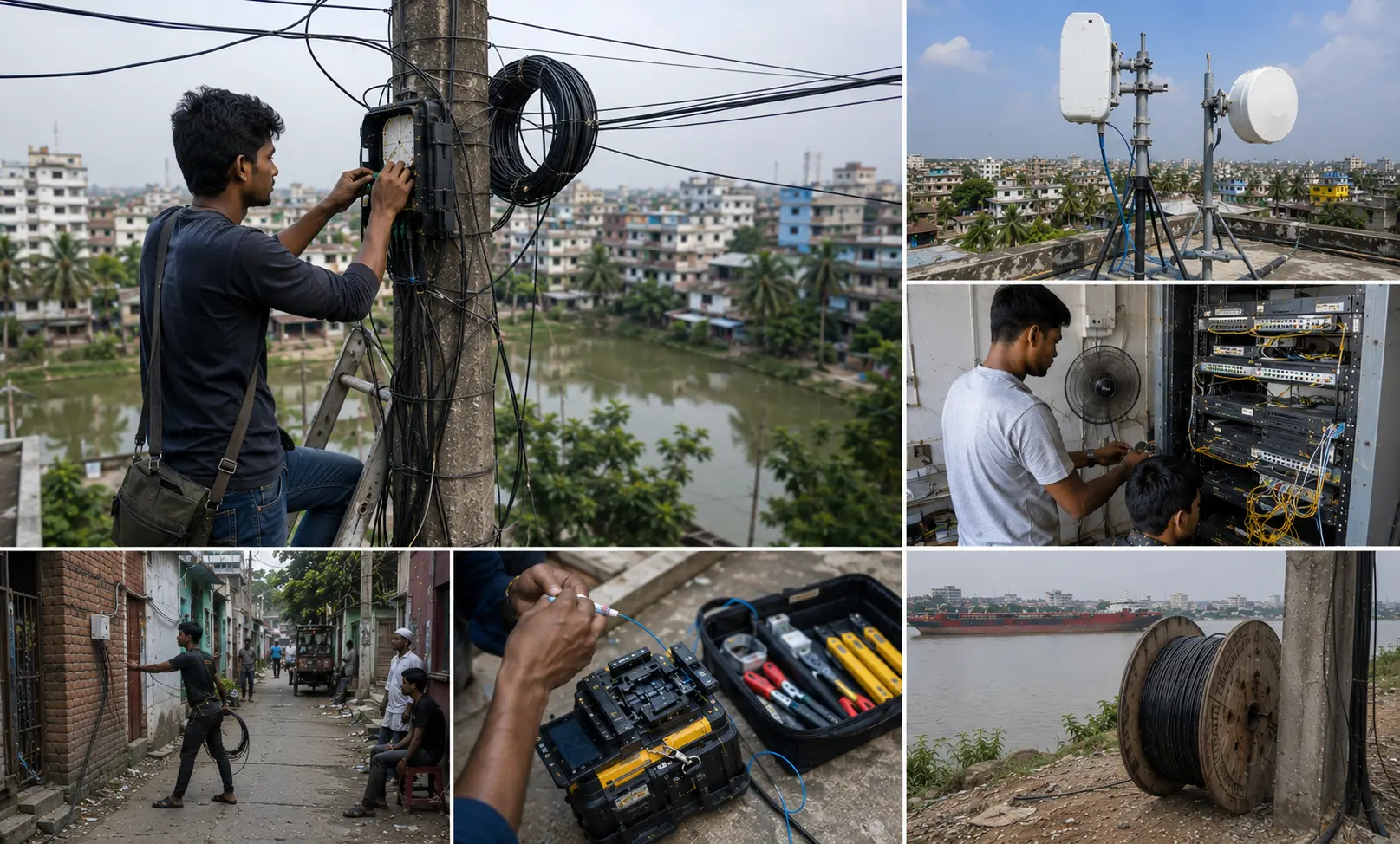
Summary
- What it says: Thesis: The small ISP survives by selling locality, not bandwidth
- Main topic: Regional ISP economics; Data sovereignty and locality
- Context: Telecommunications / Company research / Asia-Pacific
Losing the commodity, owning the street: FL ONLINE and the neighborhood broadband economy in Bangladesh
Thesis: The small ISP survives by selling locality, not bandwidth
FL ONLINE is best understood not as a differentiated technology company, but as a neighborhood broadband operator whose economic asset is a localized operating position in South Keraniganj, Dhaka. Public records identify FL Online as an Upazila/Thana Internet Service Provider licensed by the BTRC, with the official license list placing “FL Online” in the South Keraniganj thana of Rajendrapur, Baghoir, South Keraniganj, Dhaka, under license number 14.32.0000.702.47.527.21.160, valid until 18 December 2026.
The same operational identity is visible in APNIC registry data under ORG-FO7-AP, in AS150799 / FLONLINE-AS-AP, and on the company website, which describes FL Online as a BTRC-licensed ISP in South Keraniganj thana, Dhaka.
The company’s economic question is the big question facing hundreds of small fixed-access operators in Bangladesh: why do small ISPs persist when bandwidth is commoditized, retail prices are constrained, upstream bargaining power is weak, payment collection is difficult, and regulatory compliance is non-trivial? The answer is that “the internet” is a commodity at the upstream level, but access is not a commodity at the level of the street, the building, the household, the business, and support.
A small ISP can survive when it controls a sufficiently dense local distribution plant, collects bills with a low loss rate, responds to cable cuts faster than larger competitors, and turns upstream capacity into a trusted local service contract. In this model, the product is not simply megabits per second; it is installation speed, repair time, local content performance, field support, payment convenience, and the customer’s belief that a known operator will pick up the phone.
FL ONLINE’s public footprint is narrow but consistent. It advertises FTTH broadband, local content speed connected to BDIX, YouTube/Facebook cache speed, residential broadband, business/SME Internet, LAN/WAN network solutions, CCTV/IP surveillance, data connectivity, IP telephony connection, public/real IP service for an additional 200 BDT per month, prepaid billing, cash and bKash payment, and installation within 30 minutes to one day within its coverage area. Its published residential plans range from 5 Mbps at 500 BDT per month to 40 Mbps at 2,000 BDT per month, with applicable 5% VAT extra.
These facts define the business model. FL ONLINE is visibly not a national core network. It is a last-mile and access services enterprise with a public autonomous system and a tiny global routing footprint. Observed BGP data for AS150799 shows one originating IPv4 prefix, 103.107.240.0/24, zero originating IPv6 prefixes, a visible /24 IPv4 address space, RPKI validity for the IPv4 route, and Summit Communications Ltd as the visible upstream/peer. APNIC also records a portable IPv6 allocation, 2400:e7a0::/32, for FL ONLINE, but BGP.tools did not show FL ONLINE as an IPv6 origin at the time of observation.
This asymmetry is economically significant. A public IPv4 footprint of a /24 does not imply only 256 subscribers, because a retail ISP can use private addressing, NAT, CGNAT, and selective public IP assignment. But it indicates that FL ONLINE’s Internet-scale signature is small, and its customer economics likely depend more on local aggregation than on owning scarce global resources. The public/real IP surcharge at 200 BDT per month is therefore not an insignificant service line; it is one of the few visible price discrimination mechanisms in a market where basic broadband tariffs are crowded and regulated.
Canonical identity: one operational label, multiple registration surfaces
The canonical public identity is “FL Online” or “FL ONLINE,” with case varying by source. The company website uses “FL Online.” The BTRC license list uses “FL Online.” APNIC and BGP records use the all-caps version “FL ONLINE,” with organization identifier ORG-FO7-AP and AS name FLONLINE-AS-AP. The address cluster is consistent: Rajendrapur / Baghoir / Baghair / Vagoir, South Keraniganj, Dhaka-1310, with spelling variations typical of registry and OCR records rather than evidence of distinct entities.
The Bangladesh ISP Association (ISPAB) member directory adds a second identity signal: “Fl Online” appears with member number A-722, BTRC Upazila/Thana license category, the same address in Rajendrapur, Baghoir, South Keraniganj, an email address, and a mobile phone number. This listing mentions no website or social profile, even though the company website is active and is also referenced by BGP.tools and PeeringDB. This gap should be treated as an incompleteness or staleness in the association directory, not as evidence against the website.
There is no public evidence, in the records examined, that FL ONLINE is a subsidiary of Coronet Corporation Limited, Summit Communications, or any other larger operator. Relationship clues instead point toward routing, wholesale, or directory inferences. BGP.tools lists AS150799 as a member of several AS-SETs, including as149765:as-coronetiig-bd and as58717:as-summitcommunications-bd; Summit is also the visible upstream/peer for AS150799.
Coronet’s public materials describe Coronet Corporation LTD as an IIG and IP transit company in Bangladesh, and PeeringDB describes Coronet as operating AS149765 as an IIG and AS138640 as a nationwide retail ISP. This makes a relationship with Coronet commercially plausible as transit, route-set, IIG, or policy context, but does not prove ownership.
This distinction matters. If Coronet were a parent company, FL ONLINE would be a local retail appendage of a larger access/core platform, and the business question would be branch-level economics. If Coronet is only an IIG or routing-policy counterparty, FL ONLINE remains an independent or locally-controlled ISP dependent on upstream aggregation. Public records support the second interpretation more strongly than the first. ISP licensing rules in Bangladesh also make ownership changes commercially significant because BTRC guidelines require prior written approval for ownership changes and restrict share transfers without permission.
South Keraniganj as market boundary, not just an address
South Keraniganj is not incidental. It is the regulatory and economic boundary of the visible activity. The BTRC ISP licensing framework distinguishes National, Divisional, District, and Upazila/Thana licenses; an Upazila/Thana ISP license authorizes service within the administrative area of that Upazila or Thana, and an entity is issued only one such Upazila/Thana license. The official BTRC license list places FL Online specifically in the South Keraniganj thana, and the company’s coverage statement says that the entire area under the South Keraniganj thana of Dhaka district is covered by FL Online.
This territorial structure helps explain why many small ISPs can coexist even in a poorly differentiated market. License geography creates a formal container for small-scale entry.
It reduces the minimum viable ambition from “build a national ISP” to “serve a thana well enough.” The same BTRC framework imposes obligations: no person or entity may build, maintain, or operate ISP systems without a license; licensees must lease or sublease transmission from NTTN operators, except for infrastructure-sharing exceptions; and last-mile connectivity is limited to approximately 3 km in metropolitan areas and 6 km elsewhere, subject to local authority guidelines.
The South Keraniganj market is not empty. The same BTRC Upazila/Thana license list contains several operators near or in the same thana, including Alvi Online, Amar Online BD, AP Online, Commander Net, Internet Carrier, Link Line, M Amin Network, M.M. Communication Network, Idea Internet Service, Prottasha Universal, Ramss Net, and others in or around South Keraniganj. The resulting structure looks less like a single territorial monopoly than a dense local access market with overlapping operators, legacy cable-operator ties, feeder fiber paths, informal resellers, and building-by-building competition.
This density produces a paradox. Competition should erode margins, but it can also validate the category and create a local ecosystem of installers, splicers, router sellers, pole-access know-how, and customer familiarity with monthly broadband billing. FL ONLINE’s survival does not require exclusive control of South Keraniganj. It requires sufficient cluster density inside parts of that thana: enough households, businesses, and SMEs on or near its optical distribution network to sustain recurring monthly revenue before upstream, NTTN, support, and maintenance costs.
Product evidence: FTTH access wrapped in local service
FL ONLINE’s website positions the core access product as FTTH. The company states that it uses “Fiber to the Home” technology and optical fiber, and contrasts this with twisted pair, DSL, and coaxial cable. Its advertised service stack is broader than residential broadband, but not in a way that suggests a sophisticated enterprise integrator; it rather suggests the normal adjacency map of a local ISP: broadband, LAN/WAN setup, CCTV surveillance, data connectivity, IP telephony connection, and SME connectivity.
The plan scale is closely aligned with the broadband retail tariff environment in Bangladesh. FL ONLINE offers 5 Mbps for 500 BDT, 10 Mbps for 800 BDT, 15 Mbps for 1,000 BDT, 20 Mbps for 1,200 BDT, and 40 Mbps for 2,000 BDT, each with unlimited data, low-latency gaming language, extended BDIX speed, and 5% VAT extra. In June 2021, the Bangladeshi press reported the BTRC’s uniform broadband tariff framework: 5 Mbps at 500 BDT, 10 Mbps at 800–1,000 BDT, and 20 Mbps at 1,100–1,200 BDT. FL ONLINE’s public plan list fits almost exactly within that framework.
The most interesting product claims are not the megabit tiers. They are “BDIX connected,” local download speed, cache speed for YouTube and Facebook, low-latency gaming, a movie/FTP/TV server, and a public/real IP surcharge. These claims show the operator’s practical understanding of demand. For a household in a crowded broadband market, a nominal 10 Mbps or 20 Mbps plan is less meaningful than whether YouTube buffers, whether Facebook loads, whether a local FTP server saturates the connection, and whether games get a tolerable ping. For a small business, CCTV surveillance or remote access may matter more than raw download speed.
The business/SME offer is deliberately unpriced on the website: it is “Call for pricing.” This is economically rational. Residential broadband is visibly compared against reference tariffs and easily comparable. SME service allows price discrimination: a shop, a clinic, a school, a warehouse, a courier office, or a small factory may pay for a public IP, faster repair, static routing, CCTV integration, LAN cleanup, or a service level that a household will not buy. Public evidence does not reveal FL ONLINE’s customer mix, but the service menu shows where margin might be protected if residential plans become too compressed.
Payment frictions and the economics of trust
The company’s billing language is unusually revealing. FL ONLINE states that it is fully prepaid: customers must pay before the billing date or the connection is suspended immediately after the billing date. It accepts cash and bKash merchant service payments and notes that customers can request help collecting bills at their location. This is a small-ISP survival handbook in three lines. Prepaid billing reduces bad debt risk; bKash reduces payment friction; cash collection preserves the customer relationship for households that prefer physical collection; and suspension creates a credible enforcement mechanism.
Payment frictions are often underestimated in broadband analysis because analysts focus on bandwidth cost. For a small ISP, unpaid bills can be more damaging than a few points of wholesale price movement. The fixed costs of the access plant, upstream capacity commitments, field labor, and license compliance continue even when customers delay payment. A prepayment rule turns credit risk into attrition risk. This trade-off can be attractive: it is better to suspend a non-paying customer quickly than to fund a growing receivables portfolio with a small balance sheet.
The promise of bill-collection assistance also reveals why small operators persist despite low differentiation. Large ISPs may have better brands, apps, and core networks, but a local ISP can send a person to collect, troubleshoot, reconnect, replace a router, or negotiate a household’s payment schedule. This human layer is costly, but it is also defensive. In a market where switching costs are low on paper, local trust becomes a switching cost in practice.
The support signal is mixed. The website promotes 24/7/365 professional support and says FL Online is always ready with a dedicated fiber and support team. But the contact section states daily opening hours from 10:00 AM to 9:00 PM. This is not unusual for a small operator: the marketing language promises always-on service, while customer-facing staff and hours reflect the local work reality. Commercially, the gap matters because the customer’s “quality” experience may depend less on core network uptime than on the operator’s response during a rainstorm, a power issue, a fiber cut, or a router failure.
Infrastructure: a small visible AS with routing hygiene and concentration risk
AS150799 gives FL ONLINE a public routing identity. BGP.tools records the network as active, allocated under APNIC, an “Eyeball” network, registered on 7 March 2023, operating in Bangladesh, and originating one IPv4 prefix and zero IPv6 prefixes. The originated IPv4 route is 103.107.240.0/24, indicated with valid RPKI. IPinfo independently reports the same 103.107.240.0/24 network block, 256 addresses, valid RPKI ROA coverage, one peer, one upstream, and zero downstreams.
The practical interpretation is that FL ONLINE has sufficient routing autonomy to announce its own prefix and maintain a public AS, but not enough visible scale to be an infrastructure hub. The valid RPKI status is positive: it reduces the risk that global networks reject or mishandle the route because of an invalid route origin authorization. The single visible upstream/peer is a concentration risk: if Summit Communications is the only external active path visible through global BGP tools, then a Summit outage, commercial dispute, maintenance event, or filtering problem can disproportionately impact FL ONLINE’s reachability.
The company website claims connection with multiple IIGs for availability and faster paths. The BGP evidence, however, shows Summit as the visible upstream/peer and does not show multiple global upstreams for AS150799. This does not necessarily prove the website claim is false. Multiple IIG arrangements could exist below the publicly visible BGP layer, via private peering, reseller aggregation, backup paths not active at the observation time, or arrangements with providers hidden behind Summit. But from the perspective of external route observability, the case for resilient multi-homing is unproven.
APNIC records an IPv6 allocation, 2400:e7a0::/32, for FL ONLINE, status allocated portable, with mnt-routes MAINT-FLONLINE-BD. This is a large allocation in address terms, but BGP.tools showed no IPv6 prefix originated for AS150799 at the observation point. This is common among small access networks: IPv6 is allocated before it is fully deployed, routed, supported in customer premises equipment, and sold or activated for customers. Economically, dormant IPv6 means the operator remains more dependent on scarce IPv4, NAT, and public IP monetization.
There is also a registry hygiene issue. The APNIC IRT record listsinfo@flonlinebd.comandadmin@flonlinebd.combut includes remarks indicating that both are invalid, with the IRT record modified in April 2026. The same APNIC record still lists the organization and admin contacts for FL ONLINE. For a small ISP, invalid registry contact remarks are not just administrative. They can affect abuse handling, incident response, trust with upstreams, and the ability of other networks to quickly resolve routing or security issues.
PeeringDB complicates the picture. Its entry for FL ONLINE lists ASN 150799, the website flonlinebd.com, the IRR route-set AS150799:AS-FL, network type NSP, 512 IPv4 prefixes, 2 IPv6 prefixes, traffic levels of 50–100 Gbps, a heavy inbound ratio, and an Asia-Pacific geographic scope. These numbers are difficult to reconcile with BGP.tools and IPinfo, which show a /24 IPv4 and no visible IPv6 originated by AS150799. The most cautious interpretation is that the PeeringDB data is self-reported, outdated, mis-keyed, or uses fields differently from actual BGP prefixes. It is a useful weak signal, not a basis for scale claims.
Supplier dependency: IIG, NTTN, NIX, and route-set economics
Bangladesh’s regulatory framework constrains small ISPs into an upstream-dependent architecture. BTRC guidelines state that ISP licensees must lease or sublease transmission from NTTN operators, and that National, Divisional, District, and Upazila/Thana ISP licensees must connect to a licensed IIG for leased Internet bandwidth. The same guidelines require NIX connectivity for domestic inter-operator data traffic, and state that ISPs must obtain tariff approval before providing service or changing approved tariffs.
This regulatory architecture explains the small ISP’s margin problem. FL ONLINE sells retail access, but does not control all the critical inputs: international bandwidth passes through IIG relationships, transmission through NTTN or infrastructure-sharing agreements, domestic traffic through NIX/BDIX-like local exchange arrangements, and public route reachability through upstreams. The local ISP’s bargaining power is therefore limited unless it aggregates enough demand to negotiate favorable wholesale terms or attaches itself to a larger provider platform.
Coronet and Summit are commercially relevant in this context. Summit is the visible upstream/peer in public BGP tools for AS150799. Coronet appears in the AS-SET membership, and Coronet’s public positioning is precisely that of an IIG/IP transit provider. If FL ONLINE has, had, or is routed under policy structures related to Coronet, this is consistent with the wholesale structure in Bangladesh. It does not imply common ownership. It implies that the external identity of a small operator can be shaped by the routing-policy choices of larger IIG networks and carriers.
The dependency surface is therefore broad. A small ISP can have satisfied customers and still suffer from upstream congestion, poor international routes, DNS problems, misconfigured NIX, equipment power instability, fiber cuts, or billing disputes with suppliers. Conversely, a small ISP can buy competent upstream service and appear far better to customers than a larger but congested competitor in a particular locality.
That is why the observed customer experience is a composite product: local termination quality, optical signal levels, OLT capacity, aggregation oversubscription, cache hit rates, domestic exchange paths, upstream transit, DNS, and field support all collapse into a single household judgment: “the internet is good” or “the internet is bad.”
The regulated tariff problem: price caps, speed expectations, and margin compression
Bangladesh’s broadband tariff policy squeezes differentiation at the retail level. The BTRC’s 2021 tariff framework reported by the national press set familiar broadband tariff bands: 5 Mbps at 500 BDT, 10 Mbps at 800–1,000 BDT, and 20 Mbps at 1,100–1,200 BDT. FL ONLINE’s public plan scale closely mirrors these levels. This alignment can be interpreted in two ways. It gives customers price transparency and reduces predatory overcharging. It also limits the operator’s ability to recover local cost differences through ordinary residential pricing.
The margin stack is ruthless. Gross revenue per residential customer is likely concentrated around the 800–1,200 BDT monthly bands if customers cluster in the 10–20 Mbps tiers; the website’s 5 Mbps and 40 Mbps plans form the lower and upper bounds, but public records give no subscriber-level breakdown.
Against that revenue sit wholesale bandwidth, transmission, BDIX/NIX connectivity, OLT and switch depreciation, capex in fiber and splitters, ONUs or customer-premises equipment, router support, field technician salaries, fuel and transport, pole-access agreements, bKash/cash collection overhead, customer support, electricity/backup power, license fees, and bad debt or attrition through suspension.
BTRC license fees are not overwhelming in absolute terms for an Upazila/Thana operator, but they represent another fixed cost in a small-scale enterprise. The BTRC guideline enumerates Upazila/Thana ISP assessment fees of 5,000 BDT, acquisition fees of 25,000 BDT, annual fees of 10,000 BDT, renewal fees of 25,000 BDT, and a bank guarantee or pay order of 25,000 BDT; it also imposes late-payment penalties and potential cancellation if required fees are not paid.
The larger pressure is not license fees. It is the simultaneous expectation of low tariffs, higher speeds, local support, and stable service. Bangladesh’s fixed broadband market is expanding but remains much smaller than mobile internet. AMTOB industry statistics, citing BTRC, reported 134.07 million total internet subscribers at end May 2026, of which 119.12 million were mobile subscribers and 14.95 million were ISP + PSTN. Fixed ISP/PSTN subscriptions thus accounted for about 11% of internet subscriptions under this count, while mobile internet was roughly eight times larger.
A BTRC-hosted broadband connectivity report also describes structural underdevelopment in fixed broadband: in 2022, fixed broadband subscribers per 100 people were only 6.9 while mobile network subscribers were 105.3, and the report notes that FTTH requires significant infrastructure investment. The same report states that BTRC data showed 13.74 million ISP and PSTN users in October 2024, up from 12.49 million the previous October, and reports 2,715 ISPs in Bangladesh. This combination—many ISPs, relatively low fixed penetration, and capital-intensive FTTH—creates a market with growth potential but persistent pressure on local margins.
Recent pricing signals increase strategic uncertainty. A 2025 SAMENA Council article reported broadband price cuts, notably moving 5 Mbps from 500 BDT to 400 BDT and 10 Mbps from 800 BDT to 700 BDT, linked to a supply-ecosystem review. A 2026 Views Bangladesh report indicated that BTRC had approved a new tariff structure for Sam Online allowing 30 Mbps at 500 BDT up to 250 Mbps at 3,000 BDT.
These reports should not be mechanically applied to FL ONLINE without a FL-specific official tariff filing, but they are commercially important watchpoints: if lower prices or higher mandated speeds propagate across the market faster than wholesale and equipment costs fall, small ISPs face margin compression.
Why small ISPs persist despite commoditized bandwidth
The first survival mechanism is density. Once an operator has pulled distribution fiber into a neighborhood, added splitters, placed OLT capacity, built a support route, and established word-of-mouth trust, the marginal subscriber can be attractive even at low ARPU. The additional connection may require a patch cable, an ONU, router setup, and an installation visit, but it also adds recurring monthly revenue to an already amortized local plant. Scale at the national level matters less than density along specific streets and clusters.
The second mechanism is repair time. Broadband customers buy reliability, but reliability is often local. A national operator with a stronger core network may not win if a small local ISP repairs a cut cable faster, answers calls sooner, or knows which building caretaker controls rooftop access. FL ONLINE’s website emphasizes dedicated support, fiber support teams, and installation within 30 minutes to one day in the coverage area. These claims are marketing, but they describe the right competitive battlefield for a local ISP.
The third mechanism is the economics of domestic traffic. BDIX and local caching make a low-cost ISP feel faster for popular use cases. If local content, video caches, Facebook, YouTube, FTP, and nearby gaming paths work well, the user may not care that the ISP has only one visible global upstream. FL ONLINE explicitly advertises cache speed, BDIX-connected local content speed, low-latency gaming ping, and access to a movie/FTP/TV server.
The fourth mechanism is collection discipline. Prepaid billing, post-billing-date suspension, bKash payment, cash payment, and collection assistance form a local credit control system. A small ISP cannot afford a long accounts-receivable cycle. The customer relationship is therefore both social and financial: the same operator who installed the line may remind the customer to pay, collect cash, troubleshoot Wi-Fi, and sell a public IP.
The fifth mechanism is switching friction. On paper, a household can switch from one ISP to another. In practice, switching may require a new installation appointment, entry permission, cable routing, router reconfiguration, downtime, payment reconciliation, and the risk that the replacement service is worse. Customers with CCTV, public IP needs, gaming setups, work-from-home requirements, or local FTP habits face higher switching friction. FL ONLINE’s public/real IP surcharge and CCTV/data-connectivity services are exactly the kind of adjacencies that turn a commoditized broadband line into a more embedded service.
The sixth mechanism is owner-operator intensity. Small ISPs often survive because leadership, sales, collections, and technical escalation are tightly coupled. This structure does not scale gracefully, but it can work within a thana. The company’s sparse public footprint—local address, phone numbers, direct email, association directory listing, public website, APNIC registration—looks like a small operator rather than a heavily capitalized corporate access provider.
Competition and substitutes: crowded paths, mobile scale, and FWA pressure
FL ONLINE faces competition on at least four fronts. The first is other local ISPs licensed in South Keraniganj and neighboring areas. The BTRC list shows numerous operators in or near the same thana, meaning households and small businesses may have multiple fixed-line alternatives. Competition at this level is hyperlocal: who already has cable in the building, who can install fastest, who has the fewest evening slowdowns, who offers better local content speed, and who will send a technician without bureaucratic delay.
The second front is large fixed-broadband brands. Large ISPs can spread NOC, billing, app, core network, CDN, and support systems over many more subscribers. They can negotiate better upstream prices, purchase equipment on better terms, and absorb regulatory changes more easily. But large operators may have lower building-level responsiveness in particular localities. The small ISP’s defense is not scale; it is service density and local embeddedness.
The third front is mobile broadband. Bangladesh is overwhelmingly mobile in subscriber terms: mobile internet subscriptions were 119.12 million at end May 2026, compared with 14.95 million ISP + PSTN subscriptions. Mobile broadband is a substitute for light users, renters, students, and customers who do not want installation. Fixed broadband remains stronger for households with multiple users, heavy video consumption, stable work-from-home needs, gaming, CCTV, and small-office connectivity.
The fourth front is fixed wireless access. The BTRC-hosted broadband report frames FWA as important for Bangladesh’s national network build because fiber requires significant infrastructure investment and FTTH costs more. The report describes FWA as flexible, quick to deploy, and potentially cost-effective compared with FTTH, with planned 5G FWA commercial launches and penetration targets in major cities before nationwide expansion.
For a South Keraniganj FTTH operator, FWA is both a threat and a benchmark: if mobile operators can deliver stable home broadband without a fiber drop, the local fiber operator must win on consistency, latency, price, installation control, or local service.
Informal reseller and subcontractor channels are another pressure point. Public records do not identify FL ONLINE as a reseller, nor do they document a reseller network under FL ONLINE. But the crowded ecology of local ISPs in Bangladesh makes reseller dynamics commercially plausible: operators can rely on local agents, building contacts, field technicians, and small distribution arrangements that are not visible in registries. This matters because reseller channels can rapidly add subscribers but weaken service consistency, customer ownership, and payment control.
Ownership ambiguity and the Coronet clue
The directory clue naming CORONET CORP LTD or Coronet Corporation Limited is commercially interesting but not conclusive. Coronet’s public materials describe it as an IIG/IP transit provider, and PeeringDB indicates Coronet operates AS149765 as an IIG and a nationwide retail ISP under AS138640. BGP.tools shows FL ONLINE included in as149765:as-coronetiig-bd, which is consistent with a route-set or customer-policy relationship.
The strongest live routing clue, however, is Summit. BGP.tools and IPinfo both show Summit Communications Ltd as the visible upstream/peer for AS150799. This does not exclude Coronet from the supplier surface, but it suggests that, at the observed BGP level, Summit is the externally visible route path. A commercially prudent view is therefore: Summit is the proven, visible connectivity counterparty; Coronet is a plausible IIG/route-set relationship or a directory-inferred association; neither is proven as owner of FL ONLINE.
What would ownership clarity change? If FL ONLINE is locally owned, the key risks are renewal, supplier negotiation, cash flow, technical hygiene, and local competition. If it is controlled by a larger carrier or IIG, the key risks shift to portfolio rationalization, rebranding, migration onto a larger access platform, and margin optimization between wholesale and retail layers. If it is an informal retail front or franchise-like operation, the key risks become customer ownership, support quality, and whether the license holder or the operating contractor controls cash collection and field assets.
Public records do not resolve these alternatives. They do show, however, that any ownership change should be observable if formally compliant, because BTRC guidelines require prior written approval for ownership changes and restrict share transfers without permission. The absence of such public evidence is not proof of no change, but it raises the evidentiary bar for any claim that FL ONLINE is a subsidiary or successor of Coronet.
The customer service quality question: thin public noise, useful weak signals
The public record searchable for FL ONLINE is rich in registry, license, and self-published service data, and poor in customer reviews, local press, outage traces, job postings, procurement filings, or carrier-forum discussions unambiguously tied to the company. This absence limits confidence in actual service quality. A neat or functional website does not prove uptime; a valid RPKI route does not prove customer Wi-Fi quality; a BTRC license does not prove customer satisfaction.
The weak signals are nevertheless useful. The website’s service claims suggest the operator understands local broadband consumer friction points: buffering, gaming ping, local content downloads, support, and fast installation. The billing language suggests a disciplined prepaid model rather than lax postpaid credit. The APNIC contact-invalidity remarks suggest administrative hygiene risk. The visible single-upstream BGP posture suggests supplier concentration. The mismatch between PeeringDB scale claims and visible BGP prefixes suggests either outdated self-reporting or weak data governance in the network’s public profile management.
For an intelligence reader, the appropriate posture is therefore probabilistic. FL ONLINE is almost certainly a real, licensed local ISP in South Keraniganj. It probably sells FTTH broadband and related local network services. It probably depends on larger licensed transmission providers and IIG/core-network shops. It probably competes in a crowded thana market where local service execution matters. But its subscriber count, revenue, churn rate, true upstream composition, ownership, customer satisfaction, and financial resilience are not established by the public record.
Commercial reading: small, relevant, and exposed
FL ONLINE’s infrastructure relevance is local rather than national. A visible IPv4 footprint of a /24 and the absence of visible IPv6 origination do not make it a core network player. But for customers connected to its fiber plant, the company can be economically significant: it is the immediate access provider, help desk, billing relationship, and pathway to online work, entertainment, education, CCTV, and small-business operations.
The company’s main advantage is not technological differentiation. FTTH, BDIX, caches, public IPs, and SME connectivity are replicable. Its advantage, if it has one, is operational density in South Keraniganj: local area knowledge, fast installations, bill collection, and customer relationships. Its main vulnerability is that this same model is hard to defend if larger carriers or aggressive local competitors can match service responsiveness while offering higher speeds at the same price point.
This is the fundamental survival logic in a commoditized bandwidth setting. Small ISPs persist because the wholesale commodity must still be delivered over a messy, physical, socially-mediated last mile. The ISP that owns the customer relationship, not the international pipe, can earn a living if the local network is dense, the supplier bill is managed, the payment cycle is disciplined, and service failures are resolved faster than customers are willing to switch.
Evidence ledger
Identity and license. The strongest identity evidence is official and mutually reinforcing: the BTRC Upazila/Thana ISP license list places “FL Online” in the South Keraniganj thana of Rajendrapur, Baghoir, South Keraniganj, Dhaka, with license number 14.32.0000.702.47.527.21.160 and validity until 18 December 2026; APNIC registers ORG-FO7-AP as FL ONLINE in Bangladesh; BGP.tools registers AS150799 as FL ONLINE / FLONLINE-AS-AP; and the company website describes FL Online as a BTRC-licensed ISP in South Keraniganj thana, Dhaka. This proves that the target is a genuine licensed ISP identity, not merely a directory entry.
Association directory signal. ISPAB lists “Fl Online” as member A-722 with Upazila/Thana license category and the same address in South Keraniganj. The directory displays no website or social page, even though the company website is active and referenced elsewhere. This confirms legitimacy but also shows directory staleness or incomplete public profile maintenance.
Products and customer offer. The company website is the primary source of service evidence: FTTH broadband, 24/7/365 support language, multiple-IIG claim, cache speed, BDIX connectivity, movie/FTP/TV server, residential broadband, business/SME Internet, LAN/WAN network solutions, CCTV surveillance, data connectivity, IP telephony connection, published residential pricing, public/real IP surcharge, prepaid billing, cash and bKash payment, collection assistance, and fast installation. These claims establish the marketed business model but do not independently verify service quality.
Network and routing evidence. BGP.tools and IPinfo show a small public routing footprint: AS150799 originates 103.107.240.0/24, has valid RPKI IPv4 route status, shows Summit Communications Ltd as the visible upstream/peer, and has no visible downstreams. APNIC separately records a portable IPv6 allocation, 2400:e7a0::/32, for FL ONLINE, while BGP.tools shows no IPv6 prefix originated. This proves routing autonomy and suggests limited public-scale infrastructure.
Registry hygiene risk. APNIC IRT and abuse-role records list FL ONLINE contact emails but include remarks thatinfo@flonlinebd.comandadmin@flonlinebd.comare invalid, with 2026 modification timestamps on those remarks. This is a live administrative risk signal: invalid abuse or contact mailboxes can complicate incident response, routing troubleshooting, and upstream trust.
Supplier and routing-policy clues. Summit is the proven visible upstream/peer. Coronet is a plausible but unproven relationship because AS150799 appears in a Coronet-linked AS-SET and Coronet positions itself publicly as an IIG/IP transit company. The evidence supports a wholesale, routing-policy, or IIG-context reading; it does not prove subsidiary, acquisition, or successor status.
PeeringDB anomaly. PeeringDB lists FL ONLINE with AS150799, the website flonlinebd.com, the route-set AS150799:AS-FL, network type NSP, 512 IPv4 prefixes, 2 IPv6 prefixes, and 50–100 Gbps traffic. These numbers contradict the live BGP.tools and IPinfo display of a /24 IPv4 and no visible IPv6 originated. PeeringDB should therefore be treated as weak, self-reported, outdated, or mis-keyed until reconciled with routing-table evidence.
Regulatory economics. BTRC guidelines require an ISP license, classify licenses by geography, restrict Upazila/Thana service to the relevant administrative area, require transmission leasing from NTTN operators, require IIG connectivity for Internet bandwidth, require NIX connectivity for domestic inter-operator traffic, require tariff approval, impose fees, and require approval for ownership changes. These rules explain why a small ISP can exist but also why it remains dependent on larger wholesale layers.
Market structure. Bangladesh’s fixed-access market is crowded but still under-penetrated relative to mobile. AMTOB, citing BTRC, reported 14.95 million ISP + PSTN subscribers versus 119.12 million mobile internet subscribers at end May 2026. A BTRC-hosted broadband report notes that Bangladesh had 13.74 million ISP/PSTN users in October 2024, 2,715 ISPs, and fixed broadband subscribers per 100 people of only 6.9 in 2022, against 105.3 mobile network subscribers per 100 people.
Tariff and pricing pressure. FL ONLINE’s residential tariffs mirror the BTRC’s 2021 uniform broadband tariff bands reported by the national press. Later reports suggest possible rate cuts or higher-speed tariff approvals in the broader market, but these reports should be treated as sector watchpoints rather than FL-specific obligations without a current official FL ONLINE tariff filing.
Unresolved facts with commercial consequences. Public evidence does not establish FL ONLINE’s subscriber count, revenue, ownership, management, funding, installed fiber route length, OLT capacity, upstream contract terms, NTTN supplier, actual IIG composition, BDIX/NIX arrangements, customer satisfaction, churn rate, reseller use, or active renewal status past the 2026 license validity date. Each unresolved fact would change the enterprise assessment: subscriber count sets scale; upstream terms set gross margin; customer churn sets durability; ownership sets M&A optionality; and renewal status sets going-concern risk.
Watchpoints
License renewal before December 2026. The BTRC license list entry states validity until 18 December 2026. Renewal or the lack of it is the single most important formal watchpoint. A smooth renewal would confirm maintained regulatory compliance; any delay, absence, or cancellation would immediately reduce the company’s commercial value and customer-acquisition credibility.
APNIC contact remediation. The APNIC invalid-email remarks should be watched closely. If FL ONLINE updates the APNIC IRT and abuse contacts, it would be a positive governance signal. If the invalid contact remarks persist, upstreams, peers, and abuse-handling services may treat the network as administratively weaker, especially if the operator grows public IP or SME services.
Upstream diversification. Public BGP currently shows Summit Communications as the visible upstream/peer. A second visible upstream, an active backup path, or a clearer Coronet/IIG route relationship would materially improve resilience. Continued single-upstream visibility exposes FL ONLINE to supplier concentration.
IPv6 activation. APNIC shows IPv6 allocation 2400:e7a0::/32, but BGP.tools shows no IPv6 originated. Visible IPv6 origination, customer IPv6 deployment, and equipment readiness would reduce long-term IPv4 dependence and strengthen technical maturity. Continued non-use keeps the company dependent on NAT and public IPv4 monetization.
Public/real IP uptake and abuse exposure. The public IP surcharge at 200 BDT can be a higher-margin service for CCTV, gaming, remote access, and SMEs. Growth in this line would improve ARPU, but it also increases abuse, blacklisting, port-scan, and support risk. Monitor changes in public IP pricing, static IP terms for customers, and abuse traces.
Tariff-revision spillover. Reports of broadband rate cuts or higher-speed plans at similar price points are a margin watchpoint. If FL ONLINE must offer more bandwidth for the same 500–1,200 BDT price bands, it needs wholesale cost reductions, better caching, lower oversubscription risk, or higher SME/public-IP ARPU to offset the pressure.
Local competitive crowding in South Keraniganj. BTRC records show numerous licensed operators in or near the same thana. Watch for aggressive plan upgrades, free-installation campaigns, public IP giveaways, local operator mergers, or large-brand entry into the exact streets FL ONLINE serves. The threat is not abstract competition; it is a competitor who already has fiber in the same building.
Coronet/Summit routing-policy changes. If AS150799 disappears from Coronet-linked AS-SETs, changes upstreams, or starts appearing under a different IIG/customer cone, it would alter the supplier-dependency map. If Coronet becomes visible as a direct upstream, the directory clue gains weight. If Summit remains the only visible path, current concentration assumptions remain stronger.
Website plan updates and pricing-page behavior. The website plan list appears aligned with the older uniform tariff bands. An updated plan table, a new BTRC tariff publication, or a higher-speed entry plan would indicate whether FL ONLINE is actively maintaining its customer-facing offer or keeping stale information online. Website staleness would not prove inactivity, but would weaken the digital acquisition channel.
Evidence of actual customer service quality. The most valuable new evidence would be local customer reviews, outage traces, installation testimonials, Facebook posts, Google Maps listing history, complaint groups, or local forum references unambiguously linked to FL ONLINE. Positive chatter would support the local-trust thesis; repeated complaints about evening speed, support failures, or billing disputes would imply oversubscription or support-cost strain.
SME penetration. The “Business/SME” and “Call for pricing” offer is the most plausible margin escape hatch in the face of regulated residential plans. Watch for business customer references, contracts with schools/clinics/shops, CCTV deployments, static IP bundles, or local business testimonials. A significant SME mix would make FL ONLINE more resilient than a pure low-ARPU residential ISP.
FWA and mobile home broadband encroachment. Bangladesh’s mobile internet base is much larger than fixed ISP/PSTN, and national planning documents treat FWA as a lower-cost way to extend broadband where FTTH is expensive. If 5G/FWA home broadband becomes strong in South Keraniganj, FL ONLINE must defend with latency, reliability, unlimited use, local service, and price.
PeeringDB reconciliation. The gap between PeeringDB’s large traffic/prefix profile and the small live BGP visibility needs resolution. If PeeringDB is corrected downward, it confirms outdated self-reporting. If BGP visibility expands to match PeeringDB’s implied scale, FL ONLINE’s infrastructure relevance should be reassessed.
M&A, franchise, or reseller signals. Any change in website branding, billing numbers, support numbers, APNIC maintainer, BTRC license name, AS upstreams, or public customer notices could indicate an acquisition, franchise restructure, or operational transfer. Given that BTRC rules require approval for ownership changes, formal registries should eventually reflect a legitimate transfer, but informal operational control changes may appear first in billing and support channels.