
Edge Power in Pularghat: F.T Link BD and the Economics of a Small Bangladeshi ISP
Thesis: local market power can be smaller than an ASN and stronger than a tariff sheet
F.T Link BD is not an important company because it appears to be nationally large. The public record points in the opposite direction: a district-scale Bangladesh internet service provider anchored in Kishoreganj, operating under the names “F.T LINK BD,” “F.T Link BD,” and “F.T. LINKBD,” with a Bangladesh district ISP license, a public APNIC identity, its own autonomous system number, two announced IPv4 /24s, and a retail website selling home broadband plans from Tk 500 to Tk 2,000 per month. That smallness is precisely the economic point. F.T Link BD is a useful case study in edge market power: the kind of power created not by national traffic share, but by the last-mile drop, local repair labor, household trust, neighborhood density, payments discipline, and proximity to customers who care less about theoretical global bandwidth than whether Facebook, YouTube, live TV, movie servers, and the household router work tonight.
The strongest public finding is that F.T Link BD is a formalized small access operator rather than a mere informal reseller label. APNIC records the entity as ORG-FLB4-AP, “F.T LINK BD,” in Bangladesh, with the address “Pularghat Bazar, Pakundia Road, Kishoreganj -2326,” the contact email forhad@ftlinkbd.com, and a Bangladeshi phone number. The same identity appears in public routing data as AS149860, FTLINK-AS-AP, and in the Bangladesh Telecommunications Regulatory Commission district ISP license list as “F.T Link BD,” with license number 14.32.0000.702.45.676.22.082 and a Kishoreganj address. ISPAB’s company profile also lists F.T Link BD as a district-license ISP, using the same contact email, mobile number, website, and license number.
The economic conclusion is more nuanced than “small ISP equals weak ISP.” F.T Link BD has little evidence of national infrastructure breadth: public BGP tools show only two originated IPv4 prefixes, 103.189.66.0/24 and 103.189.67.0/24, or 512 IPv4 addresses; no observed IPv6 originated prefixes in those route views; two observed upstreams, Fiber@Home Global Limited and Level3 Carrier Ltd.; and no public sign of a broad hosting, data-center, or content platform business. Yet the firm’s value proposition is not wholesale internet scale. It is the local access bundle: fiber installation, home and corporate broadband, dedicated bandwidth, managed Wi-Fi, network installation and maintenance, IPTV or media services, 24/7 support, and local-language retail plans emphasizing BDIX and CDN performance. That bundle gives a small operator room to exercise local power even inside a regulated and price-compressed market.
The core intelligence judgment is therefore this: F.T Link BD’s defensibility is likely neighborhood-level, not national-level. Its power comes from sunk local drops, support responsiveness, installation relationships, and trust in a specific geography. Its vulnerabilities come from upstream dependence, regulatory tariff pressure, equipment and backhaul costs, visible local competitors, mobile broadband substitution, and the possibility that national or better-capitalized fixed operators move deeper into the same district markets. In a Bangladesh broadband market where mobile internet subscriptions greatly outnumber fixed ISP/PSTN subscriptions, but fixed users consume heavier household bandwidth, the small ISP’s strategic problem is not merely acquiring bandwidth. It is turning a fragile local service operation into a repeatable monthly revenue machine.
Canonical identity: one local operator, several public spellings
The target can be identified with high confidence despite naming variation. APNIC uses “F.T LINK BD” for ORG-FLB4-AP, the BGP ecosystem uses AS149860 and FTLINK-AS-AP, BTRC’s district ISP list uses “F.T Link BD,” and the company’s own website brands the service as “F.T. LINKBD Internet Service Providers.” These are not independent proof of corporate ownership, but they are mutually reinforcing identity traces: same country, same district address, same phone, same email domain, same website, same internet-service activity, same public network resources.
The address is also economically meaningful. The repeated location is not Dhaka’s corporate core but “Pularghat Bazar, Pakundia Road, Kishoreganj -2326.” BTRC’s district list puts F.T Link BD in the same locality, and the company website lists the same Pularghat Bazar address while giving phone and WhatsApp contact options. This suggests a geographically anchored access business rather than a national virtual brand. Locality matters because the fixed-broadband business is not only a network-layer service. It is civil access, rooftop permission, lane-by-lane installation, collection discipline, customer education, and repair logistics.
The firm’s active public web presence looks current at the homepage level and messy at the legacy-page level. The homepage carries a 2026 copyright notice, package tables, support phone numbers, a bill-payment link, a WhatsApp order form, and a service menu. Older WordPress pages still show legacy language such as “applying ISP License from BTRC,” older package placeholders, and a support-ticket form. That mixture is common in small ISP web estates: the public site is used as a sales and payment surface, while older subpages preserve stale template content. For intelligence purposes, the current homepage and external regulator/RIR records deserve more weight than old marketing pages.
The social footprint is present but less evidentiary than the technical and regulatory record. Search-indexed Facebook traces identify “F.t Link BD” with the same website, phone number, and Pularghat/Pakundia/Kishoreganj address, and show a modest page following. Another indexed social snippet refers to availability in Gojaria and Katiadi, with live TV and movie-server claims. Those signals are useful as evidence of customer-facing local marketing, but they are not audited proof of coverage, subscriber count, or ownership. They support a picture of a small retail ISP trying to expand by locality and bundle rather than by national brand advertising.
License and formal status: small, but not invisible
The most important non-technical validation is the district ISP license record. The BTRC district license list dated 30 October 2024 includes F.T Link BD at row 151, with the Pularghat Bazar, Pakundia Road, Kishoreganj address and license number 14.32.0000.702.45.676.22.082. The same screenshoted page shows other Kishoreganj-area licensed operators immediately around it, including Homenet Broadband Communication & Technologies and Kishoreganj Online Network. The date columns in F.T Link BD’s row show May 2027 dates, which makes license renewal or expiry timing a concrete watchpoint rather than an abstract compliance issue.
ISPAB’s profile reinforces the license interpretation. It lists F.T Link BD with membership number D-080, license type “District,” the same email and mobile, website ftlinkbd.com, and the same BTRC license number. However, the ISPAB profile does not show director information, and several corporate fields are blank or absent. That absence does not mean the firm lacks a legal proprietor or corporate form; it means the public directory does not resolve the ownership stack. In a small ISP, this distinction matters. The commercial decision-maker may be the same person as the network contact, but public intelligence should not convert an email handle into a proven shareholder.
The license type also frames the business. A district ISP is structurally different from a nationwide carrier, an international internet gateway, a transmission provider, or a mobile network operator. Its practical advantage is local reach. Its disadvantage is dependence on upstream layers. Bangladesh’s telecom structure historically separated access from transmission and international gateway functions: BTRC annual-report material describes NTTN licensing for nationwide transmission and notes Fiber@Home and Summit as major NTTN operators with extensive district and upazila coverage; IIGs, ITCs, BSCCL, and other upstream layers sit above access ISPs in the bandwidth chain.
That layered structure creates the central margin problem for small ISPs. They sell a simple monthly broadband promise to households, but they buy from a stack: international capacity, domestic backhaul, transmission, equipment, poles or building access, power, billing systems, field labor, and regulatory compliance. In public-policy debates, Bangladeshi ISPs have repeatedly argued that wholesale charges, NTTN costs, illegal competition, and tariff enforcement determine whether low retail prices can be delivered sustainably. That background does not prove F.T Link BD’s private cost structure, but it explains why a local ISP can have customer-level power while remaining supplier-dependent.
Network resources: enough autonomy to be real, not enough scale to be dominant
F.T Link BD’s public internet footprint is compact and coherent. BGP.Tools identifies AS149860 as F.T LINK BD, an active APNIC-allocated Bangladesh eyeball network, registered in June 2022. It shows two IPv4 originated prefixes and no IPv6 originated prefixes in that view; the originated IPv4 prefixes are 103.189.66.0/24 and 103.189.67.0/24. Hurricane Electric’s BGP Toolkit reports the same two originated prefixes, two observed BGP peers, 512 originated IPv4 addresses, and valid RPKI status for the originated IPv4 resources.
For a small access ISP, owning and announcing an ASN is commercially significant. It allows the operator to appear as a distinct network, use portable resources, configure routing policy, multi-home to more than one upstream, and preserve address continuity if upstream relationships change. This is not equivalent to route-market power: two /24s do not create leverage over national carriers. But they do make the ISP more institutionally real than a pure neighborhood reseller hiding behind another provider’s IP space. Customers may never know the ASN exists, but the ASN changes the operator’s bargaining and resilience options.
The upstream picture is simple. Public route views show Fiber@Home Global Limited, AS10075, and Level3 Carrier Ltd., AS58682, as F.T Link BD’s observed upstreams or peers. That dual-upstream footprint is better than a single point of upstream failure, but it is still narrow. The network’s resilience depends on commercial terms, physical handoff diversity, power, local aggregation, and the actual routing policies behind those observed adjacencies. Public BGP data proves reachability and visible routing relationships; it does not prove the redundancy of last-mile fiber paths, NOC maturity, or whether both upstreams are used symmetrically under stress.
RPKI status is a positive signal. The two IPv4 originated prefixes are reported as RPKI-valid in the public BGP tools checked. For a small ISP, valid route-origin authorization is a modest but real marker of operational hygiene. It reduces the risk that properly validating networks reject the ISP’s announcements, and it shows some administrative capability around RIR resources. The signal should not be overstated: RPKI-valid origin does not prove good capacity planning, clean internal routing, customer support quality, or security maturity. But in the long tail of small access networks, route-origin hygiene is still meaningful.
The IPv6 evidence is unresolved and commercially interesting. APNIC WHOIS shows a portable IPv6 assignment, 2001:df0:ccc0::/48, for F.T LINK BD. The F.T Link BD retail homepage advertises “IPv6 (Public IP Only)” in its residential package descriptions. Yet BGP.Tools and Hurricane Electric route views reported no IPv6 originated prefixes for AS149860 at the time checked. The most conservative interpretation is that IPv6 resources exist and IPv6 is marketed selectively, but there is no clear public route-view evidence of globally originated IPv6 service from AS149860 in those tools. A future visible IPv6 announcement would be a small but concrete maturation signal.
There is little public evidence that F.T Link BD is a hosting or data-center operator. IPinfo’s AS-level and prefix-level traces list the two /24s, show RPKI-valid ranges, and describe the network as F.T LINK BD, while indexed summary data reports no hosted domains for the AS and no reverse-DNS domains on one prefix page. The company’s own service menu includes dedicated bandwidth, managed Wi-Fi, network installation, IPTV or media, and IT consultancy, but not a developed hosting platform. The likely business is therefore access-led, with ancillary services, not infrastructure wholesale at data-center scale.
The Coronet clue: supplier signal, not proven parentage
The directory clues supplied with the target mention Coronet Corporation Limited and “CORONET CORP LTD.” Public research supports Coronet as an internet-infrastructure and IIG actor in Bangladesh, but it does not by itself prove that Coronet owns F.T Link BD. Coronet’s public materials describe it as an International Internet Gateway and IP transit company, while PeeringDB-style and BGP records portray Coronet as a larger infrastructure network with broader peer and upstream relationships than F.T Link BD.
The most likely commercial explanation is that the Coronet clue reflects Bangladesh’s upstream and counterparty graph rather than F.T Link BD’s ownership. Small ISPs can appear near larger IIGs, NTTN providers, and transit sellers in BGP directories, resource-relationship databases, reseller lists, or inferred supplier paths. A small district ISP may buy, resell, or route through a larger infrastructure provider without common ownership. In the available public evidence, F.T Link BD’s observed upstreams in BGP.Tools and Hurricane Electric are Fiber@Home Global Limited and Level3 Carrier Ltd.; Coronet appears as a plausible infrastructure-market neighbor or counterparty clue, but not as a verified parent.
This uncertainty matters economically. If Coronet or another large IIG/backbone operator owned or controlled F.T Link BD, the small ISP might have better capital access, cheaper wholesale bandwidth, protected backhaul, and a path to regional roll-up. If the relationship is only supplier-side or directory adjacency, then F.T Link BD remains exposed to upstream price changes, service quality, and bargaining asymmetry. At present, the evidence supports the second, more conservative reading: F.T Link BD is a local licensed ISP with visible upstream dependencies, not a confirmed subsidiary of a larger infrastructure group.
Products and channels: a local bundle, not a naked megabit
F.T Link BD’s current homepage sells broadband through recognizable household price steps: 20 Mbps for Tk 500, 30 Mbps for Tk 750, 40 Mbps for Tk 1,000, 50 Mbps for Tk 1,200, 60 Mbps for Tk 1,500, and 80 Mbps for Tk 2,000. The same package cards advertise “Buffer-Free Facebook,” “4K YouTube,” “Unstoppable BDIX & CDN Speed,” “IPv6 (Public IP Only),” a 1:8 contention ratio, and 24/7 support. That package design tells the reader what the customer is really buying: not only nominal international bandwidth, but a perceived performance bundle around common apps, local caches, domestic exchange paths, and support.
The service menu widens the revenue logic beyond residential plans. The company lists high-speed broadband, home and corporate internet, dedicated bandwidth, managed Wi-Fi, network installation and maintenance, IPTV and local media services, 24/7 support, and IT consultancy. In a district market, those adjacent services matter. Residential ARPU may be constrained by tariff norms and local willingness to pay; business customers, institutions, shops, schools, clinics, and local offices may pay for uptime, static addressing, Wi-Fi coverage, installation work, and direct support. The mix gives the ISP ways to defend margin even if headline home packages remain price-competitive.
The homepage’s local-media and content shortcuts are also strategic. It links to “Media FTP,” live TV addresses, and multiple FTP or media-server destinations, including local or private IP style addresses and named entertainment services. Whether each server is owned, mirrored, peered, or simply linked is not proven from the page. Commercially, however, the messaging is clear: F.T Link BD wants customers to associate the ISP with local entertainment access and high domestic performance. In Bangladesh-style broadband competition, BDIX, caches, FTP servers, and “movie server” language can make a low-cost package feel faster and richer than raw international Mbps would suggest.
Payment and support surfaces indicate a semi-formal small-operator operating model. The homepage includes a bill-payment link to a RadiusSpot cluster, and older pages refer to bKash shop payment and a support-ticket form. Radius billing systems, mobile-money payment links, WhatsApp orders, and ticket pages reduce the friction of a cash-heavy monthly service business. They do not eliminate collection risk, but they make it easier to convert a neighborhood installation base into recurring revenue. In small ISP economics, billing discipline can be as important as transit cost: a 5% or 10% gap in collections can erase the margin created by oversubscription.
The support promise is economically double-edged. F.T Link BD advertises 24/7 support and provides multiple phone, WhatsApp, and contact channels. That responsiveness can be a moat in a local market, because a nearby technician who knows the lane and the customer can solve problems faster than a national call center. But support labor is also a cost center. Every low-ARPU home connection carries potential truck rolls, router resets, fiber cuts, power complaints, payment disputes, and education costs. The best small ISPs turn support into trust and retention; weak ones drown in support burden after over-selling a shared network.
Pricing power under tariff compression
F.T Link BD’s posted residential prices should be read against Bangladesh’s regulated broadband tariff environment. BTRC’s 2021 “One Country One Rate” framework set benchmark prices such as Tk 500 for 5 Mbps, Tk 800–1,000 for 10 Mbps, and Tk 1,100–1,200 for 20 Mbps, while later reporting on approved tariff structures indicates market movement toward higher advertised speeds at low price points under 1:8 contention assumptions. F.T Link BD’s current posted packages, beginning at 20 Mbps for Tk 500 and using 1:8 contention language, fit a market where nominal speeds have risen while monthly household price points remain psychologically anchored.
This is not pure pricing freedom. In a regulated, competitive, and fragmented market, small ISPs often cannot simply raise household tariffs to offset upstream or equipment costs. They can adjust install fees, discounts, plan speed, contention, support intensity, public-IP charges, business plans, and collection practices; but the visible home-broadband price sheet is constrained by customer expectations and regulator attention. Bangladesh reporting has shown that tariff policy, outage compensation rules, and operator cost debates directly shape ISP economics. BTRC rules reported in 2021 said customers would receive bill relief if internet service was down for one to three consecutive days, while ISPs argued that wholesale and NTTN costs made uniform rural pricing difficult.
The 1:8 contention ratio is the hinge between affordability and service risk. In fixed broadband, an ISP sells more nominal capacity than it buys because not every customer uses peak bandwidth at once. A 1:8 ratio can be perfectly reasonable if customer behavior, caching, domestic peering, and upstream capacity are engineered well. It can also become a reputational hazard if too many heavy users converge at evening peak. F.T Link BD’s package cards explicitly advertise 1:8, which is commercially transparent but also places the firm’s performance promise in the zone where network planning determines customer trust.
Gross-margin pressure comes from several directions. The firm has to procure upstream capacity and backhaul, maintain local fiber, install and replace customer premises equipment, manage collections, pay support labor, absorb outages, and comply with license and tax burdens. Bangladesh ISP industry reporting in 2025 described small and medium ISP concerns about tax, VAT, equipment costs, and proposed fixed telecom service provider rules that could increase costs through revenue sharing, social obligation fund payments, and higher bandwidth procurement charges. Those articles do not provide F.T Link BD’s private accounts, but they identify the sector-wide squeeze that a district ISP must navigate.
The practical result is that F.T Link BD’s pricing power is likely hidden rather than explicit. It may not have much ability to charge Tk 650 for a plan that competitors sell at Tk 500. But it can gain power by controlling installation timing, wiring quality, local support reputation, package reliability, public-IP add-ons, business-customer SLAs, and the customer’s switching costs. The economics of the edge are not always visible in ARPU. They are visible in churn, unpaid bills, fault resolution time, and whether customers believe a different provider would be more trouble than the current one.
Last-mile access: the physical moat
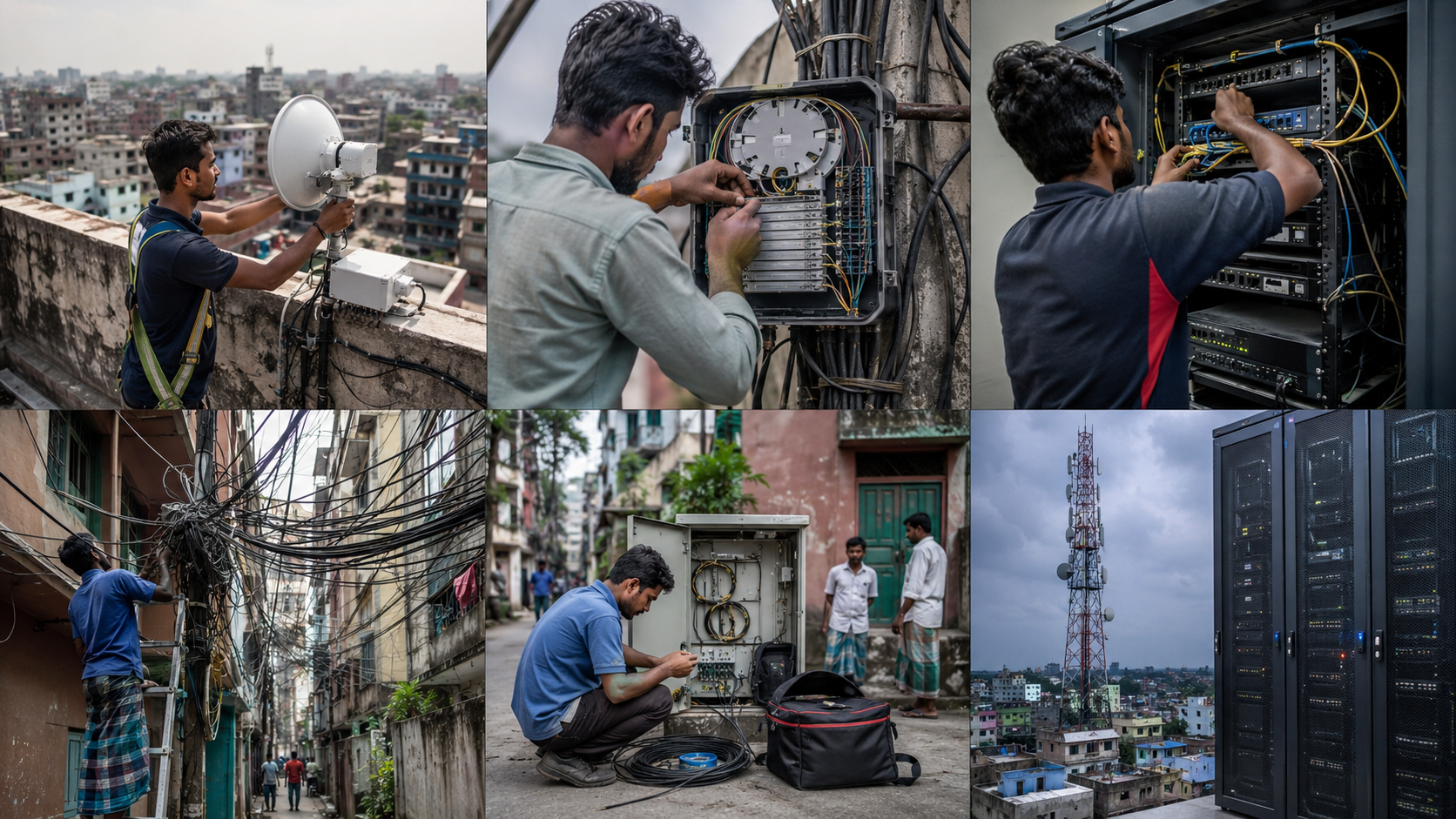
A small ISP’s strongest asset is usually not its IP address block. It is the installed last mile. Every fiber drop into a household, every rooftop permission, every lane crossing, every informal understanding with a building owner, every local technician’s phone number, and every reused distribution point creates friction for rivals. The public record does not show F.T Link BD’s fiber map, OLT count, pole agreements, or split ratios. But the company’s geography, district license, fiber-home marketing, and service menu all point toward a local access network whose value sits below the abstraction layer of BGP.
That physical moat is especially important in markets with many small ISPs and informal resellers. Reporting on Bangladesh broadband has described thousands of licensed ISPs and many illegal operators, with disputes over tariff enforcement, rural service quality, and wholesale charges. In such a market, no small ISP can assume stable monopoly rents. But a provider that already has the drop installed, knows the household, and responds quickly to faults has a switching-cost advantage even if the customer is aware of alternatives. The power is relational and operational, not contractual in the classic enterprise-software sense.
The last-mile advantage also works through density. A provider serving a compact locality can add incremental customers at lower marginal field cost than a new entrant starting from zero. Technicians can repair multiple faults in one route. Splitter capacity, local aggregation, spare routers, and customer referrals become more efficient when clustered. This is why a district ISP can matter commercially even with only two /24s visible on the global internet. The global table sees 512 IPv4 addresses; the local market sees the provider whose cable is already on the lane.
The opposite is also true: weak density can destroy the model. If customers are too dispersed, backhaul and field labor rise faster than revenue. If a local rival wins the same building or bazar cluster, installation advantage erodes. If the network relies on fragile aerial cable, repairs can absorb margins. Because no public plant map is available, F.T Link BD’s local density is an unresolved variable. But the repeated Pularghat/Pakundia/Kishoreganj anchoring and social traces of locality-based expansion make density the right unit of analysis.
Support labor as market power
The economics of small ISPs are often misread because analysts focus on bandwidth procurement and ignore the support layer. For a household customer, the ISP is the person who answers the phone, reconfigures the router, replaces the fiber connector, explains the bill, and comes after a storm or power event. F.T Link BD’s public materials put 24/7 support, WhatsApp contact, ticket creation, and multiple phone numbers close to the sales funnel. That is not decorative. It is the mechanism by which a small local provider converts weak brand recognition into customer retention.
Support labor creates local market power because it is hard to centralize perfectly. A national operator can buy more bandwidth and advertise a larger brand, but it may not have a technician three streets away who knows the exact fiber route to a household. A mobile operator can offer convenience and coverage, but it does not replace a fixed connection for high-volume household video, work, gaming, and smart-TV usage. The AMTOB/BTRC subscriber figures show the asymmetry: mobile internet subscriptions dominate numerically, while fixed ISP/PSTN subscriptions form a smaller but material base. The strategic question for F.T Link BD is whether its support responsiveness can keep fixed households loyal despite mobile’s convenience.
The labor moat is fragile because it scales poorly. Every new subscriber increases recurring support exposure. A local ISP that doubles customers without improving network monitoring, spare inventory, billing processes, and technician routing can experience margin dilution. The posted bundle’s emphasis on “buffer-free” social apps and 4K YouTube sets a high expectation. If evening congestion, upstream issues, or local fiber faults break that expectation, the same customers who value local support may turn to local complaint channels and word of mouth.
This makes support productivity a key hidden KPI. Public records show the license, ASN, routes, prices, and contacts; they do not show mean time to repair, repeat-ticket rate, power backup duration, call answer rate, or churn after faults. For an intelligence reader, those missing metrics are not minor. They determine whether the edge advantage is durable or merely promotional.
Supplier dependence: the upstream stack disciplines the local operator
F.T Link BD’s global routing depends on upstreams. Public BGP data identifies Fiber@Home Global Limited and Level3 Carrier Ltd. as observed upstreams or peers. Fiber@Home is also a major Bangladesh transmission infrastructure actor in BTRC annual-report material, which describes NTTN licensing and nationwide fiber rollout obligations and coverage by Fiber@Home and Summit. That places F.T Link BD within a layered telecom economy where a district ISP can own the customer relationship without owning the whole path to the global internet.
This structure limits bargaining power. A small ISP with 512 public IPv4 addresses and local households is unlikely to dictate terms to upstream infrastructure providers. Its leverage comes from adding enough customers to be a reliable buyer, maintaining payment discipline, and perhaps multi-homing to avoid total dependence on one supplier. Its vulnerability is that wholesale price changes, backhaul outages, international capacity issues, or regulatory obligations at higher layers can be passed down into a retail price environment where customers resist increases.
Bangladesh’s broadband debates make this dependency explicit. Operators have argued that buying bandwidth from IIGs and paying high NTTN charges complicate low-price rural broadband delivery, while regulators have pursued uniform retail pricing and service-quality rules. Those debates help explain why the public package table cannot be read as pure gross margin. Tk 500 revenue for a household plan is a gross receipt before shared upstream, backhaul, equipment amortization, support, collections, power, license fees, and failure costs.
The supplier stack also explains the commercial meaning of multi-homing. F.T Link BD’s two observed upstreams give it more resilience than a single-homed micro-operator, at least at the routing layer. But true resilience requires route diversity, physical diversity, adequate commit levels, monitoring, and the ability to shift traffic without customer-visible degradation. Public BGP data shows the existence of two upstream relationships; it does not prove equal capacity, independent fiber paths, or contractual redundancy.
Demand structure: fixed broadband is smaller than mobile, but heavier in use
Bangladesh’s internet market is numerically mobile-led. AMTOB’s May 2026 figures, citing BTRC, show 119.12 million mobile internet subscribers, 14.95 million ISP/PSTN internet subscribers, and 134.07 million total internet subscribers. Mobile operators therefore dominate the count of internet relationships. For a fixed ISP like F.T Link BD, the opportunity lies not in beating mobile on total reach, but in serving households and small businesses whose usage intensity, latency needs, shared-device environment, and entertainment habits make fixed broadband preferable.
This distinction is commercially crucial. A mobile SIM can substitute for light browsing, messaging, and backup connectivity. It is a weaker substitute for a household with multiple devices, smart-TV streaming, online classes, work calls, gaming, downloads, and local media-server use. Reporting has noted that broadband users can consume a disproportionate share of bandwidth relative to subscriber count. That gives fixed ISPs a defensible role even in a mobile-first country: they are not selling universal connectivity; they are selling household capacity and perceived stability.
APNIC Labs customer-population estimates add a soft external signal that AS149860 carries measurable eyeball traffic, though they should not be treated as audited subscriber numbers. Search-indexed APNIC Labs results show FTLINK-AS-AP with estimated “Users” figures around 12,668 to 17,505 across several 2025–2026 report dates, and 13,414 users in a 26 June 2026 report view. The APNIC Labs report itself labels the data as “Users,” “Ratio,” and “Ads,” reflecting a measurement methodology rather than a company filing. The useful inference is not that F.T Link BD has a precise subscriber count; it is that the AS appears in external population-measurement systems as a non-trivial small eyeball network.
The demand opportunity is therefore bounded but real. F.T Link BD does not need national scale to be commercially relevant. It needs enough local households and businesses in reachable clusters to cover fixed costs, buy upstream bandwidth efficiently, and keep support labor productive. The market-power question is not “Can F.T Link BD dominate Bangladesh?” It is “Can it dominate enough lanes, buildings, bazars, and local customer relationships to earn returns despite national price constraints?”
Competition: nearby ISPs, informal resellers, mobile, and national encroachment
The local competitive record is not empty. The BTRC district license list page that includes F.T Link BD also includes Homenet Broadband Communication & Technologies and Kishoreganj Online Network, both with Kishoreganj addresses. ISPAB separately lists Kishoreganj Online Network as a district-license member. This means F.T Link BD should not be modeled as a local monopoly merely because it has formal resources. It operates inside a district where other licensed fixed operators are visible.
Competition from informal or illegal resellers is harder to map but economically important. Bangladesh reporting has described a broadband market with many licensed ISPs and many illegal operators, and has tied service-quality and tariff problems to enforcement weakness and wholesale costs. Informal competitors can undercut price because they may not bear the same license, tax, support, or network-quality obligations. But they may also have weaker reliability, less route autonomy, less customer-service discipline, and less credibility with business customers. Formal status gives F.T Link BD a trust asset; informal rivalry limits how much visible tariff premium it can charge.
Mobile broadband is the broad substitute. Grameenphone, Robi, Banglalink, and Teletalk collectively serve a vast mobile subscriber base, and AMTOB’s figures show the scale difference between mobile and fixed internet. For some households, especially low-usage or temporary users, mobile data can replace fixed broadband. For heavier households, mobile is more likely a backup, a complement, or a bargaining tool used to discipline the ISP. The threat is strongest where fixed installation is delayed, unreliable, or expensive. It is weakest where the household wants predictable high-volume evening use.
A newer substitute is satellite broadband. Starlink received a Bangladesh license in 2025 and began commercial operations, but reported customer counts remained small by late 2025 and early 2026. Its immediate threat to a Tk 500–Tk 2,000 local fiber package is limited by price and use case; its greater relevance is for remote users, business continuity, high-ARPU customers, and policy benchmarking. If satellite prices fall or enterprise adoption grows, it could pressure the upper end of local ISP revenue, not necessarily the mass residential base first.
The most dangerous competitor may be neither mobile nor satellite, but a better-capitalized fixed operator moving into the same locality. A national or regional ISP with stronger upstream terms, better back-office systems, and aggressive installation promotions could weaken F.T Link BD’s edge if it can replicate local support. Conversely, a large operator that cannot match field responsiveness may remain less threatening than its brand suggests. Fixed broadband competition is won building by building.
Ownership and management: Forhad signal, unresolved legal control
The public record repeatedly points to “forhad@ftlinkbd.com” and the phone number +8801714234821 as the administrative and customer contact. APNIC’s organization record uses that email; APNIC role and abuse records list FT LINK administrator contact details; the company website and contact page use the same phone and email. A route-object record also includes “MD.FORHAD” in a description field associated with a F.T Link BD prefix.
The commercially sensible interpretation is that F.T Link BD is likely founder- or proprietor-led, with “Forhad” as a central operator, administrator, or owner-manager figure. But the public sources checked do not prove shareholding, board control, financing, beneficial ownership, or whether the legal vehicle differs from the operating label. ISPAB does not show director information in the indexed profile, and the website does not provide a corporate registry extract. This is a material unresolved fact, not a cosmetic gap.
Ownership matters because the capital needs of a small ISP are lumpy. Fiber expansion, OLTs, routers, backup power, spares, upstream commits, and customer-premises equipment require upfront spending, while revenue arrives monthly. A proprietor-led operator can be nimble and locally trusted but capital-constrained. A group-backed operator can expand faster but may lose local intimacy. If future filings show a parent, investor, or supplier-linked stake, the valuation and bargaining analysis would change. At present, the ownership answer should remain deliberately conservative: public evidence identifies the operating identity and key contacts, not the full cap table.
Reputation and informal signals: useful, but not bank-grade evidence
Public customer-review and outage evidence for F.T Link BD is thin in the sources surfaced. The company has a Facebook presence indexed by search, and the website emphasizes support and media services, but a robust pattern of independent customer reviews, outage traces, operator-forum complaints, or procurement references was not found in the public search pass. That absence should not be read as reputational strength. Small ISPs often operate through local Facebook groups, phone referrals, WhatsApp, in-person billing, and neighborhood reputation channels that are weakly indexed.
The absence of broad negative evidence is still mildly useful. It suggests F.T Link BD is not, in the indexed public record, a widely discussed national controversy, major outage case, or large fraud story. But for a local ISP, the most important reputation evidence would be hyperlocal: comments under service posts, local marketplace threads, customer complaint groups, installation-time anecdotes, business references, and repair-speed stories. Those signals are commercially meaningful because they drive churn and referrals, but they require local-language and locality-specific collection beyond the formal records.
The company’s own marketing makes reputation central. “Buffer-free,” “4K YouTube,” “24/7 support,” “BDIX & CDN Speed,” and media-server access are promises that customers can test every evening. In a market where customers may not understand autonomous systems or upstreams, perceived quality is experienced through buffering, packet loss, downtime, and whether a technician answers. Reputation is therefore not a soft variable. It is the translation mechanism between infrastructure and revenue.
Why edge power exists without national scale
F.T Link BD shows how local broadband power can exist below the level of national market share. An economist looking only at countrywide subscriber numbers would dismiss a two-/24 AS as trivial. A household in a served lane may see the same operator differently: it is the installed cable, the known support number, the monthly payment relationship, the person who comes to fix the router, and the provider whose local media and domestic routes make the connection feel usable. The market boundary is not Bangladesh as a whole; it is the practical switching set facing a household in a specific place.
The first mechanism is installation lock-in. Once a household has a working fiber connection, switching means contacting another provider, scheduling installation, possibly paying fees, tolerating downtime, reconfiguring routers and devices, and risking worse support. These are not large enterprise switching costs, but at Tk 500–Tk 2,000 per month they are large enough to matter. A small ISP that keeps service acceptable can retain customers because the alternative is not free.
The second mechanism is local trust. Broadband is a recurring credence service. Customers cannot easily inspect backhaul capacity or routing quality before buying. They rely on neighbors, technicians, shopkeepers, Facebook posts, and observed buffering. A district ISP with a known local presence can beat a larger anonymous provider if it is trusted to answer calls and fix problems. F.T Link BD’s repeated publication of local contact numbers, WhatsApp ordering, and support channels is consistent with this trust-based sales model.
The third mechanism is bundle opacity. Customers buy a named speed, but they experience a bundle of international transit, domestic peering, CDN reachability, local caches, router quality, Wi-Fi placement, and support. F.T Link BD’s package language foregrounds Facebook, YouTube, BDIX, CDN, IPv6, and media links. That bundle can create differentiation even where tariff policy compresses headline price. The provider with better domestic content performance can seem faster than a rival with the same nominal Mbps.
The fourth mechanism is geography. A local ISP’s cost curve improves when customers are clustered and deteriorates when they are scattered. Market power can therefore be intensely local: strong in one bazar or neighborhood, weak a few kilometers away. The indexed social hint that F.T Link BD markets service in additional localities such as Gojaria and Katiadi, if accurate, would represent a density-expansion strategy rather than a national land grab.
The fifth mechanism is formalization. In a market with many informal or illegal operators, a licensed ISP with an ASN, RIR resources, public contacts, and a regulator-visible identity can use formality as a trust signal. Formality does not guarantee quality. It does raise the cost of entry for competitors who want to serve business customers, advertise openly, or maintain stable upstream relationships. F.T Link BD’s APNIC, BTRC, ISPAB, and BGP footprint gives it that credibility layer.
Strategic scenarios
The base-case scenario is a disciplined local fiber ISP. F.T Link BD continues to operate as a Kishoreganj/Pakundia-centered district provider, sells regulated-price residential packages, adds small-business and dedicated customers, maintains two upstreams, and uses local support responsiveness to keep churn manageable. In this case, the business is not a high-growth national infrastructure story; it is a recurring-revenue local utility with route autonomy and modest expansion potential.
The upside scenario is density plus operational maturity. F.T Link BD could improve margins if it deepens penetration in served clusters, converts higher-usage homes to higher plans, sells more business connectivity and managed Wi-Fi, activates visible IPv6 routing, improves caching and domestic performance, and adds upstream or peering resilience. Additional prefixes, new visible routes, stronger RPKI and IPv6 posture, more corporate references, and cleaner public web infrastructure would all indicate maturation.
The downside scenario is margin compression and service stress. Wholesale bandwidth, NTTN charges, taxes, equipment costs, or new licensing fees could rise while retail prices remain politically anchored. Local rivals or informal resellers could undercut installation and monthly rates. Mobile fixed-wireless or better-funded FTSP operators could target the same customers. If F.T Link BD responds by oversubscribing too aggressively, its support burden and reputation could deteriorate. Sector reporting on proposed FTSP rules and small-ISP tax concerns shows that this pressure is not hypothetical for Bangladeshi operators.
The corporate-control scenario remains unresolved. A verified acquisition, supplier-backed financing arrangement, or parent relationship with a larger IIG or ISP would change the model. It could lower upstream costs and fund expansion, but it could also turn F.T Link BD into a retail edge of a larger network rather than a locally controlled operator. The currently available public record does not prove that outcome. The Coronet clue should therefore be monitored, not assumed.
Evidence ledger
Canonical identity and address. APNIC’s organization record for ORG-FLB4-AP identifies “F.T LINK BD” as an APNIC LIR in Bangladesh, at Pularghat Bazar, Pakundia Road, Kishoreganj -2326, with phone +8801714234821 and email forhad@ftlinkbd.com. APNIC/Hurricane Electric aut-num records connect that organization to AS149860, FTLINK-AS-AP. The BTRC district ISP license list also shows “F.T Link BD” at the same Kishoreganj address with license number 14.32.0000.702.45.676.22.082. ISPAB’s profile repeats the company name, district license type, email, mobile number, website, and license number. This is the strongest identity chain.
Public web presence and retail offer. The company website at ftlinkbd.com identifies the brand as “F.T. LINKBD Internet Service Providers,” lists phone and support contacts, provides a bill-payment link, and displays current home-broadband packages from Tk 500 to Tk 2,000. The plan cards advertise 20 Mbps, 30 Mbps, 40 Mbps, 50 Mbps, 60 Mbps, and 80 Mbps tiers, with 1:8 contention, BDIX/CDN speed, Facebook and YouTube performance claims, IPv6 for public-IP users, and 24/7 support. The site also lists corporate internet, dedicated bandwidth, managed Wi-Fi, network installation, IPTV/local media, and IT consultancy.
Legacy web pages and operational surfaces. Older pages show the same address, phone, and email, and include a support-ticket interface and older language about applying for a BTRC license. These pages are useful mainly for continuity of contact details and evidence of support/billing tooling; they should not override current license records or homepage pricing.
Routing footprint. BGP.Tools and Hurricane Electric both show AS149860 as a Bangladesh eyeball network operated by F.T LINK BD, with two originated IPv4 prefixes, 103.189.66.0/24 and 103.189.67.0/24. Hurricane Electric reports 512 originated IPv4 addresses, two observed BGP peers, and RPKI-valid originated IPv4 routes. This supports a conclusion of small but real routing autonomy.
Upstream dependence. Public BGP views identify Fiber@Home Global Limited and Level3 Carrier Ltd. as observed upstreams or peers for AS149860. This indicates at least some multi-homing, while also confirming dependence on upstream infrastructure providers. BTRC annual-report material describes Bangladesh’s NTTN structure and major transmission-network operators, placing small district ISPs within a layered market rather than a fully self-supplied network economy.
IPv6 ambiguity. APNIC records a portable IPv6 assignment, 2001:df0:ccc0::/48, for F.T LINK BD. The company website advertises IPv6 for public-IP users. BGP route tools checked showed no observed IPv6 originated prefixes for AS149860. This is a concrete unresolved operational issue: IPv6 resources and marketing exist, but public route-origin visibility was not confirmed in those tools.
Hosting and data-center evidence. Public IP intelligence sources identify the two /24s and AS149860, but indexed summaries report no hosted domains for the AS and no reverse-DNS domains on at least one prefix page. The company’s public service menu is access- and support-led rather than hosting-led. This supports the view that F.T Link BD is primarily a local access ISP, not a data-center or hosting platform.
Social and local-market signals. Search-indexed Facebook traces show “F.t Link BD” with the same website, contact phone, and Pularghat/Pakundia/Kishoreganj location, plus a modest follower base. Another indexed post snippet suggests service marketing in additional localities and references live TV and movie servers. These signals are useful as marketing and locality evidence, but not as audited proof of coverage or subscriber count.
Local competitors. The BTRC district license list page that includes F.T Link BD also shows Homenet Broadband Communication & Technologies and Kishoreganj Online Network in Kishoreganj. ISPAB also lists Kishoreganj Online Network as a district-license member. This undermines any simple monopoly reading and supports a model of localized competition among formal and informal fixed providers.
Bangladesh access-market context. AMTOB/BTRC subscriber figures for May 2026 show 119.12 million mobile internet subscribers, 14.95 million ISP/PSTN subscribers, and 134.07 million total internet subscribers. Daily Star reporting similarly notes mobile dominance in subscriber counts. TBS reporting has described a market with many licensed and illegal ISPs, broadband users consuming a disproportionate share of bandwidth, and operator concern over IIG and NTTN costs. These sources explain why fixed ISPs can be smaller in count but strategically important for heavy household use.
Tariff and service-quality context. Daily Star reporting on BTRC’s “One Country One Rate” framework identifies regulated retail benchmarks for broadband plans, while later tariff reporting shows higher nominal speeds appearing at low price points under 1:8 assumptions. Daily Star also reported outage compensation rules tied to one-, two-, and three-day disruptions. These sources explain the retail-price compression and service-quality burden faced by small ISPs.
Cost and regulatory pressure. 2025 reporting from Daily Star, Prothom Alo, and The Business Standard described ISP-sector concerns over proposed FTSP rules, revenue sharing, social obligation fund contributions, bandwidth procurement cost increases, taxes, VAT, and equipment costs. These sources do not disclose F.T Link BD’s accounts, but they provide the correct sector lens for margin pressure.
Coronet relationship clue. Coronet Corporation Limited appears in public materials as an IIG/IP-transit and internet-infrastructure company in Bangladesh. Peering and BGP-oriented sources depict Coronet as a larger infrastructure network than F.T Link BD. No public source checked proves Coronet ownership or control of F.T Link BD. The clue should be treated as an upstream-market or directory-adjacency signal unless corporate filings show otherwise.
Subscriber or user estimates. APNIC Labs indexed reports show AS149860 appearing in customer-population estimates, including figures around 12,668 to 17,505 users across several 2025–2026 dates and 13,414 users in a 26 June 2026 indexed result. These are measurement estimates, not company-reported subscribers. They support the conclusion that the AS has measurable eyeball traffic, not a precise customer count.
Watchpoints
License status and the May 2027 date window. The BTRC district license list row for F.T Link BD shows May 2027 dates. Renewal, migration, compliance, or fee changes around that period could materially affect operations. A clean renewal would support continuity; delay, migration burden, or license restructuring would raise operating risk.
Bangladesh FTSP policy implementation. Proposed fixed telecom service provider rules and related revenue-sharing or social obligation fund changes could raise the cost base for small and medium ISPs. The key question is whether district ISPs like F.T Link BD can continue under current economics, must migrate licenses, or face higher compliance and bandwidth procurement costs.
Upstream diversification or concentration. Any change in AS149860’s observed upstreams should be watched closely. Adding a third upstream, stronger peering, or a visible IXP relationship would improve resilience and bargaining options. Losing one of the two observed upstreams would increase dependence and outage risk.
IPv6 activation. F.T Link BD has an APNIC IPv6 /48 and markets IPv6 for public-IP users, but public BGP tools checked did not show IPv6 origination. A visible route announcement for 2001:df0:ccc0::/48, valid ROAs, and customer-side IPv6 availability would indicate operational maturation. Continued invisibility would keep the IPv6 claim unresolved.
Prefix growth. Additional IPv4 or IPv6 prefixes, changes in RPKI state, or route-object updates would signal growth, restructuring, or operational change. Remaining at two /24s is consistent with a compact access network; expansion would suggest either customer growth, public-IP demand, new service areas, or more ambitious routing policy.
Retail package compression. F.T Link BD’s posted Tk 500 entry package is already 20 Mbps with 1:8 contention. If the local market moves toward even higher advertised speeds at the same price, the firm will need better caching, upstream economics, and capacity planning to preserve service quality. If it cannot keep performance credible, the support burden will rise.
Local competitor buildout. Homenet Broadband Communication & Technologies, Kishoreganj Online Network, and any additional licensed or informal operators in Kishoreganj/Pakundia should be monitored for new packages, fiber expansion, public ASNs, aggressive installation promotions, or merger activity. F.T Link BD’s power is local; therefore local competitive entry matters more than national market share tables.
Mobile fixed-wireless and national-operator encroachment. Mobile operators dominate Bangladesh’s internet subscription base. If regulatory changes allow or encourage mobile operators to provide more fixed wireless or fixed connectivity in district markets, they could attack the convenience and backup-use cases that discipline small ISPs. Heavy household usage still favors fixed fiber, but mobile can cap pricing power.
Starlink and satellite substitution. Starlink’s current Bangladesh customer base appears small relative to mass fixed broadband, but it is relevant for high-value rural, business-continuity, and hard-to-reach customers. Falling hardware or monthly costs would make satellite a stronger substitute at the upper end of local ISP revenue.
Support reputation. The most important non-public KPI is service quality: repair time, evening congestion, router replacement speed, payment disputes, and outage handling. Public web claims of 24/7 support and buffer-free app performance create a promise. Local comments, Facebook posts, complaint groups, and word-of-mouth reports would show whether the promise is believed.
Payment and billing discipline. The RadiusSpot bill-payment link, bKash references, WhatsApp order channel, and support-ticket surface show attention to operating process. Watch whether payment tooling becomes smoother, whether package changes are reflected consistently, and whether unpaid-bill friction appears in customer chatter. In a low-ARPU ISP, collections discipline is a margin determinant.
Coronet or other parentage evidence. The Coronet clue should remain on the watchlist. A verified ownership link, financing relationship, or wholesale agreement with Coronet or another infrastructure company would change F.T Link BD’s bargaining and expansion outlook. Without such proof, Coronet should be treated as a market-counterparty signal, not a parent.
Equipment, currency, and tax pressure. ONTs, routers, OLTs, fiber components, batteries, and spares are cost-sensitive inputs. Sector reporting already shows concern that tax and equipment-cost relief has been inadequate for small and medium ISPs. Any currency depreciation, import-duty change, or equipment shortage would raise installation cost and slow expansion.
Content-cache and media-server economics. F.T Link BD’s website emphasizes BDIX/CDN speed, live TV, and media/FTP links. If domestic cache access improves, the ISP can deliver better perceived performance at lower international bandwidth cost. If content access, copyright enforcement, or cache arrangements change, the bundle could weaken.
Power and disaster resilience. Kishoreganj-area fixed access depends on physical plant, local power, backup systems, and field repair after weather or utility disruption. The public record does not show F.T Link BD’s backup-power or disaster-recovery posture. For customers, those hidden engineering choices become visible as downtime. For investors or counterparties, they determine whether local edge power survives stress.