
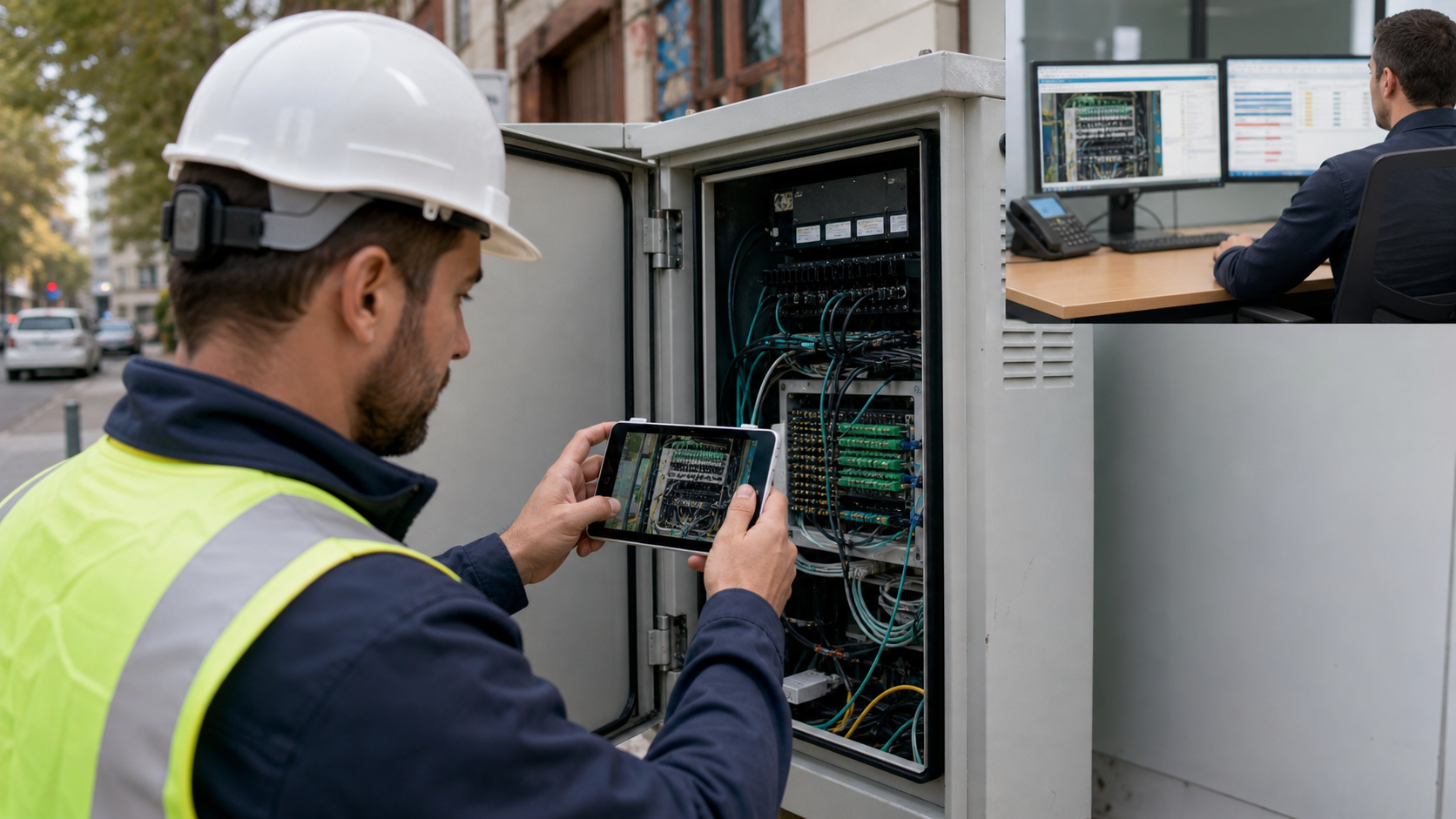
Summary

  • Deepomatic should be judged by the accepted field-verification decision, not by whether computer vision can identify an entity in a clean photo. In network construction, fiber connection, asset inspection and smart-meter-style work, the economic unit is a job that can be approved, paid, documented and folded into the network record without a preventable revisit.
  • The current public product boundary is Deepomatic inside IQGeo. Deepomatic's own site says it is now part of IQGeo; IQGeo says it completed the acquisition on August 4, 2025; and the former Deepomatic Lens product is presented as NetLux AI. That supports coverage of Deepomatic's computer-vision field-verification capability, while keeping IQGeo's broader geospatial platform, customer networks and operator outcomes separate.
  • Public evidence is strongest on workflow surface and selected customer proof points: guided mobile photo capture, real-time photo and job conformity checks, offline photo-quality validation, case management, performance dashboards, contractor-payment logic, and a Lumiere case story with 37 automated checkpoints and 97% field-report conformity. The evidence is weaker on independent accuracy, false acceptance, false rejection, review workload, support burden and total cost per accepted job.
  • The commercial test is whether fewer truck rolls, fewer manual audits, faster closeout, better as-built documentation and better contractor supervision exceed app rollout, model tuning, technician training, integration, review labor, data-quality maintenance, false decisions and disputed incentives. Deepomatic can make field work more observable, but observability is not the same as automatic trust.

The Company Boundary Is Now An Integration Boundary

Deepomatic is no longer a standalone product story in the way it was when early coverage described a Paris computer-vision company selling visual automation to field-service organizations. The directory entry identifies Deepomatic as an AI computer-vision software company focused on automated field data capture and quality verification for critical infrastructure operations. Deepomatic's public homepage is even more direct: it says Deepomatic is now part of IQGeo. IQGeo's August 4, 2025 announcement says it completed the acquisition of Deepomatic, an AI computer-vision developer specializing in automated field data capture and verification, and frames the technology as a way to turn real-time field imagery into network intelligence.

That matters because the product is now best understood as part of an operating system for network work. IQGeo's NetLux AI page says the product was formerly Deepomatic Lens and is tailored to telecom and utility use cases such as survey, construction, connection and maintenance operations. The same page says Deepomatic Lens was rebranded as NetLux AI in early 2026 and describes the change as a product-name change rather than a functional redesign. For the buyer, however, rebranding does not remove the real boundary. The field decision still moves through technicians, contractors, mobile devices, photo standards, work orders, network inventory, exception handling and back-office approval.

The acquisition can strengthen that boundary if the visual check is embedded in the same workflow where a job is assigned, located, performed, validated and written back to the system of record. It can weaken the boundary if buyers treat "AI computer vision" as a generic add-on that sits beside the work-order system and adds another dashboard to reconcile. The first arrangement can reduce duplicated verification. The second can merely move the quality problem from field inspection to data reconciliation.

That is why Deepomatic should be separated from three adjacent stories. First, it is not IQGeo as a whole. IQGeo's broader platform covers planning, design, field mobility, network management and geospatial digital twins. Deepomatic is the visual field-verification layer inside that environment. Second, it is not the telecom operator's customer outcome. A better installation photo may help a broadband customer, but churn, service experience and revenue belong to the operator's wider network and service process. Third, it is not computer vision in the abstract.

The hard problem is not detecting a connector, label, cabinet or meter once. It is making a repeated field decision under enough context that an operator can trust the result.

The Accepted Decision Is The Unit Of Value

The most useful way to evaluate Deepomatic is to ask what is accepted after the software runs. A technician completes a fiber connection. A contractor documents a cabinet. A utility crew installs a meter. A maintenance worker inspects an asset. In each case, the job is not complete because a phone captured a photograph. It is complete when the evidence satisfies the operator's standards, the right asset is linked to the right work order, the metadata is plausible, the photo is clear enough, the required checkpoints are passed, exceptions are reviewed, and the downstream system can act on the result.

That accepted decision is different from a model prediction. The model prediction may say that a photo is sharp, a serial number is visible, a cabinet is organized, an asset is present or a defect appears. The accepted decision says something operationally stronger: this job can be closed, this as-built record can be updated, this contractor can be paid, this exception should be rejected, or this site needs another visit. The gap between those two statements is where Deepomatic's product either creates value or creates hidden supervision work.

IQGeo's own materials support this framing. The NetLux AI product page describes automated photo and job conformity validation, real-time feedback, online and offline analysis, automated asset metadata collection, case-management support, field performance KPIs and data-driven decision-making. The AI computer-vision guide says computer vision can check field construction activities in real time using photos taken by workers and can help operators enforce quality standards across contractors. The same guide is careful enough to say that AI does not mean no humans are involved. It supplements quality-control managers rather than eliminating them.

That distinction should stay at the center of the analysis. If the accepted-decision rate is high, the workflow improves. If the system flags too many good jobs, it creates a review queue and delays closeout. If it accepts too many bad jobs, it pollutes the network record and creates future truck rolls. If technicians learn to satisfy the camera without doing better work, the software becomes a compliance ritual. If contractors dispute the evidence, the operator may gain a dashboard but lose trust in the payment process.

Deepomatic's target problem is valuable because field verification has historically been expensive, fragmented and late. Manual audits sample only part of the work. In-person inspections require scheduling and travel. Back-office reviewers often see the problem after the crew has left the site. Field photos can be inconsistent. Work-order systems may lack the asset context needed to judge the photo. Contractors may be paid on completion volume rather than long-run data quality. A tool that shifts validation to the point of work can change the economics. But only if the accepted decision is sound.

Photo Quality Is Not A Minor Input Problem

Photo quality is the first control surface. That sounds mundane, but it is one of the most important reasons this product category exists. Field photos are not studio images. They are taken in trenches, basements, cabinets, poles, street sites, utility rooms, customer premises and weather-exposed locations. They may be blurry, dark, cropped, overexposed, duplicated, obstructed, angled badly, missing the relevant asset, or disconnected from the work order they are meant to prove.

The mobile app evidence shows Deepomatic understands this. The Google Play listing for Deepomatic Lens describes guided photo capture, visual indicators that key elements are visible, checks for sharpness, framing and lighting, alerts when corrections are needed, and offline quality-control analysis executed directly on the smartphone. Apple's App Store listing carries the same basic promise: photo quality criteria are checked immediately, and the worker can retake the image before leaving the site.

That is not a cosmetic feature. It shifts quality control from post-hoc rejection to guided evidence capture. Without that shift, computer vision can become a better way to reject poor documentation after the expensive part of the field job is already over. With it, the product can prevent an avoidable revisit by telling the technician that the required element is missing, the label is unreadable, the framing is limited public evidence, or the job evidence does not meet the customer's standard.

Still, photo-quality validation cannot be confused with work-quality validation. A sharp, well-lit image can prove the wrong asset. A correct asset photo can be tied to the wrong work order. A valid-looking image can show a temporarily neat condition that deteriorates after closure. A technician may photograph the compliant angle and omit the messy one. A duplicate image can pass human review if the operation lacks anti-duplication controls. A photo taken from another screen or a printed image can create a false evidence chain.

IQGeo's NetLux AI page explicitly says the system addresses duplicate uploads and can recognize photos taken of another phone screen or printed image. The existence of those controls is important because it acknowledges an incentive problem, not just an image-quality problem.

This is where the field-verification task becomes more rigorous than a model demo. A demo asks whether the software can recognize the asset. A production workflow asks whether the photo, asset context, metadata, location, work-order state and technician behavior together justify accepting the job. The first is a classification task. The second is a control system.

Computer Vision Needs Workflow Context To Mean Anything

Computer vision becomes useful in field operations when the model knows what it is supposed to check. A fiber-cabinet photo is not simply an image. It is evidence for a specific stage of work. A meter-installation photo is not simply a picture of a device. It is evidence that a required installation, label, seal, location or safety condition meets a customer's rule. A construction closeout photo is not simply a record of equipment. It is a claim that the asset should be accepted into the operator's network record.

Deepomatic's public materials repeatedly point toward this workflow dependency. The NetLux AI page describes off-the-shelf AI checks for some use cases, custom AI checks for moderate-volume jobs, and higher customization for enterprise volumes. It says bespoke requirements may require tailored algorithms using customer-provided datasets. The AI guide describes deployment as an iterative process in which photos are captured, analyzed and used to update models as operations and standards evolve.

In older independent coverage, TechCrunch reported that new-client work involved integration, adding control points, using existing task libraries or training on new photo sets.

Those details make the product more credible, but they also expose the cost structure. A buyer is not purchasing a universal visual judge. It is purchasing a configured field-verification system. The system must know the operator's asset types, job stages, equipment catalog, field standards, acceptable photo angles, review thresholds, contractor rules and integration points. It must also adapt as assets, geographies and standards change.

The risk is geography-specific variation. Telecom and utility assets can vary by country, operator, contractor, legacy build, vendor equipment, housing stock, cabinet age and regulatory context. A model tuned on one operator's fiber cabinets may not generalize cleanly to another operator's asset mix. A smart-meter installation in one utility territory may have different visual requirements from another. A contractor working underground may capture different evidence from a contractor working overhead.

The buyer needs to know whether a failed check means the field work is wrong, the photo is wrong, the metadata is wrong, the model is out of distribution, or the rule is too rigid.

The NIST AI Risk Management Framework is useful here because it treats AI as a lifecycle system rather than a one-time model artifact. NIST's AI RMF Core emphasizes governance, mapping, measuring and managing risks, and says deployed AI systems should be measured in conditions similar to their deployment settings, with limitations documented. That principle fits Deepomatic's market precisely. If the deployment condition is "thousands of contractor photos from changing field environments," then evaluation has to measure that setting, not only clean examples in a sales demonstration.

Review Queues Are The Hidden Operating Cost

Automation often fails economically because exceptions grow faster than the automated path shrinks. Deepomatic's buyer therefore has to measure the queue, not only the pass rate. How many jobs pass without human review? How many are rejected immediately in the field and corrected before the technician leaves? How many are escalated to the back office? How long does review take? How many escalations are overturned? How many rejected jobs become truck rolls? How many accepted jobs later produce customer complaints, network-record corrections or maintenance work?

The product materials recognize the queue indirectly. NetLux AI is presented as helping office teams with historic operations data, case-management facilitation, performance KPIs and data-driven decision-making. The IQGeo guide says AI can let quality managers focus on work requiring attention rather than manually checking every operation. This is the correct operating model: the software should not pretend that every decision is automatic. It should reduce the human workload by separating ordinary acceptances from exceptions that deserve review.

But the queue can also become the place where savings disappear. If the model is tuned too conservatively, too many acceptable jobs land in manual review. Back-office teams then grow with volume, and the buyer may simply swap field-audit labor for screen-review labor. If thresholds are too permissive, the queue stays small but bad work enters the system. The cost appears later as service faults, customer corrections, disputed contractor performance, inaccurate digital twins or emergency maintenance.

If the queue lacks clear reasons, reviewers cannot quickly decide whether the problem is photo quality, asset nonconformity, missing metadata, model uncertainty or contractor behavior.

The better metric is not "AI checked 100% of operations" by itself. The better metric is the distribution of outcomes: auto-accepted, corrected in field, escalated, manually approved, manually rejected, revisited, later corrected and disputed. A vendor-selected case study can show strong signs of value without giving that full denominator. The buyer's internal business case needs it.

This is also where supervision cost should be explicit. Someone must define the control points. Someone must review edge cases. Someone must update the model or rules as equipment changes. Someone must investigate repeated contractor failures. Someone must handle appeals. Someone must maintain integration with work-order, inventory, payment and reporting systems. The value of Deepomatic rises if those tasks are small and structured. It falls if they become an informal human layer that makes the automation look cleaner than it is.

Contractor Incentives Can Beat A Weak Verification Design

Deepomatic operates in a market where many jobs are performed by contractors or subcontractors. That makes incentives central. Contractors are often paid to complete work quickly and may be evaluated on volume, first-time-right performance, revisit rate, documentation quality and operator satisfaction. A visual verification system can improve that relationship if it makes acceptance criteria clear, gives immediate feedback, reduces disputes and speeds payment after good work. It can damage the relationship if it appears arbitrary, opaque or tuned to reject work without giving field teams a fair correction path.

IQGeo's guide is unusually direct about contractor economics. It says AI computer vision can help automatically validate contractor work so operators can pay as soon as jobs are verified as complete and correct. It also says operators can measure which contractors are doing the best work and reward them with more projects. That is a strong commercial mechanism. It changes verification from a back-office audit into a performance-management layer.

That mechanism only works if the evidence is trusted. A contractor has to believe the rules are understandable, the app is usable, the model is not systematically misreading local conditions, and rejected work can be corrected without creating unbillable delays. A field worker has to believe that the system helps them complete the job rather than adding a camera chore after the skilled work. A network operator has to believe that passing the check correlates with fewer faults, fewer revisits and better records.

The perverse-incentive risk is real. If the metric is "photo accepted," workers may optimize for the photo. If the metric is "job closed," supervisors may pressure workers to find the shortest route through the checks. If contractors are paid faster after automated validation, they may learn which images satisfy the system while marginal physical work remains uncorrected. If the system rejects too many ambiguous cases, contractors may route more jobs to exception handling and negotiate around the tool.

If operator managers treat the dashboard as objective truth without sampling field reality, they may miss the ways people adapt.

This does not make Deepomatic weak. It explains why the product's strongest version is not just a classifier. It is a rules-and-feedback system that makes standards explicit, captures trustworthy evidence, gives technicians corrective guidance, routes ambiguous work to humans, detects duplicate or manipulated images, and uses contractor performance data carefully. A buyer should treat contractor adoption as a deployment risk, not a communications afterthought.

The Lumiere Case Shows The Right Kind Of Evidence And Its Limits

The public Lumiere customer story is important because it moves the discussion from generic computer vision to infrastructure maintenance. IQGeo says Lumiere used Deepomatic Lens for AI-based quality control of fiber cabinets. The case story lists 37 automated checkpoints on fiber cabinets, 97% conformity of field reports and 99.4% fiber cabinets maintained in working condition. It says the customer needed proper documentation of fiber work by ISPs and contractors, defect detection, accountability and actionable network intelligence to optimize maintenance costs.

That is the right operational frame. It is not a story about recognizing a cabinet in an image. It is a story about preserving infrastructure integrity through repeated checks, contractor documentation and performance management. It also names the difference between inspection and intelligence. A cabinet photo becomes useful when it feeds an ongoing view of asset health and contractor behavior.

The limits are just as important. The public case story does not disclose the baseline before the deployment, the number of photos reviewed, the false acceptance rate, the false rejection rate, the number of human reviewers, the percentage of jobs escalated, the cost of implementation, the duration of the measurement period, the total maintenance budget or the counterfactual improvement that would have happened through process change alone. It is a vendor-hosted customer story, not an independent audit.

That does not invalidate the evidence. Customer stories rarely carry audit-level detail. It does mean the conclusion should be measured. The Lumiere story supports the claim that Deepomatic-type visual AI can be embedded in real asset-quality workflows and used to track a set of field checkpoints. It does not prove that every Deepomatic deployment will achieve the same economics, nor does it prove that the model alone caused the reported results.

The deeper lesson is that Deepomatic's value depends on deciding which field checks are objective enough for automation. Some checks are well suited: is the required photo present, is the image clear, is a visible label readable, is a cabinet component present, is a serial number captured, is a meter visible, is a duplicate image being reused, is the photo tied to the correct job. Other checks require judgment: is the installation robust under future use, is the local workaround acceptable, is a defect urgent, is the contractor's explanation credible, does the field condition justify a rule exception.

The winning deployment assigns those checks deliberately instead of pushing all of them into the model.

Offline Validation Is A Field Reality, Not A Feature Bullet

Connectivity is a serious constraint in field work. Crews may work in basements, cabinets, underground locations, remote utility sites or areas with unreliable mobile coverage. If the verification loop depends on a live network connection, the technician may have to leave the site before receiving a rejection. That turns real-time feedback back into delayed audit.

Deepomatic's public mobile-app and video materials emphasize offline operation. The Google Play listing says custom quality-control analysis can be executed directly on the smartphone when there is no connectivity. IQGeo's offline explainer says workers can receive instant validation for their job even without signal. The NetLux AI FAQ says offline photo-conformity validation covers framing, lighting, blur and context, while job-conformity checkpoints were planned to become progressively available offline from late 2025.

This is a meaningful distinction. Offline photo conformity is not the same as full offline job conformity. Checking whether a photo is clear and framed can happen on-device more readily than checking the full business rule, asset identity, work-order relationship and latest network record. A buyer should ask exactly which checks are available offline, what happens when the device reconnects, how conflicts are resolved, whether model versions are synchronized, and whether offline approvals can be overridden after server-side validation.

The offline path also changes supervision. If a field worker gets immediate feedback on device, they can correct photo quality before leaving. If the app later finds a server-side issue, the revisit risk remains. If the model version on the phone is stale, the app may guide the worker according to yesterday's rules. If the operator wants stricter checks for a new asset type, devices need to receive that change reliably. The product can still be valuable, but offline operation creates a version-management and evidence-chain problem.

This is why the accepted decision should be timestamped, versioned and explainable inside the customer workflow. The operator should know which model or rule set produced the pass or rejection, what evidence was available at the time, whether the check happened offline or online, and whether any later server-side check changed the result. Without that audit trail, the operator may have faster field feedback but weaker accountability.

Integration Decides Whether The Network Record Improves

The strongest argument for combining Deepomatic with IQGeo is that field evidence can update the network record rather than remain a pile of checked photos. IQGeo's acquisition announcement says integration into geospatial network management can let operators maintain digital twins based on verified field data captured near real time. IQGeo's Network Manager Telecom page says crews can capture photos and redlines in the mobile app, while visual AI validates construction and updates the network model. The NetLux AI page describes connectors with Praxedo, Oracle, Zinier, SiteTracker, Render and other systems.

That is where the product can move from quality control to operational memory. A verified field photo can confirm an asset's presence, condition, label, location or installation state. That evidence can support planning, maintenance, compliance, contractor management and customer-service workflows. If the network record is accurate, future crews spend less time discovering reality from scratch. If the record is wrong, every downstream automation inherits a bad map.

Integration is also where cost appears. Work-order systems have messy status codes. Asset inventories carry legacy data. Contractor apps may be different from operator apps. Payment systems need clean acceptance triggers. GIS models may not match field taxonomy. Customer-specific equipment catalogs require maintenance. Data protection rules may apply to photos, locations and worker information. A useful visual AI deployment must touch these systems without making every change a custom project.

Deepomatic's product tiers acknowledge this. The Starter edition is framed around low volumes, off-the-shelf checks and no integration. Business and Enterprise tiers involve higher volumes, custom AI checks and integration into existing mobile applications. That is a reasonable segmentation, but it also shows why production value cannot be inferred from a demo. A low-volume off-the-shelf deployment may prove a workflow. A high-volume operator deployment must survive data variation, contractor adoption, integration governance and sustained review operations.

The integration test is simple to state and hard to pass: after a job is accepted, does the downstream system become more accurate without a manual reconciliation step? If yes, Deepomatic is part of a closed operational loop. If no, it is an inspection tool whose output still needs another team to translate into the real system of record.

Scale Claims Need Denominators

IQGeo says NetLux AI is used by more than 30,000 field workers, analyzes 20 million field operations per year and analyzes a photo in less than two seconds. IQGeo's guide says the computer-vision software processed more than 20 million jobs in 2024, including over half a billion transactions from more than 30,000 daily field users. Earlier public sources described Deepomatic monitoring around one million in-field operations per month. These are substantial scale signals.

They should be read as scale signals, not quality proofs. A high number of analyzed operations indicates operational usage. It does not by itself disclose how many operations were accepted automatically, how many were corrected in the field, how many were later found wrong, how many required human review, how much effort was needed to tune the system, or how performance varied across customers and geographies. A two-second photo-analysis claim is useful for field feedback, but the buyer's decision latency includes capture time, worker correction, synchronization, server-side checks, review queues and downstream system updates.

This is a common problem in enterprise AI. Volume and latency are easier to disclose than accepted-decision economics. A platform can process many images quickly and still create a costly queue. Conversely, a slower system may be more valuable if it reduces revisits and disputes. The buyer should avoid turning "20 million operations" into an assumed return on investment. It is evidence that the system is deployed at scale. The ROI still depends on local acceptance, rework and supervision.

Scale also creates maintenance requirements. More photos mean more edge cases, more asset variations, more duplicate-detection challenges, more model-drift signals and more review data. If the vendor can use that scale to improve customer-specific checks and field guidance, the product gets stronger over time. If the scale simply increases the number of exceptions, the back office absorbs the complexity.

The best buyer-side dashboard would show not only volume, but also the shape of the decision funnel: required photos per job, average retakes, first-pass acceptance, field-corrected failures, review rate, reviewer overturn rate, revisit rate, contractor variance, model/rule version, asset type, geography and downstream record corrections. That is the denominator that turns computer vision into operating economics.

The Commercial Case Is A Supervision-Cost Case

Deepomatic's commercial promise is attractive because the avoided costs are concrete. A truck roll is expensive. A delayed fiber closeout delays revenue. A bad as-built record creates future planning and maintenance cost. Manual sampling misses defects. Reopening a trench or revisiting a customer site can wipe out the savings from a quick installation. A contractor dispute consumes management time. A maintenance program without accurate asset condition data spends money reactively.

The NetLux AI page names these benefits directly: fewer truck rolls, lower quality-control costs through AI checks across operations, faster deployment calendars, more accurate digital twins and more resilient networks. IQGeo's utility-inspection blog says photo analysis can reduce manual reviews, lower truck rolls and provide auditable compliance documentation. The contractor guide logic says faster verified payment can improve contractor cash flow and operator control.

The counter-costs are just as concrete. The buyer has to roll out an app or integrate Deepomatic into an existing mobile workflow. Technicians must learn photo standards and correction flows. Contractors may need commercial changes. The operator has to define checkpoints and acceptance thresholds. Customer photos and location data require security and retention controls. Model tuning may need datasets from local assets. Integration with work order, asset inventory, GIS, payment and reporting systems requires project work. Reviewers still need to handle exceptions.

Management must monitor whether the system is actually reducing bad work rather than producing prettier reports.

The result is not a generic AI question. It is a supervision-cost question. Does the software reduce the amount of human supervision needed per accepted field job? Does it move correction earlier, when the technician is still on site? Does it make contractor oversight more evidence-based? Does it reduce repeat visits without increasing false rejection? Does it keep the network record current enough to improve later planning and maintenance? Does it let quality managers review the important exceptions instead of sampling blindly?

If those answers are yes, Deepomatic's product category is compelling. If not, the operator may pay for a system that adds structured reporting without reducing the real work.

What Buyers Should Ask Before Scaling

The first buyer question should be about the accepted decision, not the model. Which job decisions will the system be allowed to make automatically? Which will only receive recommendations? Which require human review? Which are too subjective for automation? A buyer should define those categories before scaling the deployment, because a vague "AI quality control" goal will become a vague review queue.

The second question is about evidence capture. What photos are required for each job? What counts as enough framing, lighting and context? Can the worker see what is missing before leaving the site? Are duplicates, screen photos and printed-image workarounds detected? Are location, timestamp, device, work-order and asset metadata attached? Is the evidence chain durable enough for contractor disputes and regulatory documentation?

The third question is about model and rule performance in the buyer's own environment. What is the first-pass acceptance rate? What is the retake rate? How many rejected photos are corrected immediately? How many jobs escalate? What are the false rejection and false acceptance rates on a reviewed sample? How does performance vary by contractor, asset type, region, weather, device and connectivity? What changes when the equipment catalog changes?

The fourth question is about review operations. Who owns the queue? How are exceptions prioritized? Are reviewers shown the reason for rejection? Can contractors appeal? Are repeated edge cases used to update rules or models? How quickly do changes reach field devices? How are reviewers measured so they do not become another slow manual audit layer?

The fifth question is about downstream integration. Does an accepted job update the network inventory, work-order status, contractor-payment process, compliance file or maintenance plan automatically? If it does, what safeguards prevent bad data from entering the record? If it does not, who performs the reconciliation, and does the business case include that labor?

The sixth question is about data protection and field workforce governance. Field photos may include customer premises, location data, worker activity, critical infrastructure details and commercially sensitive network information. The Google Play listing says the app may collect location and photos and videos, and that data is encrypted in transit. That is useful but not sufficient for enterprise governance. Operators still need retention rules, access controls, audit logs, customer notices where applicable and clear boundaries around worker-performance monitoring.

These questions are not hostile to Deepomatic. They are the questions that turn the product from image recognition into field operations infrastructure.

The Judgement

Deepomatic's public evidence supports a clear, narrow thesis. The company, now part of IQGeo and publicly presented through NetLux AI, addresses a real operational bottleneck: field work cannot be automated or trusted if the evidence behind each job is late, incomplete, low quality, disconnected from the work order or too expensive to review. Its strongest product signals are the practical ones: guided photo capture, instant correction, offline photo-quality checks, job-conformity validation, duplicate-photo controls, contractor-performance data, case management and integration into network-management workflows.

The evidence does not support a broad claim that Deepomatic eliminates field quality management. It does not disclose independent accuracy across messy customer deployments. It does not give a universal accepted-decision rate. It does not quantify false acceptance, false rejection, review labor or total cost per accepted job. Vendor and customer stories show plausible value, especially in fiber and utility contexts, but they do not replace buyer-side measurement.

Deepomatic is therefore best understood as an automation layer for a specific decision: can this field job, backed by these photos and this context, be accepted now? That is a valuable decision because it can prevent revisits, speed closeout, improve records and make contractor supervision more objective. It is also a demanding decision because poor images, wrong context, local asset variation, disconnected systems and misaligned incentives can all defeat the model.

The acquisition by IQGeo increases the potential upside because verified field evidence is more valuable when it updates the network model directly. It also raises the bar. If visual AI is now part of a broader network-intelligence stack, the buyer should expect more than a pass/fail photo check. The standard should be a closed loop: capture the right evidence, validate it in context, correct errors on site, route exceptions transparently, update the network record, measure contractor performance, and keep the supervision cost visible.

That is the real test for Deepomatic. Not whether a model can see an entity, but whether a network operator can accept the work.