
Summary
- Connected Business LLC is best read as the English RIPE NCC-facing identity attached to the Russian legal and operating footprint of Svyaznoe Delo and the Sky-Bridge local access service. Public evidence shows subscriber support, tariffs, a personal account system, payments, speed testing, local service in the Ramensky district of Moscow Oblast, Russian communications licences, AS210201 and RIPE number resources.
- The economic conclusion is cautious: resource-holder status is useful, but the visible scale is too small to prove a moat. Unless undisclosed customer contracts, route quality, local density or B2B demand are materially stronger than public evidence shows, the company looks more exposed to supplier costs, maintenance burden, regulation and substitute access providers than positioned to earn cloud-like or carrier-like margins.
The Incentive Is Survival Below Cloud Scale
Management's incentive is not hard to understand. A small access provider that owns a RIPE NCC member relationship, an autonomous system and an IPv4 allocation has something valuable in a market where public IPv4 addresses remain scarce. The question is whether that value is being converted into customer demand, pricing power and cash flow, or whether it is merely a ticket that lets the company keep operating in a market where larger networks set the reference price.
That distinction matters because the economics below cloud scale are unforgiving. A national carrier can spread network operations, regulatory work, security tooling, billing systems, marketing and supplier negotiations across millions of lines. A cloud platform can monetize public addresses, traffic management and interconnection across high-margin compute demand. A local access network has a different equation.
It must keep physical access lines working, answer support calls, pay for upstream connectivity, maintain field equipment, handle payments, comply with telecom rules and persuade customers not to churn to a mobile plan, a national fixed-line bundle or another local operator. The cost of each task is real even when the revenue base is small.
Connected Business LLC sits directly inside that tension. RIPE data confirms an LIR identity, AS210201 and the registered English name Connected Business LLC. Public Russian company profiles connect the same registration number to ООО "Связное Дело", whose Sky-Bridge site describes subscriber-facing services, personal account access, payments, support and service in the Ramensky district of Moscow Oblast. BGP views show one small current IPv4 announcement and no visible IPv6 origination. Third-party company profiles show microbusiness scale rather than the revenue mass of a scaled operator.
That does not make the company irrelevant. In telecom, small local providers often survive because they know buildings, settlements, radio links, cable routes and customer habits that national operators may not serve with care. A small operator can be valuable if it owns hard-to-replicate last-mile reach, if customers have few practical alternatives, if service quality is materially better than incumbent options, or if local infrastructure can be expanded at low marginal cost. The public evidence, however, does not yet prove those advantages.
It shows an operator with real access-network characteristics, but also with limited visible scale and several signals of customer-service pressure.
The economic question therefore starts with who pays and who carries the downside. Subscribers pay monthly or usage-linked access charges. They benefit if Sky-Bridge reaches places and service situations that larger operators under-serve. Connected Business LLC carries the downside when upstream prices rise, failures require field work, licences need attention, payment channels fail, customer equipment changes, or reviews turn into churn. Resource-holder status can help, but it does not automatically change that risk allocation.
Identity Starts With The Resource Record, But It Does Not End There
The cleanest official identity line comes from RIPE NCC. Connected Business LLC appears in the RIPE member directory for the Russian Federation, with a Beloozerskiy postal address, the fiberbridge.ru contact domain and the service area marked as RU. The RIPE database organisation object identifies ORG-CBL15-RIPE as Connected Business LLC, country RU, organisation type LIR, registration number 1127746486339, and the same contact domain. The autonomous-system object for AS210201 points to the same organisation and was created in September 2018.
That identity is useful, but on its own it is not enough to describe the operating company. A registry record proves number-resource administration and contactability. It does not prove the product mix, customer count, revenue model or service quality. For those questions, the important bridge is the Russian operating footprint around Svyaznoe Delo and Sky-Bridge. Public contractor and company-profile sources list ООО "СВЯЗНОЕ ДЕЛО" with OGRN 1127746486339, INN 7720754526 and the principal activity of wired telecommunications.
The same profiles name Svetlana Privalova as director and founder, with the legal entity registered in June 2012 and a Moscow legal address.
The Sky-Bridge site then supplies the practical operating boundary. Its contact page says the network connects and serves subscribers in the Ramensky district of Moscow Oblast and is coordinated by representatives of Svyaznoe Delo. The site gives support contacts, describes subscriber maintenance, Wi-Fi, television, cable work inside customer premises, personal-account management, payment options, speed testing and equipment setup guides. Those are not the signals of a pure address-holding vehicle. They are the signals of a small local broadband and adjacent communications business.
The naming is messy but economically interpretable. Connected Business LLC is the English-language resource-holder name in RIPE data. Svyaznoe Delo is the Russian legal entity tied to the same OGRN in public company sources. Sky-Bridge is the customer-facing network brand at fiberbridge.ru. The article treats those as one public operating picture only where the identifiers overlap: the RIPE registration number, domain, phone contacts, company profiles and website all point to the same small communications operation.
The more important boundary is negative. The public evidence does not show a cloud service, a hyperscale hosting platform, a national backbone, a registry business, a data-centre campus or a wholesale transit franchise. It shows local access, subscriber operations, telephone-number service references, a billing portal and network-resource administration. That boundary should discipline the economic analysis. The company should not be valued as a cloud-scale address platform simply because it has an autonomous system and IPv4 space. It should be evaluated as a local access provider with a useful but modest resource position.
The Operating Business Looks Local, Subscriber-Facing And Service-Heavy
The Sky-Bridge website is the best public window into the operating business. The homepage and support pages describe a network that sells services to households and other subscribers, not an abstract resource operation. The site refers to subscriber after-service work, connecting Wi-Fi, television, cable laying on customer premises, equipment setup, recommendations for using the internet and a personal account that lets customers manage balance, payments, tariff changes, account blocking and SMS notifications.
A separate speed-test page says the test is intended for Sky-Bridge network subscribers and for checking the connection to the operator's border node.
That operating mix carries a particular economic shape. It is labour- and service-heavy. Connecting a customer is not only a digital provisioning event; it can involve cable routing, premise visits, customer equipment, signal quality, support hours and billing disputes. Once connected, the customer can still create cost through outages, router changes, infected devices, spam events, payment delays, tariff questions and support calls. The payment FAQ explicitly discusses payment posting delays, account blocking, manual equipment authorization and blocking after infected customer devices create harmful traffic.
These are normal ISP realities, but they are also reminders that revenue quality depends on operational discipline.
The company's own construction-principles page is revealing. It says the network monitors switches, base stations, routers and servers, with polling every 1.5 minutes, and it describes response windows for failures. It also says each settlement should be connected by at least two different channels and that the network uses managed equipment to diagnose customer-side problems down to the subscriber port. This is not empty marketing if true in practice; redundancy, monitoring and managed access equipment are exactly what local providers need to raise reliability. But those same commitments increase the fixed and semi-fixed cost base.
They require equipment, tools, staff time, power, backhaul and replacement inventory.
The site also describes a Moscow telephone-number service in codes 495 and 499, including contracts with individual or legal-entity subscribers. That widens the product surface beyond plain broadband, but it does not by itself prove material revenue diversification. Without subscriber counts, take-up, churn or margin contribution, it is safer to treat telephony as an adjacent service that may raise stickiness for some customers rather than a separate moat.
What is missing is as important as what appears. The public site does not show a current customer-count disclosure, average revenue per user, gross margin, business customer mix, service-level contracts, enterprise case studies, procurement wins or wholesale revenue. It also does not show a modern enterprise sales surface. That absence does not mean the customers do not exist. It means the public case for differentiated demand is thin. A buyer or lender would need private operating data before accepting that Sky-Bridge has more than local residential or small-business access economics.
Number Resources Give Control, Not A Moat By Themselves
Connected Business LLC's strongest hard asset in the public technical record is its number-resource footprint. RIPE data shows the organisation as an LIR and links it to the 194.34.96.0/22 allocation created in September 2018. External BGP views currently show AS210201 originating one IPv4 prefix, 194.34.96.0/23, or 512 IPv4 addresses, and no IPv6 range. That distinction matters: the registry allocation indicates a larger provider-aggregatable block, while visible routing data shows a smaller originated portion. The economic value comes from control, routability and operational use, not merely from a line in a registry.
Public IPv4 addresses remain scarce, and that scarcity creates option value. RIPE's own materials explain that networks often manage shortage through transfers or address sharing technologies such as CGNAT. RIPE transfer statistics also show that IPv4 transfers are a normal part of the region's resource market. Broker and market data sources put small-block IPv4 values in a range that can make even a /23 meaningful for a microbusiness. But the asset value is not the same as operating profit. Addresses can support customers, reduce dependence on leasing, provide some balance-sheet optionality and make the network more autonomous.
They do not guarantee that subscribers will pay more for the service.
The current public routing picture is modest. BGP tools report AS210201 as active, with one IPv4 originated prefix and no IPv6 origination. Ipregistry describes the ASN as an ISP, with 512 IPv4 addresses, at least three upstream providers and no downstream networks. BGP.tools shows upstream relationships including INETCOM CARRIER LLC, Uniontel Ltd and BiMajLink d.o.o., while also listing peers such as i3D.net, Gcore and EdgeCenter in its visible table. IPIP's view similarly confirms AS210201, Connected Business LLC, the RU country designation and a 512-address current originated footprint.
For a small access provider, that footprint is useful but not decisive. A /23 can support public-address needs for infrastructure, customer assignments, CGNAT pools, servers, management, monitoring and some business users. It cannot by itself create national scale. If much of the customer base is behind private addressing or CGNAT, the address block becomes a scarce enabling resource rather than the main product.
If the company has only limited routed address use, the unused portion of the RIPE allocation may carry latent value, but monetizing that value would require policy compliance, clean reputation, counterparties and a decision about whether selling or leasing resources would weaken the operating network.
The conclusion is narrow: resource-holder status improves independence and may reduce one external cost, but the public routing record does not show a large address platform. It shows a small network with a useful resource position. That is enough to matter. It is not enough to prove pricing power.
Revenue Signals Point To A Very Small Base
The financial signal is small. Public Russian company-profile sources differ by timing and presentation, but they point in the same direction: Svyaznoe Delo is a micro-scale business. Saby reports 2024 revenue of about 7.29 million rubles and a 2024 loss of about 319,000 rubles. RBC's company profile gives the same 2024 revenue and loss figures and notes cost of sales above 7.0 million rubles. T-Bank's contractor profile lists 2025 revenue around 6.82 million rubles and a 2025 loss around 654,000 rubles, while identifying the company as a microbusiness.
Those figures should not be treated as audited investor materials for Connected Business LLC. They are third-party profiles derived from Russian official and commercial data sources. Still, they are useful directionally because they frame the scale problem. At roughly seven million rubles of annual revenue, even small cost movements can matter. Upstream charges, equipment replacement, field service, support staffing, billing, taxes, compliance, power events and RIPE fees all consume a more visible share of revenue than they would at a larger operator.
The revenue model appears subscriber-led. The site has tariff sections for internet and telephony, a personal account, monthly account blocking logic and payment FAQs. It tells users that some tariffs are monthly, that insufficient funds can block an account, and that account activation after payment can take minutes. That points to recurring access revenue, but public material does not disclose how many customers are active, how much they pay, which tariff tiers dominate, how much revenue comes from installation, and how much comes from business customers rather than households.
This is where value creation separates from revenue growth. Adding more subscribers can increase top-line revenue, but if each added village, building or radio segment requires disproportionate field work, power resilience, backhaul and support, growth may not create value. Conversely, a dense local footprint with low churn and reused infrastructure could be valuable even at modest revenue scale. The public record does not answer which case applies. It shows the need for private unit economics.
The public financial picture also weakens the argument that the number-resource asset is being transformed into high-margin enterprise demand. A small route table footprint, no visible downstream networks and microbusiness revenue are not consistent with a scaled wholesale or cloud-connectivity franchise. They are consistent with a small local ISP whose economics depend on tariff discipline, network density and operational execution. The practical question is not whether the company can generate revenue. It clearly appears to operate. The question is whether revenue can outgrow maintenance and supplier costs by enough to create value.
Unit Economics Depend On Density, Churn And Fault Costs
The unit economic model of a local broadband provider is brutally concrete. Each subscriber contributes monthly revenue. Against that revenue sit access equipment, installation cost, backhaul, upstream transit, billing, payment acceptance, support, field visits, licence maintenance, network monitoring, bad debt, customer churn and the cost of restoring service after faults. The whole model improves when customer density rises and when the same equipment, route and support structure can serve more accounts.
It weakens when customers are scattered, service failures are frequent, reviews are poor or customers churn before installation cost is recovered.
Sky-Bridge's own materials show both sides of the equation. The company says it provides subscriber maintenance, Wi-Fi, television and cable work. It says it monitors devices around the clock, duplicates channels into settlements and uses managed equipment for diagnostics. Those are value propositions. They also imply capital and labour intensity. If redundancy is actually deployed across small settlements, the company may deliver better resilience than a bare-minimum local network. But redundancy below scale can be expensive because the second channel may be paid for even when it carries little normal traffic.
Payment and blocking mechanics also matter. The Sky-Bridge payment FAQ discusses terminal-payment delays, third-party payment organizations, an 8-800 payment centre, account activation after funds post, and manual equipment authorization when customer equipment changes. These details indicate a consumer-access workflow with friction. Friction can protect the operator from unpaid usage by blocking accounts. It can also create support load and customer dissatisfaction when payments do not post quickly or equipment authorization fails.
The customer-review signal from 2ip should be handled carefully. The page lists Sky-Bridge as an ISP tied to ASN 210201 and fiberbridge.ru, with more than 1,500 speed measurements, eight reviews, an average ping figure and recent measured speeds. Several reviews are negative and complain about outages, slow service, support and substitution to mobile or national alternatives. These are user-generated comments, not audited service data. They can be biased toward dissatisfied users. But they are still relevant market signals because churn risk often appears first in complaints before it appears in financial reports.
The most important missing fact is churn. If complaints are isolated and the network serves areas with few alternatives, the company may retain customers despite weak sentiment. If alternatives are available and switching costs are low, negative service reputation can turn local access into a price-taking, high-churn business. A 20-40 Mbps experience may be acceptable in some underserved settlements and uncompetitive in dense suburbs where fibre or mobile broadband substitutes are present. Without cohort-level retention, installation-payback and support-cost data, the unit economic conclusion remains uncertain.
The Cost Base Is Harder Than The Address Block Makes It Look
Resource ownership can make an operator look asset-rich, but a local ISP's cost base is not mainly the cost of registering an ASN. It is the cost of keeping the network alive. Sky-Bridge describes switches, base stations, routers and servers. It says it uses managed equipment. It describes duplicate channels and response windows for faults. It supports subscriber premises work. Every one of those commitments creates cost before the company can claim durable margin.
The RIPE fee structure is a small but visible example. For 2026, RIPE NCC states that the annual contribution per LIR account remains EUR 1,800, with additional fees for some independent resources and ASN assignments. For a national operator, that cost is immaterial. For a microbusiness with revenue measured in a few million rubles, it is still manageable but no longer invisible, especially when combined with bank-transfer friction, currency and sanctions-adjacent compliance risk. The fee does not break the business. It illustrates how fixed administrative costs weigh more heavily below scale.
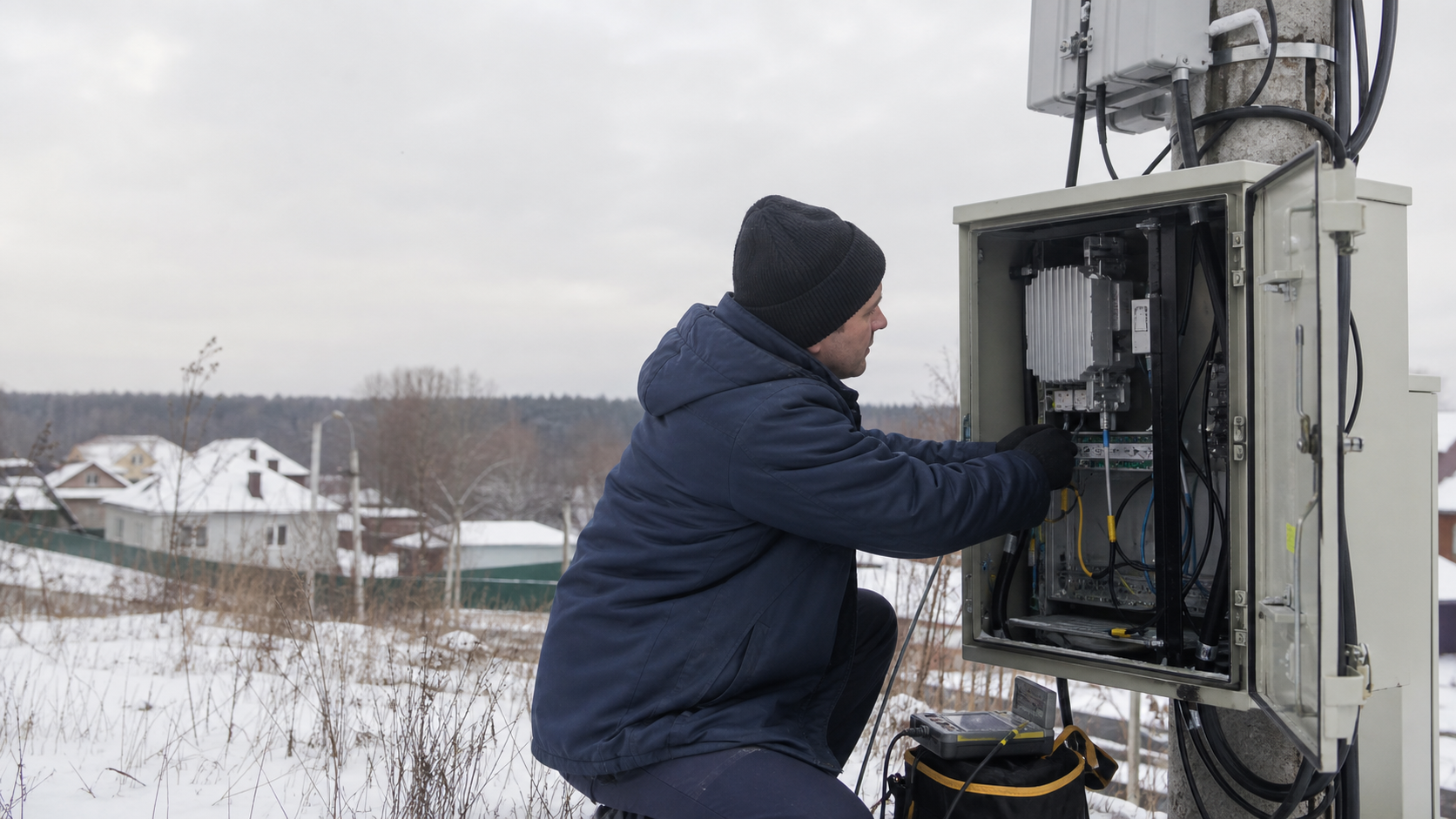
Equipment and network support are more important. A local network serving settlements needs poles, cabinets, radios or fibre routes, switches, routers, power backup, spares and staff or contractors who can respond to failures. The company's own construction-principles page mentions power events, weather events, channel failures, broadcast storms, customer attacks and settlement-level outages. Those references are operationally realistic. They also show why margin can disappear even when gross revenue is recurring. A few serious faults can consume a month's profit if the base is small.
Supplier concentration is another cost issue. BGP data shows a small set of upstream and peer relationships. If the company buys transit, backhaul or local transport from a handful of carriers, it has limited bargaining power. If one upstream changes terms, performance degrades, payment access tightens or routing becomes less reliable, the small access provider cannot easily absorb the shock. It can redesign, but redesign has cost.
The IPv4 asset can offset some costs by reducing reliance on leased addresses, but it can also tempt a misleading valuation. A /23 visible in BGP has market relevance. A /22 allocation in RIPE records has potential value if fully controlled and usable. Yet address value is not free cash. Any monetization would need to preserve service operations, comply with RIPE policies, avoid reputation issues and account for transfer or leasing risk. If the operating network needs the addresses, the asset is productive infrastructure. If it does not, it is optionality. Either way, it is not a substitute for operating margin.
Upstream Dependence Limits Pricing Power
The public routing evidence shows a network that needs other networks more than other networks need it. AS210201 is active, but it does not appear as a transit provider with downstream networks. Ipregistry explicitly says it currently has no downstream networks. BGP.tools lists three upstreams and six peers. The RIPE aut-num object lists import and export policies with several external ASNs. That pattern is normal for a small ISP, but it limits pricing power.
An access provider with no downstream networks sells connectivity mainly to end users. It buys reachability from upstream providers and may improve performance through peering. It cannot normally charge other networks for transit unless it has unique routes, customer cones or local reach they need. If it has only a small customer base and no material downstream cone, the economic rent accrues mainly to the access relationship with subscribers, not to the interconnection position.
Peering can still matter. Visible peers such as i3D.net, Gcore and EdgeCenter may improve paths to gaming, hosting, content or regional services if those sessions are active and well engineered. Local users care about latency and stability, even if they never see the route table. But peering is not the same as supplier independence. A small operator still needs reliable upstream transit, local backhaul and physical access. If a peering session fails, customers may notice less efficient paths. If an upstream fails, customers may lose reach unless redundancy works.
The company's own speed-test page reinforces the operational focus. It tells subscribers to test against the Sky-Bridge border node and to compare with other internet speed tests, including tests to Moscow. That is a practical sign of local access economics: customer experience is measured through throughput, latency and route quality to expected destinations. It is not enough to own an ASN. The network must deliver a usable path to the places customers care about.
The strategic implication is clear. Connected Business LLC can use resource control and peering to make its local access service better, but it cannot assume that those technical assets create a moat. Upstream concentration, route quality and failure response determine whether the resource position translates into customer retention. Without evidence of unique enterprise contracts or downstream customers, the company remains closer to a retail ISP than a wholesale network platform.
The fact pattern that would change this section is specific: signed long-term backhaul contracts at favourable rates, active private interconnection with major content networks, documented route-quality improvements versus local substitutes, low outage rates, and evidence that business customers pay for static addressing, reliability or managed connectivity at a premium. The public record does not yet show those facts.
Customer Concentration Is The Missing Variable
The largest unknown is customer concentration. The public material indicates a subscriber network, but not whether revenue depends on hundreds of households, a small number of building clusters, several settlements, a few business customers or one or two anchor contracts. This missing variable matters more than the autonomous system. Customer concentration determines bargaining power, churn risk, support intensity and credit quality.
If the company serves dispersed residential subscribers across small settlements, its economics may be shaped by low ARPU and high maintenance kilometres. In that case, monthly tariffs must cover not only internet access but also the long-tail cost of faults, payment questions, customer equipment and local power events. If the company serves dense apartment blocks or business compounds, the same network equipment can support more revenue per route metre and support hour. If it has enterprise customers paying for static addresses, direct support or reliable lines, margins could be better than the public consumer site implies.
The Sky-Bridge website offers clues but not answers. It refers to the Ramensky district of Moscow Oblast, subscribers, personal accounts, Wi-Fi, TV, cable work and telephony. The 2ip page shows user measurements and reviews from places such as Ramenskoye, Sofrino and Bronnitsy in older comments, though those comments are not verified customer records. The speed-test page is clearly designed for actual subscribers. These clues support the existence of a real user base, but they do not size it.
The customer-base question also controls the value of resource ownership. If most customers are ordinary households behind shared addressing, the public IPv4 block may mainly support infrastructure and a subset of users. If many customers require public addresses, business connectivity or stable inbound services, then the same block becomes more directly monetizable. If the company has too few customers to use the allocation productively, address value may be latent rather than operating.
There is also a contract-durability question. Residential customers can leave when alternatives improve, when a national operator builds fibre, when mobile broadband becomes good enough, or when service frustrations outweigh switching hassle. Business customers may sign longer contracts, but public evidence does not show that they dominate. The company's own payment FAQ suggests a monthly retail billing pattern, including account blocking when funds are insufficient. That is not a weakness by itself. It simply means investors should not assume long-duration enterprise cash flow.
The judgement would change if Connected Business LLC could show low churn, dense active subscribers, a high share of prepaid recurring revenue, a meaningful base of business customers, and installation payback comfortably inside customer life. Without that, the safe conclusion is that customer economics are plausible but unproven.
Competition Comes From National Brands, Mobile Substitution And Local Alternatives
Competition is broader than the company across the street. For a small local ISP near Moscow, realistic substitutes include national fixed broadband brands, cable and fibre operators, mobile broadband, business lines from larger carriers, and sometimes another local provider willing to underprice for share. Market-level sources show that Russia's fixed home internet market is concentrated among larger operators, with the top five operators controlling a large share of subscribers, and that Moscow's fixed home internet market is highly penetrated.
Those are difficult conditions for a small access network unless it serves local pockets where larger operators underperform or do not build.
The key comparison is not national brand prestige. It is whether Sky-Bridge can solve a local problem better than the substitute. A large provider may have lower procurement costs, better payment systems, stronger support tooling and bundled mobile or TV offers. It may also be slower to repair edge locations, less flexible with unusual premises or uninterested in small settlements. A local provider can win if it is present, responsive and technically competent. It loses if service reliability is weak because its smaller scale gives customers fewer reasons to tolerate faults.
Mobile substitution is especially important. Several user comments on the 2ip page explicitly compare Sky-Bridge unfavourably with mobile or other providers. Those comments are not statistically reliable, but the logic is real. When a fixed access line offers only moderate speeds or recurrent downtime, a household may prefer a mobile router, a national bundle or a different local access option. Mobile does not need to beat fibre everywhere; it only needs to be good enough for customers who are frustrated by outages.
Price competition can be damaging because the small ISP's costs are not fully variable. Cutting prices to retain customers does not reduce the cost of routers, monitoring, support, backhaul or field work. If the operator tries to match national promotional pricing without national scale, gross margin can disappear. If it raises price to recover costs, churn may rise. That is the price-taking trap below scale.
The path out is differentiation. That could be better uptime, local engineering, hard-to-reach settlements, static IP service, small-business responsiveness, better gaming/content latency, bundled premises work, or unusually transparent support. The public record contains some claims in this direction, especially around monitoring, redundancy and managed equipment. It also contains complaint signals that cut the other way. The article therefore does not assume differentiation; it treats it as the central fact to prove.
Regulatory And Geopolitical Pressure Raise The Hurdle Rate
Connected Business LLC's risk is not only commercial. A Russian communications operator with RIPE resources operates inside several regulatory and geopolitical layers. Roskomnadzor licence records and public contractor profiles connect Svyaznoe Delo to communications-service licensing, including channel-provision services and other communications-service licences. T-Bank's profile lists three active licences, while also recording January 2025 change notices saying licensed activities were suspended.
Because those statements can appear contradictory in profile form, the prudent reading is not to declare a definitive licence problem from a secondary page. It is to require a current official Roskomnadzor extract before any investor or counterparty values licence continuity.
Licensing matters because it controls the right to provide regulated communications services. A local ISP can survive many commercial problems, but it cannot treat licensing, data-retention, security and regulator correspondence as optional. Compliance cost tends to fall harder on small operators because the work does not shrink in proportion to revenue. Even if the company is fully compliant, the cost of staying compliant consumes management attention and cash.
RIPE-related geopolitical risk is also real but should not be exaggerated into a company-specific allegation. RIPE NCC continues to publish charging schemes, billing procedures and sanctions transparency reports because sanctions and banking restrictions affect members, end users and resource holders across the service region. RIPE materials state that members pay annual LIR fees and that sanctions-related payment and account issues can arise in the Russia/Ukraine context. EU payment-services guidance adds another layer of compliance attention for cross-border financial relationships. This does not mean Connected Business LLC is sanctioned.
It means the operating environment makes payments, ownership checks and service continuity more complex than in a low-friction jurisdiction.
The practical consequence is a higher hurdle rate. A resource-holder position in Russia can be useful, but counterparties may discount it for payment friction, sanctions-screening overhead, uncertainty around transfers, and the possibility that routing, suppliers or international services become harder to access. A small operator has less room to absorb those frictions than a large one.
Operational risk sits beside regulatory risk. The company's own materials mention power instability, weather, settlement outages, equipment hangs, attacks from user machines and broadcast storms. Those are normal network risks. They become economic risks when revenue is small and customers have alternatives. The company can reduce them with redundancy and monitoring, but every mitigation has cost.
The Investment Case Turns On Facts Not Visible Publicly
The public conclusion is therefore cautious rather than dismissive. Connected Business LLC appears to be a real small communications operator, not merely a dormant registry entry. It has RIPE member status, AS210201, a current IPv4 announcement, a customer-facing Sky-Bridge site, support workflows, payment infrastructure, speed testing and licence evidence. It also appears to have microbusiness-scale revenue, a small routed footprint, no visible downstream networks and market-signal complaints about reliability.
That combination points to a local infrastructure business that may be useful to its subscribers but does not yet prove differentiated economic demand. The resource-holder status gives control and optionality. It does not by itself create a moat. The visible customer proposition is broadband access and adjacent services in a local area. The visible technical footprint is too small to support a cloud-scale conclusion. The visible financial profile suggests that cost discipline is essential.
The judgment would change with specific evidence. First, active subscriber counts and churn would show whether the local network has durable demand. Second, ARPU by customer segment would show whether the company earns more than commodity access pricing. Third, gross margin after upstream, support, power, field work and equipment replacement would show whether growth creates value. Fourth, customer concentration data would show whether one or two anchor accounts carry the business. Fifth, contracts with upstream and backhaul suppliers would show whether supplier concentration is manageable.
Sixth, route-performance data would show whether peering and redundancy create a real service advantage. Seventh, current official licence extracts would clarify regulatory continuity. Eighth, documentation of public-address demand would show whether the RIPE resource position is being monetized through operating revenue rather than merely held.
Until those facts are visible, the economic answer leans toward price-taking risk. Connected Business LLC has enough public evidence to justify tracking as a real regional ISP/resource-holder. It does not have enough public evidence to justify assuming durable differentiated demand. Its best case is a dense, locally trusted access network whose number resources, redundancy and customer relationships support modest but stable returns. Its base case from public evidence is a small access provider exposed to customer churn, supplier costs, maintenance burden and larger substitutes.
Its downside case is a resource-holder with useful addresses but an operating business too small to cover the full cost of staying relevant.
For management, the strategic choice is not whether to sound more like a technology platform. It is whether capital and attention should go into the few areas that can actually improve economics: denser customer clusters, lower fault cost, better route quality, verified service reliability, careful tariff discipline, and contracts that make customers stay for reasons other than inertia. Strategy without those resource-allocation choices is just description. The company has a real operating surface. The public record does not yet show that it has escaped the margin risk below cloud scale.