
Summary
- Conexon Connect is the consumer-facing ISP arm of Conexon, built around electric-cooperative fiber-to-the-home partnerships, shared investment and the recurring rural broadband account rather than a national urban cable footprint.
- The public evidence supports a real regional ISP surface: residential and business internet, home and business voice, installation processes, outage status pages, customer support contacts, Lifeline participation, transparency disclosures, and a county-level operating footprint.
- The strongest operating risk is execution after the grant or construction announcement: drop scheduling, pole access, materials, local labor, storm repair, first-bill clarity, support load and take-rate durability decide whether the account becomes trusted infrastructure.
- Network evidence should be graded carefully. Conexon Connect shows strong access-service and support evidence, but the sources reviewed did not provide a clean, independently matched ASN or PeeringDB profile that would by itself prove the routing architecture.
- The judgement would improve with public market-level take rates, churn, install backlog, mean time to repair, independent speed and latency measurements, grant exposure by state, and clearer disclosure of upstream, transport and pole-cost recovery dependence.
The rural account starts before the customer has service
The most useful way to read Conexon Connect is to start with a household that has signed up but is not yet connected. The household may be a farm on a cooperative line, a church that runs community events, a rural store with card terminals, or a remote worker who has learned to keep a mobile hotspot close by. The advertised service might be a 200 Mbps plan, a gigabit plan, a 2 Gbps tier or a 5 Gbps package. But the first experience is not speed. It is waiting for the network phase, the drop crew, the in-home appointment and the billing cycle to turn a construction promise into a working line.
That is why Conexon Connect is a more interesting company than a simple "fiber is better than DSL" story. Fiber has a technical advantage over old copper loops and weather-sensitive wireless workarounds, but rural broadband economics are not solved by the optical strand alone. A rural ISP has to bring together construction management, electric-cooperative permission, pole routes, public funding, customer acquisition, local trust, call-center capacity, network monitoring, billing and truck rolls. The value of the subscription depends on the boring pieces being repeatable.
The household needs to know when the crew will arrive, where the line will run, what happens to the yard, whether the router is supported, whether a storm outage can be reported at night, and whether the first bill matches the promise.
Conexon Connect's public materials make that operating surface unusually visible. The company says it is part of Conexon and describes itself as a nationwide ISP that provides high-speed internet and digital voice to rural residents and communities. Its about page says Conexon Connect was established in early 2021 as the ISP arm of Conexon to operate and manage fiber-to-the-home networks for electric cooperatives and investors.
Conexon's ISP partnership page says the subsidiary was formed to operate and manage cooperative and investor-owned FTTH networks and lists operating states including Arizona, Colorado, Florida, Georgia, Illinois, Kentucky, Louisiana, Mississippi and Missouri. Its public status page shows a wider county-by-county status surface across multiple states, including Arizona, Colorado, Florida, Georgia, Kentucky, Louisiana, Missouri, Mississippi and New Hampshire. The exact operating footprint should therefore be read as dynamic, but the underlying point is clear: this is not just a construction consultant's website.
It is a retail and support platform attached to rural electric-cooperative broadband builds.
The thesis follows from that structure. Conexon Connect matters where rural fiber economics depend less on an advertised speed tier than on the discipline of turning construction into a serviceable account. The subscription is the economic unit. Construction is the capital event. Public funding and cooperative partnership may make the build possible. But the long-run judgement belongs to monthly service: installation completion, working Wi-Fi, support resolution, recurring payment, upgrade, repair, and the customer's decision not to return to a cable incumbent, fixed wireless plan, satellite dish, mobile hotspot or no-upgrade default.
What Conexon Connect is actually selling
Conexon Connect sells access first. Its consumer pages present fiber home internet tiers from 200 Mbps through 1 Gbps, 2 Gbps and 5 Gbps. The website also advertises no data caps and no throttling, home phone service, managed Wi-Fi, network security add-ons, outdoor Wi-Fi and small-business internet and phone services. Its business pages describe internet for rural businesses, business VoIP lines, hosted voice, SIP trunking, call-center and contact-center capabilities, mobile or soft-phone applications and an online portal for remote phone-system management.
That means the core paid unit is a rural connectivity account, with adjacent voice and managed-home-network services layered on top.
The distinction matters. This is not an enterprise software account where the primary service is hosted software. It is not a cloud-platform dependency story. The public evidence does show hosted voice and managed Wi-Fi, but those are add-ons to broadband access and communications service. The regional ISP category is therefore the right frame. The question is whether Conexon Connect can keep enough rural households and small businesses connected at a cost, service level and support standard that sustain the network after the initial construction phase.
The retail surface has several pieces that reveal how the account is supposed to behave. The FAQ says residential contracts are not required, while business services have contracts. The same FAQ says customers receive a separate internet bill from Conexon Connect even when the company is partnering with their electric provider; the electric cooperative bill and the Conexon Connect bill are separate obligations. The FAQ describes four billing cycles based on install date, partial-month charge calculation, late fees, disconnect notices, reconnect charges and leased-equipment return obligations.
It also says a pole attachment cost recovery fee may appear in markets where Conexon Connect faces higher-than-expected costs, using the example of fees paid for use of electric infrastructure.
Those details are not administrative trivia. They are the operating economics of a rural fiber account. Rural broadband has a political story about unserved communities, but the household experiences it as a monthly charge. If a customer sees a first bill that includes partial-month charges and a month in advance, the provider has to explain it before trust is damaged. If a market carries pole-cost recovery, the charge has to be legible rather than felt as a hidden surcharge. If a customer disconnects and receives a possible leased-equipment fee, the return process has to work.
If a business account has a contract, the service and repair commitment has to match the promise made to the owner who now depends on the line for payments, ordering, bookings, payroll, cloud applications and voice.
Conexon Connect's account logic therefore runs through three linked claims. The first is affordability: the home page advertises service starting at $44.95 per month with a limited-time three-year price-lock message. The second is reliability: the consumer pages emphasize fiber, unlimited data and stability, and the transparency disclosure says the company uses GPON FTTH with an optical network terminal at the customer premises. The third is support: the site lists separate sales, support, billing, technical support and outage-report channels, including a 24/7 technical support statement.
A rural customer will test all three claims over time, and a failure in any one can weaken the account even if the fiber strand itself is technically superior.
Construction is the first service experience
Conexon Connect's operating problem starts with construction because many rural customers judge the company before packets ever move. The FAQ says local network builds are generally multi-year intensive projects, built in phases, with each phase typically taking about 12 to 18 months from construction start to customer installation. That timeline is critical. A cable customer switching providers may think in days or weeks. A rural cooperative member waiting for first-time fiber may think in seasons, road crews, pole work and county boundaries.
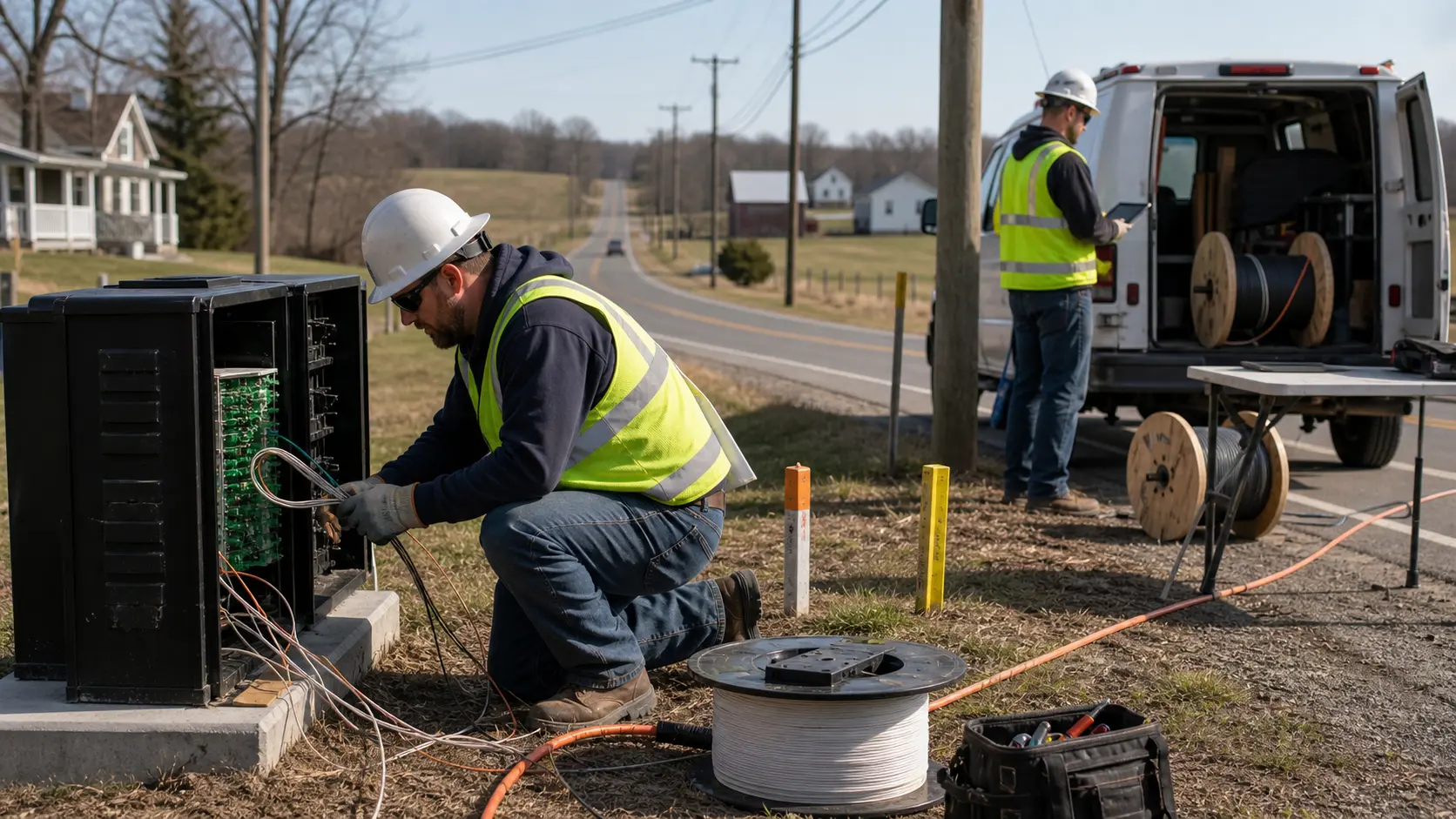
The installation description is concrete. The FAQ says fiber is pulled from main lines and follows the power-line route to the home or business. If electric service comes overhead, the broadband service usually follows overhead; if electric service is underground, the broadband service follows underground. The line is attached to a box near the electric meter, connected inside to a fiber jack and plugged into the modem Conexon Connect provides. The company says construction crews prepare the network, and then an employee contacts the customer to schedule an in-home installer to complete and test the connection.
That process prices the business in ways that a speed chart cannot. The company has to coordinate construction crews, drop crews, in-home installers, locates, pole conditions, customer schedules, right-of-way constraints, tree trimming and quality checks. Conexon's construction page, speaking to cooperative clients, describes preparation and materials, safety, site survey, construction and trenching, testing and verification, and drop installation.
It says installers complete power certification, site surveys identify utility lines and 811 tickets, crews take photos for quality assurance, and the company performs quality control on drops before checking light levels. Those claims support the idea that construction discipline is part of the product, not merely a back-office function.
The customer sees the difference in a simple way: either the crew arrives and the line works, or the promise remains a promise. Conexon Connect's own testimonials lean heavily on this gap. Curated customer comments emphasize being able to stream without buffering, work from home, avoid weather-related outages and receive an installation when expected. Because those testimonials are selected by the company, they should not be treated as independent satisfaction statistics. But they are still useful because they show what the company thinks customers value: a rural line that arrives, works, holds up and is reachable when it does not.
The risk is that construction is lumpy. A build can be efficient in one cooperative territory and painful in another. A contractor shortage, wet season, permitting delay, pole make-ready problem, supply issue, storm repair cycle or overstretched call center can turn a project announcement into frustration. A provider that grows through many cooperative partnerships must repeat the work across different topographies, electric systems, state rules, county expectations and customer habits.
Conexon's parent company presents itself as having more than 300 electric-cooperative clients, more than 200,000 miles of fiber designed and more than $2 billion secured with partners. Scale helps because it creates procurement, design and regulatory experience. Scale also raises the burden because more active builds mean more chances for local execution to vary.
For Conexon Connect, the construction story cannot be separated from the service story. A poor drop installation creates future repair calls. A rushed premise visit creates Wi-Fi complaints that feel like "bad internet" even when the optical line is fine. A missed appointment becomes a local trust problem because rural cooperative communities often carry news quickly. A clean installation, by contrast, is marketing that no advertisement can match: a neighbor sees that the line works, the business stops losing card transactions, the church livestream works, and the old DSL account finally becomes optional.
The cooperative channel changes the economics
Conexon Connect's most important distribution channel is the electric cooperative. Rural electric cooperatives are not merely landlords for pole attachments. In many territories they are the local institution with field crews, member trust, infrastructure maps, board accountability and a history of bringing expensive network infrastructure to low-density areas. Conexon Connect's public materials repeatedly frame the company as a partner to cooperatives that want fiber without necessarily building every ISP capability themselves.
That channel has an economic logic. A rural fiber build faces high cost per passing because homes and businesses are spread out. The provider must recover construction, electronics, transport, support and maintenance costs from fewer accounts per mile than an urban cable or fiber network. The cooperative relationship can reduce some uncertainty by aligning the build with existing electric routes and member communication. Conexon's own materials say its method allows co-ops to use existing infrastructure. Conexon also describes shared investment and shared revenue models for cooperatives considering Conexon Connect.
In simple terms, the co-op supplies local legitimacy and infrastructure context; Conexon Connect supplies ISP operation, broadband design, construction management, support and retail-account machinery.
The channel can be powerful because rural customers may trust the electric cooperative more than an outside telecom brand. It can also be delicate because the Conexon Connect bill is separate from the electric bill. The cooperative's name may help the customer believe the build will happen, but the ISP still owns its own service relationship. When the line is down, the customer's patience may be shaped by cooperative trust, but the ticket has to be fixed by the broadband operator's support and field process. When a bill is confusing, the cooperative halo will not protect the ISP forever.
This is why take rate is the hidden variable. The public sources reviewed do not provide Conexon Connect's take rate by cooperative territory, churn, average revenue per account, customer acquisition cost, cost per passing or cost per install. Those are the numbers that would tell whether the cooperative channel is producing durable subscription economics or simply enabling construction that still has to fight for customers.
A rural build can look successful at ribbon cutting and still struggle if households keep a cable incumbent, use satellite as backup, accept a cheaper fixed wireless plan, or delay upgrading because they are price-sensitive. Conversely, a build that is slow to complete can become powerful if customers see consistently better service and local businesses treat the line as essential.
Public funding adds another layer. Conexon says it and its partners have secured more than $2 billion in federal, state and local broadband funding, and that a Conexon-led Rural Electric Cooperative Consortium was a major RDOF winner, awarded more than $1.1 billion to serve more than 600,000 rural areas across 22 states. The NTIA's BEAD program exists because the federal government has treated universal broadband as a public infrastructure objective. That public-sector continuity helps explain why cooperative fiber is possible in places private capital often skipped.
It also creates exposure to policy shifts, grant rules, mapping disputes, eligible-area definitions, technology-neutral scoring and state-level execution. A rural fiber account may be billed monthly, but the project behind it may have depended on years of public-policy decisions.
Network evidence is real, but the public routing proof is incomplete
The public evidence supports Conexon Connect as an active access provider, but the evidence should be graded precisely. The strongest proof is not an ASN table. It is the service surface: a retail sign-up flow, home and business internet pages, voice pages, availability checking, installation detail, outage reporting, a county-level status page, Lifeline information, payment and equipment-return terms, a network-management disclosure, and 24/7 technical-support statements. Those sources show a company selling and supporting broadband accounts, not only advising other providers.
The transparency policy adds technical detail. Conexon Connect says it provides fiber broadband to residential and business customers over its broadband network and through third parties' fiber optic lines connecting to the internet. It says it contracts with one or more companies for certain network monitoring and management services.
It says it uses reasonable network management practices, does not throttle or block lawful specific content, does not prioritize traffic for payment or affiliate benefit, may prioritize voice traffic using quality of service, may block hostile ports and IP addresses, and has not established a monthly data usage cap. It also states that service is delivered through fiber connections, with ONTs installed at the customer premises and GPON FTTH technologies used to deliver service to the end user.
That is enough to support a "Medium" network evidence grade for this article. It is stronger than a marketing-only website because the support, status and transparency materials describe operating obligations. It is not "Strong" in a routing sense because the sources reviewed here did not establish a clean, independently matched current ASN, prefix set, PeeringDB profile or IX presence for Conexon Connect itself. The company may rely on transport arrangements, third-party lines, cooperative networks, wholesale connections or upstream providers in ways not visible from the public pages used for this profile.
The transparency policy explicitly mentions third parties' fiber optic lines connecting to the internet, which makes upstream and transport dependence part of the story rather than an afterthought.
For a rural ISP, that distinction matters. The user buys local access, but the experience also depends on backhaul, upstream paths, peering, transit capacity, customer-premises equipment, Wi-Fi, DNS behavior, support tooling and network operations. A provider can build a good last-mile network and still disappoint if upstream congestion, poor routing or weak support creates recurring complaints. Conversely, a provider with modest public routing visibility can still deliver excellent service if its wholesale and operations arrangements are well managed. The public evidence tells us Conexon Connect is a real access operator.
It does not let us audit the full internet path.
The missing data becomes a watchpoint rather than a reason to dismiss the company. Independent speed-test distributions, latency measurements by county, outage history, mean time to repair, packet-loss data, subscriber counts, active-prefix disclosure, upstream-provider identification and peering policy would materially sharpen the judgement. The company does publish an outage-status page by state and county, which is useful. But an "Online" status marker is a coarse signal; it does not reveal localized degradation, repair duration, recurring fiber cuts, customer premises issues or storm backlog.
A rural broadband account is ultimately judged at the household level, and public network status pages rarely show that granularity.
The account after installation is the harder moat
The first working day after installation is not the end of Conexon Connect's job. It is the beginning of the renewal question. A customer can tolerate a long build if the result feels reliable. The customer is less forgiving if the service works technically but the support experience is hard, the router behaves poorly, the bill is confusing, or a repair takes too long. Rural broadband providers often win on absence of alternatives at first. They keep accounts by making the service feel boring.
Conexon Connect tries to make that service relationship more complete through managed Wi-Fi, the MyConnectHome app, security packages, router support and upgrade paths. The home internet page says some higher tiers include wireless router, managed Wi-Fi and Safe & Secure subscriptions, while lower tiers may include router support through managed Wi-Fi subscription. The FAQ says managed Wi-Fi includes a router, can help watch for potential issues, and gives the company troubleshooting abilities when customers call.
The MyConnectHome app lets customers view connected devices, set parental controls or guest networks, and change Wi-Fi credentials.
Those features are important because many rural "internet" complaints are really home-network complaints. A fiber line can deliver the subscribed speed to the ONT while a customer's old router, thick walls, barn distance, device age, malware, Wi-Fi interference or poor extender placement creates a bad experience. Conexon Connect's transparency policy explicitly says actual speeds can vary because of device performance, wireless connections, distance to destinations, congestion at websites, other networks and customer-owned routers. Managed Wi-Fi is therefore a support strategy as much as a revenue add-on.
If the provider controls more of the home-network environment, it can diagnose issues faster and reduce blame-shifting between access network, router and device.
But managed Wi-Fi also raises expectations. If a customer pays for support, the provider owns more of the outcome in the customer's mind. A rural household that uses telehealth, remote learning, streaming and work-from-home applications does not separate optical-layer performance from the kitchen-table laptop experience. A small business that buys business internet and phone service will not treat call quality, Wi-Fi and payment-system reliability as separate abstractions. The account has to be repairable across layers.
Conexon Connect's public support posture is broad. The consumer and business pages list customer care, billing, technical support and outage channels. Conexon's parent support page says its Network Engineering and Technical Support Call Center offers complete fiber network support services designed for co-ops, with experienced network engineers and customer-service representatives acting as an extension of cooperative staff. This is one of the more important parts of the Conexon system. Many rural electric cooperatives know poles, storms, members and outage communications.
They may not want to hire a full broadband NOC, voice-regulatory team, ISP billing platform, abuse desk and residential Wi-Fi support operation. Conexon Connect's value proposition is that it can absorb those ISP functions while the co-op retains local trust.
The risk is load. A support system that performs well at one scale can become strained when many cooperative builds move from construction into active service. Each newly connected county adds installation questions, router problems, first bills, speed complaints, outage calls and equipment returns. If Conexon Connect grows faster than support capacity, the customer experience could deteriorate even while the network footprint expands. That risk is especially relevant in rural markets because a single prolonged outage or poor repair episode can shape community perception more strongly than a national advertisement.
Pricing is not just a monthly number
Conexon Connect's public price signals are simple on the surface and more complex underneath. The home page advertises service starting at $44.95 per month, with a limited-time three-year price-lock guarantee. The home phone page shows a residential phone price of $29.95 per month when bundled with internet and $39.95 per month without internet. The Lifeline page says eligible customers can receive federal broadband or phone discounts and describes Missouri-specific Lifeline discounts. The FAQ says residential service does not require a contract.
These are attractive signals for rural households that have been choosing among high-cost satellite, weak DSL, capped mobile data or unreliable fixed wireless.
But rural broadband affordability depends on the full bill, not the headline price. The FAQ describes partial-month charges, billing a month in advance, late fees, disconnect notices, reconnect charges, returned-check fees and a possible pole attachment cost recovery fee in certain markets. Equipment return terms matter too. The FAQ says leased equipment must be returned after disconnect and that an account can be charged a $500 leased-equipment fee if equipment is not received within 15 days, with the fee removed once return is confirmed.
Those terms are not unusual in telecom, but they are important in low-density markets where household budgets can be tight and the alternative may be to avoid fixed broadband altogether. A rural fiber provider needs enough revenue to support construction debt, electronics, customer support, transport and repair. Customers need enough predictability to trust the bill. The company's challenge is to make cost recovery explicit without making the account feel like a pile of exceptions.
The pole-cost recovery disclosure is especially revealing. It acknowledges that Conexon Connect may face higher-than-expected costs in some markets and may pass through a recovery charge, with pole infrastructure given as an example. That is a small line on a FAQ page, but it captures the central rural fiber problem. The cost to serve one cooperative territory is not the same as another. Terrain, pole conditions, underground construction, make-ready work, storm exposure, contractor availability, state rules, grant requirements and take rate all shape the economics. A national advertised price does not erase local cost differences.
The open question is how often those charges appear and how material they are to customer adoption. The public sources reviewed do not provide market-by-market price sheets, all broadband-label disclosures, installation fees, promotional end dates, pole-recovery prevalence, average bill size or customer churn after promotions end. Those gaps matter because affordability is not a moral slogan; it is the difference between a household keeping fiber active and reverting to a cheaper workaround.
A service that is technically excellent but perceived as confusing or expensive can lose marginal households, especially if a cable provider, satellite plan or fixed wireless carrier offers a lower introductory price.
Conexon Connect's best defense is to align price with repair accountability. Rural households may pay more for a line that works through remote work, telehealth and school days, but they need to believe the provider will answer the phone and fix the problem. That is why the article title frames the company as a repairable account. The subscription is not just access to bandwidth; it is a claim on an operating organization.
Business accounts widen the stakes
The residential account is the visible story, but the business account is where rural fiber can change local economic behavior. Conexon Connect's business internet page says the service is designed for businesses and emphasizes cloud-based applications, customer connections and operating continuity. The business phone page offers business VoIP lines, cloud-based hosted voice, remote and mobile solutions, call-center and contact-center services, SIP trunking and an online portal for remote management.
For a rural store, church, clinic, school-adjacent service provider, farm office, repair shop, restaurant, contractor, accountant or local government office, connectivity is no longer a convenience. It carries card transactions, bookings, inventory systems, tax filings, payroll, video meetings, security cameras, cloud backups, voice, customer messaging and compliance paperwork. A business can often survive a residential-style evening outage. It may not survive repeated weekday service interruptions if payment systems fail or customers cannot call.
Business service also changes Conexon Connect's obligations. The FAQ says business services require contracts. Contracted business accounts can raise expectations for uptime, repair priority, voice quality, static addressing, support response and clarity around service credits or remedies. The public pages reviewed do not provide detailed business service-level agreements, repair commitments or commercial pricing. That absence does not mean the commitments do not exist; it means the public evidence is not enough to grade the business reliability claim in detail.
Still, the business surface is strategically important. Business accounts can improve revenue density in rural networks where residential passings are thin. Voice services can add recurring revenue and deepen dependence. Managed services can increase stickiness. A business customer that moves phone and internet to Conexon Connect is less likely to treat the provider as a commodity if the service becomes part of daily operations. But the same stickiness cuts both ways: a bad outage can become a public complaint because the business impact is immediate.
The business account also clarifies the competition. A rural business may compare Conexon Connect not only with DSL or fixed wireless, but with cable if available, mobile backup, satellite backup, or a multi-connection setup. The best alternative may not be a single substitute; it may be redundancy. A farm office might keep a cellular modem after fiber arrives. A shop might keep cable for a while if cancellation is risky. A remote worker might keep satellite as insurance. Conexon Connect's job is to become the primary line so consistently that backups become just backups.
Competition is about substitutes, not only rivals
The competitive set for Conexon Connect is broader than a list of named ISPs. In a rural area, the incumbent cable company may be strong in a town but absent beyond it. DSL may exist but be too slow or distance-sensitive. Fixed wireless may be quick to deploy but vulnerable to line-of-sight, congestion or weather. Mobile hotspots may be useful but capped, deprioritized or expensive at high usage. Satellite may reach places wireline networks do not, but it creates different latency, capacity, weather and equipment-cost considerations.
The final substitute is delayed upgrade: the household keeps doing what it has done because switching takes time, trust and money.
Conexon Connect's strongest claim against these substitutes is not "more speed" alone. Gigabit marketing can be persuasive, but many households do not need 5 Gbps. They need a reliable line that allows two workers, students, streaming devices, cameras and phones to function without rationing. The company's own consumer pages point to remote work, online learning, telemedicine, gaming and streaming. Those use cases are ordinary, not exotic, and that is the point. Broadband has become household infrastructure.
The second claim is symmetry and stability. Fiber's upload performance matters for video calls, cloud backups, content creation, farm data, security footage and small-business routines. Conexon Connect's public pages emphasize symmetrical upload and download speeds, no data caps and no throttling. That positioning is especially relevant against old DSL and some wireless or satellite substitutes where upload capacity, data use or consistency can be limiting.
The third claim is local repairability. Satellite can be bought by a household without a local cooperative build. Fixed wireless can deploy faster in some places. Cable incumbents may have established local crews. Conexon Connect's differentiator is that it attaches the broadband account to an electric-cooperative fiber build and a support system designed for co-op members. That model has to prove that it can repair service as well as install it. Storms are the obvious test.
Rural electric systems already understand storm restoration, but fiber adds new restoration dependencies: splices, drops, electronics, customer premises equipment and coordination between electric and broadband crews.
The competitive risk from satellite and fixed wireless may rise when public-funding rules favor technology neutrality or speed of deployment over fiber durability. The NTIA BEAD program and the FCC's broadband-map challenge process show why the policy environment matters. If a state sees satellite or fixed wireless as an eligible substitute for certain locations, fiber builders may face harder funding math. If maps overstate availability, unserved households may wait. If maps understate a competitor's service, grant dollars may flow into contested territory.
Conexon Connect's long-run position depends not only on what it builds, but on how public programs classify rural need.
The most important competitive question is customer-perceived value. If Conexon Connect delivers a clean install, clear bill, stable line and fast repair, the cooperative fiber account can be sticky even at a premium. If it misses appointments, confuses bills or leaves outages unresolved, customers will re-evaluate substitutes that previously looked inferior.
Public-sector continuity is an asset and a dependency
Conexon Connect sits inside a larger public-policy project: making high-speed broadband available in places where private telecom economics often failed. Conexon's funding page says its partners have secured more than $2 billion in federal, state and local broadband funding and highlights RDOF success by the Rural Electric Cooperative Consortium. The NTIA's BroadbandUSA page describes BEAD as a program to support government projects for broadband deployment, mapping and adoption.
Academic work on broadband-map challenges and Connect America Fund outcomes underlines a recurring theme: public money can expand networks, but reported availability, actual serviceability and compliance can diverge.
That context helps explain why Conexon Connect's market is attractive and fragile at the same time. Public funding can bridge the capital gap in low-density rural territory. Electric-cooperative partnerships can convert local infrastructure into broadband routes. But the same dependence exposes the company to state grant calendars, federal policy changes, challenge processes, eligible-location disputes, technology preferences, labor rules, affordability expectations and post-award compliance. A company that builds rural fiber is not only competing for customers; it is navigating the rules that decide where public capital flows.
The "public-sector continuity" topic is therefore evidence-triggered. Conexon Connect's model is not simply a private retail ISP expanding from city to city. It is tied to cooperative broadband programs, grant-seeking expertise and public infrastructure policy. The parent company markets funding help as a core service. The subsidiary operates networks that emerge from those cooperative and investment models. Readers should not infer that every Conexon Connect market depends on the same grant or that Conexon Connect itself is the recipient of every funding stream discussed.
The point is structural: rural cooperative fiber often depends on a public-private chain, and Conexon is one of the firms organized around that chain.
Public-sector continuity also creates a reputational obligation. Grant-backed broadband is often justified by promises about education, telehealth, remote work, public safety and economic development. If a provider receives the benefit of that framing, it must meet a higher standard of clarity and repair. A missed installation is not merely a private customer-service failure when the project has been sold as community infrastructure. A repeated outage is not just churn risk when local officials and cooperative boards have attached their credibility to the build.
The public evidence reviewed does not show Conexon Connect failing that obligation. It also does not provide enough independent performance data to prove the obligation is consistently met. The honest judgement is conditional: the model is well aligned with the rural access problem, but the proof of quality requires more market-level operating data than the company currently makes easy to inspect.
Customer signals are encouraging, curated and incomplete
Conexon Connect's public customer signals are positive but should be weighted carefully. The home page says the company is top-rated by customers and shows a 2025 NPS icon of 79. It also says reviews are based on more than 1,000 Google reviews with a 4.3 score. The testimonials page presents selected customer comments that emphasize speed, no buffering, rural access, consistent service and switching from long-time prior providers. Case-study snippets describe a church in Kentucky, a Florida customer who values broadband for safety and health access, and a Mississippi remote worker who needed reliable service.
These are useful signals because they align with the business thesis. The customers are not praising abstract bandwidth. They are praising the practical change from weak service to usable service: movies without buffering, no lag, remote work, safety information, church outreach, and a rural community finally connected. That is exactly the product Conexon Connect needs to deliver.
But curated testimonials and company-displayed review aggregates are not the same as independent cohort data. They do not reveal complaint distribution, install delay rates, churn, repair time, speed-test performance, first-call resolution, average wait time, county-level variation or the share of unhappy customers who remain silent. They may overrepresent satisfied customers and underrepresent unresolved problems. A rigorous assessment would compare Conexon Connect's service metrics with cable, fixed wireless and satellite alternatives by county and technology type.
The Light Reading Leading Lights 2024 result adds an industry signal. Conexon, Washington EMC and Tri-County Electric Cooperative won in the Bridging the Digital Divide category for Conexon Connect Fiber Broadband Impact. That recognition is not an audited performance report, but it is an external industry award from a telecom publication and judging panel. It supports the view that Conexon Connect's cooperative broadband work has visibility beyond its own website.
The status page is another signal, although a limited one. It lists counties and online status across states. As a customer-facing tool, it is useful because it gives subscribers a place to check whether a county issue is known. As an evidence source, it is a snapshot of disclosed service areas and broad status, not proof that every subscribed household is performing well. The page also contains some county-state pairings that should be read cautiously because county names can repeat across states and the display may group operating territories in ways that are not intuitive.
The right conclusion is not that the page is flawed, but that it is a support aid rather than a network audit.
The absence of a strong negative public signal in the sources reviewed is not enough to declare the customer base satisfied. For a fast-growing rural ISP, the more useful question is what the company will disclose over time: NPS methodology, retention, complaint volume, repair metrics, install backlog, service-credit policies and independent speed-test results. Those are the numbers that turn testimonial evidence into operating evidence.
What would change the judgement
Several facts would materially improve or weaken the view of Conexon Connect. The first is take rate by cooperative territory. A rural fiber build needs enough subscribers per mile to support maintenance, support and capital recovery. A high take rate in mature territories would show that cooperative trust and fiber performance are translating into durable accounts. A weak take rate, especially after grant-funded construction, would suggest that price, competition or execution is limiting the model.
The second is churn. Rural fiber can look strong at launch because customers are excited to leave poor alternatives. The harder test is whether they stay after the promotion ends, after the first outage, after the first bill surprise, and after cable, fixed wireless or satellite competitors react. Public churn by cohort would show whether Conexon Connect is building an account base or a launch spike.
The third is repair performance. Mean time to repair, outage frequency, storm-restoration time, repeat-trouble rate, truck-roll completion, first-call resolution and support wait time would reveal whether the service is repairable at scale. This is especially important because Conexon Connect markets support and managed Wi-Fi as part of the value proposition. A rural provider that can fix problems quickly gains trust; one that cannot loses the cooperative advantage.
The fourth is independent network performance. Public speed and latency data by market, measured against subscribed tiers, would sharpen the network grade. Conexon Connect's transparency policy is candid that actual speeds can vary and that internet performance depends on many factors beyond the access line. Independent tests would show whether those caveats remain normal or become material.
The fifth is cost recovery and price durability. If pole attachment recovery fees or other local charges are rare and well explained, they are manageable. If they become common or large, they could change the affordability story. Similarly, a three-year price lock is valuable only if customers understand what happens after it expires and what fees are outside the lock.
The sixth is grant and policy exposure. If BEAD, RDOF, state grants and cooperative financing continue to support fiber builds, Conexon Connect's addressable market remains large. If policy shifts redirect dollars toward lower-cost wireless or satellite options, Conexon Connect may face harder capital allocation choices. If map challenges or eligibility disputes delay awards, the construction-to-account timeline stretches.
The seventh is transparency around upstream and transport. The transparency policy's reference to third-party fiber optic lines connecting to the internet is normal for a regional ISP, but more disclosure would help. Customers and analysts would benefit from knowing how Conexon Connect manages transit, peering, redundancy and capacity as its footprint grows.
None of these missing facts negate the company. They define the monitoring agenda. Conexon Connect's public story is strong enough to justify attention, but not complete enough to treat the model as proven in every territory.
The bottom line
Conexon Connect is best understood as an operating bet on rural accountability. Conexon can design, fund and manage fiber builds with electric cooperatives; Conexon Connect then has to convert those builds into accounts that customers keep. The company's public pages show a real ISP surface: home and business fiber tiers, voice, managed Wi-Fi, billing systems, support channels, installation processes, Lifeline participation, outage status, transparency disclosures and cooperative partnerships. The evidence supports the Regional ISP topic and the public-sector continuity lens.
It does not support treating the company as a cloud-service story, and it does not support overstating public routing evidence.
The opportunity is substantial. Many rural households and small businesses have been asked to function with inadequate connectivity for too long. A cooperative fiber account can change daily life in ways that are easy to underestimate from an urban market: remote work without rationing, telehealth that does not drop, card payments that work, a church livestream that reaches homebound members, a student who can upload homework, a farm office that can use modern software, and a family that no longer has to manage data caps like a household utility.
The risk is equally practical. Rural broadband is expensive because distance, labor and maintenance are expensive. Public funding can close a capital gap, but it cannot guarantee a good installation, a clear bill or a fast repair. Cooperative trust can win attention, but it can also be spent quickly if broadband service disappoints. Fiber is the right long-term technology for many of these communities, but fiber has to be built, lit, supported and repaired.
That is why Conexon Connect's most important metric is not the top advertised speed. It is whether the company can make rural fiber feel ordinary. Ordinary means the appointment happens, the line works, the Wi-Fi is diagnosable, the bill is understandable, the support number answers, the outage page helps, the repair truck comes, and the customer stops thinking about fallback options. If Conexon Connect can repeat that across cooperative territories, it becomes more than an ISP attached to rural construction. It becomes a repairable account for places that were long treated as too costly to serve well.
Selected sources
- Conexon Connect home page: https://conexonconnect.com/
- Conexon Connect home internet page: https://conexonconnect.com/home/internet/
- Conexon Connect business internet page: https://conexonconnect.com/business/internet-business/
- Conexon Connect FAQ: https://conexonconnect.com/about/faq/
- Conexon Connect Internet Transparency Policy: https://conexonconnect.com/assets/Documents/Internet-Transparency-Policy.pdf
- Conexon Connect about page: https://conexonconnect.com/about/
- Conexon Connect network status page: https://conexonconnect.com/status/
- Conexon Connect testimonials page: https://conexonconnect.com/about/testimonials/
- Conexon Connect Lifeline page: https://conexonconnect.com/assistance-programs/lifeline/
- Conexon parent home page: https://conexon.us/
- Conexon ISP partnerships page: https://conexon.us/isp-partnerships/
- Conexon funding page: https://conexon.us/services/funding/
- Conexon construction services page: https://conexon.us/services/construction/
- Conexon support page: https://conexon.us/services/support/
- Light Reading Leading Lights 2024 winners: https://www.lightreading.com/optical-networking/light-reading-s-leading-lights-2024-the-winners
- NTIA BroadbandUSA funding programs page: https://broadbandusa.ntia.gov/
- Broadband Data Collection challenges research: https://arxiv.org/abs/2404.04189
- Connect America Fund availability research: https://arxiv.org/abs/2405.18657