
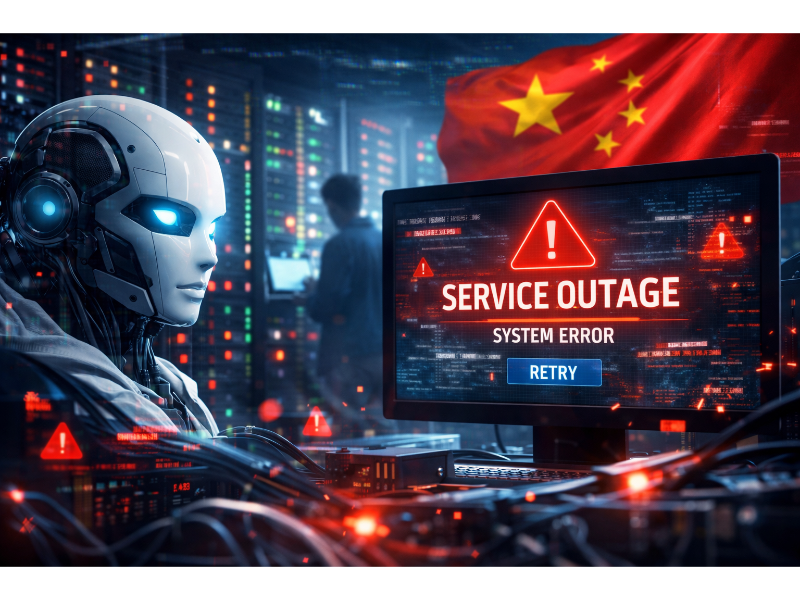
- DeepSeek’s chatbot experienced its most prolonged disruption during peak global attention in early 2025
- The outage highlights infrastructure pressure as China’s AI sector scales rapidly
What happened: alongside first major disruption to viral growth
China’s DeepSeek AI chatbot suffered its longest service outage since its surge in popularity, disrupting access for users during a period of intense global interest. The disruption followed a viral rise in early 2025, when the system drew widespread attention for its competitive performance against Western AI tools.
The outage affected availability across multiple regions and temporarily limited access to core chatbot functions. Users reported failures to load responses and intermittent connectivity issues, reflecting strain on backend systems during peak demand.
DeepSeek’s rapid adoption had placed it under unusual load conditions, exposing scaling challenges common to fast-growing generative AI platforms. Service was later restored, but the disruption marked a significant stress test for the company’s infrastructure.
Also read: DeepSeek presses ahead with V4 launch amid AI copying row
Also read: DeepSeek’s role in shaping telecom AI remains uncertain
Why this is important
The outage underscores the operational challenges facing China’s expanding AI ecosystem as demand accelerates. DeepSeek’s rise reflects a broader race between Chinese and Western firms to deliver high-performance large language models at scale, where reliability now matters as much as capability.
Frequent comparisons have been drawn with US-based platforms such as OpenAI’s ChatGPT, where outages in past years also revealed infrastructure bottlenecks during rapid user growth. In this context, DeepSeek’s disruption signals that the competitive edge in AI is no longer just model quality, but also uptime, latency, and resilience under load.
The incident also highlights the strain on data centres and network infrastructure across Asia-Pacific as generative AI adoption expands. As governments and enterprises integrate AI tools into workflows, even short outages can disrupt productivity, customer services, and developer ecosystems.
Ultimately, the episode reflects a maturing phase in the global AI industry, where reliability engineering is becoming central to maintaining trust and sustaining growth.