
Summary
- OpenAI OpCo is best assessed by the accepted action backed by a model: a model-assisted response, classification, tool call, or record update that can be reviewed, repeated, gated, and recovered within a real operational path.
- OpenAI's strongest case is not a single model demonstration but the combination of the Responses API, functions and tool calls, structured outputs, state management, evaluations, data controls, permissions, admin APIs, and processing tiers around the model capability.
- The weak point is the gap between a plausible reply and accepted work. adherence, tool access, and retrieval alone do not prove business correctness, human trust, preparation for rollback, or customer savings.
- Buyers must separate model capability from OpenAI's product reliability and their own live outcome. The real denominator includes integration effort, test data, human review, exception handling, privacy controls, capacity planning, contingency engineering, and vendor concentration.
Accepted Action Is the Right Denominator
The useful unit for judging OpenAI in enterprise software is not the reply. A reply can be fluent, fast, and impressive yet be unusable. It can lean on stale context. It can request a step the system is not allowed to perform. It can conform to a JSON structure but pick the wrong business category. It can save a worker thirty seconds and then cost an engineer an hour when the exception path is unclear. The better unit is the accepted action backed by the model.
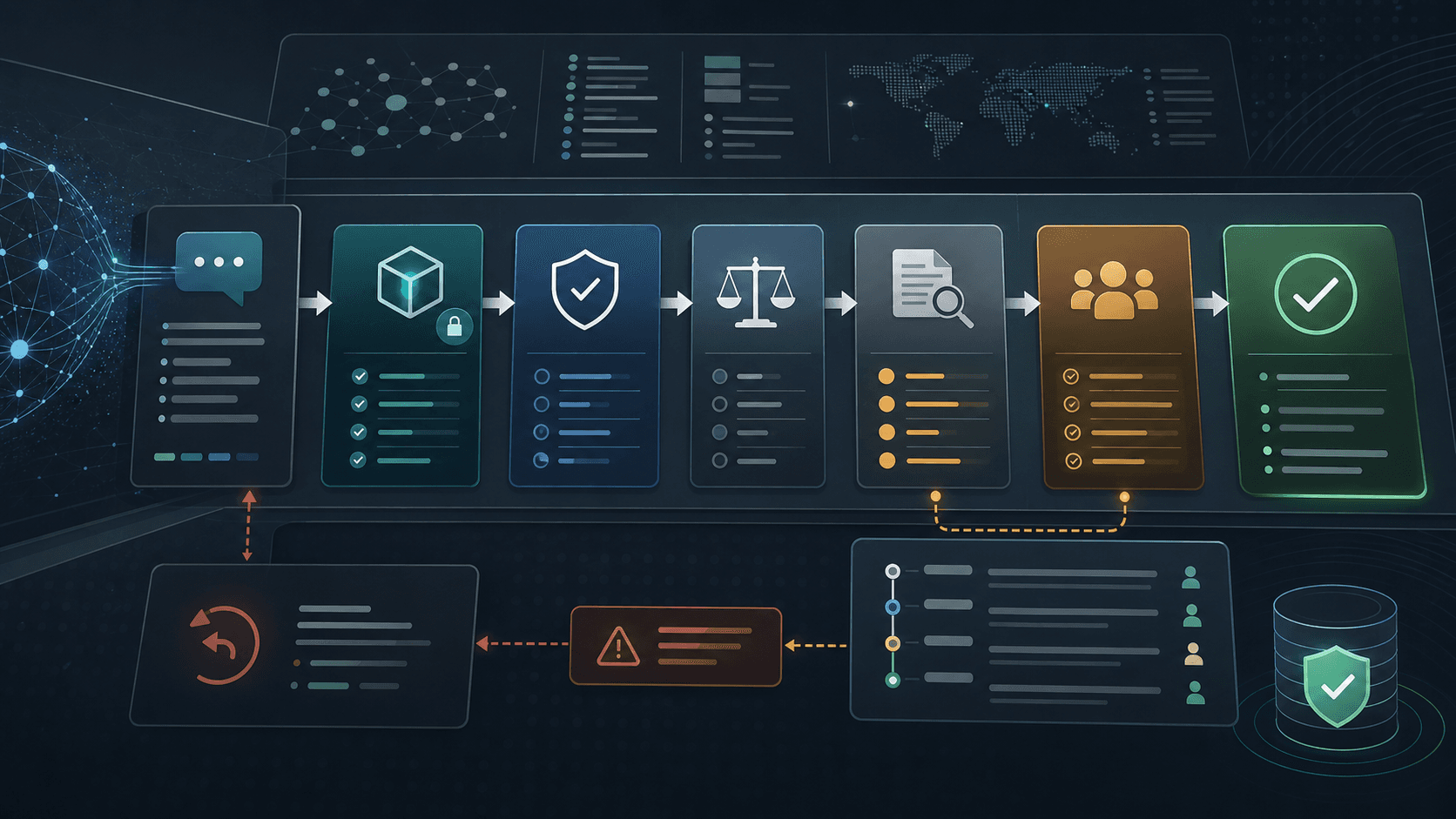
An accepted action is the whole path from request to usable result. The model receives the right instruction and context. The application constrains the permitted output. The tool or system connection executes with proper authority. The result is validated against a business rule. Evidence is available for review. Failures are handled without silent damage. Cost and latency are tolerable for the task. A human or a downstream system can accept the result against a standard defined before the request arrived.
This approach is stricter than measuring API calls, token volume, or output fluency. It is also fairer to OpenAI. The company supplies an important part of the model and product layer, but it does not own all customer databases, approval rules, ticket queues, call-centre processes, warehouse records, financial policies, or safety procedures into which its models integrate. A customer can misuse a powerful model with weak tools, vague policies, and no review path. A customer can also make a more limited model useful by surrounding it with careful validation and measured escalation.
This article focuses on OpenAI OpCo, the directory entity linked to the API and enterprise product surfaces operated by OpenAI. It does not cover the non-profit governance structure, exclusive litigation coverage, general model news, Microsoft strategy, Azure infrastructure claims, or the quality of the customer's own application. These boundaries matter because production value is generated jointly. OpenAI supplies foundation models, APIs, tool interfaces, structured-output features, data controls, and enterprise admin surfaces. Customers bring data, permissions, acceptance criteria, reviewers, downstream systems, and contingency procedures.
Therefore, the test is practical. Can OpenAI help convert a repeated model request into work the business can accept at a total cost lower than manual handling, established SaaS automation, a cloud-provider alternative, an open-source stack, internal development, or simply doing less of that task? That question is not answered by saying a model can reason well in an ideal exchange. It is answered by counting accepted outputs, rejected ones, escalated ones, tool errors, retries, reviewer minutes, latency failures, data-control work, maintenance, recovery exercises, and switching cost.
OpenAI's Product Surface Moves Toward Operational Work
OpenAI's current developer surface is no longer just a text-generation endpoint wrapped in customer code. The public documentation positions the Responses API as a central primitive for building applications that combine model output, tool configuration, response state, usage accounting, storage options, and previous response IDs. Around this sit function calls, built-in tools, structured outputs, conversation-state management, evaluations, rate limits, data controls, role-based permissions, and admin APIs. The product direction is clear: OpenAI wants to place itself closer to the point where model output turns into work.
This matters because enterprises have learnt that a model alone is not a system. A model can classify a support ticket, draft a reply, summarise a contract, suggest a data query, prepare an order adjustment, or choose a system tool. But the business task is not complete until the output is verified against policy, attached to the correct record, assigned to the right owner, logged, costed, and reversible. The product layer around the model is where the vendor can reduce the customer's effort.
OpenAI's advantage is that it controls both the model interface and many of the developer-facing constraints around it. Structured outputs can constrain the shape of data returned to an application. Function calls can define the tools the model may request. Built-in tools can trim some custom integration work. Conversation-state guidance can help developers keep relevant context across turns. Evaluations give teams a place to test behaviour against criteria. Data controls, RBAC, and admin APIs provide enterprise teams with governance surfaces a bare model endpoint would not offer.
The limit is that these product surfaces still need a customer-defined operating contract. A tool definition says what a model may ask to do; it does not prove the model chose the right tool for the customer's policy. A says which fields must be present; it does not prove the values are true. A state-management function can preserve context; it does not prove the context was current, complete, or allowed. An evaluation can catch regressions; it does not prove the test set represents the most important edge cases.
This is where OpenAI's business case becomes both stronger and more demanding. The company can reduce the amount of undifferentiated machinery a developer must build before attempting model-backed automation. It can also set expectations that customers move from experiments to repeated work more quickly. Once that happens, procurement and engineering teams need a denominator better than "the model answered." They need to know whether the accepted action is cheaper, safer, and easier to maintain than the alternative.
Structured Output Reduces One Failure Mode, Not All
Structured output is one of the most important pieces in the accepted-action chain because enterprise systems rarely consume free text without trouble. A support queue expects a category, priority, and owner. A financial process expects a code, an amount, and a reason. A compliance review expects a finding, a severity, an evidence reference, and a caveat. A workflow engine expects fields it can validate. If a model returns prose where an application needs a bounded entity, the integration becomes fragile.
OpenAI's documentation positions Structured Outputs as a way to make a model response adhere to a supplied JSON. This is a material improvement over asking the model to "return JSON" and hoping the application can parse it. It can prevent missing required keys, invalid enum values, and other form errors that force retries or manual repair. It is especially useful when a model's result becomes input to another system that needs predictable fields.
But adherence is not acceptance. A model can place a value in every required field and still pick the wrong value. It can classify a ticket as billing when it is actually fraud. It can pull a renewal date from a stale clause. It can correctly format a recommended refund amount while applying the wrong policy. It can pass a syntax validator and fail the business.
This distinction is where many automation business cases become too optimistic. Early savings are visible: fewer malformed outputs, fewer parsing failures, fewer brittle rules. The hidden cost remains: reviewers, validators, test sets, exception categories, and escalation paths still must catch incorrect but well-formed results. In a low-risk enrichment task, that may be enough. In credit, health, safety, regulated access, or customer money movement, an incorrect but perfectly formed action is still unacceptable.
A stronger customer design treats structured output as a contract boundary, not a trust boundary. The defines what the application can receive. A separate validator checks business rules. A permissions layer checks authority. A reviewer or a policy engine decides whether execution is allowed. A log of the input, model output, validation result, and final decision remains available for later review. In that design, OpenAI's structured-output feature reduces one class of failures, but the accepted action still depends on the customer's control stack.
That does not make the feature small. It means its value must be correctly accounted. The value is not "now the model is correct." The value is lower integration friction, fewer malformed outputs, clearer testability, and a cleaner path to downstream validation. Those savings belong in the denominator, as do the validation costs that remain.
Tool Use Shifts Risk from Words to Consequences
The accepted-action question gets sharper when the model can call tools. OpenAI's function-calling and tool-use documentation gives developers a way to describe functions, define parameters, and let the model request external data or actions. That is the moment a model-backed system moves from "tell me" to "do this." It is also the moment model uncertainty can create operational risk.
An incorrect paragraph may confuse a reader. An incorrect tool call can change a record, send a message, update a ticket, query restricted data, incur an expense, trigger a downstream process, or create an obligation. The danger is not that tool use is inherently unsafe. The danger is that teams sometimes treat tool choice as if it were the same as tool authority. It is not. A model can decide a tool is relevant; the application still must decide whether the action is permitted, safe, reversible, and backed by evidence.
OpenAI's product surface can help by making tools explicit. A function definition can state a name, description, parameters, and strictness. A built-in tool can cut custom integration for common tasks. Tool search and remote connections can reduce the burden of loading every capability into each request. These are useful checkpoints because they make the executable surface visible to developers.
The heavier customer work begins after the definition. Tool inputs need validation outside the model. Side effects need idempotency. Expensive or destructive actions require approval. Read-only tools should not share authority with write tools. The system must know what happens when a tool returns an error, an ambiguous result, a partial success, or a stale record. A reviewer needs enough evidence to decide whether the action can be accepted. The rollback path must exist before the first failure.
The practical design is to separate proposal from execution. The model can gather context, choose a likely next step, and prepare structured arguments. The customer code checks the arguments, permissions, and policy. Low-risk actions can execute automatically. Medium-risk ones may require review. High-risk ones can remain manual. Each branch must be accounted. A system that completes sixty per cent of cases without review and escalates forty per cent is not a failure if those escalations are expected and cheap. It is a failure if the business case assumed one-hundred-per-cent automation.
This is also where OpenAI's value must be compared against alternatives. A conventional SaaS tool may automate fewer cases but apply known rules more predictably. A robotic-process tool may be expensive to maintain but easier to audit for a bounded screen sequence. An open-source model stack may reduce vendor concentration but shift more integration and security work to the customer. Manual processing can look inefficient until the model path requires too much review. Accepted action makes these comparisons honest.
Context and State Are Costs, Not Background Details
Model-backed actions often fail because the system does not know enough at the right moment. It may lack the latest account status, the relevant policy, the previous reviewer decision, the correct customer tier, or the exact permissions boundary. OpenAI's conversation-state documentation acknowledges the problem by explaining that individual text-generation requests are independent unless state is supplied or stored through the matching product path. This detail is not just a developer chore. It is part of reliability.
In a repeated business task, context must be gathered, filtered, updated, and expired. Too little context produces guesswork. Too much context produces cost, latency, and privacy risk. Wrong context creates false confidence. Stale context creates outdated decisions. Context from a restricted system creates permission issues. So a useful OpenAI application needs a context budget, not just a token budget.
Consider a customer-service action. The model may need the customer's plan, open tickets, recent messages, refund policy, fraud signals, and regional rules. Some of that data can be read automatically. Some may be unavailable to a given user. Some may change while the request is being processed. Some may not be appropriate to send to the model at all. The accepted action depends on retrieving enough evidence while respecting data boundaries and cost limits.
The same problem appears in developer tools, data analysis, sales operations, and security review. The output can look confident, but the reviewer needs to know what evidence was used and what was unavailable. If the system cannot show that, the human must double-check the source manually or accept blind risk. Both outcomes reduce the economic case.
OpenAI's product surfaces can reduce parts of this load. State management, input token counting, retrieval-related tools, and response metadata make it easier to reason about what was sent and what came back. They do not remove the customer's need to design for data freshness, permission filtering, citation discipline, retention, and evidence display. The cost of that design belongs in the price of every accepted action.
This is why context-heavy automation often moves more slowly than demos suggest. The first demo uses clean input. The live system meets incomplete records, conflicting documents, old tickets, missing attachments, privacy restrictions, data-quality gaps, and users asking for things they are not allowed to receive. OpenAI can make models more capable of handling messy information. The business still must decide when the mess should stop the action.
Evaluation Is Recurring Operational Work
OpenAI's evaluation documentation says teams should test model outputs against criteria they define, analyse results, and iterate. That is the right advice. It is also a reminder that evaluation is not a launch ritual. It is recurring operational work.
The most important evaluation question is not "is the model good?" but "is this system good enough for this accepted action under this policy?" A model that is excellent at summarising long documents may be unreliable for pulling a narrow contractual carve-out. A model that is useful for drafting replies may be too risky for final approval. A model that passes an internal test set may fail when a new product, region, policy, or input format appears.
Evaluation has several layers. There is model behaviour: did the model follow instructions, use evidence, and avoid unsupported claims? There is product behaviour: did the API return a response in the required time, preserve state, apply the output format, and expose errors clearly? There is application behaviour: did the customer code validate fields, enforce permissions, and route exceptions? There is business behaviour: did reviewers accept the action, reject it, or spend more time correcting it than the manual work would have required?
OpenAI can help with evaluation tooling and product documentation, but the acceptance standard is local. A logistics firm, a bank, a software vendor, a telecom operator, and a hospital will not share the same threshold. Even inside the same company, a drafting task and an execution task should not share the same threshold. The cost of building, maintaining, and reviewing those thresholds is part of the business case.
The need for evaluation becomes more important when models, tools, or product features change. A model that scores higher on a public benchmark can still shift the output distribution inside a customer's system. It can use tools differently, produce longer responses, cost more, cost less, reject more cases, or display uncertainty differently. A lower-cost model may be acceptable for classification but not for final recommendations. A faster processing tier may help user-facing work but not reduce reviewer time. Without regression tests tied to accepted actions, teams are left to discover changes through user complaints or downstream defects.
The honest buyer question, therefore, is not whether evaluation exists. It is how many accepted-action test cases are needed, who maintains them, how often they run, what a failure means, who reviews failures, and whether the result changes deployment decisions. That is where the cost of supervision becomes visible.
Enterprise Controls Are Part of Reliability
Privacy and permissions are often treated as procurement requirements, separate from product reliability. For model-backed actions, they are part of reliability. A system that produces the right answer using data it should not have seen cannot be accepted. A system that lets a broad service identity run sensitive tools because it was easier to configure is not reliable. A system that cannot show who changed a setting or what retention policy was applied is not ready for repeated enterprise work.
OpenAI's data-control documentation states that API data is not used to train or improve OpenAI models unless customers explicitly opt in. It also distinguishes abuse-monitoring logs, application state, endpoint-specific retention, and zero-data-retention eligibility. The enterprise privacy and enterprise data pages describe customer ownership, retention controls, SSO, feature controls, and security commitments. The RBAC documentation describes organisation and project permissions, custom roles, groups, and consistent permissions across dashboard and API surfaces.
The admin API documentation covers admin automation, audit-log review, project management, key management, spend alerts, data retention, and rate-limit operations.
These are important product controls. They make OpenAI more plausible for enterprise buyers than a consumer-style model interface with no admin surface. They also shift work to the buyer. Someone must choose the retention setting. Someone must decide what data can enter a model request. Someone must manage keys, projects, groups, roles, and allowed IPs. Someone must review audit logs and spend alerts. Someone must reconcile OpenAI's controls with the customer's identity provider, data-loss rules, ticketing system, and compliance evidence.
This work is not merely bureaucratic. It changes the accepted-action denominator. A model-backed action that saves two minutes but requires an unapproved data flow may be unusable. A tool integration that works in a sandbox but cannot be granted scoped authority in the live account may not scale. A low-cost model call that creates retention or review requirements can be more expensive than it first appears.
Therefore, OpenAI's controls should be measured as enabling conditions, not automatic trust. They can shrink the gap between a developer experiment and an enterprise deployment. They can ease due diligence. They can help security teams constrain access and track administration. But they still require a customer operating model. A solid vendor control that is not used is not a control in practice.
Throughput, Latency, and Price Decide Whether the Action Is Viable
For repeated model-backed work, throughput is not an abstract infrastructure number. It is part of the product experience. A late reply can be harmless in overnight enrichment and unacceptable in a customer-facing interaction. A rate-limit error can be a normal back-pressure signal for batch work and a severe outage for a live decision path. A cheaper processing tier can improve economics for review tasks and hurt economics if its delay makes humans wait.
OpenAI's rate-limits documentation sets the basic constraint: limits are imposed to manage abuse, fairness, and infrastructure load; they are defined at the organization and project level, vary by model, and can include shared family limits, usage limits, and vector-store ingestion limits. That means a buyer cannot calculate throughput from the model choice alone. The operational question is whether the chosen account, project, model, tier, and request pattern can support the accepted-action target.
The processing-tier pages sharpen the trade-off. Priority processing is positioned for lower, consistent latency in habitual high-value user-facing applications. Flexible processing trades lower cost for slower responses and occasional resource unavailability, making it more suitable for lower-priority, async, or evaluation-type work. The scale tier lets enterprise customers buy token units for a specific model snapshot and add the purchased quota to rate limits. Each of these choices changes the economics of accepted actions.
The key is to price the full path. Token cost is only one component. The cost of an accepted action also includes retrieval, tool execution, validation, logging, storage, reviewer time, failed attempts, latency buffers, monitoring, support tickets, escalation, contingency, and periodic testing. A model call that is cheap but doubles review time can be expensive. A more expensive model that reduces rejection and escalation can be cheaper per accepted action. A committed-capacity plan can be sensible for steady high-value traffic and wasteful for spikey jobs.
Latency has a similar structure. OpenAI's production guidance notes that request latency is heavily influenced by model choice and generated-token length. That is useful, but accepted-action latency includes more than the model. It includes data retrieval, validation, tool calls, downstream API waits, human review, and rollback checks. A user-facing process may need a fast first response and a later final action. An admin task may prefer slower, cheaper processing if the result arrives before the next review window.
The right measurement is not average response time. It is acceptance time. How long until the business can trust the result? If a model replies in two seconds but a reviewer takes four minutes to verify evidence, the accepted-action time is not two seconds. If an automated path handles simple cases instantly and routes uncertain cases clearly, the blended average can still be valuable. The metric must fit the work.
Incidents Make Contingency Part of the Design
OpenAI's status pages and incident history are useful because they remind buyers that even solid centralised services have service events. The public status page reports aggregate availability by product group, and the history page logs incident recoveries involving API errors, latency, and specific API surfaces. A March 2026 incident report described elevated API error rates and latency across several models caused by an internal scheduling system running a large batch of infrastructure actions simultaneously.
The lesson is not that OpenAI is unusually fragile. Any cloud or model vendor can have failures. The lesson is that accepted actions require a failure policy. A system that depends on OpenAI must know what to do when a request times out, returns an error, slows down, switches model availability, hits a rate limit, or produces an incomplete result. The answer will differ by task.
Some work can wait. Some can fall back to a smaller model. Some can go to manual review. Some can use cached context. Some must stop immediately because partial execution is dangerous. Some must continue in read-only mode only. Some must route to another vendor, but that route must be tested before the incident. Contingency that exists only in architecture diagrams is not contingency.
This is another place where the accepted-action denominator prevents illusions. A team must count failed attempts, delayed attempts, escalated attempts, and contingency attempts. If a model-backed path completes most work cheaply but sends a predictable fraction to manual handling, the business can plan staffing. If failures are rare but expensive, the business needs recovery exercises. If the contingency vendor uses different output formats, security behaviour, tool semantics, or data policies, switching during an incident can create new risks.
The operational decision is not "trust OpenAI" or "don't trust OpenAI." It is which tasks can depend directly on it, which tasks need a human hold point, which tasks need another vendor path, and which tasks should remain manual. OpenAI can improve status reporting, error documentation, processing tiers, and product resilience. The customer still must translate those signals into business-continuity rules.
The Alternative Isn't Free Either
A serious evaluation of OpenAI must compare it against realistic alternatives. The first alternative is manual work. Manual work is slow and expensive, but it can be flexible, accountable, and easier to stop. For infrequent, high-stakes actions, manual handling can remain the cheaper safe option because the cost of automation controls would outweigh the savings.
The second alternative is established SaaS automation. A support platform, a CRM, a security tool, a financial system, or an IT service can automate bounded tasks with deterministic rules. These systems may be less flexible than OpenAI-backed applications, but they often have mature permissions, audit trails, and domain-specific exception handling. OpenAI's advantage is breadth and language ability. The established systems' advantage is task-specific governance and known operational behaviour.
The third alternative is another model or cloud vendor. A buyer may prefer a vendor that sits inside its existing cloud estate, offers a preferred regional footprint, supports a favourite model, provides stronger procurement terms, or reduces vendor concentration. OpenAI's advantage is model and product momentum. The trade-off is that centralising high-value actions around a single vendor can increase negotiation, continuity, and migration risk.
The fourth alternative is open source or in-house infrastructure. That path can improve control, locality, and customisation, but it shifts model serving, security, evaluation, updates, monitoring, and tool orchestration to the customer. It can be attractive for regulated data, high volume, special latency needs, or strategic independence. It is rarely free once staffing, hardware, cloud capacity, and maintenance are accounted.
The fifth alternative is to do less. Some AI projects assume every task must be automated. That is not always true. A company can decide to automate triage but not execution, draft replies but not send them, enrich records but not overwrite them, summarise evidence but not decide the case, or assist reviewers rather than replace review. Doing less can yield a better accepted-action ratio because the automated portion is narrower and easier to govern.
OpenAI's strongest case appears when language understanding, tool access, and structured output let a customer handle a large volume of medium-risk work with clear review and contingency. Its weakest case appears when the task is infrequent, high-consequence, poorly specified, data-poor, latency-critical, heavily regulated, or already well served by deterministic software. Most business tasks sit between those poles. That is why measurement matters more than slogans.
What Buyers Must Measure
The first metric is the accepted-action rate. Out of all requests, how many become accepted results without manual correction? How many are rejected? How many are escalated? How many require a second model call, a tool retry, a human query, or a rollback? This is the basic yield measure. Without it, teams can report impressive usage while hiding the cost of rejections and exceptions.
The second metric is reviewer minutes per accepted action. OpenAI can accelerate the first draft or the structured result, but the business case depends on whether the reviewer trusts it. If reviewers re-read every source because the evidence display is weak, automation has shifted work rather than removed it. If reviewers only inspect uncertain cases and can see the evidence quickly, the savings are real.
The third metric is the cost of failure. What happens when the model returns an unsupported answer, picks the wrong tool, violates a, loses state, times out, hits a rate limit, or produces an ambiguous result? The cost includes immediate correction, downstream cleanup, customer impact, audit work, and any loss of trust among staff. A low error rate can still be expensive if each error is serious.
The fourth metric is latency to acceptance. It should include model time, retrieval, tool execution, validation, human wait, and final confirmation. Different tasks need different thresholds. The useful comparison is not the fastest possible response but whether the accepted result arrives in time to change the work.
The fifth metric is cost per accepted action. Token spend is visible but not sufficient. Add tool costs, storage, logging, evaluation, engineering maintenance, security review, procurement, reviewers, support, and contingency. Then compare against manual handling, established software, and alternative vendors. Only then can a buyer decide whether OpenAI is cheaper or simply more interesting.
The sixth metric is switching cost. How much work is required when a model, an API feature, a data source, a policy, a, or a downstream system changes? Can tests detect regression? Can the team roll back? Can a different model or vendor be substituted? A system that is cheap to launch and expensive to change may not be cheap.
The seventh metric is concentration risk. If OpenAI becomes the central decision aid in support, data analysis, developer tooling, and operations, the buyer gains consistency but also dependence. The risk may be acceptable. It must be priced explicitly through contract terms, contingency plans, export paths, model abstraction, in-house skills, and governance.
Watchpoints for the Next Operating Cycle
The first watchpoint is feature churn. OpenAI's product layer moves fast, and rapid product movement is a double-edged advantage. New surfaces can shrink customer integration work and expose better controls. They can also shift the abstractions a customer should build on. If a team tightly couples an application around a feature that later changes direction, the cost appears as migration, retesting, and staff retraining. Buyers should prefer designs that isolate model choice, tool contracts, schemas, review logs, and contingency logic away from any single feature path.
The second watchpoint is evaluation transition. The public documentation already shows that some evaluation surfaces have a planned transition timeline. That does not make evaluation less important; it makes ownership clearer. The customer should treat evaluation data, thresholds, reviewers, and decision logs as its own operational assets. The vendor's tooling can run tests and speed iteration, but the organisation needs to preserve the acceptance standard outside a single console. If the tool changes, the standard must survive.
The third watchpoint is hidden human work. OpenAI-backed systems can make workers faster, but they can also make their work more cognitively demanding. A reviewer may handle more cases, but each case may require checking evidence, watching for unsupported conclusions, spotting privacy risks, and deciding whether a tool action is safe. If that oversight goes unmeasured, the business will confuse throughput with saving. A good deployment logs why humans overrode the system, which cases were confusing, and whether reviewers are spending less time on value or simply more time policing uncertainty.
The fourth watchpoint is policy drift. Model-backed systems often start with a clear task: triage these tickets, draft these replies, route these exceptions. Over time, users ask for more. A read-only assistant becomes a recommender. A recommender becomes an executor. An executor gets broader authority because exceptions are inconvenient. Each expansion can be rational in isolation and risky in aggregate. The clean answer is a periodic authority review: what can the system read, what can it propose, what can it execute, what must it escalate, and what must stay out of scope.
The fifth watchpoint is evidence display. Many systems store logs but do not show the evidence at the moment of acceptance. A reviewer who cannot see the source, the model output, the validation checks, the tool response, and the policy caveat in one place will reconstruct the case manually. That destroys savings and increases inconsistency. So the product stack should be judged not only by the data it can retain but by the decision view it makes possible.
The final watchpoint is staff trust. Staff will not accept a model-backed system simply because it is technically available. They need to see that it knows when to stop, that it eases review rather than making it harder, and that mistakes are corrected without shifting blame. OpenAI can supply model capacity and product controls. The organisation must supply the trust discipline that turns those controls into accepted work.
OpenAI's Real Opportunity Is Boring in the Best Way
OpenAI's most durable opportunity is not the spectacular answer. It is the boring accepted action: the case routed correctly, the record enriched with evidence, the support reply drafted and approved, the internal question answered with sources, the policy exception escalated rather than executed, the developer task bounded, the analyst output checked, the low-risk step completed without making the reviewer start over.
That is where OpenAI can create real enterprise value. Its models provide breadth and reasoning capability. Its APIs provide a programmable interface. Structured outputs cut down on malformed integration. Tool calls connect language to systems. State management and response metadata help developers keep context. Evaluations support regression discipline. Data controls, RBAC, and admin APIs make enterprise adoption more plausible. Processing tiers let customers trade cost, throughput, and latency more deliberately.
The same list explains why the work is hard. Every useful surface creates a design question. Which tool is allowed? Which fields are required? What data can be sent? Which result needs review? Which failure should be retried? Which action must be stopped? Which model should be used? Which tier is worth paying for? Which logs must be kept? Which alternative is good enough when the primary path fails?
OpenAI is tested by how well those questions can be answered at scale, and customers are tested by whether they ask them before declaring victory. The model-backed action is accepted only when the business can trust it, explain it, recover from it, and afford it. That is the measure that separates useful automation from a compelling demo.