
Summary
- ARIN did not begin with a member ballot for its first directors. The 1997 formation record named three Network Solutions-linked initial directors to make the new corporation operational.
- The first Advisory Council was also not a member-elected body in the surviving 1998 account; the amended Bylaws say it was nominated and elected by the Board while requiring a revised member-approved selection method within a year of incorporation.
- By April 1999, ARIN's Board was working on direct member election of trustees, and the FY2000 annual report later described the fall 1999 Denver meeting as the first membership election of new trustees.
- The democratic opening was real, but its scale cannot be certified from the fixed public record: membership grew from 216 to about 784, yet the eligible-voter list, turnout, blank ballots, candidate totals, geography and nonparticipants are not supplied.
The election begins with an empty denominator
The most important fact about ARIN's first election is not a named winner. It is the missing denominator behind the act of election itself. The surviving public record can tell us that ARIN began with named initial directors, that the first Advisory Council was selected by the Board, that the institution later worked toward direct member election of trustees, and that the fall 1999 Denver meeting produced two member-elected trustees.
It cannot, on the selected record alone, tell us how many organisations were eligible to vote, how many actually voted, how many declined or failed to return a ballot, how many ballots were blank or spoiled, how many candidates were considered, or how the electorate was distributed across the region.
That absence should be treated as evidence about institutional memory, not as an accusation. A startup corporation needed officers and directors before it could hold anything resembling a mature election. A registry moving from government-adjacent formation into nonprofit self-administration had to put legal authority somewhere before it could invite a broader membership to exercise choice. The later election of trustees was therefore a meaningful transfer of selection power. It should not be erased by a purist demand that every founding act begin with a fully measured franchise.
But the reverse is also true. A later member election cannot be used to invent a clean democratic origin story for earlier choices. Incorporators naming the first directors is not the same act as members casting ballots. A Board selecting an advisory body is not the same as members choosing that body. A report saying two trustees were elected does not reveal the size of the electorate, the turnout rate, the candidate field, the share of membership that stayed silent, or the relationship between the 216 members reported before expansion and the roughly 784 organisations reported afterward. Membership size is not turnout.
A meeting archive is not a certified election return. Named officeholders are not a denominator.
This article therefore reconstructs ARIN's opening in dated stops rather than as a single legitimacy claim. The first stop is the 1997 formation instrument that placed Kim Hubbard, Don Telage and Phil Sbarbaro, each linked to Network Solutions and the same Herndon address, on the initial Board. The second is the Board-selected first Advisory Council described in the 1998 Bylaws. The third is the June 1998 obligation to replace that initial selection arrangement with a revised member-approved method. The fourth is the April 1999 Board record showing counsel working on direct member election of trustees.
The fifth is the fall 1999 Denver election, described later as the first membership election of new trustees.
The chain supports a bounded conclusion. ARIN opened from appointment and Board selection toward member choice between 1997 and 2000. That opening was real. Yet the public record does not let the reader measure the democratic weight of the first trustee election with the precision that a mature membership institution should want. The first election is visible as an institutional milestone. It is not visible as a complete electoral return.
1997: initial directors made the corporation possible
The ARIN Articles of Incorporation place the first institutional fact on firmer ground than later origin stories sometimes allow. The Articles named Kim Hubbard, Don Telage and Phil Sbarbaro as initial directors. The record links them to Network Solutions and a Herndon address. It says those directors would serve until the first annual meeting or until successors were elected and qualified.
That language matters for two reasons. First, it confirms that ARIN's first Board did not arise from a recorded member vote. The Articles created a legal starting point. They named people who could act for the corporation. They supplied continuity between incorporation and later governance. They did not report a campaign, a ballot, a certified electorate, or a membership franchise.
Second, the Articles set a limit on how far criticism should go. Initial directors in a new nonprofit are not automatically a democratic scandal. A corporation cannot easily ask members to elect trustees before it has a recognized corporate body able to admit members, hold assets, adopt Bylaws, call meetings and define voting rights. Founding appointment is often a bridge. The governance question is whether the bridge is short, documented and replaced by accountable selection, or whether it hardens into control while later institutions decorate the result.
For ARIN, the fixed record supports the bridge reading up to a point. The named directors were not described as permanent sovereigns. The language pointed toward an annual meeting or successor election. That is an important legal signal. The Articles also do not themselves prove that the later replacement was broad, competitive or well attended. They create an expectation of transition, not a record of participation.
The Network Solutions connection should also be handled carefully. It is a fact that the initial directors were linked to Network Solutions in the formation instrument. It is not, from that fact alone, proof of an improper private capture. Network Solutions sat near the institutional history from which ARIN emerged. A startup registry corporation would naturally draw operational knowledge from people already close to registry administration. The legitimacy concern is not that experienced people served. The concern is that later democratic weight must be measured, not presumed, when the first act was appointment by a narrow founding circle.
The Articles therefore answer one question and open several more. Who selected the first directors? The formation instrument did, through named initial directors rather than a member ballot. Was that selection necessarily illegitimate? No; it was an ordinary way to give a new corporation capacity to act. Did it create a democratic mandate for future registry governance? No; mandate would have to be earned through later member participation, visible rules and accountable replacement. The Articles establish origin authority. They do not certify origin consent.
The first Advisory Council was selected inside the Board's circle
The second stop narrows the distinction between consultation and election. The ARIN Bylaws amended 30 June 1998 say the first Advisory Council was nominated and elected by the Board. They also required a revised member-approved selection method within twelve months of incorporation.
That combination is crucial. The Advisory Council carried a participatory title, but its first formation did not come from a member ballot in the record under review. It was Board-selected. The Bylaws did not hide that fact. They recorded an initial internal appointment arrangement and attached a reform requirement to it. The instrument therefore contains both a closed beginning and a built-in acknowledgment that the closed beginning should not remain the ordinary method.
This distinction prevents two bad readings. One reading treats the first Advisory Council as if the word "advisory" automatically made it a broad membership expression. The 1998 Bylaws do not support that. The selector was the Board. If members later approved a revised method, that later approval cannot be read backward into the first AC's composition. The first AC may have offered useful expertise and representation, but usefulness is not the same as election by the affected membership.
The other bad reading treats Board selection as proof that member voice was irrelevant by design. The Bylaws are more complicated. They imposed a time-bound move toward a member-approved method. A governance instrument that commands its own replacement in a defined area is not the same as one that entrenches closed selection indefinitely. ARIN's internal record, at least in this version, recognized that a Board-selected advisory body needed a different legitimacy basis if it was going to become a durable feature.
The missing record lies between the requirement and the later public summary. The Bylaws point toward a revised member-approved selection method within twelve months of incorporation. The selected record does not provide the full member vote on that revision, the voting contacts, the ballot text, the margin, the alternatives rejected, or the number of members that participated. This matters because "member-approved" can cover many levels of participation. It may mean overwhelming assent by a large share of eligible organisations. It may mean approval by a small active subset.
It may mean a voice vote at a meeting with uncertain attendance. Without the electoral file, the phrase tells us the direction of reform but not its depth.
The first Advisory Council therefore belongs in the story as a transitional body. It was not a founding legislature of the membership. It was a Board-created advisory structure that the Bylaws themselves expected to be replaced or regularized through a member-approved method. That is a serious institutional opening. It is also a documentary warning: whenever a body changes from appointed to elected, the record must preserve who was allowed to choose and who actually did.
June 1998 created an obligation, not a measured electorate
The June 1998 Bylaws perform a different function from the 1997 Articles. The Articles made ARIN a functioning corporation. The amended Bylaws articulated how an internal body should move from Board selection toward membership approval. That shift is more than clerical. It shows the institution attempting to convert startup authority into accountable procedure.
Still, an obligation to redesign selection is not the same as a certified election. The Bylaws tell us that a member-approved selection method was required. They do not tell us whether all members were notified, how many were eligible, which organisations had voting contacts, whether votes were weighted or one-per-member, what quorum applied, whether there was contestation, or how many members abstained. The missing denominator remains missing.
This gap is especially important because the size and composition of ARIN's membership changed sharply around the same era. The FY1999 annual report later said membership increased from 216 to about 784 after automatic extension to subscribing customer ISPs. A membership rule adopted before, during or after that expansion could have very different democratic meaning depending on which organisations were included, which were active, and which were able to cast votes. A member-approved method adopted by a small pre-expansion membership would not carry the same representational reach as one adopted by the wider membership.
A method adopted after automatic expansion would still require proof that the new organisations were not merely listed as members but actually had voting ability, contacts, notice and ballot access.
The language of membership can conceal these differences. "Member" is a status. "Eligible voter" is a subset defined by rule, contact, standing, notice and timing. "Actual voter" is another subset. "Candidate" and "officeholder" are still different categories. A mature election record keeps these terms apart because legitimacy depends on the transitions among them. The June 1998 obligation moves the institution toward member approval. It does not supply the numbers needed to evaluate how broadly that approval was exercised.
The obligation also complicates criticism. If ARIN's founders had intended to keep all selection power inside the initial Board without review, a Bylaw deadline for revised member-approved selection would be odd. The document signals an internal recognition that founder and Board authority needed widening. That recognition should count in ARIN's favor. The problem is not the absence of any reform commitment. The problem is that the selected public record does not preserve enough about the reform vote to convert the commitment into a measured mandate.
In a governance history, that difference is decisive. A reform obligation ranks above silence. It ranks below a complete electoral archive. ARIN had the first. The selected record does not provide the second.
April 1999: the Board shaped direct trustee election before members voted
The Board of Trustees Meeting Minutes for 11 April 1999 add another dated step. They record counsel working on direct member election of trustees and show the Board shaping the mechanism before the member election. This is not the election itself. It is the design moment before the election.
Design moments matter because the rules of a first election can determine who is invited, who can stand, who can be nominated, what notice is given, how ballots are returned, whether remote members can participate, and how disputes are resolved. A first election is not only a vote. It is also a ruleset built by those already in office. When the same Board that began through founder appointment shapes the method for later trustee election, the transfer of power is meaningful but not self-authenticating. The design file becomes part of the legitimacy file.
The April 1999 minutes support ARIN's case in one respect. The Board was not ignoring the need for member election of trustees. It was working on it, with counsel involved. That suggests legal seriousness and procedural preparation. A rushed oral claim that members somehow chose successors would carry less weight than minutes showing active work on direct election. The record captures institutional movement toward a more accountable structure.
The same minutes also mark a missing-evidence boundary. They summarize discussion. They do not provide the complete draft rules, eligible-voter denominator, dissenting views, full candidate criteria, notice list, ballot form, vote-counting method or challenge rules. They show governance design taking place, but not enough detail to evaluate whether the design invited broad participation or merely formalized a controlled transition.
That is why the April 1999 stop should not be treated as a suspicion trigger by itself. Boards ordinarily design election rules before members vote. Counsel involvement is normal. The issue is record completeness. If the institution wants later readers to understand the democratic value of its first election, design records should be paired with election records. The minutes show preparation. They do not show participation.
The timing also matters. By 1999, ARIN was nearing a larger membership base. If automatic extension to customer ISPs expanded membership from 216 to about 784, then the rules being designed had to answer practical questions: which of those organisations could vote, whether all had been notified, how each organisation identified its voting contact, whether any were ineligible because of fee or service status, and how votes from organisations not physically present in Denver would be handled. The selected record does not answer those questions. It lets us see a doorway being built, not the crowd that walked through it.
Membership expansion widened the base without proving the electorate
The FY1999 annual report supplies the most tempting denominator in the story: membership increased from 216 to about 784 after automatic extension to subscribing customer ISPs. That number is vital, but it must not be misused.
The increase shows a wider membership base. It supports a real institutional change. A corporation with 784 member organisations is different from one with 216. Automatic extension to customer ISPs suggests that ARIN was not limiting membership only to a tiny founding group. It widened the set of organisations connected to formal membership at roughly the same time that governance reforms were unfolding.
But a membership base is not an election denominator unless the record connects it to eligibility and ballots. To make 784 an election denominator, one would need evidence that all about 784 organisations were eligible for the relevant election, that each had a recognized voting contact, that each received notice or a ballot, and that the election rules counted them in the same way. The selected record does not provide that evidence. It says membership grew. It does not certify the voting roll.
This distinction is not pedantry. It is the difference between democratic symbolism and measurable accountability. A report saying membership expanded can support the claim that ARIN's community base became broader. It cannot tell us whether the first trustee election had 700 eligible voters, 500, 216, a smaller meeting-attendance electorate, or some other denominator defined by standing and procedure. It cannot tell us whether nonparticipation was high or low. It cannot tell us whether new customer ISP members were administratively ready to vote in time for the Denver election.
The increase also raises a timing question. If membership was expanding as election rules were being finalized, the institution faced a moving target. A rule appropriate for 216 established members might perform differently for roughly 784 organisations newly recognized as members. Notice, education, candidate recruitment and contact verification become more difficult when the electorate expands quickly. That does not make the election invalid. It makes the election file more important.
The record's strongest fair reading is that ARIN broadened formal membership while moving toward member election. The record's limit is that it does not prove how the broader base translated into actual voting power. The absent voters in the article title are not named individuals. They are the unmeasured difference between the member list and the returned ballots.
Fall 1999 in Denver: a real transfer with an incomplete return
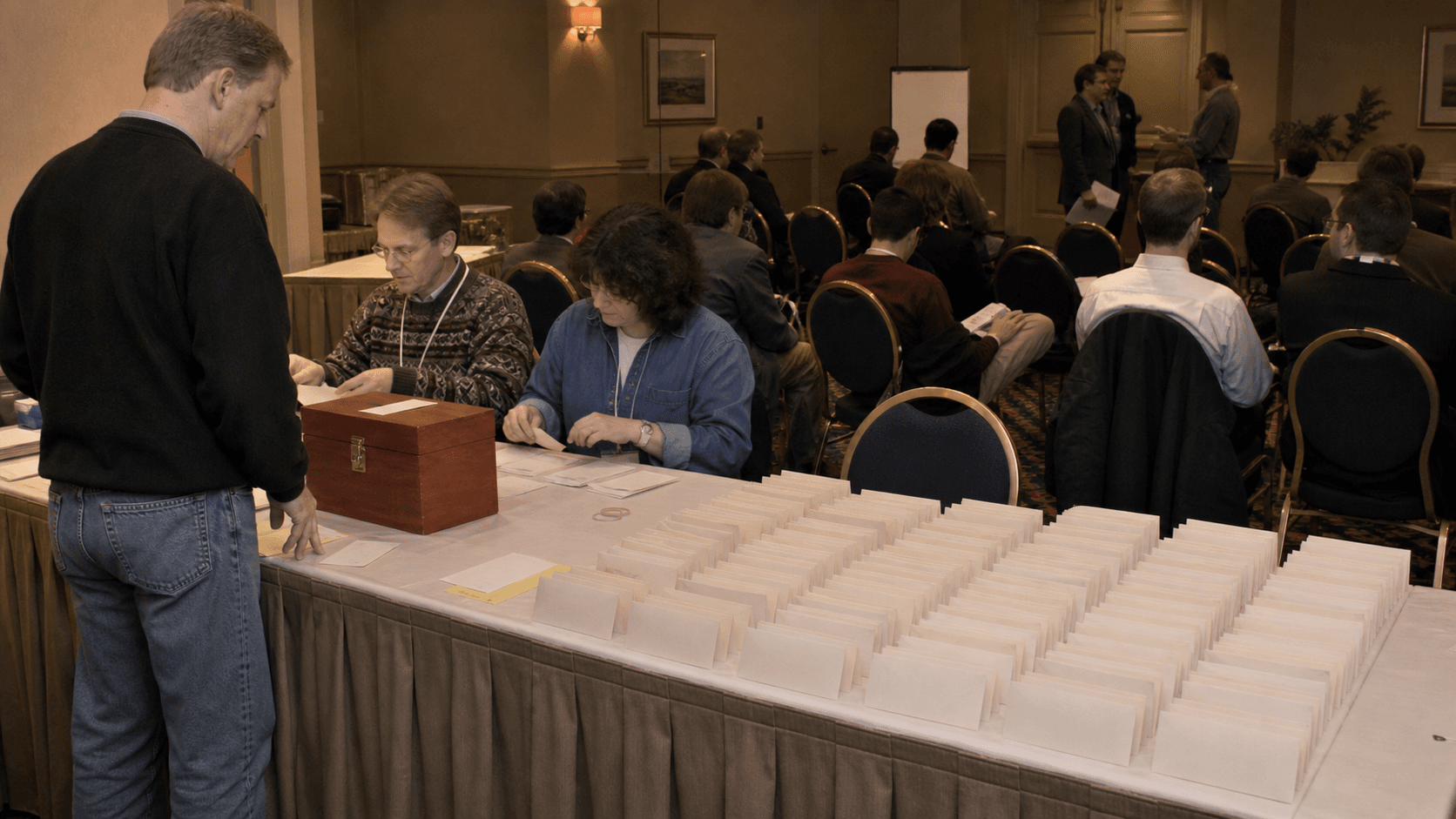
The FY2000 annual report is the central public account for the milestone. It calls the fall 1999 Denver event the first membership election of new trustees, says two trustees were elected, and records contemporaneous Advisory Council and ASO Address Council selections. The ARIN FY2000 Annual Report therefore proves a meaningful change: members had moved from being outside the selection of initial directors to participating in the election of new trustees.
That is not a small point. In the institutional history of a registry, the first member-elected trustees mark a transfer from founder appointment and Board-designed governance toward a more accountable membership corporation. It is the moment when ARIN can say that at least part of its Board no longer rested solely on initial appointment or internal succession. Member choice had entered the Board's composition.
The problem is that the same report does not provide a complete return. It names the type of act and the outcome in institutional terms, but not the electoral denominator. It does not give the eligible-voter list. It does not state how many organisations voted. It does not provide candidate totals. It does not identify blank or invalid ballots. It does not break participation down by geography or organisation type. It does not show whether the election was contested, lightly contested, or shaped by a narrow nomination path. It does not let the reader compare the 216-to-784 membership expansion with actual turnout.
This is why the first election should be described as an opening rather than a full democratic settlement. An opening is a real change in who may choose. A settlement is a mature pattern in which the electorate is defined, participation is measured, contestation is visible and nonparticipation can be studied. ARIN reached the first in the record. The second requires records not provided here.
The Denver setting also should not be overstated. A meeting archive such as the ARIN IV Members Meeting archive gives a point of reconstruction and anchors the period. It is not a certified election return by itself. Meeting records can show agenda, attendance atmosphere and institutional context. Election legitimacy needs voter eligibility, ballot handling and totals. The meeting may be where the milestone occurred; it is not, on its own, the full evidentiary file.
The correct sentence is therefore measured: in fall 1999, at Denver, ARIN held the first membership election of new trustees, and two trustees were elected. The incorrect sentence is larger: the full membership clearly and broadly authorized the new governance order. The selected record supports the first and does not support the second.
A compact reconstruction ledger
The institutional opening can be summarized as a ledger of offices, selectors and missing records:
| Date or period | Office or body | Selector shown in the record | Known denominator | Missing record | Legitimacy claim supported |
|---|---|---|---|---|---|
| April-August 1997 | Initial Board directors | Formation instrument naming Kim Hubbard, Don Telage and Phil Sbarbaro | None shown as an electorate | Any member ballot for initial directors | Corporate startup authority, not member election |
| By June 1998 | First Advisory Council | Board nomination and Board election | Board as selector, not member electorate | Candidate file, member vote, participation data | Transitional advisory body, not member-elected origin |
| June 1998 | Revised AC selection method | Required member-approved method within twelve months of incorporation | Not supplied | Vote text, voter roll, turnout, alternatives | Reform obligation and direction of travel |
| 11 April 1999 | Direct trustee election design | Board and counsel preparing the method | Not supplied | Draft rules, dissent, eligible-voter denominator | Evidence of preparation for member choice |
| Fall 1999, Denver | New trustees and related selections | Members for trustees; contemporaneous AC and ASO AC selections recorded | Membership base grew from 216 to about 784, but eligible-voter denominator not certified | Voter list, ballots, candidate totals, blank ballots, geography, nonparticipants | First member election of new trustees, incomplete electoral return |
This ledger is deliberately restrained. It does not convert silence into wrongdoing. It also does not convert officeholder names into turnout. The difference between a known selector and a known electorate is the core finding.
The ledger shows that ARIN's opening had stages. In the first stage, legal capacity came from initial appointment. In the second, advisory capacity came from Board selection. In the third, the governance text required a member-approved method. In the fourth, the Board worked on direct election. In the fifth, members elected new trustees. Each stage moved the institution away from closed founder appointment. Each stage also left a different evidentiary question.
The most important lesson is that "member" is not a single number. At one point the relevant body may have been the initial Board. At another it may have been members eligible to approve a revised advisory-selection method. At another it may have been members eligible to elect trustees. At another it may have been attendees or remote voters in the Denver election. If the record collapses these categories, legitimacy analysis becomes inflated. A responsible account keeps them apart.
The voters who never appeared in the record
The absent voters in this story are not people to be named by guesswork. They are the organisations that may have existed in the membership base, may or may not have been eligible, may or may not have received ballots, and may or may not have participated. Without a certified list, they cannot be identified. Without ballot totals, their silence cannot be measured. Without geography, their regional distribution cannot be assessed. Without candidate records, their range of choice cannot be judged.
This is the central evidentiary finding, not a rhetorical flourish. If membership grew from 216 to about 784, the institution had a much wider formal community than at the start. That fact increases the importance of knowing how many of those organisations participated in first trustee election. A low turnout from a large electorate would carry a different meaning from a high turnout from a smaller eligible roll. A contested election would carry a different meaning from an uncontested slate. A geographically concentrated voting body would raise different questions from one spread across the region.
The record supplied here does not let the reader choose among those possibilities.
The missing denominator also prevents retroactive consent claims. One might be tempted to say that once members elected trustees in 1999, the members had endorsed ARIN's earlier formation choices. That goes too far. A member vote for two trustees is not necessarily a vote ratifying every founding decision, every initial director, every Board-selected advisory appointment or every detail of the transition from Network Solutions-linked startup authority to nonprofit governance. It may show acceptance of a new election stage. It does not automatically approve the whole past.
At the same time, the missing denominator should not be used to deny the election entirely. The FY2000 report's description of the first membership election is evidence that the election occurred. The absence of turnout data weakens the ability to evaluate breadth. It does not erase the fact that trustee selection had changed. The proper judgment is not "there was no election." It is "there was a first member election whose participation file is incomplete in the public record."
That formulation matters because legitimacy is not all-or-nothing. Institutions can become more accountable without becoming fully transparent. They can move from appointment to election while still failing to preserve enough data for later measurement. ARIN's first trustee election appears to fall into that middle category.
The startup defense deserves full weight
Any fair account must give the startup defense full force. ARIN was not a long-settled parliament deciding whether to exclude a known electorate. It was a new nonprofit registry corporation being made operational. Initial directors were necessary. A Board-selected first advisory body could be a rational bridge. Counsel work on direct election before the first trustee vote was not suspicious by itself; it was how a corporation builds voting rules.
The initial directors named in 1997 had to perform basic tasks. They could adopt and amend Bylaws, hold meetings, define membership status, arrange corporate administration and create the conditions under which members could later participate. If one demands a member election before these tasks are possible, the demand becomes circular. The institution needs a starter authority in order to create the membership election that later limits that starter authority.
The first Advisory Council can be defended in similar terms. A new registry needed advice and policy input before its member-selection arrangements were fully mature. Board nomination and Board election of the first AC could supply continuity and expertise. The 1998 Bylaws' requirement for a revised member-approved selection method shows that the closed arrangement was not presented as the permanent ideal.
The 1999 election then becomes more important, not less. It is the moment when the bridge is meant to become a road. If initial appointment and Board selection are justified as temporary necessities, the later election must be documented well enough to show how temporary authority yielded to member choice. That is why the missing denominator matters. It is not a complaint that ARIN had a startup phase. It is a request for the records that prove the startup phase opened into measurable accountability.
The startup defense also helps explain why the strongest critique should not use fraud language. The fixed record does not show fraud. It shows a staged transition with incomplete public election data. The problem is not that a new corporation had initial directors. The problem is that the later member election, which carries much of the legitimacy burden for the transition, is reported without enough electoral detail to measure its reach.
Offices should not be merged
ARIN's early governance record involved several offices and bodies: the Board of Trustees, the Advisory Council and the ASO Address Council. The FY2000 annual report records the first membership election of new trustees and contemporaneous AC and ASO AC selections. These should not be merged into one generic "election" story.
The Board carried corporate authority. Its first directors were named in the Articles. Later member election of trustees changed the source of Board composition. That is the highest-stakes move in the chain because trustees govern the corporation.
The Advisory Council was different. Its first members were nominated and elected by the Board under the 1998 account, while the Bylaws required a revised member-approved selection method. Its legitimacy question is not identical to the Board's. A Board-selected advisory body may be acceptable as a temporary device. A member-approved selection method may broaden its base. But an AC selection is not the same as trustee election, and its own voting record would have to be examined separately.
The ASO Address Council selection is different again. It connects ARIN's regional community to a wider number-resource coordination setting. The FY2000 report's mention of contemporaneous ASO AC selections shows that the Denver-era governance activity was not confined to one office. It does not supply the details needed to compare the selection bodies, candidate fields or electorates across those offices.
Keeping offices separate prevents legitimacy laundering. A clear trustee election should not automatically validate the first Advisory Council selection. A member-approved AC method should not prove turnout for trustee election. An ASO AC selection should not substitute for a certified Board election return. Each office has its own selector, rules, candidates and consequences.
The office distinction also prevents exaggerated criticism. If a record is incomplete for one body, that does not necessarily make every contemporaneous selection illegitimate. It means each needs its own file. For the Board, the key question is the first member election of trustees. For the Advisory Council, it is the replacement of Board selection with member-approved selection. For the ASO AC, it is how the regional selection related to member participation. The selected record gives enough to see activity. It does not give enough to complete all three election files.
What a complete first-election file would contain
A complete first-election file would not need to name abstainers in public. It would need to preserve enough aggregate and procedural evidence for legitimacy to be measured.
First, it would contain the certified eligible-voter list by organisation, or at least a verifiable count tied to a defined rule. The count would distinguish members in general from members in good standing, designated voting contacts, and organisations actually eligible for the trustee vote. It would identify the date on which eligibility was determined. It would explain how newly added customer ISP members were treated.
Second, it would contain notice and ballot evidence. For an expanded membership, notice is not a formality. If hundreds of organisations became members through automatic extension, the institution needed a way to reach them, tell them what offices were open, explain nomination and ballot rules, and preserve enough evidence that notice was sent. The record should show whether remote participation existed and how members not present in Denver could vote.
Third, it would contain nomination and candidate records. A vote with two elected trustees means little without knowing the candidate field. Were there more candidates than seats? Were nominees recruited broadly? Were any rejected? Were affiliations disclosed? Did the field reflect the membership's range of organisations? Candidate data is not an ornament. It determines whether the electorate had a genuine choice.
Fourth, it would contain ballot totals. The archive should identify ballots cast, invalid ballots, blank ballots, candidate totals and any quorum or threshold. It should permit a later reader to calculate turnout against the eligible denominator. It should not rely on membership totals alone.
Fifth, it would contain aggregate participation context. Geography, organisation type and attendance status would show whether the election was broad across the region or concentrated among a smaller active subset. This article does not repeat a geographic representation study; it simply notes that geography is part of any mature election file when a regional registry claims membership accountability.
None of these requirements demands a national-population vote. ARIN is a membership corporation, not a public state election. The relevant denominator is not every Internet user in North America. It is the eligible membership under ARIN's own rules. That makes the archival burden modest: define the members who could vote, record those who did, record the choices offered and preserve the result.
Why the first election cannot authorize the whole founding story
The first member election of trustees is often asked to carry too much. It can prove that members began selecting trustees. It can support the claim that ARIN was moving toward membership accountability. It can mark a transition from founder appointment to an elected Board component. It cannot, without more, authorize every choice made before it.
The chronology matters. Initial directors were named in 1997. The first Advisory Council was Board-selected before the revised method took effect. The April 1999 Board record shows existing trustees shaping direct-election machinery. The fall 1999 election came after these steps. A later vote cannot make earlier acts member-elected. It may legitimate a forward-looking structure. It may signal acceptance of continuity. It may bring new trustees into office. But it does not change the historical nature of the founding acts.
This is not a merely semantic point. Institutions often rely on later participation to soften the appearance of earlier closure. That can be fair if the later participation is broad, informed and well recorded. It can be misleading if the later participation is invoked without the denominator. The missing turnout record therefore limits how strongly the first election can be used as a retrospective mandate.
At the same time, the first election should not be trapped by the founding acts. A member-elected trustee is not illegitimate merely because initial directors were appointed. If that were the rule, no startup corporation could ever become accountable. The question is whether the transition is clear enough. ARIN's record shows the direction of transition. It leaves participation measurement unresolved.
The most accurate legitimacy claim is therefore narrow: by fall 1999, members had elected new trustees, marking a real institutional opening after founder appointment and Board selection. The claim that should be avoided is broad: the membership, as a measured electorate, had fully ratified ARIN's founding and early governance choices. The second claim requires the missing voter file.
The burden of proof rises with the claim
Different claims require different evidence. A modest claim that ARIN had initial directors needs the Articles. A claim that the first Advisory Council was Board-selected needs the 1998 Bylaws. A claim that ARIN worked on direct trustee election by April 1999 needs the Board minutes. A claim that members elected two trustees in fall 1999 needs the FY2000 annual report. A claim about the democratic breadth of that election needs much more.
This proportionality is the discipline missing from many origin stories. Institutions tend to narrate openings as if every later accountable feature was present from the start. Critics tend to narrate startup appointment as if it permanently contaminates every later election. The fixed record supports neither habit. It supports a chain in which authority widened over time and where the evidentiary burden rises sharply when the institution wants to describe that widening as democratic legitimacy.
For the first trustee election, the burden is not excessive. The institution need not prove that every member loved the outcome. It need not prove that the wider public voted. It need not prove that no one abstained. It need only preserve the electoral basics: who could vote, who did vote, who could stand, who stood, how votes were counted and what the totals were. Those records are ordinary for any membership body that later wants to tell a democratic story.
The absence of those basics creates a confidence boundary. The article's confidence is high enough to reconstruct the opening because the dated instruments align: Articles, Bylaws, Board minutes, annual reports and meeting archive all point to a transition. The confidence is lower for turnout, competition and representational breadth because the necessary numbers are absent. That is why the final judgment is not about whether ARIN opened; it did. It is about how far the record lets us measure that opening.
The burden also applies to counterclaims. No one should infer that absent organisations were excluded, apathetic, confused or opposed. The record does not name them. It does not show their ballots. It does not show that they were eligible. It does not show that they received notice. The missing denominator is a limit on institutional boasting and on critical speculation alike.
The ranked finding
The first ranked finding is that ARIN's founding Board was appointed through the formation instrument, not elected by members. That is a descriptive fact supported by the 1997 Articles. It should be understood as startup authority rather than as a member mandate.
The second finding is that the first Advisory Council was Board-selected in the 1998 account, while the Bylaws required a revised member-approved selection method. This is the clearest evidence of a closed first step paired with a reform obligation. It shows both the limits of the initial AC and the institution's own recognition that the selection method needed to move outward.
The third finding is that the fall 1999 Denver election was a real transfer of choice. The FY2000 annual report's description of the first membership election of new trustees is enough to establish a meaningful institutional milestone. It would be wrong to reduce that milestone to mere symbolism.
The fourth finding is that the election's democratic weight remains unmeasured in the selected public record. Membership growth from 216 to about 784 widens the context but does not define the eligible-voter roll. Two elected trustees show an outcome but not turnout. Meeting-era records anchor the event but do not replace a certified return. The absent voter denominator is therefore not a minor footnote. It is the central record gap.
The fifth finding is that ARIN's origin story should be written as staged opening, not as either instant democracy or permanent closure. The institution began with narrow founder authority, created an advisory body internally, wrote reform requirements, prepared direct election, and then held a member trustee election. That sequence is credible and important. Its missing electoral file prevents stronger claims about breadth, consent and representational depth.
The remedy, measurement and archival test
The election-record remedy is straightforward: publish or preserve a first-election file that distinguishes members, eligible voters, ballot recipients, ballots returned, blank or invalid ballots, candidates, winners and office types. If full names cannot be published for privacy or archival reasons, aggregate counts and rule text can still be preserved. The remedy is not a demand to expose private member correspondence. It is a demand to separate electoral facts that should never have been merged.
The turnout-denominator measurement is equally narrow. For the fall 1999 trustee election, the relevant denominator is the number of member organisations eligible to vote under ARIN's rules at the eligibility cut-off, not the total public affected by Internet number policy and not a rough membership figure detached from ballot rights. The numerator is ballots cast in the trustee election. The participation analysis should then distinguish in-person, remote or proxy voting if those methods existed, and should not infer abstention from membership totals unless eligibility and notice are established.
The precise archival test has three parts. First, locate the rule text that governed the Denver trustee election, including nomination, eligibility, notice, ballot return and counting rules. Second, locate the certified or administratively relied-upon voter roll and ballot totals for the trustee seats, with candidate totals and blank or invalid ballot counts. Third, match that file against the FY1999 membership expansion and the ARIN IV meeting archive to determine which organisations were members, which were eligible, which received the opportunity to vote and which actually participated.
If those records exist, they would not merely answer a historical curiosity. They would calibrate the legitimacy of ARIN's opening. They would show whether the first member-elected trustees emerged from a broad newly expanded electorate, a smaller eligible subset, a meeting-centered active core or some other configuration. They would make it possible to praise the opening with precision or criticize it with evidence.
Until then, the most defensible conclusion is restrained. ARIN's first member election was a genuine institutional opening after founder appointment and Board selection. It was not a retroactive democratic origin for every earlier choice. It was also not a certified mass-participation story in the record now available. The voters who never appeared are the missing denominator between membership and ballots, and that gap is where the first election's unresolved legitimacy still sits.