
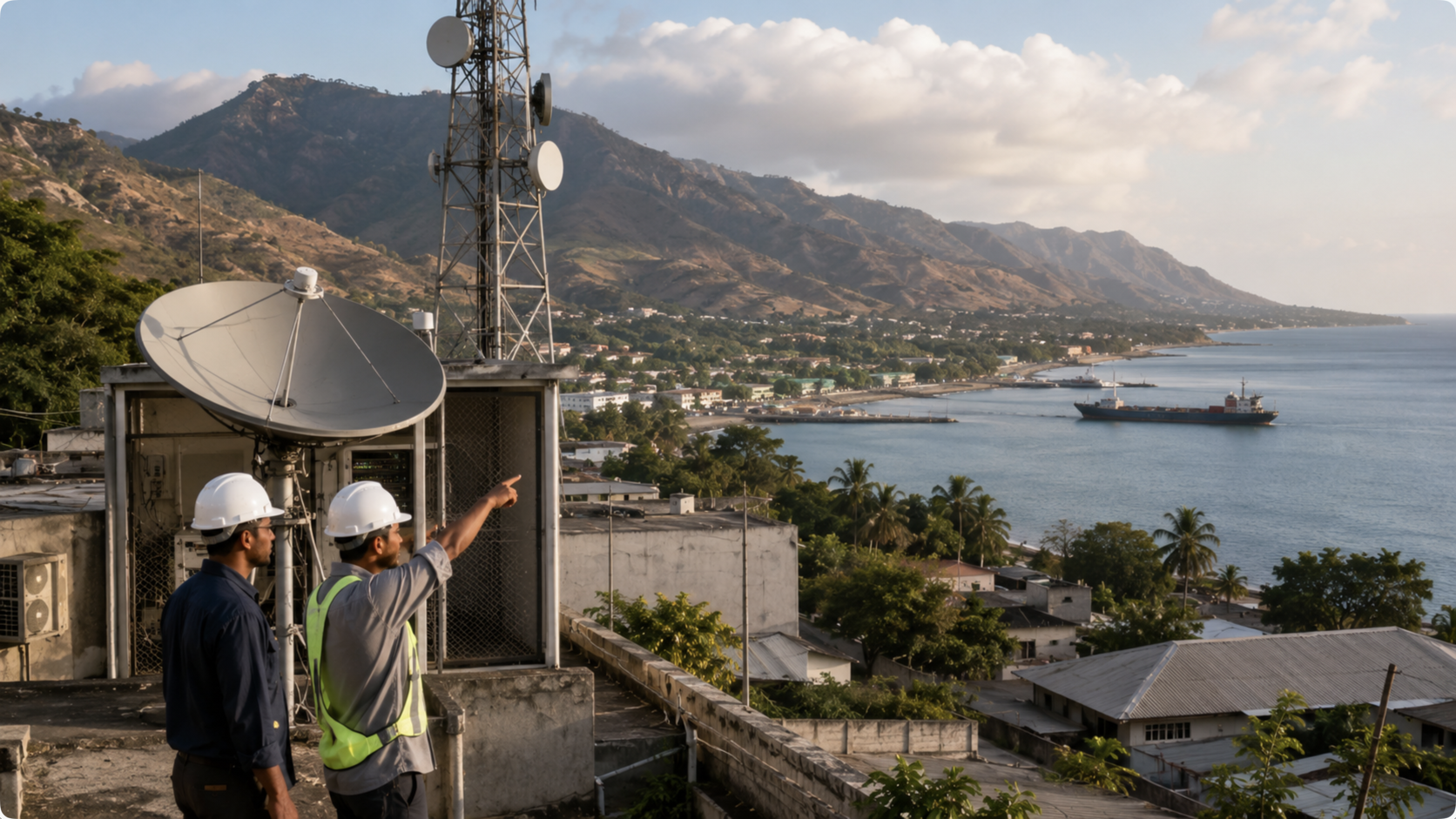
Apurva at the Edge of a Thin Internet Market: Scarcity Rents, Dormant Routing Assets, and the Economics of Trust in Timor-Leste
Timor-Leste’s Internet economy begins with scarcity, not scale. In a large, dense market, an ISP’s bargaining power is usually read through subscriber counts, fiber miles, tower portfolios, peering density, and marketing share. In Timor-Leste, the industrial logic is harsher and more granular: a route out of the country, a reliable upstream relationship, a cross-connect, a public IPv4 block, a technician who can get to a customer site, and a trusted invoice in Dili can matter disproportionately. The country’s historical dependence on satellite uplinks and Indonesian terrestrial transit, the small fixed-broadband base, the absence of a mature local exchange fabric, and the concentration of institutional demand around government, embassies, NGOs, hotels, schools, and a small formal private sector all make Internet access less like a commodity utility and more like a negotiated bottleneck business. An ANC/APNIC Foundation presentation described legacy connectivity as expensive, limited, and high-latency, with Timor-Leste until recently relying on satellite uplinks and Indonesian terrestrial transit; the same material listed only 564 fibre-to-the-premises broadband connections, 285 DSL lines, 86 fixed-wireless premium lines, and 469 satellite broadband connections against a much larger mobile/prepaid communications base.
APURVA UNIPESSOAL LDA sits inside that scarcity economy as a small, legally visible Timorese Internet operator whose public network evidence is much weaker than its formal registration footprint. The strongest records identify APURVA as an APNIC Local Internet Registry organization, an autonomous-system holder, and the holder of portable IP resources: ORG-AUL5-AP, AS148989, IPv4 block 103.175.148.0/24, and IPv6 block 2001:df7:f980::/48. Its own website presents “Apurva Lda” or “Apurva Unipessoal Lda” as an ISP established in 2020, with a registered ISP number, a Dili address, a phone number, and a commercial pitch aimed at government, private-sector, NGO, school, hotel, embassy, and other institutional customers.
The investment-relevant question is therefore not whether APURVA is a large operator. The public evidence says it is not currently visible as one. Hurricane Electric’s BGP data says AS148989 has not been visible in the global routing table since June 12, 2025, while IPinfo characterizes the ASN as inactive with zero hosted domains and zero visible IPv4 or IPv6 addresses; DB-IP similarly reports zero current prefixes, while IP2Location still associates the ASN with 256 IPv4 addresses and the IPv6 /48 as registered resources. That gap between registry resource ownership and current routing visibility is the report’s central fact. APURVA looks less like an active backbone competitor today and more like a thin-market option: a licensed local ISP identity, with scarce numbering resources and possible institutional sales ambitions, whose commercial value would rise sharply if it secured economical upstream capacity, joined a future IXP, activated routing security, and converted local trust into recurring enterprise connectivity revenue.
The canonical target: a Timorese ISP identity, not just a directory name
The canonical identity is APURVA UNIPESSOAL LDA, country code TL, APNIC organization handle ORG-AUL5-AP. APNIC records list the organization as a Local Internet Registry, with address “Av. Rua Nicolau Lobato no. 6, Bidau Lecidere, Nain Feto,” Dili, phone and fax +67077288333, and email info@apurvalda.net. The AS record identifies AS148989 with the as-name APURVA-AS-AP and description APURVA UNIPESSOAL LDA. The IPv4 record assigns 103.175.148.0/24 as portable address space under netname APURVA-TL, and APNIC’s IPv6 whois result identifies 2001:df7:f980::/48 with the same netname, organization, country, and maintainer structure.
The same business appears publicly under several operating labels: “APURVA UNIPESSOAL LDA” in APNIC, “APURVA UNIPESSOAL, LDA. (APURVA ISP)” in the ANC operator-list snippet, “Apurva Lda” on the website title and footer, “Apurva ISP” in marketing copy, and “Apurva Unipessoal Lda” on the about page. The spelling is not perfectly disciplined: the website also contains the phrase “Apurval Unipessoal Lda” in one section, which appears to be a typo rather than a separate entity. In a thin market, such naming looseness matters less for consumer branding than it does for procurement, KYC, supplier onboarding, abuse handling, and regulatory due diligence. The evidence points to one target entity, but it also points to a small-operator documentation culture rather than the polished governance surface of a large carrier.
The public regulator-facing context is stronger than an ordinary web listing. The company’s site states “Registered ISP No. 007/REG/ANC/VI/2021,” and the ANC search result lists APURVA UNIPESSOAL, LDA. at the same Dili address, with the same phone number and the operating label APURVA ISP. A separate ANC announcement search result names “Yohanes Jefri Yap, Diretor” for APURVA UNIPESSOAL, LDA., and ANC’s public event archive shows the regulator awarding certificates of registration in July 2021 to APURVA Unipessoal, Morapido Net, Elite Computer, and Megtelso. Those records do not prove current scale, but they do establish that APURVA was not merely a domain name: it entered the formal telecommunications operator ecosystem around 2021.
Ownership remains unresolved in the public materials reviewed. “Unipessoal” indicates a single-member company form in Portuguese naming convention, and the ANC search snippet gives a director name, but the available public evidence does not disclose beneficial ownership, capitalization, bank financing, shareholder structure, or any acquisition by a parent network. The website’s footer says it is “Powered by BSTT,” and host.io shows the site links to bsttimor.com, but this looks more like a website-development or local services trace than evidence of parentage. Wifiku appears in DNS and hosting records, and historically in routing adjacency, but that is not evidence that Wifiku owns APURVA. The cleanest judgment is that APURVA is a Timorese registered ISP/LIR identity with a publicly visible director signal and no publicly verified parent, financing, or successor entity.
Geography turns upstream access into bargaining power
Timor-Leste’s geography makes upstream access the first economic variable. The country is small, mountainous, archipelagic in its connectivity constraints, and separated from the dense carrier hotel markets that shape bandwidth pricing in Singapore, Jakarta, Darwin, and other regional hubs. Before the submarine-cable transition, the practical upstream menu was dominated by satellite and cross-border Indonesian routes. That means the marginal ISP was not simply buying “Internet transit”; it was buying availability, latency, weather risk, foreign-route dependence, and the right to resell an experience that customers would judge locally but that might fail regionally. The ANC/APNIC Foundation material explicitly frames the old model as satellite plus Indonesian terrestrial transit, expensive and high-latency, with median speeds often below 5 Mbps.
The Timor-Leste South Submarine Cable changes that bargaining environment, but not automatically. The government announced the successful landing of TLSSC on June 24, 2024, connecting Timor-Leste to the Vocus North-West Cable System in Australia; public descriptions put the system at about 607 km with seven repeaters and a design capacity of 27 Tbps between Timor-Leste and Australia. Submarine-cable capacity is not the same as affordable retail bandwidth. The commercial issue is who gets capacity, on what tariff, through what landing-station governance, with what domestic backhaul, and under what cross-connect or resale terms. A small ISP like APURVA benefits from TLSSC only if it can purchase or indirectly access that capacity at a wholesale price that narrows the gap with incumbents.
This is why the APURVA case is economically interesting despite its small public footprint. In a dense market, a /24 and a license may be too small to move the needle. In Timor-Leste, they can be option value. A registered ISP with an APNIC-recognized ASN can, in principle, originate routes, request peering, obtain transit, issue public IP service to enterprise customers, and present itself as a legitimate network operator rather than a pure reseller. But that option only monetizes if the company can solve three scarcity problems at once: cheaper upstream, reliable last-mile installation, and local support credibility. Without those, numbering resources sit idle and the business becomes a sales desk for someone else’s bandwidth.
Customer switching costs strengthen the importance of local trust. A household can swap a SIM card or test Starlink where available; a hotel, embassy, NGO office, school, ministry unit, or private institution has more to lose. Switching business connectivity can mean changing public IPs, reconfiguring firewalls, replacing customer-premises equipment, renegotiating invoices, reworking procurement paperwork, retraining support contacts, and accepting downtime. APURVA’s own site targets precisely these institutional segments, not mass-market mobile consumers. That positioning makes sense because switching costs are higher, trust matters more, and service support can differentiate even a small provider—provided the provider can actually deliver uptime.
The website sells an ISP-integrator; the network data show a dormant carrier surface
APURVA’s website presents a broad ISP and communications-services proposition. The home page states that Apurva Lda is an Internet Service Provider and uses a consumer-friendly “Search, Compare, Connect” sales funnel. The about page says the company was established in 2020 and exists to provide quality Internet to society, companies, embassies, and government. Its listed business activities include Internet services; wired and wireless telecommunication activities; wholesale of electronics and telecommunication equipment; and wholesale of computers, accessories, and software. It also claims affordable broadband, integrated telecommunication and IT services, leased live service, 24/7 monitoring and support, fibre-optic connectivity, and technicians able to plan, execute, and deploy customer installations.
Those claims should be read as commercial positioning, not independently verified operating scale. The site does not publish specific retail or enterprise packages, service-level agreements, network maps, upstream providers, customer names, public case studies, or peering relationships. It contains small-operator or template-like signals, including a “We achieve” section listing one satisfied client, ten projects completed, one accolade, and “1K+ lines of code.” A small client count could be candid, stale, or simply a website artifact; it is not enough to size the business. It does, however, reinforce the picture of a micro-operator or integrator rather than a national access network.
The APNIC records give APURVA the formal ingredients of a network operator: an ASN, portable IPv4, portable IPv6, maintainer records, route-maintenance fields, and abuse contacts. But BGP visibility is the reality check. Hurricane Electric reports that AS148989 has not been visible in the global routing table since June 12, 2025, with one historical IPv4 originated prefix and one observed IPv4 peer. IPinfo classifies the ASN as inactive and shows zero hosted domains and zero visible IPv4 or IPv6 addresses. DB-IP reports zero current IP addresses and zero prefixes, while IP2Location’s ASN page lists the registered 103.175.148.0/24 and 2001:df7:f980::/48 ranges but no upstreams or downstreams.
The right interpretation is not that APURVA never had network relevance. The right interpretation is that registry records and routing records measure different things. APNIC proves resource assignment. BGP tools measure what is being announced and observed. IPinfo and DB-IP measure current visibility and hosted-domain use. IP2Location reflects registry association and ASN-resource mapping. When those records diverge, the economic read is that APURVA controls or has been assigned scarce resources, but those resources are not currently producing the public routing footprint one would expect from a visibly active ISP. That makes the company’s infrastructure position conditional: it has the permission layer, but not a demonstrably active traffic layer.
One operational hygiene issue is material. APNIC’s IRT and abuse-role records now include remarks that info@apurvalda.net is invalid, even though the same email appears on APURVA’s website and in APNIC organization fields. In routing markets, abuse-contact validity is not a decorative issue. It affects trust with upstreams, peering partners, incident response, RPKI/IRR maintenance culture, and the probability that the company can pass due diligence for institutional customers or wholesale suppliers. A stale or invalid abuse mailbox does not prove the business is inactive, but it is consistent with a low-maintenance or low-operations state.
The Wifiku trace: dependency signal, not ownership proof
The most concrete external dependency trace points to PT Wifiku Indonesia. Host.io shows apurvalda.net resolving to 116.0.1.28 on AS59139, PT Wifiku Indonesia, with nameservers ns1.wifiku.net.id and ns2.wifiku.net.id and a standard Apache web server. Hurricane Electric’s historical AS148989 record also identifies one observed IPv4 peer, AS59139 PT Wifiku Indonesia. Wifiku’s public interconnection profile describes it as an Indonesian network service provider with Asia-Pacific scope, multiple prefixes, and meaningful traffic scale relative to APURVA’s small footprint.
This trace has to be handled carefully. It could mean Wifiku hosted the website and DNS only. It could mean Wifiku historically provided transit or a reseller path. It could mean a broader operational relationship between Indonesian and Timorese connectivity actors. The public records do not establish ownership, exclusivity, current transit service, or a commercial contract. But the pattern is commercially meaningful because it fits Timor-Leste’s old scarcity structure: small operators in Dili may need Indonesian technical or upstream partners to reach the wider Internet, especially before local submarine-cable access and a local exchange fabric become economical for smaller players.
If APURVA’s production service, not just its website, depends on an Indonesian upstream or hosting partner, the business has a mixed dependency profile. The upside is practical access to established regional infrastructure, routing know-how, DNS hosting, and possibly lower setup complexity. The downside is supplier bargaining power: APURVA’s gross margin, latency, support response, outage narrative, and foreign-exchange exposure would be shaped by an upstream party outside Timor-Leste. In a thin market, dependence can be rational and still cap bargaining power. A small ISP can win customers through local trust, but it cannot fully control quality if the route, cache access, or congestion point belongs to someone else.
Demand-side economics: APURVA’s natural customer is institutional, not mass retail
APURVA’s own customer list is revealing. It names government, private sector, NGOs, schools, hotels and accommodation, embassies, and private institutions. This is the correct demand segment for a small Dili ISP or ISP-integrator. Mass-market household Internet in Timor-Leste is structurally pulled toward mobile broadband and, increasingly, satellite alternatives in underserved areas. Institutional connectivity, by contrast, still rewards local installation, documentation, support calls, invoicing discipline, and the ability to adapt a connectivity package to a site’s physical constraints.
The ANC/APNIC Foundation numbers help explain why. The country’s communications base is overwhelmingly mobile and prepaid: the presentation listed about 1.49 million mobile telephone subscribers, almost all prepaid, but only a tiny number of fixed-broadband lines. Internet Society Pulse also identifies Timor-Leste as a small least-developed and small-island-developing-state context with no active IXPs recorded in PeeringDB under its methodology. APNIC’s Timor-Leste NOG write-up describes a young, rural, fragmented market in which three networks represent most end-user traffic while the remaining visible ASNs are government or smaller ISPs.
For APURVA, this implies that the revenue base, if active, is likely project-like and relationship-based rather than high-volume automated retail. A plausible revenue stack would include monthly connectivity, installation fees, managed Wi-Fi, CPE resale, small LAN/firewall work, static public IP service, backup links, and IT/communications support. The website’s listed activities—Internet service, wired and wireless telecommunication, telecom-equipment wholesale, and computer/software wholesale—fit an integrator-ISP model rather than a pure access-network model. That business can work in a small market, but it produces lumpy customer acquisition, high support intensity, and limited economies of scale.
The gross-margin pressure is straightforward. Upstream bandwidth is bought in hard currency or foreign-linked terms, equipment is imported or sourced through regional supply chains, technicians must visit sites, customers may require installation credit, and support expectations can be high because a small institutional customer’s Internet outage often becomes a management problem rather than a helpdesk ticket. Timor-Leste’s broader affordability problem intensifies that pressure: APNIC Foundation’s 2025 EmpowerTech material described connectivity as slow, unreliable, and expensive, with many people spending up to US$1 daily when incomes are only a little above US$2 per day. A small operator that cannot lower its upstream cost will be squeezed between customer price sensitivity and supplier power.
Switching costs create local rents, but only after service credibility is earned
The reason small operators can survive in a scarce market is that customers do not buy bandwidth alone. A school buys a working network that teachers can use. A hotel buys guest Wi-Fi that does not destroy ratings. An embassy buys continuity, security, procurement cleanliness, and someone accountable. A ministry office buys an invoiceable service and a local contact. Once installed, those customers face switching costs that go beyond price: site survey, cabling, antenna alignment, router configuration, public-IP renumbering, firewall rules, DNS changes, user disruption, contract approvals, and the uncertainty of whether the next provider will be better.
This is where APURVA’s smallness can be an advantage if paired with execution. A large mobile or incumbent fixed operator may have stronger infrastructure, but not always the responsiveness or customization a small institution wants. A micro-ISP can sell “we know your building, we answer the phone, we can fix the link,” and those claims carry weight in a market where formal infrastructure layers are thin. APURVA’s website leans into this service logic by advertising consultation, 24/7 monitoring and support, fibre connectivity, and technical deployment services.
The same switching costs can also work against APURVA. If a customer is already on Timor Telecom, Telemor/Viettel, Telkomcel/TELIN, Starlink, Kacific, or a more visible local ISP, APURVA must offer a reason to endure the move. That reason could be lower price, better local support, a backup link, procurement fit, a specific installation capability, or a relationship with a trusted intermediary. It is unlikely to be network scale. The BGP record does not support a claim that APURVA currently has a superior autonomous network footprint, public peering base, CDN footprint, or customer cone.
The practical economic wedge is therefore niche redundancy. APURVA may not need to displace incumbents wholesale; it could serve as a secondary link, a managed Wi-Fi vendor, a last-mile installer, a procurement-compliant local partner, or a reseller-integrator that bundles connectivity with IT support. In a thin market, backup links are valuable because outages are not abstract. If an embassy, NGO, hotel, or government office can reduce downtime by adding a second provider, the small operator’s bargaining power can exceed its market share.
Competition: incumbents, local ISPs, satellite, mobile broadband, and informal substitution
The competitive map is broader than APURVA’s public footprint. ANC/APNIC Foundation materials list a Timor-Leste operator universe that includes Timor Telecom, TELIN/Telkomcel, Viettel Timor/Telemor, Gardamor ISP, METROLink, Raph Vision, SACOMTEL, MORAPIDO, APURVA, MEGTELCO, CESLINK, Kacific Broadband Satellites, Starlink Timor, Gonsoa, Nerravi, Vorakai, Chiliasa, Eleanor, and Lorotel. IPinfo and IPgeolocation show active routed presence for major and smaller networks such as Viettel Timor Leste, Timor Telecom, Telekomunikasi Indonesia International T.L., Gardamor, Metrolink, Gonsoa, Morapido, Sacomtel, and others; APURVA appears among the registered Timor-Leste ASNs but with no active routes in those datasets.
The largest substitutes for a small ISP are not always other fixed ISPs. They are mobile broadband, satellite broadband, and direct enterprise arrangements with larger carriers. Mobile networks have an enormous retail base relative to fixed broadband, and IPinfo’s country profile identifies the main mobile-carrier IP presence as Telemor, TT, and Telkomcel. Satellite providers such as Kacific and Starlink Timor appear in the regulator/operator landscape, and they can change the outside option for remote sites, NGOs, and higher-income customers. A small ISP’s pricing power is strongest where these substitutes are inconvenient: dense institutional sites, buildings needing managed internal networks, customers requiring local invoices, or customers that need a blended primary-plus-backup service.
Incumbents also have a quality-of-experience advantage through caches and direct content relationships. The ANC/APNIC Foundation presentation identifies Meta CDN presence in Dili and Google Global Cache nodes intended to improve local performance. Netify’s Meta CDN data shows Meta cache presence in Timor-Leste associated with networks such as Viettel, Timor Telecom, and Telekomunikasi Indonesia International, while Google explains that Google Global Cache lets ISPs serve Google content from within their own networks, easing congestion and reducing traffic over peering and transit links. Small operators without cache access may have worse perceived performance even if they buy adequate transit.
This matters because customer experience is not priced only by Mbps. A user judges YouTube, WhatsApp, Facebook, Instagram, app updates, video calls, and cloud services. If incumbent networks host caches or have better routes to caches, their service can feel faster at the same nominal speed. APURVA’s public records show no visible CDN hosting or hosted-domain base on its own ASN. Its website itself is hosted on Wifiku’s Indonesian ASN rather than on APURVA’s own visible network. That does not prevent APURVA from serving customers, but it weakens any claim to independent content-distribution advantage.
The IXP question: a policy change that could either democratize or expose APURVA
Timor-Leste’s lack of an active local IXP is one of the most important structural facts. Internet Society Pulse reports no active IXPs in the country under its PeeringDB-based methodology, and the ANC/APNIC Foundation presentation argues for an IXP to localize traffic, lower transit fees, improve resilience, and encourage local content. APNIC’s own infrastructure guidance describes IXPs as layer 1/2 structures where three or more autonomous systems interconnect and exchange local traffic locally rather than sending it overseas.
For APURVA, a functioning IXP has two opposing effects. On the positive side, it could reduce the penalty of smallness. If APURVA reactivates AS148989, obtains a port, configures a route-server session, and peers with local networks, it could improve latency to domestic destinations, caches, government services, and other local networks without buying all traffic as paid transit. It could also make APURVA more legitimate in the eyes of enterprise customers and upstream suppliers. The ANC/APNIC Foundation design discussion includes route servers, IXP Manager, monitoring, DNS, root/auth services, AS112, RPKI validator, NTP, and cache-related infrastructure—exactly the shared technical layer that smaller ISPs cannot economically build alone.
On the negative side, an IXP can expose operators that are not really operating networks. If the future Dili exchange publishes members, ports, traffic graphs, route-server participants, and peering policies, it becomes much easier to separate active networks from licensed but dormant ones. A small ISP that does not join may look peripheral; one that joins but carries little traffic may lose narrative power. The IXP would democratize access to local interconnection, but it would also raise the evidentiary bar for claiming infrastructure relevance. APURVA’s watchpoint is not simply whether Timor-Leste launches an IXP; it is whether AS148989 appears there as a functioning participant.
Trust governance is central. The ANC/APNIC Foundation presentation states that initial IXP meetings should emphasize latency, cost, national sovereignty, shared governance, trust, and transparency. That is not incidental language. In thin markets, operators may avoid local peering because of competitive mistrust, fear of unequal traffic ratios, uncertainty about neutrality, or concern that incumbent carriers will dominate the shared infrastructure. A small APURVA-like operator benefits most if the IXP is genuinely neutral, affordable, and technically well-supported.
TLSSC lowers the ceiling on scarcity rents, but raises the value of local execution
The submarine cable is the biggest exogenous shock to the economics of Timor-Leste Internet access. Historically, high upstream cost and high latency created room for scarcity rents: customers paid more not because providers were inefficient, but because the supply chain was narrow. TLSSC has the potential to lower wholesale costs and improve latency to Australia and onward routes. That should compress some price premiums and make bandwidth less exotic. The government’s public messaging explicitly links the cable to speed, latency, investment attraction, and digital-economy development.
But cable capacity is not the same as retail competition. If access to TLSSC capacity is expensive, vertically controlled, delayed, or bundled through incumbents, small operators may still face high marginal costs. If it is open, transparent, and available at reasonable volume increments, then operators like APURVA could become more viable. Their differentiation would shift from “I can get you any Internet at all” to “I can install, support, invoice, and manage your Internet better.” That is a major change in bargaining power. Upstream scarcity rents decline; customer-service rents and local integration rents become more important.
This is why APURVA’s dormant routing record is not the whole story. If the company’s internal business is a reseller/integrator, it may benefit from cheaper wholesale even without announcing its own ASN. If it wants to become a true facilities-based or route-visible ISP, TLSSC plus a local IXP could give it the cost base and interconnection layer it previously lacked. The economic question is whether APURVA has management capacity, capital, supplier relationships, and a customer pipeline. The public record proves the formal resource layer; it does not prove the execution layer.
Business model under scarcity: recurring access plus high-touch services
A realistic APURVA business model has four revenue lines. The first is recurring Internet access: fixed wireless, fibre-fed last-mile where available, leased connectivity, or resold access. The second is installation and customer-premises equipment: routers, radios, antennas, cabling, Wi-Fi access points, backup power, and network configuration. The third is managed IT and communications services, supported by the website’s claims around integrated telecom and IT offerings. The fourth is equipment/software wholesale or resale, which the website lists explicitly.
The revenue logic is appealing because each customer can produce both one-time and recurring income. A hotel, school, embassy, NGO, or private institution may need equipment, installation, recurring bandwidth, support, upgrades, and perhaps a backup link. The difficulty is that small customer count makes cash flow fragile. One late-paying government or institutional customer can matter. One upstream price change can erase margin. One technician leaving can reduce service quality. One outage at an upstream provider can damage APURVA’s reputation even if APURVA is not at fault.
Pricing power comes from scarcity and trust, not from network scale. APURVA can charge a premium only if customers believe it will solve their local problem faster than alternatives. That belief can be created through relationships, demonstrated support, and procurement fit. It cannot be created by a website alone. The public site’s lack of packages, named customers, testimonials, network metrics, or uptime claims suggests that APURVA’s sales process, if active, is likely offline and consultative. That is normal for a thin institutional market, but it limits external visibility.
Payment friction is another important margin variable. Timor-Leste’s small formal economy, public-sector procurement cycles, NGO budgeting, and import dependence can turn a theoretically high-margin monthly service into a working-capital problem. The regulator-fee environment may also matter. Local press search results quote ANC leadership discussing annual fees or contributions from operators and ISPs, including APURVA among the ISP set, with a 2% revenue-based payment mentioned in those reports. That is not large enough by itself to determine economics, but it is part of the compliance cost stack for small operators.
What the public record proves—and what it does not
The public record proves five things with reasonable confidence. First, APURVA UNIPESSOAL LDA is a formal Timor-Leste entity in APNIC records, not merely an SEO directory artifact. Second, it holds or is assigned APNIC-numbered resources: AS148989, 103.175.148.0/24, and 2001:df7:f980::/48. Third, it publicly markets itself as an ISP/IT/communications-service provider from Dili. Fourth, it appears in ANC operator and certificate-registration context around 2021. Fifth, its current public route visibility is weak to nonexistent in major BGP/ASN tools.
The record suggests—but does not prove—that APURVA may operate more as a small reseller-integrator, dormant ISP, or project-based connectivity provider than as a fully active independent access carrier. The strongest suggestive evidence is the mismatch between formal ISP/network resources and the absence of visible routing, hosted domains, public customer references, public package pricing, public peering, or current upstreams. The Wifiku-hosted website and historical Wifiku peer trace suggest an Indonesian technical dependency surface, but not ownership or a current exclusive upstream relationship.
Several commercially important facts remain unresolved. There is no public proof of active subscriber count, current revenue, customer concentration, working-capital position, wholesale contract terms, physical last-mile assets, spectrum or wireless permissions, current license renewal status beyond website/operator-list traces, ownership, shareholder capital, debt, or M&A interest. There is no public evidence that APURVA hosts CDN caches, peers locally, operates a data center presence, or has a current route-security posture. Each unresolved fact would change valuation. A company with ten paying enterprise customers, cheap TLSSC wholesale access, and a functioning AS is very different from a dormant license holder with a website and an invalid abuse contact.
Competing hypotheses
The conservative hypothesis is that APURVA is a dormant or lightly maintained ISP/resource holder. This fits the BGP record, IPinfo inactivity signal, DB-IP zero-prefix view, invalid APNIC abuse-contact remarks, and the low-evidence website. Under this hypothesis, APURVA’s economic value is mainly option value: an ISP registration, local address, phone number, ASN, and IP resources that could be reactivated, sold, partnered, or used as a procurement shell. This is the most evidence-consistent reading today.
The second hypothesis is that APURVA is an active reseller-integrator whose own ASN is not central to its production service. This also fits the evidence. A small Timorese operator can sell connectivity, installations, Wi-Fi, equipment, and IT support without announcing its own prefixes if it is reselling or bundling another provider’s access. In that model, the APNIC resources are strategic optionality or legacy infrastructure, while actual customer service rides on upstream partners. The website’s service mix and Wifiku DNS/hosting trace are consistent with this model, though not proof.
The third hypothesis is a transitional reactivation story. APURVA was registered and numbered in 2021, had some BGP visibility historically, disappeared from global routing visibility in June 2025, and could reappear as TLSSC and IXP plans change the cost of becoming route-visible. Under this view, the dormant state is not terminal; it is an option waiting for cheaper upstream, a customer contract, or a local peering point. This is plausible because Timor-Leste’s infrastructure environment is changing rapidly after the cable landing and ongoing local interconnection discussions.
The fourth hypothesis is that APURVA becomes an acquisition or partnership platform. For a foreign or regional operator, acquiring or partnering with a small licensed local ISP could provide market entry, regulatory continuity, local relationships, and APNIC-numbered resources. The evidence does not show such a transaction, but the option is economically rational in a thin market. The value would be highest if the license is clean, the resources are in good standing, the director/shareholder can transact, and the company has even a small base of institutional customers.
Commercial judgment
APURVA is not presently evidenced as a major Timor-Leste network. The visible indicators that would support that claim—current BGP announcements, multiple upstreams, public peering, hosted domains on its ASN, CDN/cache participation, customer references, package transparency, visible outage or review footprint, procurement awards, and active abuse/routing hygiene—are absent or weak in the public record. The company should not be treated as a proven carrier-scale competitor to Timor Telecom, Telemor/Viettel, Telkomcel/TELIN, or the more visibly routed local ISPs.
Yet APURVA should not be dismissed as irrelevant. In Timor-Leste, the economic value of a small operator can be discontinuous. A licensed local ISP with an ASN, a /24, an IPv6 /48, a Dili address, and institutional positioning can matter if market conditions shift. Scarcity makes small permissions valuable. A public IPv4 /24 is a minimum global-routing unit and a useful enterprise-service asset. A local ISP registration can matter in procurement. A working relationship with an upstream can matter more than brand awareness. A trusted local installer can win accounts even without owning national infrastructure. APURVA has pieces of that option set; the unresolved question is whether it has the operational engine.
The strongest economics-style conclusion is that APURVA’s value is convex. If nothing changes, it remains a small or dormant resource holder with weak public routing relevance. If TLSSC wholesale access becomes open and affordable, a neutral IXP goes live, APURVA restores BGP announcements with valid RPKI, obtains one or two reliable upstreams, and lands institutional customers, its relevance could rise quickly from near-invisible to niche-important. Thin markets allow that jump because the distance between “no route” and “one useful route plus local trust” is commercially large.
Evidence ledger
APNIC organization, ASN, IPv4, and IPv6 records. APNIC is the strongest primary source for canonical identity. It identifies APURVA UNIPESSOAL LDA as ORG-AUL5-AP, a Timor-Leste Local Internet Registry; AS148989 as APURVA-AS-AP; 103.175.148.0/24 as APURVA-TL portable IPv4 space; and 2001:df7:f980::/48 as APURVA-TL portable IPv6 space. The same APNIC records also show the Dili address, phone number, maintainer structure, and invalid-contact remarks for the abuse/IRT email. Commercial meaning: APURVA has formal resource legitimacy, but weak contact hygiene.
APURVA website. The website supports the operating identity “Apurva Lda,” “Apurva ISP,” and “Apurva Unipessoal Lda.” It states that the company was established in 2020, markets ISP, IT, wired/wireless telecom, fibre, leased-service, monitoring/support, equipment-wholesale, and computer/software activities, and targets government, private sector, NGOs, schools, hotels, embassies, and private institutions. It also lists Registered ISP No. 007/REG/ANC/VI/2021, the Dili address, phone, email, and office hours. Commercial meaning: the company positions itself as an institutional ISP-integrator, but the site does not prove active scale or network performance.
ANC regulator signals. ANC search-result snippets list APURVA UNIPESSOAL, LDA. / APURVA ISP at the same Dili address and phone, and one ANC announcement snippet names Yohanes Jefri Yap as director. ANC’s event archive shows July 2021 certificate-registration activity involving APURVA and other operators. Commercial meaning: APURVA entered the formal operator/regulatory ecosystem, but public regulator snippets do not disclose current customer base, license renewal status, assets, or finances.
BGP and ASN visibility tools. Hurricane Electric reports that AS148989 has not been visible in the global routing table since June 12, 2025, with one historical IPv4 prefix and one historical observed peer. IPinfo classifies AS148989 as inactive with zero hosted domains and zero visible IPv4/IPv6 addresses. DB-IP reports zero current IP addresses/prefixes. IP2Location associates the ASN with 103.175.148.0/24 and 2001:df7:f980::/48 but shows no upstreams or downstreams. Commercial meaning: APURVA has assigned resources, but current public route visibility is dormant or negligible.
Website hosting, DNS, and Wifiku dependency trace. Host.io shows apurvalda.net on 116.0.1.28, AS59139 PT Wifiku Indonesia, with Wifiku nameservers. Hurricane Electric’s historical record also identifies AS59139 as APURVA’s observed IPv4 peer. PeeringDB/BGP tooling presents Wifiku as a materially larger Indonesian network-service provider. Commercial meaning: Wifiku is a concrete dependency signal, at least for website/DNS and historically for routing adjacency, but the public record does not prove ownership, exclusive transit, or a current production-service contract.
Timor-Leste market-structure and infrastructure context. ANC/APNIC Foundation material identifies the regulator’s role, operator universe, legacy dependence on satellite and Indonesian transit, tiny fixed-broadband counts, CDN/cache context, local-traffic tromboning, and IXP plans. Internet Society Pulse reports no active IXPs in Timor-Leste under its methodology. APNIC NOG material describes a small, rural, developing market with traffic concentrated among three major end-user networks. Commercial meaning: APURVA operates, or could operate, in a market where local trust, upstream routes, and shared interconnection can create outsized effects.
Submarine-cable transition. Timor-Leste government and submarine-cable sources report TLSSC’s June 2024 landing, its connection to Vocus NWCS, roughly 607 km route, seven repeaters, and 27 Tbps design capacity. Commercial meaning: TLSSC can reduce the old scarcity premium, but the benefit to small operators depends on wholesale access, landing-station economics, domestic backhaul, and whether capacity is made available on terms that non-incumbents can use.
CDN/cache and quality-of-experience evidence. ANC/APNIC Foundation material identifies Meta CDN and Google Global Cache presence in Dili, Netify associates Meta cache presence with larger local networks, and Google explains that GGC lets ISPs serve Google content from within their networks to ease congestion and reduce transit load. Commercial meaning: quality advantage may accrue to operators with cache access and stronger interconnection, not simply to the lowest headline Mbps price.
Unresolved evidence gaps. I found no robust public evidence of APURVA’s active customer list, revenue, package pricing, physical network map, last-mile assets, current upstream contract, spectrum/wireless authorization details, procurement awards, financing, shareholder structure, M&A activity, CDN deployments, public outage history, job posts, or customer-review corpus. Commercial meaning: the analyst should treat APURVA as a formally real but operationally opaque small operator until fresh evidence appears.
Watchpoints
AS148989 returning to global BGP. The most important signal would be AS148989 again announcing 103.175.148.0/24, and ideally 2001:df7:f980::/48. The number of upstreams, route stability, prefix age, and observed traffic would distinguish a real reactivation from a test announcement.
RPKI, IRR, and abuse-contact hygiene. Valid ROAs, corrected APNIC abuse contact, maintained route objects, reverse DNS, and consistent whois fields would show operational seriousness. Continued invalid-contact remarks would reinforce the dormant-resource hypothesis.
Upstream replacement or diversification. A move from a Wifiku-associated dependency surface toward TLSSC-backed transit, local incumbent transit, or multiple international upstreams would change latency, cost, and bargaining power. One upstream means supplier risk; two or more credible upstreams create resilience and negotiating leverage.
Participation in a Timor-Leste IXP. If a Dili IXP launches, watch for AS148989 on the member list, route-server sessions, port speed, traffic graphs, and peering policy. IXP membership would be a strong signal that APURVA is becoming a network operator rather than only a reseller-integrator.
TLSSC wholesale access terms. The cable’s commercial effect depends on tariffs, cross-connect charges, minimum commitments, resale rules, and domestic backhaul. Open, granular access would help small ISPs; concentrated wholesale control would preserve incumbent advantages.
CDN/cache access. APURVA’s service quality would improve if it could reach Meta, Google, or other caches locally through peering or shared infrastructure. If caches remain concentrated on larger networks, APURVA may need to compete through support and price rather than performance.
Regulator-list changes and license renewals. Removal from ANC operator lists, failure to renew registration, or new compliance obligations would reduce option value. Updated certification, published license details, or inclusion in IXP/regulatory programs would increase credibility.
Institutional customer proof. Named government, embassy, NGO, school, hotel, or enterprise contracts would matter more than consumer marketing. Even a small number of credible institutional accounts could validate the switching-cost thesis and create recurring revenue.
Public package/pricing transparency. Published plans, SLAs, installation fees, support commitments, and business packages would suggest a more active sales operation. Continued generic website copy would keep the business in the opaque micro-operator category.
Competitor fixed-wireless, fibre, and satellite moves. Timor Telecom, Telemor/Viettel, Telkomcel/TELIN, Gardamor, Metrolink, Gonsoa, Morapido, Sacomtel, Starlink Timor, and Kacific can all pressure APURVA’s niche. Mobile or satellite price drops would weaken APURVA’s pricing power unless it differentiates through managed service and local support.
M&A or partnership signals. Any partnership with an Indonesian ISP, Timorese incumbent, systems integrator, satellite provider, or foreign entrant would be material. APURVA’s license, ASN, and IP resources could become more valuable inside a better-capitalized operating platform.
IP-resource monetization. Transfer, leasing, or non-use of the /24 would reveal whether the resource is being treated as operating infrastructure or financial/strategic inventory. In a world of scarce IPv4, a clean portable /24 has value even if the ISP business is dormant.
Local support capacity. Job posts, technician hiring, vehicle/equipment procurement, office expansion, or field-installation references would show that APURVA is investing in the operational layer that customers actually experience.
Customer-service traces. Google reviews, Facebook posts, outage complaints, forum chatter, or local word-of-mouth signals would be commercially useful. Positive support traces would validate the local-trust thesis; unresolved complaints would be damaging in a small market where reputation travels quickly.
Government digital-infrastructure procurement. Timor-Leste’s cable, IXP, CDN, and digital-government buildout may create subcontracting opportunities. A small ISP-integrator with local registration could benefit from installation, managed connectivity, backup-link, or equipment-supply packages even without becoming a large carrier.