
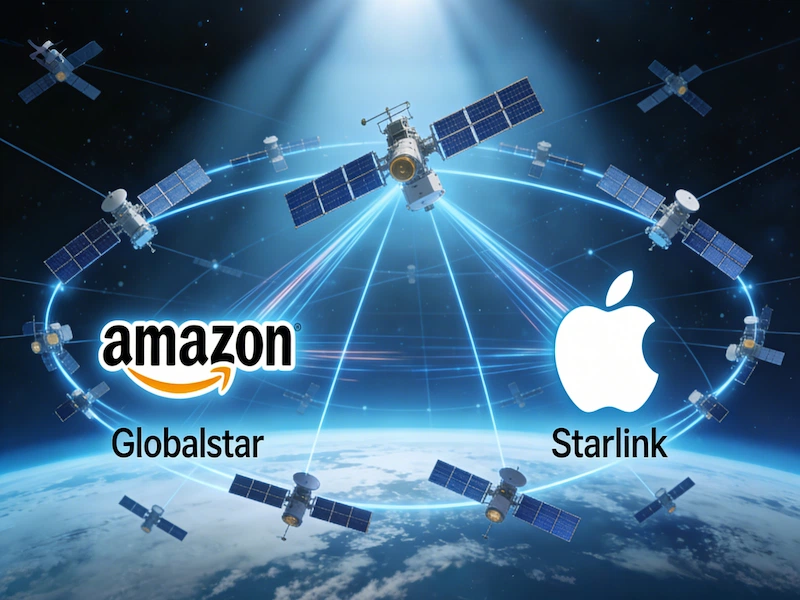
- Amazon is exploring a Globalstar acquisition to accelerate its LEO satellite push and compete with Starlink.
- Apple’s existing partnership with Globalstar introduces strategic uncertainty.
What happened
Amazon is reportedly exploring a $9bn acquisition of Globalstar, in a move that would accelerate its position in the low Earth orbit (LEO) satellite market. The deal would complement Project Kuiper, Amazon’s planned constellation of more than 3,200 satellites, which remains in early deployment compared with SpaceX’s Starlink.
Globalstar brings a functioning LEO network and, crucially, access to licensed spectrum—an increasingly scarce asset as competition intensifies. The operator also has a strategic partnership with Apple, which committed over $450m to support satellite-enabled Emergency SOS services on iPhones, as confirmed by.
For Amazon, acquiring Globalstar could shortcut years of infrastructure buildout by adding operational satellites and spectrum rights. However, existing agreements—particularly with Apple—may restrict how these assets are controlled, integrated or monetised post-acquisition.
Why it’s important
Amazon’s potential move signals a shift from gradual deployment to strategic acceleration in the satellite race. While Starlink leads with scale, launch cadence and an established user base, Amazon is leveraging capital and ecosystem integration to compress the timeline.
The real battleground is no longer just satellites, but spectrum and ecosystem control. Globalstar’s assets could give Amazon a faster route to market while strengthening links between Kuiper and AWS, enabling bundled connectivity solutions for enterprise, government and edge use cases.
However, Apple introduces a decisive variable. Its financial backing and service dependence on Globalstar create a layer of influence that Amazon cannot easily displace. Control over the end-user device ecosystem gives Apple leverage in shaping how satellite services are delivered, priced and expanded.
This dynamic reframes the competitive narrative. Amazon’s satellite strategy has the potential to disrupt Starlink’s dominance, but the outcome may depend less on orbital scale and more on strategic alignment. If Apple maintains influence over Globalstar’s capacity or direction, it could effectively shape how far Amazon can go.
From a financial perspective, a $9bn bet underscores Amazon’s willingness to invest in long-cycle infrastructure with uncertain returns. Yet if integration succeeds, it could redefine Amazon as a fully integrated connectivity provider.
In effect, Amazon may challenge Starlink—but Apple determine who ultimately wins.
Also read: Sparkle partners with Anthropic to offer Claude AI via Amazon Bedrock
Also read: Amazon eyes $9bn Globalstar deal to challenge Starlink