
Amader Net and the Economics of the Neighborhood ISP: Why a Thinly Visible Dhaka Broadband Name Can Survive the Commodity Bandwidth Squeeze
Small local ISPs endure because broadband is not bought as a pure commodity at the customer’s door. Bandwidth may be purchased upstream in standardized increments, pushed through licensed gateways, routed across fiber, and resold in packages that look interchangeable on a price sheet. But the residential and small-business customer does not experience the internet as an abstract Mbps input. The customer experiences a cable entering a building, a router that stops working during rain or load-shedding, a technician who either arrives or does not, a monthly payment habit, a local phone number, and the reputational knowledge that “this provider fixes things quickly in our lane.” That is the economic opening for a small Bangladeshi ISP name such as Amader Net.
Bangladesh’s fixed-broadband market is structurally smaller than mobile by subscriber count but more consequential than its share implies. AMTOB’s BTRC-sourced industry statistics for May 2026 put total internet subscribers at 134.07 million, of which 119.12 million were mobile internet subscribers and 14.95 million were ISP plus PSTN subscribers. In other words, fixed service is a minority access category by subscriber count, yet it is the category around which households, small offices, media consumption, gaming, remote work, and neighborhood service relationships are organized. The Daily Star reported in 2021 that, although mobile internet users were much more numerous, broadband users consumed 58 percent of Bangladesh’s total bandwidth.
That asymmetry explains why small ISPs are commercially more durable than a simple bandwidth-commodity model would predict. The upstream gigabit is tradable; the last 200 meters are not. The retail plan can be copied; the building access relationship cannot be copied instantly. A national operator may have stronger capital, better marketing, and lower purchasing cost, but a small ISP may know the building manager, the electrician, the local shop that collects payments, the fastest route for a splice team, and the customer’s tolerance for a half-day outage. Where customers buy reliability as a relationship rather than as an SLA document, small providers can persist despite wholesale pressure.
Amader Net is a useful case precisely because the public record is thin, contradictory, and operationally suggestive. The target is not a glossy national broadband brand with a clean investor deck. The strongest primary records identify Amader Net as a Bangladesh entity in APNIC’s registry: organisation handle ORG-AA160-AP, org-name “Amader Net,” org-type LIR, country BD, with an address at 205/5 Al Basir Plaza, Box Culvert Road, Motijheel, Dhaka, and a last-modified date of 5 September 2023. Its own autonomous system, AS136945, exists in public routing registries, but bgp.tools currently marks it as not in the global routing table, with zero IPv4 and zero IPv6 prefixes originated. A BTRC cancellation notice then lists “Amader Net” among 228 ISP licenses cancelled in May 2023 for failure to convert licenses, with the Amader Net row showing the same Motijheel/Fakirapool area address and “ISP (Cat-A)” license type.
Yet that is not the end of the story. Amader Net’s allocated portable IPv4 block, 103.149.74.0–103.149.75.255, remains visible in public network records as “AMADERNET1-BD,” described as Amader Net and tied to ORG-AA160-AP. The two /24s inside that block appear in bgp.tools under Race Online’s AS63969, each labeled “Amader Net” and each showing a valid RPKI certificate. The commercial implication is important: Amader Net’s own ASN may be dormant, and its historical Cat-A license may have been cancelled, but its numbering resource still appears in the live routing economy through a larger upstream or aggregator. In a small-ISP market, that is often where persistence hides: not in a pristine standalone corporate profile, but in a customer book, a route object, a local brand, an upstream announcement, or a successor/adjacent operating name.
The cleanest thesis is therefore not “Amader Net is a currently independent full-service ISP.” The stronger, evidence-bound thesis is this: Amader Net was a real Bangladesh ISP/network entity with APNIC-recognized resources; its standalone regulatory and BGP posture weakened or lapsed; and the surviving commercial value, if any, is likely located in local access relationships, IPv4 resources, reseller/upstream arrangements, or migration into adjacent operating identities rather than in a self-contained national network. That distinction matters because the economic question is not only whether Amader Net as a named licensee is fully active. It is why a named local online provider can remain economically relevant even when bandwidth itself is commoditized.
The neighborhood bargain: where commodity bandwidth becomes a service business
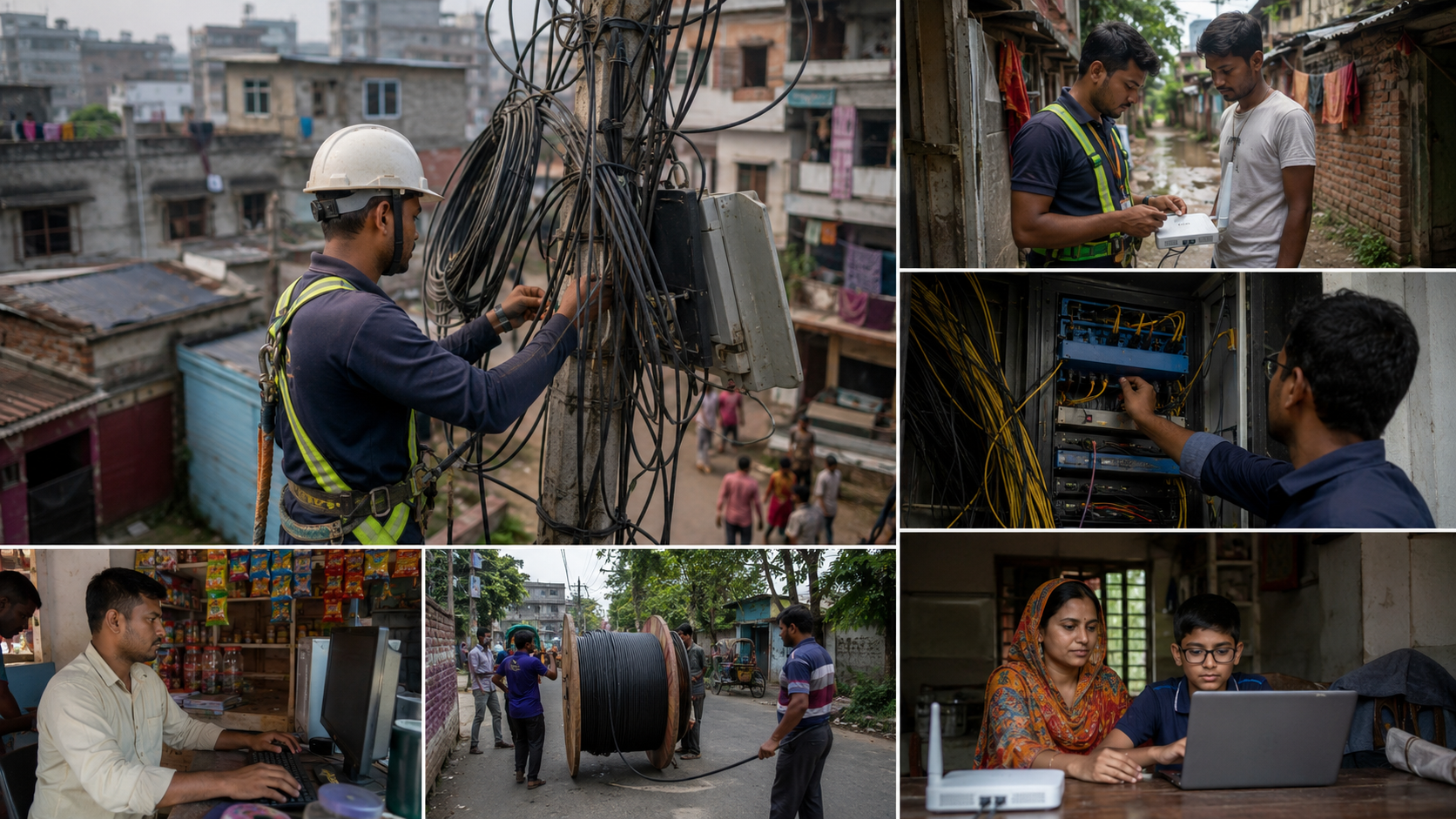
The Bangladeshi ISP customer buys four things that are bundled into one monthly broadband bill. First is upstream internet access: international transit, domestic routing, cached content, and local exchange access. Second is last-mile construction: fiber to a home, a switch in a building, drop cable, router configuration, and sometimes a shared local topology that only the neighborhood operator understands. Third is support: a technician who can come when a fiber is cut, a router is misconfigured, or an ONU loses power. Fourth is payment continuity: someone must collect, remind, reconnect, and handle credit or delay without destroying the relationship.
Only the first of those is close to a commodity. The other three are local, labor-heavy, and relational. That is why the price of bandwidth can fall while the small ISP remains difficult to displace. If the customer’s problem is that the cable was cut by construction, the best global transit contract does not repair the service. If the customer’s problem is that a router needs to be reconfigured after a power event, a cheaper upstream megabit is irrelevant. If the customer pays late but is known to the collector, the economics of churn differ from a purely digital subscription model.
Bangladesh’s regulatory structure reinforces this local character. The BTRC’s ISP licensing guidelines state that no person or business entity may build, maintain, and operate ISP systems and services without a license, and they define ISP license categories as Nationwide, Divisional, District, and Upazila/Thana. The same guidelines state that ISPs take leased or sub-leased transmission from NTTN operators and that last-mile connectivity is limited to roughly three kilometers in metropolitan areas and six kilometers in other locations, subject to local authority instructions. This is not a market where every local provider simply buys a global circuit and runs free. It is a layered system: licensed retail service, licensed gateways and transmission providers, local last-mile limits, and administrative geography.
For a small ISP, the economic result is a narrow but defensible role. It does not need to own the whole stack to survive. It needs to own enough of the customer relationship and the last-mile operating routine to avoid being reduced to a pure bandwidth reseller. Amader Net’s public trail illustrates this. Its own AS136945 does not currently originate routes, but the Amader Net IP block is still visible under Race Online. That suggests a model in which the small operator’s independent routing capability is less central than its dependence on, or integration with, a larger network operator. The upstream can change; the last-mile customer relationship may be stickier.
Identifying the target: Amader Net is real, but the name is not clean
The target can be identified accurately from primary network records. APNIC’s authoritative WHOIS record for ORG-AA160-AP gives the org-name as Amader Net, org-type LIR, country BD, and an address at 205/5 Al Basir Plaza, Box Culvert Road, Motijheel. The record includes a Bangladesh phone number, an email address using “amadernet,” and a last-modified date in September 2023. bgp.tools maps AS136945 to Amader Net, says it was registered on 5 March 2020, and shows the APNIC aut-num as “AmaderNet-AS-AP” with country BD, organisation ORG-AA160-AP, and route maintainer MAINT-AMADERNET1-BD.
That establishes existence. It does not establish current retail operation.
The naming environment is messy. Public records and websites surface at least three closely named but not necessarily identical entities. “Amader Net” is the APNIC/RIR and BTRC-cancellation-list target. “Amader Net Ad Communication” is a separate visible operator, associated with the domain anc.net.bd, AS138697, ISPAB membership, a Babubazar/Midfort service area, and a BTRC Upazila/Thana licensing context. “Amader Network,” also branded ANET, is another Dhaka broadband identity with its own website and BTRC listing in Kalabagan.
The evidence does not prove that these are parent, successor, affiliate, or proprietor-related entities. It proves something more limited but still commercially valuable: the “Amader” broadband naming space in Dhaka is crowded enough that customer-facing identity may be more fluid than formal network identity. In a market of small proprietorships, local licenses, route objects, and neighborhood trading names, that ambiguity is not noise. It is part of the business model. A customer may remember “Amader Net” as the provider; the regulator may list a specific licensee; APNIC may preserve an address block; a current website may be under a slightly different name; and routing may occur through another ASN entirely.
For intelligence purposes, this means Amader Net should be treated in layers. The narrow layer is the APNIC/BTRC entity: Amader Net, ORG-AA160-AP, AS136945, and 103.149.74.0/23. The broader commercial layer includes similarly named local operators only as comparables or possible but unproven continuity paths. The most dangerous analytical error would be to merge them casually. The second most dangerous error would be to ignore them entirely, because neighborhood ISP economics often persist through precisely these adjacent labels.
The sleeping ASN and the live address block
The network evidence is the most informative part of the case. AS136945 is a registered APNIC ASN for Amader Net, but it is not currently in the global routing table and originates no IPv4 or IPv6 prefixes according to bgp.tools. IPinfo separately characterizes AS136945 as inactive, with no visible IPv4 ranges, IPv6 ranges, peers, or upstreams. A purely ASN-based read would conclude that Amader Net is dormant.
The IPv4 evidence complicates that conclusion. Public WHOIS data for 103.149.74.0/24 shows the broader inetnum 103.149.74.0–103.149.75.255 as AMADERNET1-BD, description Amader Net, country BD, organisation ORG-AA160-AP, status “ALLOCATED PORTABLE,” and route maintainer MAINT-AMADERNET1-BD. That is a /23, or 512 IPv4 addresses. In a small ISP environment, a /23 is economically meaningful. It can support NAT pools, real-IP add-ons, small enterprise customers, infrastructure addresses, server/service exposure, and reputation-sensitive assignments. It is not a national-scale resource, but it is large enough to matter.
The live route view shows those two /24s inside Race Online’s AS63969. bgp.tools lists 103.149.74.0/24 and 103.149.75.0/24 under Race Online Limited and labels both as Amader Net with valid RPKI certificates. IPinfo’s prefix page for 103.149.74.0/24 similarly places the range under AS63969 Race Online, marks the prefix RPKI valid, associates the ASN domain with amadernet.net, and shows recent Dhaka traceroute/pingability evidence.
This pattern has several possible explanations. Amader Net may have outsourced BGP origination to Race Online while retaining resource identity. Race may be upstreaming or aggregating Amader Net’s access network. The customer base may have been migrated to a larger provider while the legacy IP block remained labeled. The address block may be announced for a reseller, colo, or local access network that no longer uses AS136945. None of these can be confirmed from the public record alone, but all point to the same economic conclusion: upstream dependence is high, and independent ASN operation is not the core asset at present.
The contact records also point toward dependency. The WHOIS data for the Amader Net inetnum lists an IRT address at Khwaja Tower, Mohakhali, with info@race.net.bd as the email and abuse mailbox; the record remarks that info@race.net.bd is invalid. That is not proof of operational failure, but it is a signal of administrative fragility. For a small ISP, stale abuse contacts, upstream-controlled route origination, and an inactive ASN are not trivial. They affect deliverability, incident response, regulatory confidence, and the ability to bargain with transit providers.
The live-route evidence therefore says more than a company website would. It says Amader Net’s resource footprint has not vanished from the internet, but the control plane appears to sit elsewhere. The asset is not an autonomous network in the strong sense. It is a named resource and possibly a local-service or customer relationship embedded in a larger routing provider.
The license event: cancellation as a shock to the small-ISP equilibrium
The BTRC cancellation notice is the hardest adverse fact. The notice, dated 29 May 2023, concerns cancellation of 228 ISP licenses. It states that the listed entities failed to convert their ISP licenses within the specified time, violated the licensing guidelines and Bangladesh Telecommunication Regulation Act, and that activities under those licenses would be illegal and punishable; it also directed the entities to refrain from ISP-license-related activities and surrender their licenses within ten days. The list includes “Amader Net,” address “205/5, Al Bashir Plaza (6th Floor), Fokirapol, Motijheel, Dhaka-1000,” license type “ISP (Cat-A).”
That notice should be read against the 2020 guideline conversion regime. BTRC’s ISP guidelines converted existing Category A/B/C licenses into Upazila/Thana licenses, with existing licensees required to apply for conversion within one year. Daily Star coverage from 2022 described a broader regulatory push in which BTRC directed IIG providers to disconnect 286 ISPs that had not converted their licenses; the article also quoted the ISPAB president saying that over 40 percent of the 286 either did not operate or operated on a very limited scale.
For Amader Net, the commercial question is not simply “was the license cancelled?” The notice says yes for the listed Cat-A license. The question is what happened to the underlying business assets. A cancelled license can mean the operator ceased service. It can mean the customers migrated to another licensee. It can mean the proprietor continued under another entity. It can mean the address resource lived on while the retail operation declined. It can mean the provider was already marginal and the notice formalized an existing commercial reality. Each scenario produces different value.
The license event also changes bargaining power. An ISP with a clean license, active ASN, valid route objects, and current contacts can bargain with upstream providers, landlords, corporate customers, and equipment suppliers from a stronger position. A provider with a cancelled legacy license must rely on another licensed entity, a new license, a partnership, or asset monetization. That shifts value away from the formal Amader Net entity and toward whoever controls the customer relationship, the active PoPs, and the upstream arrangements.
This is a recurring theme in Bangladesh’s small ISP market. The Financial Express reported in late 2022 that BTRC rejected 301 ISP license applications to avoid oversaturation, and quoted ISPAB’s secretary general saying about 2,700 ISPs were working in the country, with some thanas or upazilas having more than ten ISPs where only two would be sufficient. The same article noted that ISPs must renew licenses every five years and obtain tariff approval before rolling out a service. Oversupply, local fragmentation, and license conversion pressure create a market in which many small names exist, but not all of them maintain full regulatory, financial, and operational continuity.
The adjacent names: evidence of market form, not proof of corporate continuity
Amader Net Ad Communication is the most important adjacent signal. Its ISPAB member page lists “Amader Net Ad Communication,” MD. Shopon, membership reference A-531, license type Upazila/Thana, membership since 31 December 2024, valid until 31 December 2025, and establishment date 28 October 2018. It also shows email and mobile contact information while stating that license number, trade license number, BIN, TIN, director information, addresses, and PoP offices are not on file in that directory entry. The BTRC Upazila/Thana license list as of 18 December 2024 includes “Amader Net Ad Communication,” PS Kotwali, with an address at 56 Midford Road, Haji Yousuf Mansion, Babubazar, Kotwali, Dhaka, and also lists “Amader Network” in Kalabagan with a next-renewal date in February 2027.
Amader Net Ad Communication’s own website is a classic local-ISP artifact. It says the operator is “a nationwide internet service provider in Bangladesh” but “only Available in Dhaka Midfort/Babubazar Division,” and it advertises FTTH/FTTP home connectivity, low prices, 24/7 support, 99.99 percent uptime, 5,000-plus customers, 20-plus certified engineers, and a connection team within one hour. These are self-claims, not audited operating metrics, but they are commercially revealing because they show the selling proposition: locality, quick installation, home and corporate service, support, and low-cost connectivity.
Its published packages show the retail economics. The lowest offer is 500 BDT per month. The Economy plan is 5 Mbps at ৳500 per month, including YouTube, Facebook, BDIX, FTP and TV server references; higher plans step through 8 Mbps at ৳700, 10 Mbps at ৳800, 12 Mbps at ৳900, 15 Mbps at ৳1000, and 20 Mbps at ৳1200. The same page lists Real IP, CCTV camera, proxy, server setup, and networking setup as services. A BDIX.link listing separately describes “Amader Net FTP” as a video site hosted by Amader Net Ad Communication, with site link 103.136.62.10, added in January 2022.
The network footprint of Amader Net Ad Communication is active in a way Amader Net’s AS136945 is not. bgp.tools lists AS138697 as Amader Net Ad Communication, registered on 12 March 2019, active under APNIC, network type “Eyeball,” originating three IPv4 prefixes and two /24s, with upstreams EXABYTE LTD and Fiber@Home Global Limited. The originated prefixes are 103.136.62.0/24, 103.136.62.0/23, and 103.136.63.0/24, each marked as having valid RPKI.
This does not prove that Amader Net Ad Communication is Amader Net’s successor. It does prove that the “Amader Net” brand family, broadly understood, maps to exactly the commercial model that explains small-ISP persistence: local FTTH, BDIX/FTP/media features, real-IP upsells, CCTV/networking services, and dependence on larger upstream providers.
Amader Network/ANET reinforces the same point from a separate angle. Its website describes Amader Network as an IT-enabled company delivering internet services to dedicated and home/office broadband customers through FTTx. Its FTP page lists local media/software/speed-test resources, and its products page advertises consumer routers. Again, the intelligence value is not that ANET is Amader Net. It is that local ISP survival in Dhaka is built around bundled access, device support, local content, and small-office services—not only raw internet transit.
What the customer is really buying: repair response, local content, and a known face
The Amader Net case becomes more legible when the customer offer is decomposed. A fixed-broadband household in Dhaka may compare headline Mbps, but the purchase decision is often shaped by softer variables: who installed service in the building; whether the provider has already pulled fiber into the lane; whether neighbors recommend it; whether a support person answers at night; whether the provider includes BDIX, FTP, TV server, or gaming-friendly latency; whether payment can be delayed without immediate conflict; and whether a technician can replace or reconfigure a router quickly.
The adjacent Amader Net Ad Communication package page makes that bundle visible. The plan table does not merely say “5 Mbps.” It adds YouTube Unlimited, Facebook Unlimited, BDIX Unlimited, FTP and TV server, and “Quality Bandwidth.” Economically, these add-ons are an attempt to make a low-Mbps plan feel high-value. Domestic exchange, local servers, cached content, and on-net media reduce the pain of a small international bandwidth allocation. They also make the customer less likely to judge the provider only by international speed tests.
That is why neighborhood trust matters. A low-price plan is fragile if service is poor. A customer paying ৳500–৳1200 per month will not tolerate many days of outage, but also will not pay enterprise-grade prices. The provider’s only way to make this work is to run a dense, repetitive, low-cost support operation. Technicians must know the local topology. Customer service must separate router issues from upstream issues quickly. The provider must keep enough spare routers, fiber patch cords, ONUs, and connectors to repair common failures. The collection system must be efficient enough that small ARPUs are not consumed by payment friction.
This is a labor-arbitrage business as much as a bandwidth business. The best local ISP is not necessarily the one with the cheapest upstream Mbps. It is the one that can dispatch the lowest-cost competent technician fastest, reuse installation knowledge across many customers in a compact area, and keep churn low through familiarity. A provider that owns a few buildings deeply can be more profitable than a provider that nominally covers a larger geography but spends too much on truck rolls, refunds, and complaints.
The Bangladesh regulatory framework implicitly recognizes this geography. The Upazila/Thana category is explicitly local; last-mile length is bounded; transmission is obtained from NTTN operators; retail ISP activity is licensed. The provider’s defendable asset is not only network electronics. It is permission, route, rights-of-way practice, building access, customer trust, and a repeatable maintenance loop.
Revenue logic and margin pressure: why the monthly bill is not the profit pool
The local ISP revenue model has a deceptively simple face: monthly broadband plans. Underneath that are several revenue streams and cost pressures.
The main stream is recurring retail access: home broadband at low monthly rates and small-business/corporate connections at higher ARPU. Adjacent evidence from Amader Net Ad Communication shows home packages from ৳500 to ৳1200 per month, with router sales at ৳1400 and add-on services such as Real IP, CCTV, proxy, server setup, and networking setup. Those add-ons matter because raw home broadband margins are thin. A real IP can be sold to gamers, remote workers, CCTV users, small offices, or customers who need inbound access. Router sales and installation fees can subsidize acquisition. CCTV and networking setup convert technical trust into higher-margin service revenue.
Gross margin pressure comes from both sides. Retail prices are politically and competitively constrained, while upstream and operating costs are multi-layered. BTRC’s 2021 “One Country, One Rate” framework fixed maximum broadband tariffs at Tk 500 per month for at least 5 Mbps, Tk 800–Tk 1,000 for 10 Mbps, and Tk 1,100–Tk 1,200 for 20 Mbps, after meetings with IIG, NTTN, International Terrestrial Cable operators, and ISPs. Those same price points line up closely with Amader Net Ad Communication’s public package table, suggesting that small ISPs price inside a regulated and nationally visible tariff environment rather than with unconstrained local monopoly power.
At the supply-chain level, bandwidth-price reductions do not flow automatically to end users or small ISP margins. Prothom Alo reported in 2025 that Bangladesh Submarine Cable PLC, Fiber@Home, and Summit Communications announced 10–20 percent reductions at two stages of the internet supply chain, but operators questioned how much would benefit consumers because internet pricing depends on multiple factors. The same report quoted ISPAB’s president saying that IIGs sell bandwidth to ISPs at Tk 200 per Mbps while BTRC revenue sharing was calculated at Tk 365 per Mbps, arguing that the benefit depends on how the reduction is applied.
That is the small ISP’s squeeze. If wholesale bandwidth becomes cheaper, customers and regulators expect lower prices or higher speeds. If retail prices fall or speeds rise, the provider must provision more capacity, upgrade aggregation, and manage congestion. If the operator does not improve service, churn rises. If it improves service too much without upselling, margin falls. The rational strategy is to increase perceived value through BDIX, local content, support, and add-ons while oversubscribing carefully enough that evening congestion does not destroy reputation.
This is where upstream bargaining matters. A small ISP with one upstream has weak leverage and fragile service. A small ISP with multiple upstreams or a relationship with a well-connected aggregator can improve resilience and negotiate better. Amader Net Ad Communication’s AS138697 has two listed upstreams, EXABYTE and Fiber@Home. Amader Net proper’s IP block, by contrast, is visible under Race Online AS63969 rather than its own ASN. Race Online’s PeeringDB profile shows a much larger interconnection footprint, including BDIX, AIX-BD, BTCL IX, ISPAB-NIX, NOVO NIX, and SUMMIT NIX presence, with traffic levels listed at 300–500Gbps. If Amader Net’s block is riding through Race Online, the upside is access to a stronger interconnection platform; the downside is dependence.
Payment friction and the importance of cash discipline
For a neighborhood ISP, billing is a network function. A customer who does not pay consumes attention, generates reconnection work, and creates social friction. A provider that disconnects too quickly may lose goodwill; a provider that extends too much credit destroys cash flow. The local operator’s advantage is knowledge: who is a reliable late payer, who is likely to churn, who needs a reminder, who can be reached through a building contact, and who will pay once service is restored.
This is why digital billing and support apps are not merely convenience products. They reduce the cost of small collections. Search-visible Google Play information for Amader Network’s app says customers can open support tickets, inform the technical team about problems, pay monthly bills through bKash, view payment history, receive outage or offer notifications, and reconnect automatically after paying overdue bills. That is not evidence about Amader Net proper, but it is strong evidence of the operating direction among similar neighborhood ISPs: convert manual collection and phone support into lower-cost digital workflow while preserving the local support promise.
For Amader Net, this is a key unresolved commercial fact. If the entity still has customers under some arrangement, the quality of its billing and collection process will strongly determine value. A customer book of 1,000 households paying low ARPU with high delinquency may be worth little. A compact customer book with automated reminders, known payment habits, and low truck-roll cost may be worth much more. The public record proves resource identity and regulatory trouble; it does not prove the state of collections, churn, or active subscriber count.
Upstream dependence: the bargaining table behind the local brand
The upstream stack in Bangladesh is not optional. BTRC’s ISP guidelines say licensees take leased or sub-leased transmission networks from NTTN operators, while the local last-mile is bounded and subject to local authority instructions. The Daily Star’s 2022 report on license conversion enforcement described IIGs as gateways for routing international incoming and outgoing internet-based data traffic and noted BTRC direction to IIG providers regarding non-converted ISPs.
For a small ISP, upstream bargaining is a negotiation over survival. The provider needs enough capacity to avoid congestion at peak hours, enough domestic/local exchange access to make Facebook/YouTube/BDIX claims credible, enough route stability to avoid outages, and enough price flexibility to fit regulated retail tariffs. But the small provider rarely controls the upstream. It buys, leases, peers through another party, or operates under someone else’s routing umbrella.
Amader Net’s current network posture is a textbook dependence signal. Its own ASN is not globally routed, while its /23 is visible under Race Online AS63969. That could be efficient. Race Online has an extensive PeeringDB-listed exchange presence and far larger traffic profile than a small local ISP would normally have. But dependence reduces strategic freedom. If the route origin, abuse contact, and interconnection path sit with the upstream, then the small operator’s ability to change suppliers, advertise independently, or sell enterprise-grade reliability is limited.
The same bargaining logic appears in Amader Net Ad Communication’s active AS. It has two upstreams—EXABYTE and Fiber@Home—which improves redundancy compared with a single upstream but still places the small eyeball network beneath larger providers. The commercial advantage is that the local ISP can buy resilience without building the backbone. The commercial risk is that upstream pricing, policy, maintenance, or disputes can hit service quality, while customers blame the local brand.
In bargaining terms, the local ISP’s leverage comes from subscriber density and payment reliability. A provider with many paying customers in compact neighborhoods is valuable to upstreams because it aggregates demand. A provider with scattered customers, high churn, and license uncertainty is weak. Amader Net’s public evidence—cancelled Cat-A license, inactive ASN, but live IP block under Race—suggests a weakened independent bargaining position unless there is a strong unobserved customer base.
Competition: why national brands and mobile substitutes do not fully erase the local ISP
The competitive set is broad. A customer can use mobile broadband, a national fixed ISP, a cable/fiber provider with stronger brand recognition, a local neighborhood ISP, a reseller, or a building-specific provider. Small offices can buy from enterprise-focused providers, larger ISPs, or aggregators. Content and cloud services can bypass some local differentiation by improving caching, but they cannot repair a fiber drop inside a building.
Mobile is the largest substitute by subscriber count. Bangladesh had 119.12 million mobile internet subscribers versus 14.95 million ISP plus PSTN subscribers at the end of May 2026, according to AMTOB’s BTRC-sourced data. But mobile is not a perfect substitute for fixed broadband. Mobile works as backup, mobility, and personal access; fixed broadband is more attractive for households with multiple devices, streaming, gaming, work-from-home, CCTV, and small-office usage. That is why broadband can carry a high share of bandwidth even with far fewer subscribers.
National and larger ISPs compete on brand, capacity, and process. They can standardize packages, offer apps, build call centers, negotiate better upstream rates, and advertise reliability. But they may be slower in a narrow lane or older building where a local operator already has access. Local ISPs compete on immediacy and familiarity. The larger operator wins when customers care about corporate process, brand trust, or higher speeds. The local operator wins when installation and repair dominate the purchase decision.
The most dangerous substitute for a small local ISP may not be a national retail brand; it may be consolidation by upstreams, infrastructure owners, or stronger local rivals. If a provider like Race Online, Fiber@Home-linked operators, Summit-connected networks, or other aggregators can combine wholesale strength with neighborhood execution, the small ISP’s independent role shrinks. The BTRC broadband strategy also points toward consolidation: a 2024 broadband connectivity report recommends raising rules for issuing broadband ISP licenses, reducing the number of ISP licenses, and combining or recycling more than 2,000 existing ISP licenses.
This is the core threat to Amader Net’s persistence. A small ISP can survive commodity bandwidth pressure when its local relationships are valuable and its regulatory footing is clean enough. It struggles when regulation pushes consolidation, upstreams own the routing, and customers can be migrated with limited disruption.
Ownership, management, and the missing cap table
The public record does not establish Amader Net’s beneficial ownership, management team, financing, or shareholder structure. APNIC records show contact details and maintainer roles; they are not corporate registry evidence. The APNIC organisation email uses an “amirul.amadernet” Gmail address, but that should not be treated as ownership proof. The route-resource records show Amader Net’s network maintainer and Race Online-linked IRT contact information, but that is operational/administrative evidence, not a cap table.
For Amader Net Ad Communication, ISPAB lists MD. Shopon, but also says no director information is on file and leaves BTRC license number, trade license number, BIN, and TIN blank in that member directory. That makes it useful as a market comparator and identity-adjacent signal, but insufficient as a corporate bridge to Amader Net proper.
This unresolved ownership matters economically. If Amader Net is a proprietorship with a small customer book and owner-operated support, value may sit almost entirely in relationships and receivables. If it is controlled by a larger network or has migrated customers into Race Online or another partner, value may sit in resource continuity and customer retention. If the owner holds the /23 but has no retail operation, the asset may be more like an address/resource holding with limited local operating value. If the brand was absorbed by a similarly named provider, then the relevant diligence would be customer contracts, license continuity, and migration history—not ASN status.
Financing is equally opaque. Small ISPs often finance growth through customer installation fees, router/device margins, vendor credit, owner capital, and incremental reinvestment. The public evidence here is too thin to assign a balance sheet. But the economics imply that capital needs are concentrated in fiber drops, switching/OLT equipment, customer premises equipment, backup power, support vehicles or motorcycles, spares, and working capital for collections. An operator under regulatory stress may defer maintenance, which can create a vicious cycle: lower service quality, higher churn, weaker collections, less cash for repairs.
Four competing hypotheses for Amader Net’s current state
The first hypothesis is regulated dormancy. Under this view, Amader Net was a real Cat-A ISP/network entity, failed to complete license conversion, had its license cancelled in 2023, stopped operating as an independent retail ISP, and now survives only as registry residue and a routed legacy address block. The inactive ASN and cancellation notice strongly support this hypothesis. Its commercial implication is low operating value but possible residual value in IPv4 resources, local customer migration history, and brand recognition.
The second hypothesis is upstream-managed continuity. Under this view, Amader Net’s independent ASN became unnecessary or uneconomic, but customers or infrastructure continued under a larger upstream’s routing—currently visible through Race Online AS63969. The /23 being routed as Amader Net under Race Online supports this as a plausible mechanism. The commercial implication is that Amader Net may still matter locally, but its bargaining power is subordinate to the upstream.
The third hypothesis is brand migration or local successor continuity. Under this view, some of the market presence associated with “Amader Net” moved into a similarly named licensed operator such as Amader Net Ad Communication or another local entity. This is plausible because Amader Net Ad Communication is an active local broadband identity with an active AS, ISPAB membership, and Babubazar/Midfort service claims. It is not proven. The commercial implication would be meaningful if customer lists, technicians, addresses, or ownership overlapped; absent that proof, the hypothesis should guide diligence rather than conclusion.
The fourth hypothesis is resource monetization without meaningful retail continuity. Under this view, the most valuable remaining asset is the 103.149.74.0/23 address block, while retail operations have shrunk or disappeared. The live Race origin and inactive AS make this possible. IPv4 scarcity gives a /23 some value, but in a regulated ISP context the realizable value depends on APNIC transfer rules, routing reputation, contractual control, and whether the block is encumbered by customer assignments.
The evidence does not select one hypothesis conclusively. It does, however, rule out the naive version of the story: Amader Net is not simply a transparent currently routed standalone ISP with visible independent upstreams. Its public profile is more consistent with a small-provider lifecycle event: formation, resource acquisition, licensing stress, upstream dependence, and possible migration or dormancy.
The business-intelligence read: persistence without clean independence
For a business and infrastructure audience, Amader Net’s importance is not scale. It is signal. The case shows how a small ISP can persist in fragments even when formal independence weakens. The name can persist in customer memory. The IP block can persist in routing. The service habits can persist in a neighborhood under another license. The upstream relationship can preserve connectivity even after an ASN sleeps. The brand can be confused with adjacent names because customers care more about installation and support than corporate form.
That persistence is economically rational. A local ISP’s value is built by repeatedly solving small coordination problems: entering buildings, collecting small bills, repairing fragile drops, handling router issues, managing peak contention, and translating upstream capacity into a service customers find acceptable. These capabilities are hard to price on a wholesale bandwidth chart. They are also hard to audit from the public web.
For Amader Net specifically, the public evidence supports a cautious negative view of standalone status but a more nuanced view of residual relevance. The APNIC organisation and IPv4 resource records are real. AS136945 is inactive. The BTRC Cat-A license was listed as cancelled. The address block is still visible through Race Online. Adjacent “Amader” operators show active local broadband patterns but are not proven successors. The commercially intelligent position is therefore: do not underwrite Amader Net as a clean active ISP without further proof; do not dismiss the name as irrelevant without checking customer migration, route control, and local operating continuity.
Evidence ledger
The strongest identity evidence is APNIC’s ORG-AA160-AP record. It proves that Amader Net exists as a public APNIC organisation, identifies it as an LIR in Bangladesh, gives the Motijheel Al Basir Plaza address, and shows a September 2023 modification date. It does not prove current retail operation, license status, ownership, or subscriber count. Commercial meaning: the target is not a directory artifact; it is tied to formal internet-number-resource administration.
The strongest ASN evidence is bgp.tools for AS136945. It proves that AS136945 is assigned to Amader Net, registered in March 2020, active/allocated under APNIC, and currently not in the global routing table with zero originated IPv4 or IPv6 prefixes. Commercial meaning: Amader Net’s independent routing presence is dormant or absent, so any active service must be routed through another ASN, migrated, or not operating publicly.
The strongest IP-resource evidence is the WHOIS data for 103.149.74.0–103.149.75.255. It proves that the /23 is allocated portable space under AMADERNET1-BD, described as Amader Net and tied to ORG-AA160-AP. It also shows an IRT/abuse contact using Race Online contact details and an invalid-contact remark. Commercial meaning: the address block is a real asset, but administrative hygiene and upstream dependence require diligence.
The strongest live-routing evidence is Race Online AS63969’s route view. bgp.tools lists 103.149.74.0/24 and 103.149.75.0/24 under AS63969, labels both “Amader Net,” and marks both with valid RPKI. Commercial meaning: Amader Net’s resources have not disappeared from live routing, but they appear under a larger provider’s ASN, which changes bargaining power and control.
The strongest regulatory adverse evidence is the BTRC cancellation notice dated 29 May 2023 and the row listing Amader Net. The notice says 228 ISP licenses were cancelled for failure to convert, warns that activity under those licenses is illegal and punishable, and lists Amader Net at Al Bashir Plaza/Fakirapool/Motijheel as ISP (Cat-A). Commercial meaning: Amader Net’s historical license continuity is impaired unless there is a later renewal, migration, new license, or successor arrangement not surfaced in the record reviewed.
The strongest regulatory-framework evidence is BTRC’s ISP guideline record. It proves that ISP operation requires a license, that license categories include Nationwide, Divisional, District, and Upazila/Thana, that ISPs rely on NTTN transmission leasing/subleasing, that last-mile distance is bounded, and that Category A/B/C licenses were to convert into Upazila/Thana licenses. Commercial meaning: small local ISPs operate inside a geographically and administratively constrained framework, making license conversion and area compliance economically central.
The strongest market-pricing evidence is BTRC’s “One Country, One Rate” reporting and current supply-chain reporting. The 2021 tariff framework put retail ceilings around Tk 500 for 5 Mbps, Tk 800–Tk 1,000 for 10 Mbps, and Tk 1,100–Tk 1,200 for 20 Mbps; later reporting shows wholesale price reductions do not automatically translate into consumer price reductions because costs are multi-layered. Commercial meaning: local ISPs face retail price compression, speed-upgrade expectations, and limited room to differentiate on raw bandwidth.
The strongest adjacent-operator evidence is Amader Net Ad Communication’s ISPAB listing, website, package page, and AS138697. ISPAB lists MD. Shopon, membership reference A-531, Upazila/Thana license type, and membership validity through 2025; the website claims FTTH service in Midfort/Babubazar, 24/7 support, fast installation, and low prices; the package page lists ৳500–৳1200 monthly retail plans; bgp.tools shows an active eyeball ASN with three IPv4 prefixes and upstreams EXABYTE and Fiber@Home. Commercial meaning: this is not proof of succession from Amader Net, but it is strong evidence of how similarly named Dhaka local ISPs compete.
The strongest local-content evidence is the BDIX.link “Amader Net FTP” entry, which lists Amader Net FTP as a video site hosted by Amader Net Ad Communication at 103.136.62.10. Commercial meaning: local FTP/media/BDIX-style value propositions remain part of the small ISP retail bundle and help providers differentiate beyond international bandwidth.
The strongest broader-market evidence is AMTOB’s BTRC-sourced May 2026 subscriber statistics and reporting on license saturation. The market has far more mobile internet subscribers than fixed ISP/PSTN subscribers, but fixed broadband carries heavy usage, while regulatory reporting and press coverage describe a fragmented ISP population with oversaturation in some localities. Commercial meaning: fixed broadband is a smaller but high-value usage category, and the local ISP field is crowded enough to invite consolidation and enforcement.
Watchpoints
The first watchpoint is whether AS136945 begins originating routes again. If Amader Net’s own ASN reappears in the global routing table with 103.149.74.0/23 or its /24s, that would materially improve the case for independent network revival. If it remains inactive while the block stays under Race Online, upstream-managed continuity remains the better interpretation.
The second watchpoint is any RPKI or route-origin change for 103.149.74.0/24 and 103.149.75.0/24. A shift from AS63969 to AS136945, AS138697, or another ASN would reveal operational migration, sale/lease, upstream renegotiation, or consolidation. Because both /24s currently appear under Race Online with valid RPKI, the route-origin record is the most efficient public indicator of control.
The third watchpoint is BTRC license reappearance or migration. Any future BTRC list showing Amader Net under Upazila/Thana, District FTSP, or FTSP status would change the regulatory assessment. The absence of such evidence keeps the 2023 cancellation as the controlling adverse fact. Future migration rules are especially important because policy documents encourage existing ISP categories to migrate into FTSP or District FTSP frameworks, with legacy rights subsumed after migration.
The fourth watchpoint is whether Amader Net’s APNIC organisation or IRT records change. Updated contacts, removal of invalid-contact remarks, a new maintainer, or a transfer of the 103.149.74.0/23 block would be commercially meaningful. Contact cleanup would suggest active stewardship; a transfer would suggest monetization, acquisition, or restructuring.
The fifth watchpoint is Race Online’s role. Race Online’s PeeringDB profile shows a much larger exchange and interconnection footprint than Amader Net itself. If Amader Net’s prefixes remain under Race and Race expands aggregation of small ISP resources, Amader Net may become economically indistinguishable from a customer/resource label inside a larger network. If Race disappears as origin, diligence should focus on the successor ASN and whether customer-facing service changed.
The sixth watchpoint is customer-facing evidence under adjacent names. Amader Net Ad Communication and Amader Network should be monitored for changes in address, directors, package pricing, BTRC license entries, AS-paths, customer complaints, outage notices, and app/payment infrastructure. Any overlap in personnel, address, phone numbers, route objects, or customer migration language would strengthen or weaken the successor-continuity hypothesis.
The seventh watchpoint is tariff compression. BTRC-linked tariff evolution is moving toward more bandwidth for the same or lower price. A 2026 report said BTRC approved a tariff for Sam Online allowing 30 Mbps at Tk 500, 100 Mbps at Tk 1,000, and 250 Mbps at Tk 3,000, with a maximum shared contention ratio of 1:8. If such pricing becomes broadly enforced, small ISPs must either upgrade capacity and support productivity or lose customers to better-capitalized providers.
The eighth watchpoint is broadband-policy consolidation. Bangladesh’s broadband connectivity planning recommends raising broadband minimums, encouraging PON/FTTH investment, reducing ISP license fragmentation, and combining or recycling more than 2,000 ISP licenses. If implemented aggressively, the policy environment will favor licensed, capitalized, and operationally disciplined providers over legacy small names with weak compliance records.
The ninth watchpoint is local service quality. The commercially decisive evidence will not necessarily appear in APNIC or BTRC first. It may appear in customer comments, Facebook outage posts, app reviews, local complaint records, technician hiring, or neighborhood word of mouth. For Amader Net or any successor, the key questions are: how fast are repairs, how congested is peak-hour service, how easy is payment, how often are customers disconnected, and whether support is still local enough to command trust.
The tenth watchpoint is M&A or quiet absorption. Small ISP consolidation can occur without prominent press. A customer book can be transferred, a route can be originated by a larger ASN, a license can be migrated, and a brand can fade while service continues. In Amader Net’s case, the combination of inactive ASN, live address block under Race Online, and cancelled historical license makes quiet absorption or upstream-managed continuity one of the most important scenarios to monitor.