
Summary
- AI infrastructure growth is physically substantial, but capital expenditure, power use and accelerator counts cannot be converted directly into public IPv4 demand because most high-performance fabric traffic is private.
- New demand appears at service edges, stable outbound identities, tenant boundaries, security appliances, regional interconnection and hybrid-cloud links where counterparties still require globally reachable or allowlisted addresses.
- IPv6 is the correct scaling tool for large internal fabrics and can reduce private-address collision, yet real IPv6 cluster designs still retain IPv4 egress for legacy destinations and dual-stack public load balancers.
- Public IPv4 pricing and bring-your-own-address services show that cloud platforms already treat address identity as a metered and portable commercial input rather than a free incidental feature.
- Registered transfer data demonstrates an active redistribution mechanism, but transfer counts should not be read as a direct measure of AI demand because they include mergers, repeat movements and many unrelated uses.
- Needs-based rationing is poorly suited to uncertain AI projects: it rewards polished forecasts, delays fast-changing deployments and gives registries avoidable influence over technology, location and business-model choices.
- The Number Resource Society should publish source-backed market evidence, represent members acting under valid powers of attorney and press RIRs to verify authority, record transfers, preserve history and support route security while leaving price and investment risk to buyers and sellers.
The return is to the planning table
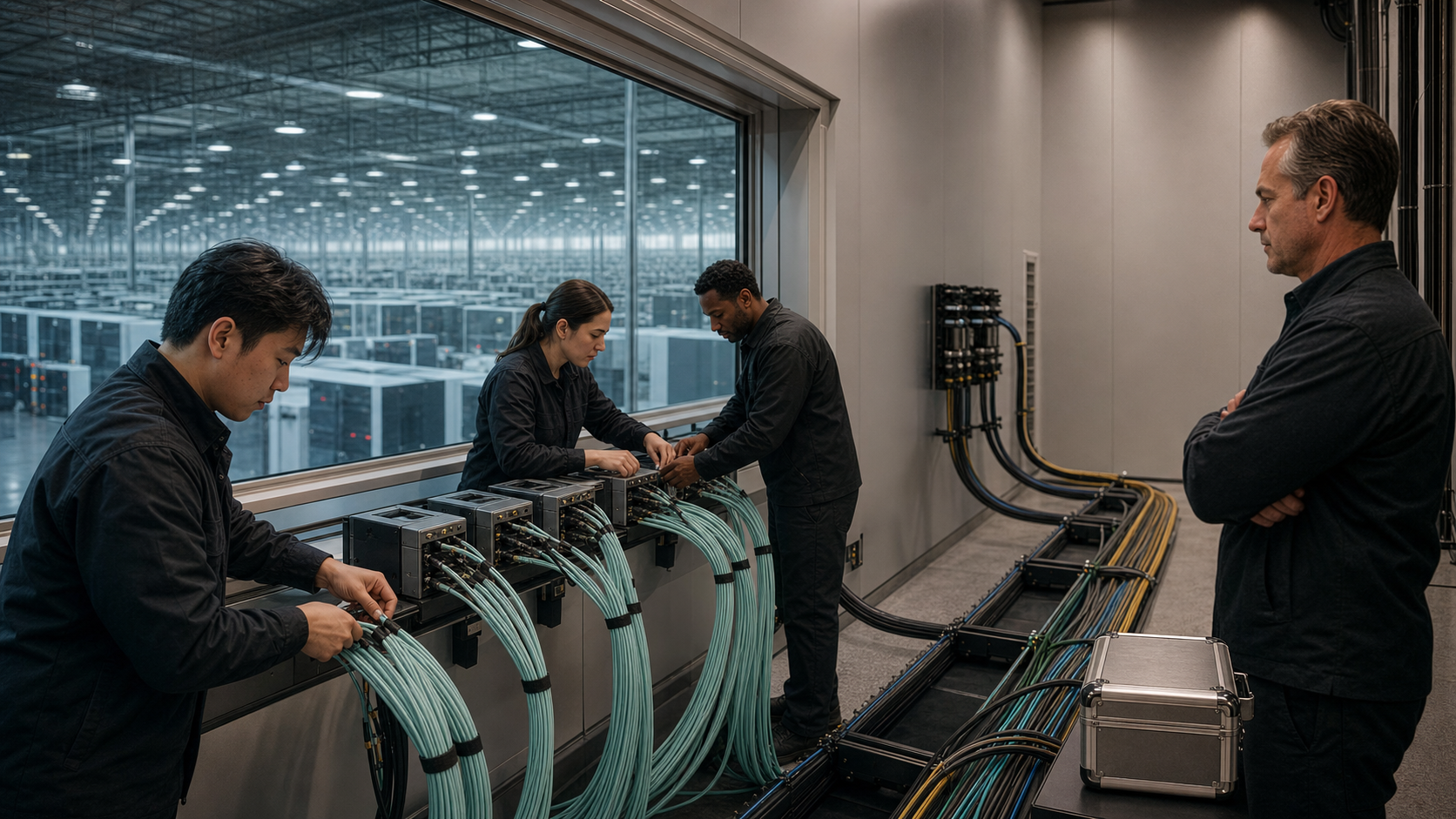
Address demand never vanished. Mobile operators, hosting companies, enterprises, content networks and cloud platforms continued to use public IPv4 throughout the rise of IPv6 and shared-address architecture. What changed after 2023 was the prominence of infrastructure itself. Generative AI turned compute capacity from an abstract service into a visible contest over land, power, chips, fibre and construction. Address planning returned to executive attention because networks were again being built at unusual scale and speed.
The word return therefore needs discipline. It does not imply that AI recreates the early Internet, where one public address might be assigned directly to each server. Modern facilities use private or otherwise controlled address spaces for most internal work. Front ends, load balancers, translation systems and service meshes aggregate large numbers of machines behind fewer public identities. AI can produce enormous compute growth with much slower growth in public address count.
Yet aggregation does not make the public boundary unimportant. It can make each boundary more consequential. One egress identity may represent thousands of training workers reaching a software repository. One ingress service may front an inference product used by millions. One customer-owned prefix may preserve allowlists and reputation across a migration. One translator may connect an IPv6 cluster to every remaining IPv4-only data source.
The useful question is thus not whether AI causes a simple numerical surge. It is whether AI investment increases the number, diversity and value of public network boundaries. The answer depends on architecture. A single-tenant training campus has a different profile from a multi-tenant inference cloud. A national facility connected to government networks has different continuity needs from a hyperscaler's internal cluster. An edge service distributed across many economies may consume more public identities than a much larger centralized training system.
Governance should follow this heterogeneity. Institutions need evidence that separates internal scale from public demand and observed deployment from announcements. They should make legitimate transactions easy without claiming the ability to forecast an inherently volatile industry better than firms risking their own capital.
The physical investment is large enough to matter
The strongest evidence for a structural change comes from physical investment rather than promotional claims about model capability. The International Energy Agency's 2025 Energy and AI analysis estimated that data centres consumed about 415 terawatt-hours in 2024 and projected roughly 945 terawatt-hours by 2030 in its base case. It attributed almost half of the net increase to accelerated servers, while also publishing high-efficiency, headwinds and faster-growth cases.
Those scenarios are useful because they make uncertainty explicit. Data-centre electricity demand can rise rapidly while efficiency, grid bottlenecks, finance and supply constraints change the realized path. The IEA estimated that global data-centre investment approached half a trillion dollars in 2024 and noted that local concentration matters more than the sector's modest share of global electricity. A project can be small in worldwide statistics and still dominate a local grid connection queue.
Company disclosures confirm the order of magnitude. Microsoft said in January 2025 that it was on track to invest approximately USD 80 billion in AI-enabled data centres during its fiscal year, more than half in the United States. Alphabet later reported USD 91.4 billion of capital expenditure for 2025, with the company's earnings discussion saying that most went to technical infrastructure and dividing that investment roughly between servers and data centres plus networking equipment.
Corporate figures should not be added mechanically. Fiscal definitions differ, and investment can include replacement, land, buildings, servers, networking and general cloud demand alongside AI. They are still material evidence that the 2023-2027 period involves a large expansion of compute and network capacity rather than a purely speculative software cycle.
Address demand should be expected somewhere in such an expansion. Every facility needs management, security, service exposure, external data movement and interconnection. But the relationship is architectural, not proportional. Megawatts and capital expenditure establish that the infrastructure base is growing. They do not tell a registry how many public addresses a particular operator requires.
A GPU is not a public-address unit
The easiest mistake is to multiply accelerator count by one address. Large AI systems are connected by dedicated high-performance fabrics optimized for east-west traffic among compute, storage and control systems. These networks can use private IPv4, IPv6, unnumbered links, specialized transports and multiple isolated planes. Their internal endpoints are not necessarily reachable from the public Internet and should not be.
NVIDIA's description of its Spectrum-X Ethernet platform refers to systems scaling to 100,000 accelerators and to links across multiple data centres. The figures are vendor claims about supported scale, not a census of deployed capacity. They nevertheless show why internal addressing, topology and telemetry are substantial engineering concerns. They do not imply 100,000 public IPv4 addresses.
A useful facility model separates at least four planes. The accelerator fabric carries synchronized training or inference traffic. The storage fabric moves datasets and checkpoints. The management plane handles provisioning, health and repair. The service plane accepts customer requests and reaches external systems. Only parts of the latter two normally need direct or translated public reachability, and even those can be strongly aggregated.
Security reinforces the separation. Exposing every accelerator directly would increase attack surface, complicate policy and waste scarce address space. Private subnets, controlled gateways, identity-aware access and dedicated interconnect are normal choices. IPv6 can provide generous internal addressing without requiring every global address to be openly reachable. Address scope and route policy matter as much as uniqueness.
This distinction protects both markets and institutions from inflated claims. A buyer should not justify a large IPv4 acquisition merely by citing accelerator count. A registry should not infer that a dense facility has no public need because internal systems are private. The evidence belongs at the boundary: expected public services, tenant design, egress identity, counterparties, geographic distribution, resilience and migration requirements. AI increases network scale; public-address demand emerges from how that scale connects to the rest of the economy.
Training and inference create different address profiles
Training clusters are large, concentrated and bursty. They move enormous volumes among accelerators and storage but may expose few public services. Data can arrive over dedicated links or controlled gateways. Engineers can access management systems through private connectivity. The public IPv4 count can therefore be modest relative to power use and equipment value.
Inference changes the shape. A model offered to customers needs regional endpoints, load balancing, denial-of-service protection, observability and reliable connections to customer applications. Multi-tenant inference can require separate egress identities, customer-specific allowlists or geographic routing. A provider may distribute inference closer to users to reduce latency or meet data-location requirements. Each region adds public boundaries even when each boundary fronts highly aggregated compute.
Fine-tuning and enterprise deployment sit between the two. A customer may move private data into a cloud training environment, call external repositories, connect to an on-premises identity system and expose a limited application endpoint. Hybrid connectivity can reduce public exposure, but supplier and customer systems often span several networks. The address requirement follows trust boundaries rather than model size.
AI services also create machine-to-machine traffic that is sensitive to stable identity. Retrieval systems query external databases. automated applications call payment, mapping, communications and security services. Counterparties may use address allowlists, rate limits or reputation controls even when stronger application identity is available. Those practices can be criticized as brittle, but they remain commercial facts.
The distinction has policy consequences. A training-campus announcement is weak evidence for a large public allocation. A distributed inference service can have meaningful public demand without a spectacular accelerator count. Needs-based evaluation encourages applicants to translate incomparable architectures into a single bureaucratic story. A market asks a simpler question: is the buyer willing to pay for the space and comply with accurate registration? That does not eliminate due diligence. It places technology and demand risk with the investor rather than the registry.
Public ingress is small in count and large in consequence
An AI service can hide thousands of machines behind a handful of public endpoints. That conservation is beneficial. It also concentrates operational and commercial value. Customers store the endpoint in security policies, applications and contractual documentation. Abuse reputation accumulates around it. Domain records point to it. Monitoring systems test it. A change can require coordination across organisations the provider does not control.
The public edge therefore behaves like a service identity, even though an address is not a legal identity and should not be treated as one. Stability reduces customer change cost. Multiple addresses support geographic distribution, failure isolation and denial-of-service defence. Dedicated addresses can separate tenants whose risk profiles should not be combined. Public-sector or regulated customers may demand known ranges for network controls.
IPv6 can supply these edges generously where customers can reach them. Dual-stack load balancers can serve both address families while the application fleet uses IPv6 internally. Translation can accept IPv4 customers and forward into an IPv6 service. The architecture conserves IPv4 without making it irrelevant.
The public count also depends on product boundaries. A hyperscaler can aggregate many services behind shared global edges. A smaller regional provider may need distinct addresses for facilities, tenants or upstream relationships because it lacks the same global front-door infrastructure. A sovereign or sector-specific cloud may deliberately isolate customers rather than maximize aggregation. Address efficiency is therefore not a neutral measure of worth.
Thin registration should preserve the information required to operate these edges: the recognized holder, current contacts, route authority, transfer history and relevant reverse delegation. It should not require public disclosure of sensitive topology or customer names. The goal is to make a public claim interpretable and portable, not to expose the facility. Where a small number of addresses carries large service consequence, accuracy and timely control matter more, not less.
Outbound identity is where scarcity often reappears
Many AI workloads do not accept unsolicited Internet traffic, yet they still reach outward. They download software, retrieve model components, access data services, call commercial APIs, report telemetry and connect to customer systems. Those destinations see a public source address after translation or at a gateway. The source can become an allowlisted, rate-limited or reputation-bearing identity.
When thousands of workers share one address, efficiency rises but attribution becomes harder. Abuse by one workload can affect the reputation of others. Port and connection limits can create contention. Logs must map a public session back to a tenant, job or internal endpoint at the relevant time. A customer that needs isolation may request a dedicated egress address even when it has no public server.
AI can increase this demand through the number of automated connections rather than the number of human users. Automated AI services, retrieval systems and synthetic-data services may contact many external endpoints repeatedly. Efficient application design and caching can reduce traffic. The relevant institutional point is that an outward-only workload can still create demand for stable public IPv4 identity.
Cloud pricing makes the choice visible. AWS's public IPv4 charge applies to in-use addresses across multiple services and has encouraged customers to inventory unnecessary exposure. A customer can consolidate egress, use private connectivity, adopt IPv6 or bring its own space. Each alternative carries different price, portability and control.
Registries should not decide how many egress identities an AI service deserves. They should ensure that customer-owned space can move, that holder and route records are correct and that fraud can be challenged. Operators and customers can then decide whether dedicated identity is worth its market cost. Scarcity is communicated through price rather than an official judgment about whose workload is sufficiently important.
Private address collision is an interconnection constraint
Public scarcity can distract from a second addressing problem: private networks collide. Enterprises, acquired companies, cloud projects and facility operators often choose from the same limited private IPv4 ranges. When two overlapping networks need direct connectivity, ordinary routing cannot distinguish identical addresses without translation, renumbering or an intermediary.
AWS's VPC peering documentation states that peering cannot be created when IPv4 or IPv6 ranges overlap. It further notes that the presence of any overlapping IPv4 block can prevent peering even if the parties intended to use only non-overlapping blocks or IPv6. That is a product-specific rule, but it illustrates a general problem encountered in multi-cloud and merger integration.
AI increases the chance of collision because projects assemble networks quickly across organisational boundaries. A model developer connects training, storage, data suppliers, enterprise customers and inference regions. A colocation provider hosts tenants whose private plans were created independently. A new campus may need to join an older cloud estate with little address discipline.
IPv6 is a strong answer for internal uniqueness. It can give clusters and facilities ample non-overlapping space, simplify cross-cluster growth and reduce dependence on repeated private IPv4 ranges. The benefit is real even when public IPv4 remains at the service boundary. Internal IPv6 and external dual-stack are complements.
The institutional implication is subtle. Demand for public IPv4 should not be inflated merely to avoid poor private planning. Nor should public space be used internally without careful routing controls. But an organisation that can bring a recognized prefix across facilities may use global uniqueness to reduce merger or interconnection friction. Registration and route authorization then determine whether the claimed space can be used safely. Address demand is partly about public reachability and partly about escaping collision, and evidence should distinguish the two.
Real IPv6 cluster design still keeps an IPv4 bridge
The design of large container clusters shows how AI-scale growth can move internal addressing to IPv6 while retaining a concentrated IPv4 requirement. AWS's EKS IPv6 guidance describes IPv6 as a way to address exhaustion inside large clusters and reduce overlapping ranges across clusters. Pods and services receive IPv6, allowing internal scale without consuming a private IPv4 address for each one.
The same design keeps compatibility. Nodes receive both address families. A pod that must reach an external IPv4 destination uses a local IPv4 identity and source translation through the node and, for public Internet access, through a gateway with a routable public IPv4 address. Public services can use a dual-stack load balancer that accepts IPv4 clients and translates toward the IPv6 cluster.
This is not a defect in IPv6. It is a sensible architecture for an uneven Internet. It sharply reduces internal IPv4 consumption and keeps the scarce public addresses at defined edges. It also demonstrates why an IPv6 cluster can generate or preserve public IPv4 demand. The requirement moves from every workload to the gateways and load balancers on which every workload depends.
AI operators should measure that concentration. How many jobs share an egress address? What happens when its reputation is blocked? Can the gateway scale with connection volume? Is there enough independent capacity for maintenance and regional failure? Can a customer receive a dedicated address when a counterparty requires one? Is the address platform-owned or portable?
A registry evaluating a needs claim would struggle to judge the correct answers because they depend on workload behavior, product commitments and risk tolerance. A market lets the operator choose a larger or smaller inventory at a visible cost. Thin registration ensures that whichever inventory it acquires has a clear holder and usable authority. IPv6 supplies internal abundance; the market prices the remaining compatibility edge.
Geography turns one AI service into many public boundaries
AI capacity is geographically concentrated, but demand for local and regional service is widening. The IEA expects the United States, China and Europe to remain the largest data-centre electricity markets while identifying rapid growth in Southeast Asia. Microsoft has described investments across the Global South and new capacity in multiple national markets. Corporate announcements must be separated from completed facilities, yet they signal a push toward more geographic nodes rather than one universal campus.
Location matters for latency, energy, regulation, resilience and access to data. Training can sometimes be centralized where power and accelerators are available. Inference and regulated workloads may need to sit closer to users or within a jurisdiction. A service that expands from one region to ten may need additional public edges, egress pools, interconnection sessions and operational contacts even if each region is more address-efficient than the original.
Regional expansion also exposes unequal IPv6 capability. A cloud can operate an IPv6-rich internal network and still serve customers or suppliers in economies where IPv4 remains the common denominator. Dedicated links solve some relationships, not the open Internet. The address plan must follow the least-modern material counterparty as well as the newest facility.
Sovereign and public-sector projects add continuity expectations. A government may require local service, known routing, incident contacts and the ability to change contractors without changing public identity. Customer-owned address space can support that continuity if registration and platform acceptance are sound. Provider-owned addresses can be simpler initially but increase switching cost.
This is why AI address demand cannot be inferred from a global compute total. Geography multiplies boundaries, while aggregation compresses addresses within each boundary. The net effect must be measured in deployed regions, public endpoints, egress identities and portable prefixes. Institutions should publish those observable indicators rather than use national AI ambition as a shortcut for allocation.
Fibre and interconnection matter more than the campus photograph
Public discussion often represents AI infrastructure with a building, cooling equipment and rows of machines. The network effect is harder to see. A useful facility must connect to power, but it must also connect to users, other facilities, cloud regions, data sources and transit networks. Redundant fibre paths, interconnection capacity and routing policy determine whether installed accelerators become a usable service.
Microsoft's account of its Wisconsin AI facility claimed hundreds of thousands of accelerators and enough fibre to circle the planet several times. The statement is a company description, not an independent engineering audit. Its value here is qualitative: frontier-scale compute is being designed as a distributed network system, not an isolated warehouse.
Inter-facility traffic can remain private over dedicated transport. Public addresses become relevant at control points, failover edges, partner connections and services exposed beyond the operator's backbone. An operator may also use separate autonomous systems or address ranges to isolate regions and manage routing. Resilience can increase demand for independent prefixes even when raw endpoint count is small.
The network evidence should therefore include more than facility megawatts. It should identify announced versus operational sites, active network routes, autonomous-system relationships, public service ranges, observed routing, interconnection partners and customer availability. No one measure proves demand. Together they distinguish a live network from a building announcement.
Registries are well placed to publish number-resource and route-security evidence, but not to certify that a data centre's business case is sound. Interconnection providers and operators can supply facility and traffic evidence. Investors can assess contracted demand. The separation of roles matters. A thin registry makes network authority legible without turning address registration into approval of the entire AI project.
Cloud platforms already operate private address markets
Public cloud turns addressing into a menu of metered products and platform rules. The provider supplies public addresses, charges for them, sets quotas and decides which managed services can use them. Customers can reduce consumption through private endpoints, shared load balancers, translation and IPv6. They can sometimes bring registered address space they already control.
Bring-your-own-address support is particularly revealing. Google Cloud's BYOIP documentation lets customers use their own public IPv4 and IPv6 space with supported resources. Verification for externally advertised space uses route-origin authorization and reverse-DNS validation, and provisioning can take several weeks. The service also has product and prefix-size limitations. Microsoft Azure and AWS offer related capabilities with different boundaries.
This is a private market layered on a public authority record. The customer first obtains recognized rights through a registry relationship or transfer. The cloud then decides whether and how those rights can be attached to its services. The value of the space depends on both layers. A registry error can prevent verification; a platform limitation can prevent practical use.
AI customers care because portable public identity is an exit option. A model service can move compute while retaining an address range known to customers and counterparties. That does not make migration effortless: routing changes, security state, platform features and application configuration still matter. It reduces one important class of switching cost.
Platform-supplied addresses remain appropriate for many workloads. They are quick to obtain and integrate with managed services. The governance concern is not that every AI company should own space. It is that organisations with a material continuity need should have a credible path to acquire, register and carry it. Markets reveal the cost of that option. Registries should make its authority reliable. Platforms should make eligibility and limitations clear.
Transfer records show redistribution, not a verdict on AI
The IPv4 transfer market is no longer hypothetical. APNIC's 2026 review of IP addresses through 2025 counted 5,619 registered transfer transactions across the five RIR systems in 2025 and about 33.4 million addresses represented in those records. It estimated roughly 342 million addresses listed since 2012, while warning that the aggregate likely counts some blocks more than once.
The same data shows substantial regional differences. RIPE NCC received the largest number of recorded transactions in 2025; ARIN's recorded volume rose; APNIC's transferred volume was lower than in some earlier years. Counts include merger and acquisition changes as well as market transfers. They cannot be read as a direct price series, a measure of unique addresses changing hands or evidence that AI caused a particular transaction.
What the records prove is narrower and important: an established redistribution mechanism can move registration from one holder to another after free-pool exhaustion. APNIC's transfer-log specification calls for daily cumulative publication and includes the resource, source, recipient, regions and date. That public history supports due diligence and market analysis.
AI demand enters this market alongside hosting, access, enterprise and many other uses. A buyer may acquire space for a new inference region, a portable egress range or general cloud growth. The market does not need the registry to rank those motives. It needs the registry to verify the authorized source, prevent conflicting transfers, record the recipient and support the resulting security state.
Transfer evidence should be combined with routing observation and facility data. A block transferred to a cloud operator may remain unrouted, replace leased space or support non-AI services. An address announcement near a new campus may reflect ordinary network reorganization. Responsible analysis states these uncertainties. It does not deny the market or assign every movement to the most fashionable source of demand.
Needs rationing rewards narratives rather than truth
Some transfer regimes still ask recipients to demonstrate future use or efficient utilization. APNIC's current policy asks recipients for a detailed plan within a stated period. ARIN's transfer guide describes utilization and projected-use tests for specified-recipient transfers. These rules emerged from a tradition in which registries allocated scarce space without a market price and sought to prevent waste.
Applying the same discretion to AI growth is especially problematic. A model provider can produce impressive forecasts of users, accelerators and regions while its commercial demand remains uncertain. A quieter infrastructure supplier may have contracted customers but a less fashionable story. A registry reviewer is then pushed toward judging model economics, tenancy, security architecture and national strategic value.
The review also creates timing risk. AI projects change facility, cloud and architecture as power and chips become available. An approval tied to a detailed plan can become obsolete before deployment. Requiring repeated justification rewards organisations with large policy teams and established relationships. Small entrants pay more heavily for delay and explanation.
Most importantly, need is not a neutral fact when addresses can be shared, translated, leased, bought or replaced partly with IPv6. The right quantity depends on the operator's tolerance for reputation sharing, connection limits, customer requirements, resilience and future switching cost. A reviewer can always demand more compression. It cannot observe the full cost imposed by that demand.
A voluntary buyer spending its own capital has stronger incentives to test those trade-offs. Overbuying carries a price and holding cost. Underbuying creates service constraints and expensive emergency acquisition. Fraud, sanctions, insolvency and conflicting title still require controls, but those are authority and integrity questions. They do not require an institution to certify that an AI service deserves its chosen architecture.
Thin registration is an active institution, not an empty one
Removing needs rationing does not mean removing the registry. A functioning market needs a more precise institution. Someone must establish that the seller is authorized, identify the recipient, prevent simultaneous conflicting transfers, preserve history and update the records on which route security and relying services depend.
Thin registration begins with verified holder identity and authority. It records the current holder, relevant status, contact channels and effective date. It makes transfer procedures predictable and publishes enough history for the market to understand prior changes. Protected corporate and security evidence can remain access-controlled while the public record states the result.
It also supports operational services. Route-origin authorization must be available to the new holder at the right time. Reverse-DNS authority and relevant contacts need a coordinated handoff. The former holder's ability to issue current instructions should end. A disputed transfer needs independent review and a remedy that does not depend entirely on the institution accused of error.
Thinness concerns mandate, not quality. The registry should not set the commercial price, choose a buyer's AI architecture, reserve addresses for favoured sectors or assess whether one model is socially superior to another. It should publish service performance, transfer time, corrections and contested cases. It can make standardized data available for research without exposing customer secrets.
This division is particularly suitable for AI, where technology and demand change faster than public administration. The market bears forecast risk. The registry makes authority legible. Network operators decide routing. Cloud platforms state product eligibility. Security systems evaluate announcements. Each actor can be held to evidence within its competence.
A market needs safeguards against false scarcity and capture
Markets allocate through willingness to pay, not social worth. That is a strength when the alternative is discretionary prediction, but it does not resolve every concern. Large incumbents may hold deep inventories. Brokers can obscure beneficial ownership. Leasing can separate the visible route user from the registered holder. Insolvency or sanctions can interrupt control. Reputation problems can make nominally equivalent blocks differ substantially.
Thin registration should address the integrity of exchange without becoming a price regulator. It can require authorized signatures, verified counterparties, conflict disclosure and a clear effective transfer. It can publish aggregate concentration measures and distinguish ownership, authorized use and temporary service arrangements where policy permits. It can preserve evidence for courts while avoiding public exposure of sensitive contracts.
Competition also needs portability. A holder should be able to move its space between qualified service providers and clouds without an incumbent veto. Platform BYOIP rules should be clear enough for customers to compare. Registry services should not bundle unrelated products so tightly that leaving one provider risks the recognized resource record.
Concentration deserves observation rather than improvised confiscation. If AI demand leads a few platforms to accumulate more IPv4, the public should be able to see transfer and routing trends at an appropriate aggregate level. Competition authorities can examine anticompetitive conduct under their own mandates. Registries should not invent broad reallocation power from an address-distribution concern.
The same restraint applies to unused holdings. A market price gives holders an incentive to sell or lease, but some may keep space as an option. Accurate registration and fees can discourage abandoned records. Any stronger intervention needs a clear legal and contractual basis, evidence and review. AI urgency should not become a pretext for uncertain seizure or favoured access.
The right metrics are boundaries, not announcements
A credible AI address-demand account should begin with deployed infrastructure. Facility status needs categories such as proposed, permitted, under construction, energized and operational. Power reservations and accelerator orders are useful but should not be treated as live network capacity. Company capital expenditure should be tied to actual regions and services where possible.
Network measures then identify the boundary. Count public IPv4 and IPv6 prefixes originated by the operator, changes in route announcements, customer-owned ranges brought into platforms, public load-balancer addresses, dedicated egress pools and interconnection sites. Track whether addresses are used directly, shared through translation or held for failover. Protect sensitive topology by publishing aggregates and ranges of values.
Demand quality matters too. A stable customer endpoint differs from a temporary test. An egress address supporting thousands of automated jobs differs from an idle reservation. Observed traffic, connection concurrency, tenant count, reputation incidents and allowlist dependencies help explain value without turning bytes into entitlement.
Registry measures should include transfer time, correction time, disputes, failed authorization, RPKI handoff and reverse-DNS continuity. Market measures can include completed volume, price indices where reliable, lease terms and concentration. No single actor holds all of this information, so claims should state their limits.
The most important negative evidence is also measurable. If a large AI campus adds compute without adding public prefixes, that supports the aggregation thesis. If an IPv6-first cluster retains only a few public IPv4 gateways, it shows conservation rather than absence of dependence. If a regional inference expansion adds many small public edges, it shows geography multiplying boundaries. The objective is not to prove demand in advance. It is to observe where it actually appears.
The 2027 cases should remain conditional
By 2027, one plausible case is concentrated growth. A few hyperscalers complete large campuses, aggregate services behind global edges and use internal IPv6 extensively. Public IPv4 demand rises modestly in count but remains highly valuable at gateways and customer-owned portable ranges. Platform pricing and transfer markets handle most adjustment.
A second case is distributed inference. More regional and sovereign facilities come online, enterprise AI moves into production and low-latency services spread. Public boundaries multiply across economies. IPv6 handles internal growth, but uneven customer capability preserves dual-stack edges. Demand shifts toward smaller regional ranges, egress identity and interconnection continuity.
A third case is infrastructure headwinds. Power, transformers, finance and chip supply delay many announced projects. Compute efficiency improves, and some expected capacity is cancelled. Buyers that acquired addresses speculatively may resell them. A market allows the error to be repriced; administrative allocations based on forecasts would leave institutions deciding whether to reclaim or forgive.
A fourth case is platform concentration. AI start-ups consume cloud-supplied addresses rather than acquiring their own, while large platforms accumulate or retain inventory. Direct market demand from smaller firms appears weak even though they pay address and translation charges through cloud bills. Portability becomes the central concern because public identity is controlled by the platform account.
All four cases support thin authoritative registration. None supports a registry choosing the winning AI architecture. The evidence to watch through 2027 is completed facility capacity, deployed regions, public-edge count, IPv6 cluster adoption, public IPv4 charges, BYOIP use, transfer volume, platform concentration and tested customer migration. Conditional analysis is not indecision. It is the proper response to an investment cycle with wide published scenarios and visible physical bottlenecks.
A Number Resource Society should make demand legible
The Number Resource Society has a constructive role if it makes demand and authority legible without pretending to manufacture either. It can publish consistent statistics on address holdings, transfers, routing and route-security coverage. It can show how much activity reflects mergers, market exchange, inter-regional movement and new registration. It should explain limitations such as repeat transfers and unrouted space.
For AI-related research, the Society can convene operators, clouds, facilities and customers around common measurement definitions. Public IPv4 at a service edge should not be confused with private cluster addresses. Announced capacity should not be counted as operational. Customer-owned space should be distinguished from platform-supplied identity. IPv6 internal scale and IPv4 compatibility can be reported together.
NRS should advocate for fast, neutral and portable transaction services operated by the responsible RIRs or other lawfully authorized registry operators. A qualified buyer and authorized seller should be able to complete a transfer without persuading those operators that their preferred model or business plan is superior. The authoritative record maintained by the responsible registry should support cloud verification, routing authorization, reverse delegation and later provider change.
Independent review bodies, not NRS, should decide disputes on preserved evidence; NRS can document recurring barriers and represent a member only when that member has granted valid authority.
NRS should also accept that a successful IPv6 future reduces the salience of parts of its IPv4 advocacy. It should not seek a larger mandate by exaggerating AI scarcity. Nor should it dismiss legitimate compatibility needs to advertise protocol progress. Its value lies in evidence-led advocacy, member education and accountable representation during change, not in settling transactions or controlling registry state.
This positive case is intentionally limited. A Society that controls price, sector priority, technology assessment, registration or remedies would become a powerful planner with weak information and would cease to be an advocacy body. The credible role is narrower: publish research, compare outcomes, convene affected operators, support members and present their authorized cases. Strong records, reliable authority and enforceable remedies remain duties of RIRs, other lawfully authorized operators and independent review bodies.
The warning signs are easy to specify
Several developments would indicate that AI address demand is being governed badly. The first is address claims based solely on accelerator count or announced megawatts. Those figures establish scale, not public need. The second is a registry demanding confidential model and customer plans in order to judge whether a transfer is deserved. That invites discretion beyond registration competence.
The third warning is opaque platform concentration. If public IPv4 charges rise while customers cannot see use, remove accidental addresses or bring portable space, scarcity becomes a private toll without a practical outside option. The fourth is incomplete transfer evidence: stale holders, unavailable route authorization, uncertain reverse delegation or a former provider retaining control after payment.
The fifth is policy nostalgia. Free-pool allocation rules were designed for a different environment. Recreating them around AI would turn volatile forecasts into administrative entitlements and barriers to entry. The sixth is market romanticism: treating payment as sufficient even when the seller lacks authority, the block is disputed or the transaction conceals control that relying parties need to understand.
Positive signals are equally concrete. AI operators adopt IPv6 for internal scale, consolidate public IPv4 where sharing is safe and acquire dedicated space where customer continuity justifies it. Transfer records update promptly. Cloud platforms support customer-owned space with transparent limits. Route-security handoffs work. Published statistics distinguish completed facilities from announcements and observed demand from inference.
These tests do not favour or oppose AI. They ask whether the institutions around scarce public identity are responding to evidence. That is a more durable standard than a special allocation programme tied to one technology cycle.
Public identity is the scarce layer, not compute itself
The AI investment boom makes abundance and scarcity visible at the same time. Accelerator performance grows. Internal networks can use IPv6 at enormous scale. Software can aggregate many workloads behind a few edges. Yet stable public identity, trusted by customers and reachable from older networks, remains scarce where it depends on IPv4.
Scarcity at the boundary can be managed. Prices encourage conservation and reveal the cost of dedicated identity. IPv6 expands the set of transactions that do not require IPv4. Translation compresses demand. Customer-owned prefixes support portability. Accurate registration reduces uncertainty. None of these measures requires a registry to select worthy AI firms.
The institutional settlement should place risk with the party best able to bear it. Investors decide whether a campus will be built. Operators decide the address architecture. Buyers and sellers decide whether scarce space is worth its price. Cloud platforms decide which products they support, subject to competition and contractual accountability. RIRs and other lawfully authorized registry operators verify and record authority and support the relevant security services; independent review bodies provide remedies.
The Number Resource Society can publish evidence, convene affected parties, advocate for those safeguards and represent members acting through valid powers of attorney.
That separation will be tested as projects move from announcement to operation through 2027. Some will consume less public space than expected because aggregation and IPv6 work well. Others will discover that customer allowlists, regional expansion, egress reputation or provider exit require more stable identity. A market can respond to both errors. A rationing institution tends to freeze an early forecast into a privilege or denial.
AI data centres have not restored the old one-server, one-address Internet. They have made the public boundary important again by concentrating more economic activity behind it. The policy response should be equally modern: internal abundance, efficient compatibility, voluntary redistribution, portable rights and an authoritative record that is strong enough to be trusted but too narrow to plan the industry.