Summary
- Britain’s transport department has proposed cyber-security, tamper-protection and metering requirements for public chargepoints, but has not settled how compliance will be checked.
- The proposed rules would apply to chargepoints sold or installed in Great Britain, with no retrofit requirement; the timetable therefore depends on replacement and device life.
A security standard can tell a manufacturer what to build. It cannot tell an operator, driver or regulator who must prove that the installed device still meets the rule. Britain’s new public-chargepoint consultation has the first part in view. The second is still being designed.
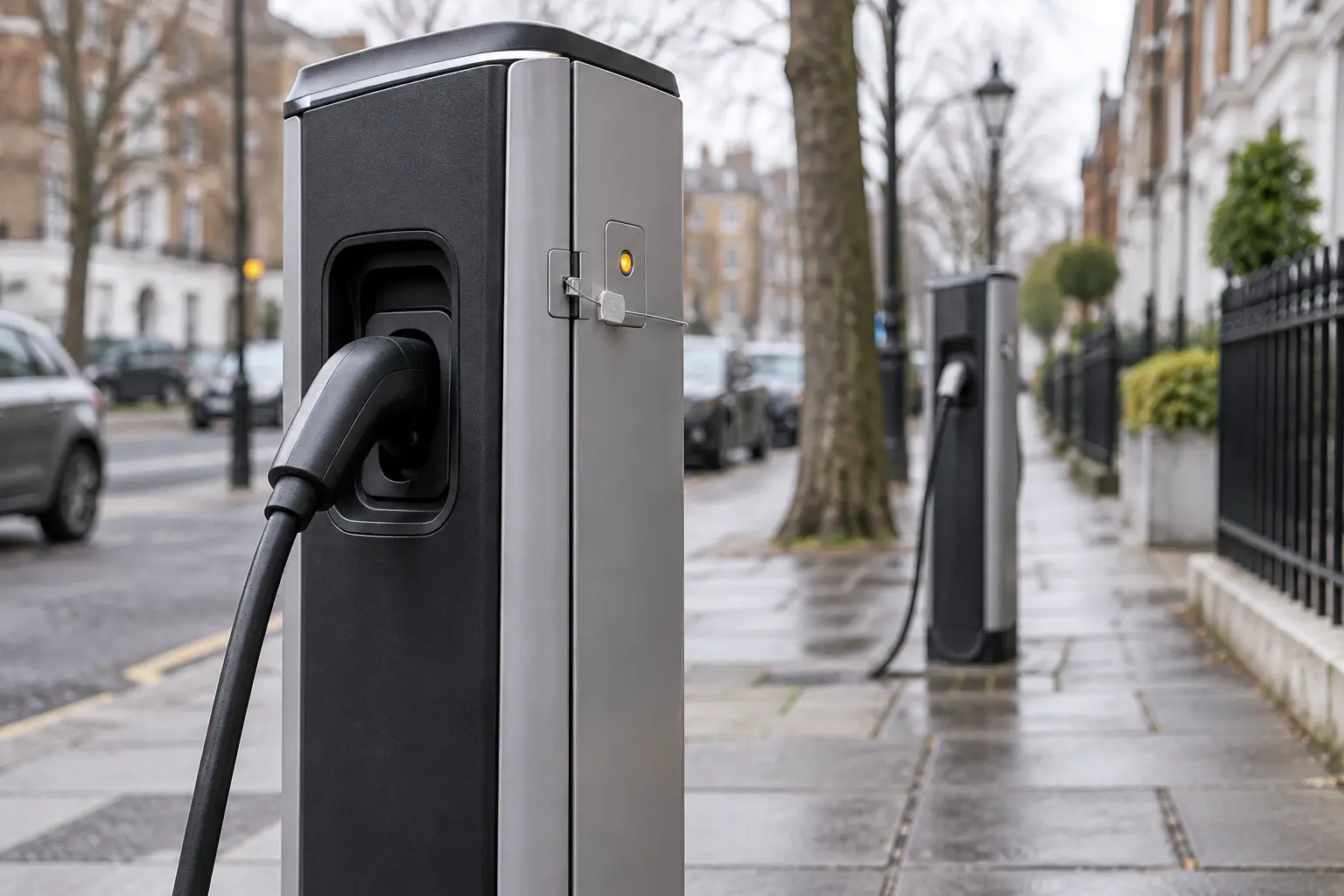
The Department for Transport opened the consultation on 29 October. It proposes ETSI 303 645 for public chargepoints sold or installed in Great Britain, considers EN 18031 as an alternative route, and asks about physical anti-tamper protections and Class B electricity meters. DfT says the existing smart-chargepoint rules cover domestic and small non-domestic devices, not public ones. These are proposals, not law. DfT consultation · Full consultation
The proposed product duty would fall on businesses that sell or install the devices, chiefly manufacturers, importers and distributors. The consultation then offers two assurance routes. One would let those businesses assess themselves against the ETSI test specification, with a regulator carrying out spot checks. DfT has not chosen that regulator. The other route would require accredited third-party testing and certification. If EN 18031 is accepted as equivalent, DfT says it will also develop a way to check that compliance.
The paperwork already governing public chargers covers a different control point. The Public Charge Point Regulations 2023 set operator duties around matters such as payment, rapid-network reliability, helplines, data and price display; the Regulations assign their enforcement to the Secretary of State. That does not name the body that would verify the separate product-security proposals. A chargepoint can therefore meet its public-service obligations while the institutional route for checking its cyber baseline remains unanswered. Public Charge Point Regulations 2023
DfT proposes no retrofitting. A device already in service would be replaced with a compliant one when it reaches the end of its life and is decommissioned. The department asks respondents how long chargepoints normally last and how much time manufacturers need to implement the rules. The consultation does not provide a public fleet-age distribution, so the replacement horizon cannot yet be calculated.
Responses close at 11:59pm on 20 December 2026. The decision to watch is not only which standard wins. It is who receives the evidence, who can inspect a device and who has to act when the paperwork and the unit on the pavement disagree.
Official sources
Member Briefing
Deeper Profile Context
Sign in with the right membership level to unlock the full briefing and source notes.
Only for Strategic Circle
Strategic Circle
Open to all readers. Unlock profile briefings after joining and signing in.
Join Strategic CircleOnly for Leadership Alliance
Leadership Alliance
For qualified IP-asset owners and management; sign in to unlock alliance briefings.
Join Leadership Alliance