Summary
- The same Cummins Centum generator set carries 2,000 kW standby and 1,825 kW Data Center Continuous; the step is 175 kW, or 8.75 percent, by my arithmetic.
- ISO 8528-1 added a Data Centre Power rating in 2018, and Cummins' 2025 bulletin states that this rating "is not appropriate for Uptime Institute Tier III or Tier IV certification" because it assumes a reliable utility — so the category the market buys was written outside the standard by the manufacturer.
Two columns on one page
Cummins publishes the Centum series on its own site with the ratings side by side: Standby 1750–2000 kW (2188–2500 kVA) and Data Center Continuous 1600–1825 kW (2000–2281 kVA) (C1750D6E / C2000D6E product page). Read the two models separately and the paired numbers are 1,750 kW against 1,600 kW, and 2,000 kW against 1,825 kW.
My arithmetic, and no one else's: 2,000 minus 1,825 is 175 kW, which is 8.75 percent of 2,000. And 1,750 minus 1,600 is 150 kW, which is 8.57 percent of 1,750. Both machines step down by the same order of magnitude between the two printed ratings.
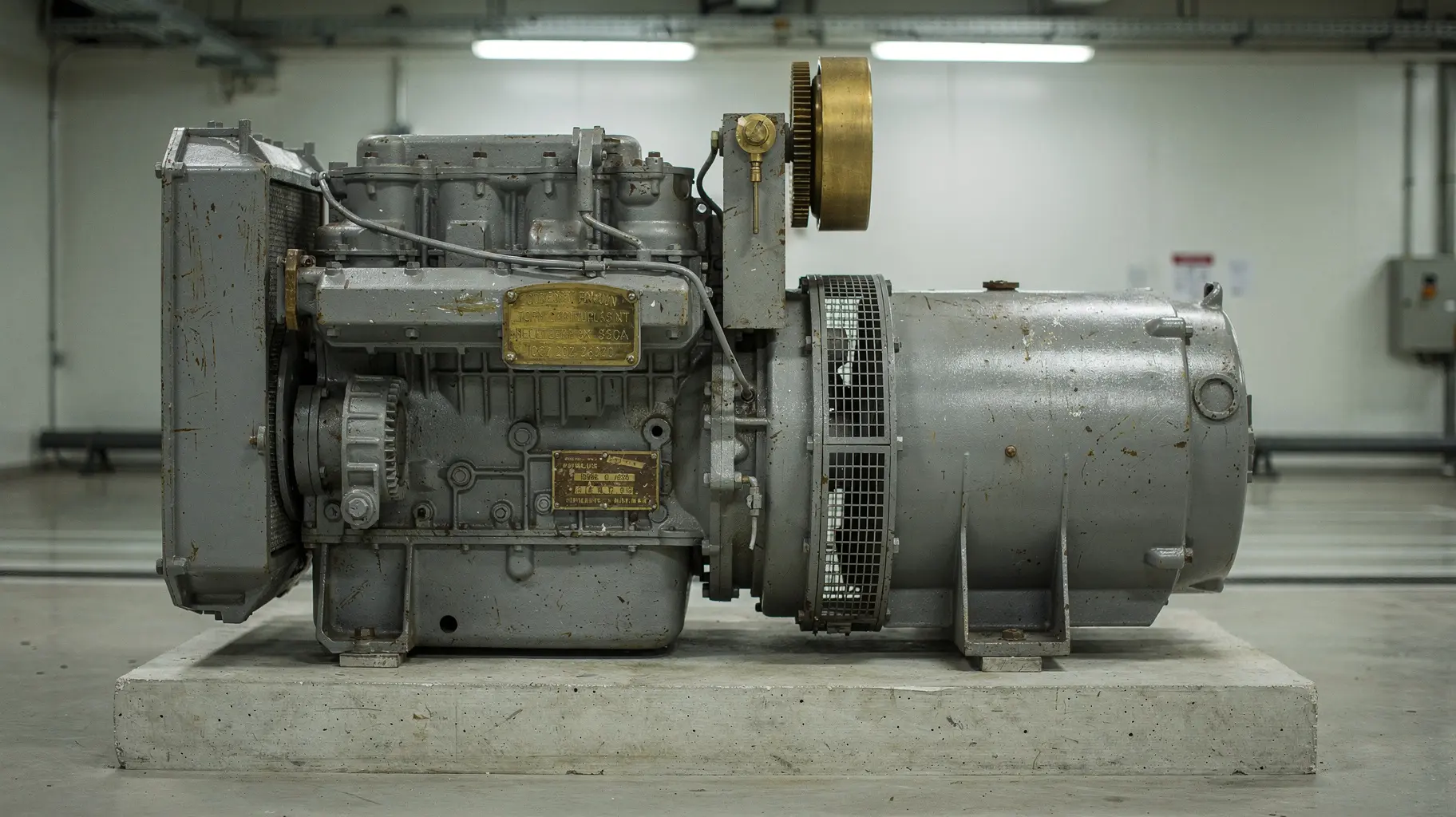
The data sheet makes the mechanics unmissable. Cummins bulletin NAD-6744 rates the C1750D6E at 1750 kWe (2188 kVA) Emergency Standby Power and 1600 kWe (2000 kVA) Data Center Continuous, and the engine under the canopy tells the same story: gross engine output for the same QSK50-G24 is 1947 kWm (2611 bhp) at ESP and 1746 kWm (2341 bhp) at DCC (C1750D6E data sheet, NAD-6744). The generator was not derated by a marketing department. The engine is asked to deliver less.
And the footnote on that sheet is the most important sentence in this article: "DCC at standby power available subject to Cummins' site-specific assessment; contact your Cummins distributor." The August 2025 international rating cards repeat it, alongside the reminder that "All ratings include radiator fan losses" and that specifications may change without notice (Cummins international rating cards, Bulletin 6614076, Rev. 8/25). Those cards also show the smaller end behaving the same way: the C175D6E carries 175 kWe standby and 160 kWe prime — my arithmetic puts that step at 15 kW, or 8.57 percent of 175.
So the higher figure is not a promise that travels with the machine. It is a figure subject to an assessment the manufacturer performs about the site it will live on.
What the standard actually prints
Cummins' own explainer of ISO 8528-1 sets out the four categories the standard recognises: Emergency Standby Power (ESP), Prime Rated Power (PRP), Limited-Time Power (LTP) and Continuous Operating Power (COP) (Understanding ISO 8528-1).
Then it does something more useful than naming them. It prints the ceilings. ISO 8528-1 defines standby power as the maximum power available to energise a variable load "where it has been determined that the total annual runtime doesn't exceed 200 hours of operation", with an average load factor over any 24-hour period that "shall not exceed 70 percent of ESP". Prime power allows unlimited hours but caps the 24-hour average at 70 percent of the prime rating, with 10 percent overload capability.
And there is a counting rule that will surprise anyone who has modelled a load profile from memory: in calculating the 24-hour average, Cummins states that powers below 30 percent of the rating are treated as 30 percent, and standstill time is not counted.
My arithmetic on those ceilings: 200 hours out of 8,760 is 2.28 percent of a year. Two hundred hours at the permitted 70 percent average is 140 equivalent full-load hours a year.
The explainer is equally explicit about when the category is legitimate. The ESP rating is intended where the set is backup to the normal utility or primary source, and is not intended for utility paralleling operation. A standby nameplate is therefore a nameplate about an interruption, not about a plant.
The category the standard added, and the certifier that will not take it
In 2018 ISO added a rating to 8528-1 called Data Centre Power. Cummins' Bulletin 5600406, Rev. 2/25, describes what happened next in a single paragraph: "Although it is intended for use in the data center market this rating is not appropriate for Uptime Institute Tier III or Tier IV certification. The rating definition makes reference to availability of a reliable utility and prohibits prolonged operation in parallel with a utility" (Data Center Continuous ratings, Bulletin 5600406).
Read that twice. The standard wrote a category for data centres. The certification regime those data centres are built against will not accept it, because the category assumes the utility is still there — and the whole point of a Tier III/IV generator plant is that the utility is not.
The certifier's own position, in its own words: "Only continuous ratings, derated prime ratings or standby ratings with no runtime limitations qualify for the Tier III or IV requirement for engine generators", resting on the premise that the only reliable source of power for a data centre is the engine-generator plant (Uptime Institute, Accredited Tier Designer technical paper: engine-generator ratings).
Cummins' FAQ turns that into a checklist of four factors: constant load; no limitation on run hours; no limitation on average load factor; no requirement for reliable utility service. The same FAQ is careful about what certification is: Uptime Institute does not certify specific brands or models of generator sets, and the manufacturer must demonstrate compliance (PowerHour FAQs, Bulletin 5544091).
And a Cummins data-centre specification deck prints the whole taxonomy as a table of run-hour ceilings: Emergency Standby Power, variable load, 200 hours; Prime Rated Power, variable, unlimited; Limited Time Prime, constant, 500 hours; Continuous Operating Power, constant, unlimited; Data Centre Power, variable or constant (Specifying standby generator set requirements for data centers). Five rows, five duty cycles, and the row the standard invented for this market is the one carrying a utility assumption the certifier cannot use.
One honest boundary. The disqualification sentence is Cummins' sentence about ISO's category. Uptime Institute's public abstract does not mention ISO Data Centre Power at all; what it states is the no-run-time-limit rule. The exclusion is a derivation from that rule plus the category's own utility reference, and it is presented here as Cummins' derivation, quoted.
Cummins' answer to its own problem is a proprietary category. Its white paper on Data Center Continuous ratings puts the arithmetic plainly: "Of these ISO definitions, the only rating that meets Uptime Tier III or Tier IV at 100 percent of the generator rating is Continuous" (Data Center Continuous ratings white paper). Continuous would fit the rule, and it would also oversize a data-centre plant, because a continuous rating carries a different set of engineering assumptions about how the machine spends its life. So Cummins prints DCC instead: continuous output to a constant or varying load for unlimited hours in a data-centre application.
The reference condition underneath the number
Every one of those figures sits on a reference condition, and Cummins prints one in the clearest sentence I found in its literature: "At ISO3046 reference conditions, altitude 1013 mbar (30 in. Hg), air inlet temperature 25 °C (77 °F)" (C1540 N5CC generator set data sheet, D-6019).
Two things about that sentence. It names pressure and air-inlet temperature; the retrieved text of that sheet prints no relative-humidity figure beside them. And it sits above a temperature-and-altitude multiplier table, because a generator set rated at 25 °C is not a generator set rated at the ambient of a hot afternoon. That particular sheet is for a continuous-rated natural-gas set, not a data-centre standby or DCC product — it is evidence of how Cummins states reference conditions, nothing more. But the discipline is the point: a nameplate kilowatt is a kilowatt at a stated condition, and the condition is part of the claim.
Which is why the DCC footnote matters so much. "DCC at standby power available subject to Cummins' site-specific assessment" is a manufacturer saying that the higher of its two numbers is not available until someone has looked at the site. The reference condition, the ambient and the duty cycle are settled together, by the party that will also warrant the machine.
What the step is worth in machines
Cummins works an example in the same white paper: four 2,500 kW DCC-rated sets in place of five 2,500 kW ISO Prime-rated sets, for the same data-centre demand with no run-time limit.
My arithmetic on that: four sets print 10,000 kW of nameplate; five print 12,500 kW. The prime-rated fleet therefore carries 2,500 kW more nameplate for the identical load, a ratio of 0.8. The lower category is not a smaller generator. It is the same generator counted over a longer duty.
That single ratio is where the money goes. A plant that has to demonstrate unlimited run hours at full rating cannot buy the standby column, and it cannot buy the ISO prime column at 100 percent either, because prime caps the 24-hour average at 70 percent. It buys either continuous, or a derated prime figure, or a manufacturer's own unlimited-hours category with a site letter behind it. Each route changes the machine count, and the machine count changes the capital cost, the fuel storage, the emissions hours and the footprint.
The commercial stake
This is not a footnote in Cummins' accounts. It is becoming one of the reasons the accounts exist.
For full-year 2025 Cummins reported revenues of $33.7 billion, down 1 percent, with Power Systems sales of $7,463 million against $6,408 million in 2024. Fourth-quarter Power Systems sales were $1.9 billion, up 11 percent, with segment EBITDA of $418 million, or 21.7 percent of sales, against $314 million, or 18.0 percent, a year earlier. Cummins attributed the growth primarily to power generation demand, "particularly for data center markets in North America, China and Asia Pacific", with North America up 15 percent and international up 8 percent, and guided full-year 2026 revenue to rise 3 to 8 percent with EBITDA of 17.0 to 18.0 percent of sales (Cummins fourth-quarter and full-year 2025 results).
My arithmetic on the segment lines: external Power Systems sales of $4,114 million against total segment sales of $7,463 million is 55.1 percent, so the $3,349 million balance is intersegment and represents 44.9 percent of the segment. Quoting the external figure as though it were the segment would understate it by nearly half. And $7,463 million over $6,408 million is 1.165 — a 16.5 percent increase, which is the 16 percent management used on the call.
The Form 10-K adds the two sentences that make the rating question unavoidable. The power generation line is described as "standby and prime power generators ranging from 2 kilowatts to 3.5 megawatts" for customers with data center and other applications; and Power Systems represented 18 percent of consolidated net sales and 31 percent of consolidated EBITDA in 2025, against 16 percent and 23 percent in 2024. "We also have strong demand for our data center products extending out six to eight quarters" (Cummins Form 10-K, fiscal year 2025).
On the earnings call, as transcribed by a third party rather than by Cummins, management put 2025 data-center-related revenue at about $3.5 billion across Power Systems and Distribution, described Power Systems as a record $7.5 billion up 16 percent with a 22.7 percent EBITDA margin, guided 2026 Power Systems growth of 12 to 17 percent at 23 to 24 percent EBITDA, reported record fourth-quarter power generation order intake with orders being taken into 2028, and said capacity for its 95-litre data-centre engine and generator set had been doubled (Cummins Q4 2025 earnings call transcript).
My arithmetic on the one figure that describes this article's subject directly: about $3.5 billion of data-centre revenue against $33.7 billion of total 2025 revenue is approximately 10.4 percent.
An article about a noun in a specification sheet can look like pedantry next to numbers of that size. It is the opposite. When a tenth of a company's revenue turns on a category that its certifier defines, the category is the product.
What a reader can check
Four questions, all answerable from documents in front of you.
Which column is that number in? "Standby" and "Data Center Continuous" are different duty cycles printed by the same manufacturer for the same engine, and they differ by roughly nine percent at 2 MW.
What is the run-hour ceiling behind it? Standby is 200 hours a year; prime is unlimited hours at a 70 percent 24-hour average with 10 percent overload; limited-time prime is 500 hours; continuous is unlimited at 100 percent; and the data-centre categories that carry no limit are either ISO's — which Cummins says will not certify — or the manufacturer's own.
What condition does the number assume? At minimum, the pressure and inlet temperature printed on the sheet, and whether a derate table sits beside them.
And is there a letter? The footnote on Cummins' own data sheet says DCC at standby power needs a site-specific assessment. A purchaser who wants the high number should expect to ask for the document that grants it.
A nameplate is not a measurement of a machine. It is a measurement of an agreement about how the machine will be used — and for a data centre, the agreement that decides the machine count is the one the certifier will sign.
The reading limits, stated once. Direct retrieval of several of these documents returned no readable text through the route I used, and the passages quoted above came from the search-index rendering of the same URLs; where a flattened table's column alignment was uncertain I have quoted no figure from it unless a second document or a product page prints the same number.
The Data Center Continuous white paper hosted as asset 0057416 carries no printed publication or revision date in the retrieved text, and the 2018 ISO Data Centre Power definition itself was not read from ISO's own text — what is quoted is Cummins' description of that definition and of its consequences. The approximately $3.5 billion figure is a third-party transcript's account of a call, not a line in a filing.
Member Briefing
Read the full trend briefing
Members read the full briefing with the source notes behind every finding.
Strategic Circle
A daily briefing in your language, built from changes we have verified.
Join for USD 20/monthCancel anytime.
Members also get the full research library, a daily briefing on the networks they follow and the private forum.