Summary
- Hurricane Electric's IP Transit FAQ defines its largest-native-IPv6-backbone claim as measured by customer networks connected and customer prefixes announced, and prints no count, date or method for either quantity.
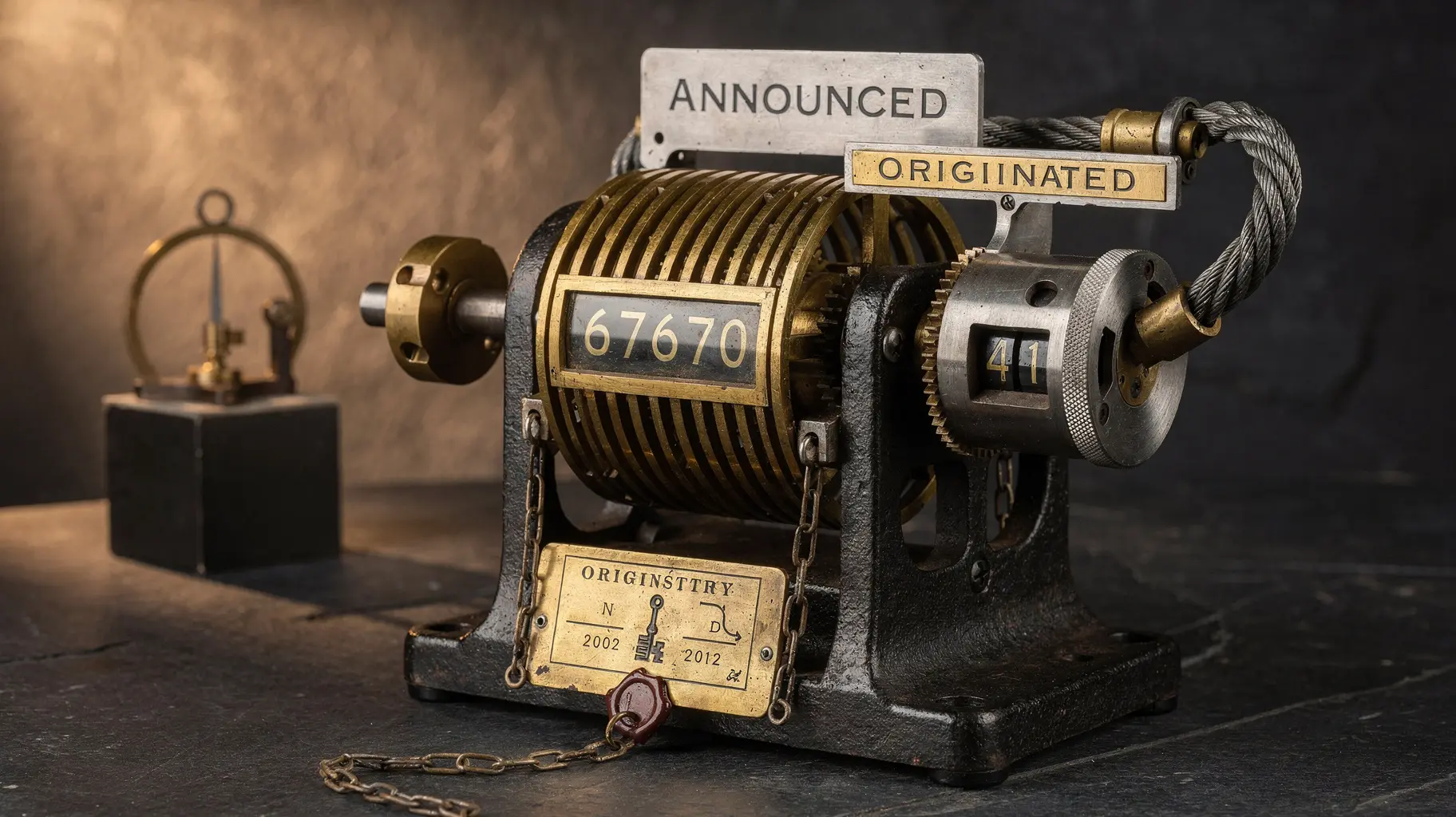
- Its own BGP toolkit page for AS6939 prints 41 IPv6 prefixes originated against 67,670 IPv6 prefixes announced — a ratio of 1,650.5 to one, my arithmetic — so the number behind the claim is the size of the table it carries, not the space it originates.
- The same registrant holds AS6427, registered 28 June 2002 and still active, which has not been seen announcing a prefix since 2018 and whose two listed blocks are recorded in ARIN and RIPE to Panasonic Avionics, Proofpoint and, at the covering /32, Fortinet.
The ARIN record for AS6427 is not a routing document. It is a document about a name. It carries the handle AS6427 and the name HURRICANE-ELEC, with status active, a registration event at 2002-06-28T00:00:00-04:00, and a last-changed event at 2012-02-24T09:44:34-05:00. The registrant entity is handle HURC, vCard name Hurricane Electric LLC, 760 Mission Court, Fremont, California 94539, United States. The administrative and technical contact is ZH17-ARIN.
Those two dates are doing a lot of work. From 28 June 2002 to today is 8,911 days, about 24.4 years. From the last edit to today is 5,383 days, about 14.7 years. Both are my arithmetic on the two printed events, and both are the wrong thing to be impressed by unless you know what the object is for.
The object contains no prefix, no route, no peer, no transit. An RDAP autnum object holds allocation, holder, contact and event data, and it stops there. Everything a reader usually wants to know about an AS number — whether it announces, where it connects, whether anything is behind it — lives in a different document produced by a different process. That distinction is the whole case file.
What the routing documents say, and how narrowly they say it
The RIPE NCC's RIPEstat page for AS6427 states that the AS "does not originate prefixes visible in RIS" and is not seen in RIS as a transiting network. At its 2026-10-24 16:00 snapshot it was visible to 0.0% of 269 IPv4 and 0.0% of 257 IPv6 RIS full peers. It was last seen on 2018-07-23 16:00 announcing 205.220.128.0/18.
Read that carefully. The measure is not "the internet". It is the share of RIS's named full-feed peers that saw this origin at a stated moment. A visibility figure of zero is a strong statement about a peer set, and it is not a census of every router on earth.
Hurricane Electric's own BGP toolkit page for AS6427 says the same thing in the operator's own voice: "AS6427 has not been visible in the global routing table since July 21, 2018", with the warning printed beside it that some displayed information is from that time. The page lists 2 prefixes originated, 0 prefixes announced, 0 RPKI-originated-valid prefixes, 0 AS paths observed, and 1 observed BGP peer — AS6939 Hurricane Electric LLC, for both IPv4 and IPv6. This is operator-adjacent data about the operator's own AS, self-labelled as historical.
The CIDR Report reaches the same verdict from a separate aggregation of global feeds: NOT Announced, and "This AS is not currently used to announce prefixes in the global routing table, nor is it used as a visible transit AS."
Two dates disagree by two days. RIS last saw the origin on 23 July 2018; the toolkit says 21 July. Different collector windows, same event. I print both rather than pick a winner, because neither document is a court record and the two-day gap tells you something useful about how soft a "last seen" stamp is.
Since 23 July 2018 is 3,042 days, about 8.3 years, of silence in the RIS record. That is my subtraction, not the registry's.
The blocks on the nameplate belong to three other companies
The toolkit lists two prefixes originated beside AS6427: 205.220.128.0/18 and 2a0d:ff80:2600::/48. A reader who stops there concludes that Hurricane Electric is sitting on an IPv4 /18 and an IPv6 /48 under this AS number. ARIN's own registry says otherwise.
A lookup of 205.220.128.0 returns NET-205-220-128-0-1: 205.220.128.0/19, name PAC-59, type DIRECT ALLOCATION, status active, registrant Panasonic Avionics Corporation, registered 2010-04-13 and last changed 2026-09-11. A lookup of 205.220.160.0 returns NET-205-220-160-0-1: 205.220.160.0/19, name PROOF, type DIRECT ALLOCATION, status active, registrant Proofpoint, Inc., registered 2019-01-24T10:45:01-05:00 and last changed 2024-11-08T09:55:14-05:00.
Two /19s do not merely sit inside a /18. They tile it exactly. Each /19 holds 8,192 addresses; 8,192 plus 8,192 is 16,384, which is the size of a /18. That is my arithmetic on the two records, and the point it establishes is structural: the block listed beside AS6427 is, in ARIN's registry, two direct allocations to two companies that are not Hurricane Electric.
The IPv6 side behaves the same way one level up. A RIPE RDAP query for 2a0d:ff80:2600::/48 returned not a /48 object but the covering allocation 2a0d:ff80::/32, handle US-OPAQNETWORKS-20180313, type ALLOCATED-BY-RIR, status active, country NL, registrant ORG-ONI4-RIPE — Fortinet, Inc. of 909 Kifer Road, Sunnyvale — with registration and last-changed events both at 2018-03-13T13:33:39Z. No distinct /48 registration appeared in the response. So the specific assignment of that /48 is not established by any document I read, and the containing /32 is held by a third company.
RIPEstat's prefix overview for the exact /18 reports announced false with no origin ASN. That is a statement about that exact prefix on the date of the query, not about the two /19s, which are separate objects that could be routed separately. I am not going to slide from one to the other.
Put the four documents side by side. A registry custody record in Hurricane Electric's name. A routing history that stops in July 2018. An IPv4 block recorded to Panasonic Avionics and Proofpoint. An IPv6 block whose covering allocation is recorded to Fortinet. Four documents, four processes, four different answers to what looks like one question.
The other AS number under the same name
Hurricane Electric is not a mystery. AS6939 carries the handle AS6939 and the name HURRICANE, status active, the same registrant entity handle HURC with vCard name Hurricane Electric LLC, a registration event at 1996-06-28T00:00:00-04:00 and a last-changed event at 2024-11-25T11:09:46-05:00. RIPEstat's as-overview for AS6939 prints the holder as HURRICANE - Hurricane Electric LLC with announced true for the 2026-11-20 window.
So one registrant keeps two AS numbers, four years apart in vintage, and the two are in different documentary states this morning. AS6939 is announced today. AS6427 has not announced since 2018 and has one observed peer, which is AS6939 itself. There is nothing sinister in that. Companies hold numbers they are not currently routing, for administrative continuity, for future use, because the number is easier to keep than to get back. The interesting part is not that a number is quiet. It is that the quiet number carries a famous nameplate.
What the biggest-network claim actually counts
The FAQ answer is the most precise sentence Hurricane Electric has published about its own headline: "Yes, Hurricane Electric operates the largest native IPv6 backbone in the world as measured by the total number of customer networks connected and by the total number of customer prefixes announced."
Both components are customer quantities. Neither is printed with a value, a date, a counting rule or an auditor. So the claim, as written, cannot be recomputed by anyone — including Hurricane Electric, from that page alone.
The About page uses a shorter form: Hurricane Electric is "considered the largest IPv6 backbone in the world as measured by number of networks connected", and within its network it "exchanges traffic directly with more than 9,600 different networks". No date on the 9,600, no definition of "different networks", no statement that they are IPv6 networks.
The IP Transit page prints a larger one: "over 34,000 BGP sessions with over 10,500 different networks via over 320 major exchange points and thousands of customer and private peering ports."
Two pages, two numbers, 900 networks apart, neither dated. That gap is my subtraction. And the same sentence gives a ratio worth pausing on: 34,000 sessions across 10,500 networks is 3.24 sessions per network, my division. If every network were one session, the quotient would be 1.00. So the page is counting sessions and networks as different kinds of object, which is correct of it and easy to miss when the numbers are read as a scale.
Now the toolkit, which is the one place where Hurricane Electric publishes the field its own FAQ says the claim rests on. The AS6939 page prints Prefixes Originated (v6) 41, Prefixes Announced (v6) 67,670, and BGP Peers Observed (v6) 7,672.
Sixty-seven thousand six hundred and seventy divided by forty-one is 1,650.5. That is my arithmetic, and it is the sharpest number in this article. When the metric is "customer prefixes announced", the quantity being counted is the size of the table AS6939 carries — prefixes originated by Hurricane Electric's customers and everyone else downstream, not prefixes Hurricane Electric itself originates. The toolkit prints both fields on the same page in the same units, which is more honest than most marketing pages manage, and the distance between them is the claim.
The milestone ladder, and the unit that changes on it
The dated part of this story is a series of company announcements. On 27 October 2010 Hurricane Electric announced it was "the first network in the world to connect to over 1,000 IPv6 networks", and named the basis: the number of networks connected. On 7 March 2013 it was "the first Internet backbone to connect to over 2,000 IPv6 networks", doubling in less than three years, same basis. On 15 August 2017, Data Center Knowledge reported the 4,000 milestone and quoted company president Mike Leber on growth in "the number of networks we connect to".
Three dated numbers with a stated basis and no published counting rule. Then the FAQ's two-part definition arrives and adds a second component — customer prefixes announced — which none of the three releases used. Then the toolkit publishes 67,670 prefixes announced and 7,672 observed IPv6 peers. The label has moved at least three times: networks connected in the releases, customer networks plus customer prefixes in the FAQ, prefixes announced in the toolkit. A 2017 figure of 4,000 networks and a 2026 figure of 7,672 peers may or may not be the same object.
No document I read reconciles them, and I am not going to do the reconciliation on Hurricane Electric's behalf.
The fourth rung is a contact book
One more record sits under AS6427 and it is the one most likely to be misread. The abuse contact, ABUSE1036-ARIN, carries an Unvalidated POC remark stating that ARIN received no response from the POC since 2024-12-26.
ARIN's own description of that flag is narrow: validation was attempted, no response came back since the listed date, and the consequence concerns the point of contact. It is a statement about a mailbox, not about a network, an allocation or a route. An unvalidated abuse contact on a number nobody is announcing is exactly as consequential as it sounds, which is to say it is a detail about registry hygiene and not a signal about connectivity.
What each document can attest
Keep the rungs separate and the case file writes itself.
A registry autnum object attests custody of an identifier: who holds AS6427, since when, with which contacts. An RDAP network object attests custody of an address block: who holds 205.220.128.0/19 and 205.220.160.0/19, since when. A route collector attests visibility inside a named peer set at a stated time. An operator's own toolkit attests the operator's view of its own table, labelled historical when it is historical. A marketing page attests a claim, and a FAQ attests the claim's own definition. Only the first two have an authoritative custodian, and neither of them can tell you whether a packet moves.
The practical error this case file exists to catch is small and expensive: reading a nameplate as a network. HURRICANE-ELEC is a name on an allocation, 24.4 years old, last edited 14.7 years ago, with a routing history that ended in 2018 and two blocks that ARIN and RIPE record to Panasonic Avionics, Proofpoint and Fortinet. None of that makes the allocation wrong. It makes the nameplate a poor proxy for anything.
And the claim? Hurricane Electric's own FAQ says what it counts. Its own toolkit prints that field at 67,670 next to 41. Both figures are the company's. The distance between them is the largest IPv6 network in the world, as defined by the company that operates it — a table, measured by what passes through it.
Member Briefing
Read the full trend briefing
Members read the full briefing with the source notes behind every finding.
Strategic Circle
A daily briefing in your language, built from changes we have verified.
Join for USD 20/monthCancel anytime.
Members also get the full research library, a daily briefing on the networks they follow and the private forum.