
Summary
- Bangladesh's international capacity is landed at two named sites — Cox's Bazar for SEA-ME-WE-4 and Kuakata in Patuakhali for SEA-ME-WE-5 — both attributed to one operator, and that two-site footprint is itself the most concrete fact in the public record.
- The capacity numbers in circulation are one ministry-issued statement re-reported twice, not two independent measurements: 7,200 Gbps in total, 4,200 Gbps in use, 3,000 Gbps available, and a Tbps rendering that is a rounding artefact of the same figures.
- The SEA-ME-WE-6 figures do not reconcile. A 34 Tbps addition plus 7.2 Tbps gives the reported 41 Tbps total; a 30 Tbps addition does not. The two cannot both be right, and neither is instrumented.
- No consortium share schedule, tariff instrument, licence document or independent traffic measurement was retrievable on 17 October 2026, so the gap between assigned share, lit capacity and released capacity remains unverified.
- Three names attach to one asset — a directory card, a regulator portal listing and the operator's own self-designation — and the article treats that as a dated record-layer lag rather than a concealment.
- The operator's claim to be the guardian of "trusted" systems against private "untrusted" entrants is a market-structure claim wearing security vocabulary; it currently fails the instrument test.
At 16:28 UTC on 17 October 2026, two Bangladeshi newspapers reported the same statement from the posts and telecom ministry describing how much international bandwidth the country has and how much of it is free. At 16:32 UTC, a retrieval of the operator's own website returned two landing stations rather than one. Between those two timestamps, five separate retrieval generations were captured, and every measured value in this article is bound to one of them: the 7,200 Gbps and 4,200 Gbps and 3,000 Gbps figures come from the 16:28 and 16:30 UTC generations reporting the ministry statement (The Daily Star); the 7.2 Tbps, 34 Tbps and 41 Tbps figures come from the 16:28 and 16:30 UTC generation of the second outlet (Dhaka Tribune); the regulator's portal listing comes from the 16:29 and 16:30 UTC generations (BTRC); the two landing stations come from the 16:32 UTC generation of the operator site (operator website). Nothing below is drawn from a source outside that set, and where the set is silent, this article says so rather than filling the gap.
The subject is the entity BTW tracks as Bangladesh Submarine Cable Company Limited, a small member of the APNIC public member directory with country code BD and no autonomous system number or IP block recorded on its card (directory record). That card is a registry artefact. It establishes membership in a regional internet registry and nothing more: not a landing station, not a consortium share, not a service role. Its own data-gap note warns against inferring any of those from the membership row. Everything else in this article had to be acquired separately, and the pattern of what could and could not be acquired is the finding.
The physical layer: two beaches, not one
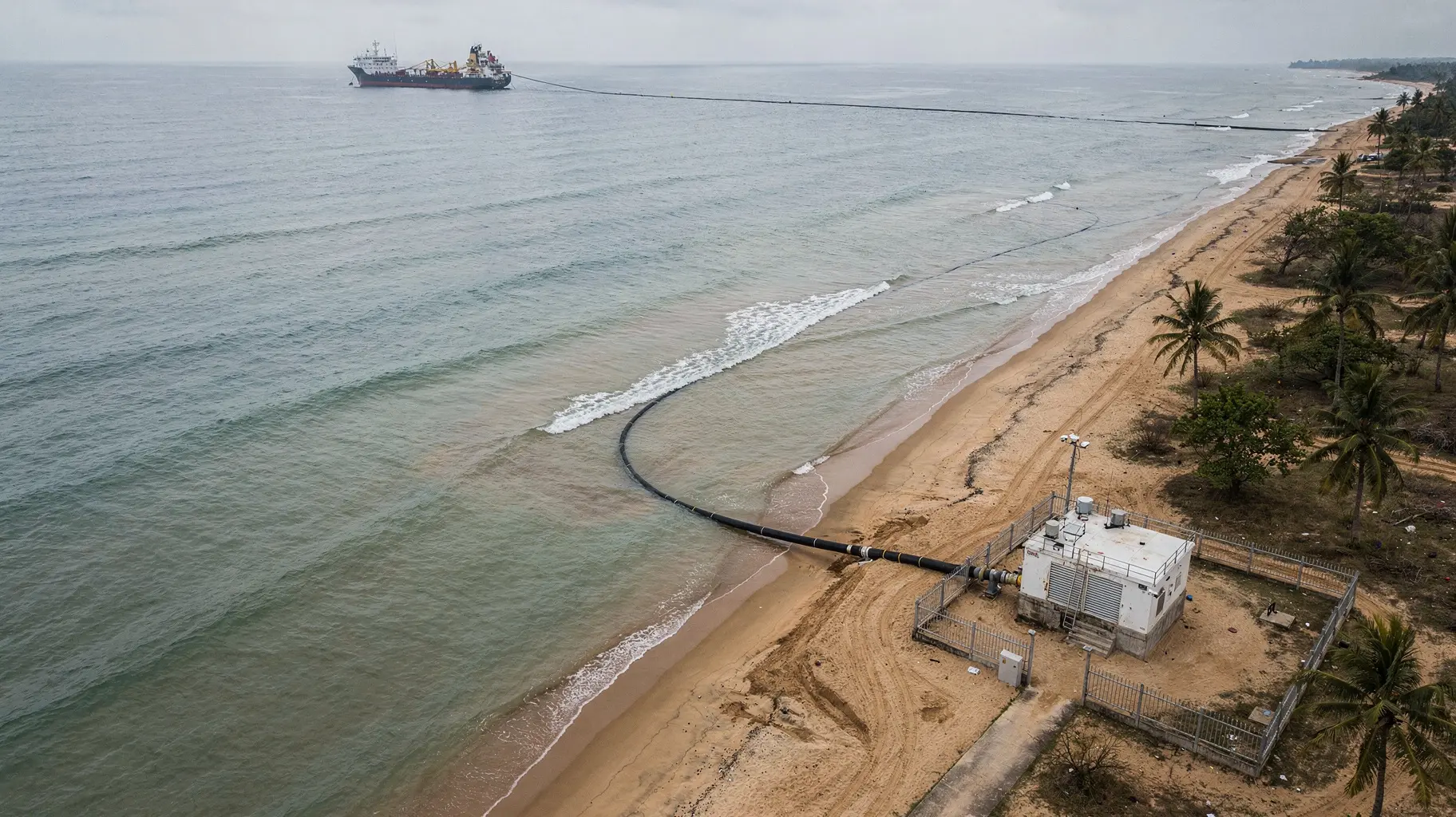
The most useful correction in the whole evidence set is geographical. The operator's website, as summarised by the retrieval channel, names two landing stations: one at Cox's Bazar serving SEA-ME-WE-4, and one at Kuakata in Patuakhali serving SEA-ME-WE-5 (operator website). That matters because the intuitive reading of a single-cable country — one beach, one building, one point of failure — is wrong here in a specific and checkable way. Bangladesh's submarine connectivity is split across two coastal sites, roughly a full cable generation apart, and the operator's own account places itself at both.
A caution belongs on that sentence, and it is not decorative. The operator site was retrieved as a provider-written summary with no verbatim page text retained. No sentence from that site can be quoted, and the attribution of the two stations is a channel summary of what the site says rather than a reading of the site itself. The retrieval channel also recorded that direct access to the site and to capacity-allocation specifications was limited. So the two-site footprint is the most concrete physical fact in this article and it still arrives second-hand.
Anyone who needs it at engineering grade will have to read the site and the landing-station records directly.
What the two-site footprint does not tell us is equally important. It does not tell us whether the operator owns both stations, leases capacity at either, or holds a consortium share that entitles it to capacity at a station operated by someone else. In submarine cable economics those are different positions with different cost structures and different bargaining power, and the public record retrieved here does not distinguish them. Two stations under one name is a fact about geography and branding. It is not yet a fact about control.
The capacity claim, and who is actually speaking
The numbers that circulate in Bangladeshi coverage of this operator have a single origin, and identifying that origin changes how they should be read. The Daily Star's report attributes the figures to "a statement issued by the posts and telecom ministry", and the company is described as saying, within that statement, that it operates two "trusted submarine cable systems" — SEA-ME-WE-4 and SEA-ME-WE-5 — "with a combined capacity of about 7,200 Gbps", of which "4,200 Gbps is already in use domestically, while an additional 3,000 Gbps remains available for allocation" (The Daily Star).
The second outlet reports the same statement in different units: two systems with "around 7.2Tbps of capacity, of which about 4Tbps is being supplied and another 3.2Tbps remains available", and adds that SEA-ME-WE-6 "is expected to become operational in 2027, adding 34Tbps and taking BSCPLC's total capacity to around 41Tbps" (Dhaka Tribune).
Two outlets, two renderings, one narrator. This is the single most important discipline to apply to the entire subject, because the temptation is to treat the Gbps version and the Tbps version as corroborating each other. They do not corroborate. They are the same sentence counted twice.
The narrator matters as much as the duplication. A ministry statement issued on behalf of a state-linked operator is a declaration, not an audit. It tells you what the operator and its supervising ministry are prepared to say about utilisation on a particular day. It does not tell you how utilisation was measured, over what interval, at which layer of the network, or whether "in use" means capacity contracted, capacity provisioned, or bits actually carried. Those are not pedantic distinctions.
They are the difference between a commercial claim and an engineering measurement, and no source in this evidence set supplies the definitions.
The arithmetic: what closes, what does not, and what that tells you
Running the numbers is worth doing explicitly, because the results separate a rounding difference from a genuine contradiction.
At Gbps precision the identity closes exactly. 4,200 plus 3,000 equals 7,200, which is the stated total. At Tbps precision the identity also closes: about 4 plus 3.2 equals 7.2. And the cross-report comparison is consistent with ordinary rounding in opposite directions: 4,200 Gbps rounds to about 4 Tbps, and 3,000 Gbps rounds to 3.0 Tbps rather than 3.2 Tbps, which means the second outlet's figures are not simply the first outlet's figures rounded — they are a slightly different pair that happens to sum to the same total.
The 200 Gbps difference on each side of the split is the kind of discrepancy that appears when two journalists convert the same underlying numbers into different units, or when the underlying statement itself carried a range. It is not evidence of two different measurements.
That is the reassuring half. The unreassuring half concerns SEA-ME-WE-6, and here the arithmetic refuses to cooperate.
If the existing systems carry 7.2 Tbps and SEA-ME-WE-6 adds 34 Tbps, the resulting total is 41.2 Tbps, which is the "around 41Tbps" the second outlet reports. The figures are internally consistent. If instead SEA-ME-WE-6 adds 30 Tbps — the figure carried in the provider summary of the first outlet — the resulting total is 37.2 Tbps, which is not 41 Tbps by any rounding convention. The 30 Tbps and 34 Tbps figures describe the same system, and only one of them reconciles with the total that accompanies it in the reporting.
Two consequences follow. First, at least one of the two SEA-ME-WE-6 figures is wrong, and the public record does not say which. Second, and more revealingly, the figure that fails the arithmetic test is the one that survives only as a provider summary with no verbatim source text behind it, while the figure that passes arrives inside a retained verbatim excerpt. That is not proof that 34 Tbps is correct — a cable's design capacity is set by its consortium and its suppliers, not by arithmetic elegance — but it is a reason to prefer the reconciled figure and to treat the other as an unresolved variant rather than an alternative fact.
The timing shows the same pattern. The second outlet's verbatim text says SEA-ME-WE-6 is "expected to become operational in 2027". The first outlet's provider summary places it at the end of 2026, but no date appears in the verbatim excerpt retained from that source. A twelve-month spread in the commissioning date of a system that is supposed to multiply a country's international capacity is not a minor discrepancy for anyone planning against it.
The honest statement is that the public record contains both dates, that the later one has verbatim support and the earlier one does not, and that neither has been confirmed by a ready-for-service notice from the operator or the consortium.
Five different things called capacity
The word capacity is doing too much work in this story, and separating its meanings is the analytical core of the article.
There is the design capacity of a cable system: the theoretical throughput the fibre pair and the repeaters were specified to carry, a number fixed years before any customer exists. There is the capacity assigned to a landing party under the consortium agreement: the share of that design capacity the national participant is entitled to use, usually expressed in fibre pairs or wavelength slots. There is the capacity actually lit by the landing party: the terminal equipment installed and powered at the station, which is almost always less than the assigned share.
There is the capacity released to domestic carriers: what the landing party makes available commercially, on terms set by contract and, where a regulator intervenes, by tariff. And there is traffic actually carried, which is the only one of the five that a customer experiences and the only one that an independent party could in principle measure from outside.
No source in this evidence set distinguishes among these five. The ministry statement's "in use domestically" and "available for allocation" are consistent with the fourth layer — released capacity, some taken up and some not — but they are equally consistent with the third, and nothing in the reporting resolves it. When an operator says 3,000 Gbps "remains available for allocation", a reader cannot tell whether that means unlit terminal capacity that could be commissioned, lit capacity with no buyer, or assigned share not yet drawn down from the consortium.
The three imply completely different constraints on how fast the country could absorb a demand surge, and completely different costs to the operator.
This is why the headline number should not be used for planning. A country with 7.2 Tbps of design capacity, 4.2 Tbps lit and 3.0 Tbps unsold has a very different problem from a country with 7.2 Tbps lit, 4.2 Tbps sold and 3.0 Tbps of dark fibre entitlement it has never equipped. The first has spare inventory. The second has a capital-allocation decision to make. The published figures fit both.
Three names for one asset
A second kind of ambiguity runs through the record, and it concerns identity rather than quantity.
The BTW directory card carries the name Bangladesh Submarine Cable Company Limited, abbreviated BSCCL, and records its legal type as a private company registered in Bangladesh. The regulator's portal lists the entity in Bangla as বাংলাদেশ সাবমেরিন কেবল কোম্পানী লিমিটেড (বিএসসিসিএল) — the same legacy name — among its important links (BTRC). The operator's own statements, as reported, and current industry reporting use a different name entirely: Bangladesh Submarine Cables PLC, abbreviated BSCPLC (Dhaka Tribune; syndicated report).
There is a further detail that no single source flags but the record shows plainly. The APNIC member directory links the entity to the address bsccl.com, while the operator site retrieved in this evidence set is bsccl.com.bd. Two domains, one of them the older registry-linked address and one the current national domain, is exactly what a corporate transition looks like from the outside: the operating reality has moved and the record layers have moved at different speeds.
The right treatment of this is neither to ignore it nor to inflate it. A regulator's portal is a lookup record, not an authority over a company's current trading name; portals lag renames routinely, in every jurisdiction, and the lag is not evidence of anything sinister. But the lag is a small accountability finding worth stating, because a reader trying to match a capacity claim to a legal entity, or a counterparty trying to serve a notice on the right company, has to resolve the naming question first, and the public record does not resolve it.
The directory card's characterisation as a private company, meanwhile, sits awkwardly against press descriptions of a state-owned, publicly listed enterprise under the posts and telecommunications division. Neither characterisation is an incorporation filing. This article does not settle the question, and a reader should treat any confident assertion about the entity's legal form as resting on something not present here.
The trust vocabulary and the market structure underneath it
The operator's statement, as reported, does something more interesting than publish a capacity figure. It divides the world into "trusted submarine cable systems" — its own two, plus the forthcoming SEA-ME-WE-6 — and private entrants it characterises as untrusted, on grounds of cybersecurity and national stability (The Daily Star).
That vocabulary deserves to be quoted rather than adopted, and the reason is structural. The same reporting that carries the trust framing also carries the objection to it. Industry stakeholders argue that the operator's dominant position and control over international routes restrict competition and pose infrastructure risks, and private-sector proposals are described as capable of adding roughly 51 Tbps of capacity, framed by their proponents around digital sovereignty and reduced reliance on terrestrial bandwidth through India (Dhaka Tribune). A syndicated headline states the accusation more bluntly, attributing to industry stakeholders the claim that the operator's dominance is "restricting competition and hampering efforts to provide more" affordable, reliable internet (syndicated report). That last source is a truncated lead sentence ending in an ellipsis; it is evidence that the accusation is published, and nothing more.
Read together, the two halves describe a market-structure dispute wearing security vocabulary. A designation of "trusted" that is applied to an incumbent's own systems and withheld from prospective competitors is, whatever else it is, a barrier to entry that requires no licence document, no tariff filing and no fault record to operate. That is not an accusation of bad faith. It is an observation about how trust language functions when it is asserted by the party that benefits from it and cannot be tested by the parties it excludes.
The test that would settle it is specific and currently unmet. A security distinction between cable systems would become a genuine argument if it were supported by a published certification regime, a threat assessment, a documented refusal of a landing licence on stated grounds, or an incident record showing that one class of system failed where another held. None of those appears in the evidence set retrieved on 17 October 2026. In their absence the distinction reads as an accountability claim that has not yet produced its instrument — which is a different and more precise finding than saying the claim is false.
What the regulator's portal shows, and what its silence means
Because the leverage question turns on whether the operator's position is granted by an instrument or accumulated by incumbency, the regulator's public surface was searched directly. The portal is the statutory authority's own front door, listing policies, guidelines and licence categories, and it does list the entity (BTRC). In the pages retrieved on 17 October 2026, however, no instrument granting an exclusive submarine-cable landing right to this entity was retrievable, and the portal does not on its face detail a singular exclusive legal instrument conferring landing rights.
That negative finding has to be stated with its own limits, and the limits are the point. A public portal is not a complete archive of a regulator's instruments. Licensing may sit in a separate register, in a gazette, in a ministry file, or in the terms of the consortium participation itself rather than in a licence at all. The correct conclusion is narrow: as of 17 October 2026, a reader could not verify from the regulator's public pages that an exclusivity instrument exists. It is not that no such instrument exists.
But the narrow conclusion carries real weight, because of what it does to the rest of the argument. If exclusivity were instrumented and public, the operator's gatekeeping would be lawful by document, and the analytical frame would shift from an unproven monopoly to a statutory one — a much easier thing to argue about, because the remedy would be a change to a named instrument.
If exclusivity is instead an artefact of incumbency — being the state-linked entity that joined the consortia first, holding the landing stations, and being the counterparty domestic carriers already deal with — then there is no single document to amend and the barrier is much harder to dislodge. The public record retrieved here is consistent with the second reading and does not prove it.
Registry membership is not a network
One further discipline is worth stating plainly, because it is the kind of error that travels well and ages badly. The BTW directory card for this entity records an APNIC member directory row: a small member, country code BD, an APNIC-linked website, and nothing else. No autonomous system number. No IPv4 or IPv6 block. No relationships. No leadership contacts. A confidence score of 0.82, which is a statement about the quality of the card as a review object, not a probability that the entity operates anything.
A registry membership row is a governance fact. It says an organisation participates in a regional internet registry's membership structure. It does not say the organisation announces routes, operates a landing station, sells transit, or controls capacity. In this case the membership row and the landing-party claim happen to point at the same organisation, and the press reporting fills in the operational role that the card cannot. But the two layers must not be collapsed: the card did not establish the operational role, and it would have looked identical if the entity were a dormant holding company with a single member fee.
That is not a technicality. It is the same distinction that makes the capacity numbers hard to use. Registry layers record entitlements and identities. Operational layers record equipment, contracts and traffic. The interesting questions in this story all live in the second layer, and the second layer is where the evidence thins out.
The demand side, as cited rather than measured
One more figure completes the picture, and it arrives with a double attribution that should be preserved. The operator is reported as citing a Bangladesh Telecommunication Regulatory Commission projection of national demand at around 30 Tbps in 2030 (Dhaka Tribune). That is a regulator's forecast relayed by the operator and reported by a newspaper — three steps from the underlying model, and the model itself was not retrieved.
Forecasts of this kind are useful for exactly one purpose: they show what the incumbent believes it needs to be true in order to justify its build programme. A projection of 30 Tbps in 2030 sits comfortably below a post-SEA-ME-WE-6 position of around 41 Tbps, which is precisely the argument the operator is making — that planned capacity covers projected demand and no crisis is imminent. Whether the projection is sound is a separate question, and the stakeholders who want private entry are effectively disputing it.
When a demand forecast and a supply plan are published by the same interested party in the same statement, the forecast should be read as part of the argument rather than as an input to it.
What the record establishes, and what it does not
Pulling the layers apart produces a short list of things that are established and a longer list of things that are not.
Established, at the level of dated public reporting: two cable systems are in service, named SEA-ME-WE-4 and SEA-ME-WE-5; two landing stations are attributed to the operator, at Cox's Bazar and at Kuakata in Patuakhali, with the caveat that this rests on a channel summary rather than on retained site text; a third system, SEA-ME-WE-6, is under construction with a commissioning date reported as either the end of 2026 or 2027; a total capacity of about 7.2 Tbps with a stated split of roughly 4 Tbps in use and 3.2 Tbps available, published in Gbps as 7,200 / 4,200 / 3,000; a demand projection of about 30 Tbps for 2030 attributed to the
regulator; a private-sector proposal described as capable of adding roughly 51 Tbps; and a published dispute in which stakeholders say the operator's dominance restricts competition while the operator says its systems are the trusted ones.
Not established, and not for want of trying: the consortium share assigned to Bangladesh or to this operator on any of the three systems; the split between design capacity, lit capacity, released capacity and carried traffic; the terms on which capacity is released to domestic carriers, including any tariff; the existence or content of any exclusivity instrument; the ownership and contractual status of the two landing stations; any independent measurement of utilisation; any cable-fault or restoration record; and any filing that settles the entity's legal form or current registered name.
On all of these the public record retrieved on 17 October 2026 is silent, and this article reports that silence as a finding rather than treating it as a gap to be bridged by inference.
The consequence for a reader is practical. The capacity figure of 7.2 Tbps is safe to quote with its attribution and unsafe to plan against. The two-landing-station footprint is the most robust physical fact available and still rests on a summary. The trust framing is a claim by an interested party that has not produced its evidence.
And the leverage question — the one that matters for carriers paying for transit capacity and for anyone modelling national resilience — remains open, in a way that is itself informative, because a position that cannot be documented is a position that cannot be tested, and a position that cannot be tested is one that counterparties have to price as a risk rather than accept as a fact.
Member Briefing
Deeper Profile Context
Sign in with the right membership level to unlock the full briefing and source notes.
Only for Strategic Circle
Strategic Circle
Open to all readers. Unlock profile briefings after joining and signing in.
Join Strategic CircleOnly for Leadership Alliance
Leadership Alliance
For qualified IP-asset owners and management; sign in to unlock alliance briefings.
Join Leadership Alliance