Summary
- On the operator's own September 2026 statement, its two submarine systems hold about 7.2 Tbps, of which about 4 Tbps is supplied and about 3.2 Tbps remains available — a margin the operator presents as headroom, not as a shortfall.
- The last measured national split, dated March 2026, puts SEA-ME-WE-4 at about 2,704 Gbps and SEA-ME-WE-5 at about 1,488 Gbps against consumption above 10,000 Gbps, with the remainder entering overland from India. Summed, the submarine share is roughly 4.2 Tbps, less than half the measured total.
- The April 2026 four-day maintenance window on SEA-ME-WE-5 is the only dated disruption in the record. It is a scheduled interruption, not a fault, and no restoration interval for any cable was obtained.
Two systems, one company, four numbers
The company at the centre of this record is tracked in the BTW directory as Bangladesh Submarine Cable Company Limited (BSCCL). Every 2026 source retained for this briefing instead names the operator as Bangladesh Submarine Cables PLC (BSCPLC). No corporate-registration document, gazette notice or renaming instrument was obtained, so the link between the two names is treated here as an unresolved identity question rather than an established fact.
On capacity, the September 2026 report is specific. The operator "said its two existing submarine cable systems have around 7.2Tbps of capacity, of which about 4Tbps is being supplied and another 3.2Tbps remains available," according to Dhaka Tribune's account of the bandwidth debate. The same report records the operator's expectation that a third system, SEA-ME-WE-6, becomes operational in 2027, "adding 34Tbps and taking BSCPLC's total capacity to around 41Tbps."
Those are the operator's numbers about the operator's plant, reported at one remove. They say what the company believes it holds. They do not say what the country uses, and the two questions have different answers.
What the March measurement actually splits
The only measured division of national bandwidth in the record comes from a different occasion and a different purpose: a report on scheduled maintenance. As of March 2026, The Daily Star reported, "Bangladesh's total bandwidth consumption currently exceeds 10,000 Gbps. Of this, the SEA‑ME‑WE‑5 submarine cable supplies around 1,488 Gbps, while the country's first submarine cable, SEA‑ME‑WE‑4, provides about 2,704 Gbps." The remainder, the report states, is sourced from India through international terrestrial cable operators over land-based connectivity.
The arithmetic that follows is mine, not either source's. The two per-system figures sum to about 4,192 Gbps, or roughly 4.2 Tbps. That is consistent with the operator's separate "about 4 Tbps" being supplied, which is the one point of agreement between the two documents. Set against consumption above 10,000 Gbps, it implies submarine cable carried less than about 42 per cent of measured national bandwidth in March 2026.
On its own stated capacity, the company's unsold 3.2 Tbps is roughly 44 per cent of 7.2 Tbps — idle margin at the same moment the country was reported to be drawing the majority of its bandwidth overland.
Both percentages inherit every weakness of their inputs. Consumption, capacity supplied and capacity available are three different measurements taken by different parties at different moments, and none of the underlying documents is an audited statement. What survives those caveats is directional and uncomfortable: the operator with the landing rights is not the party carrying most of the traffic.
Two beaches, and a corridor nobody has mapped
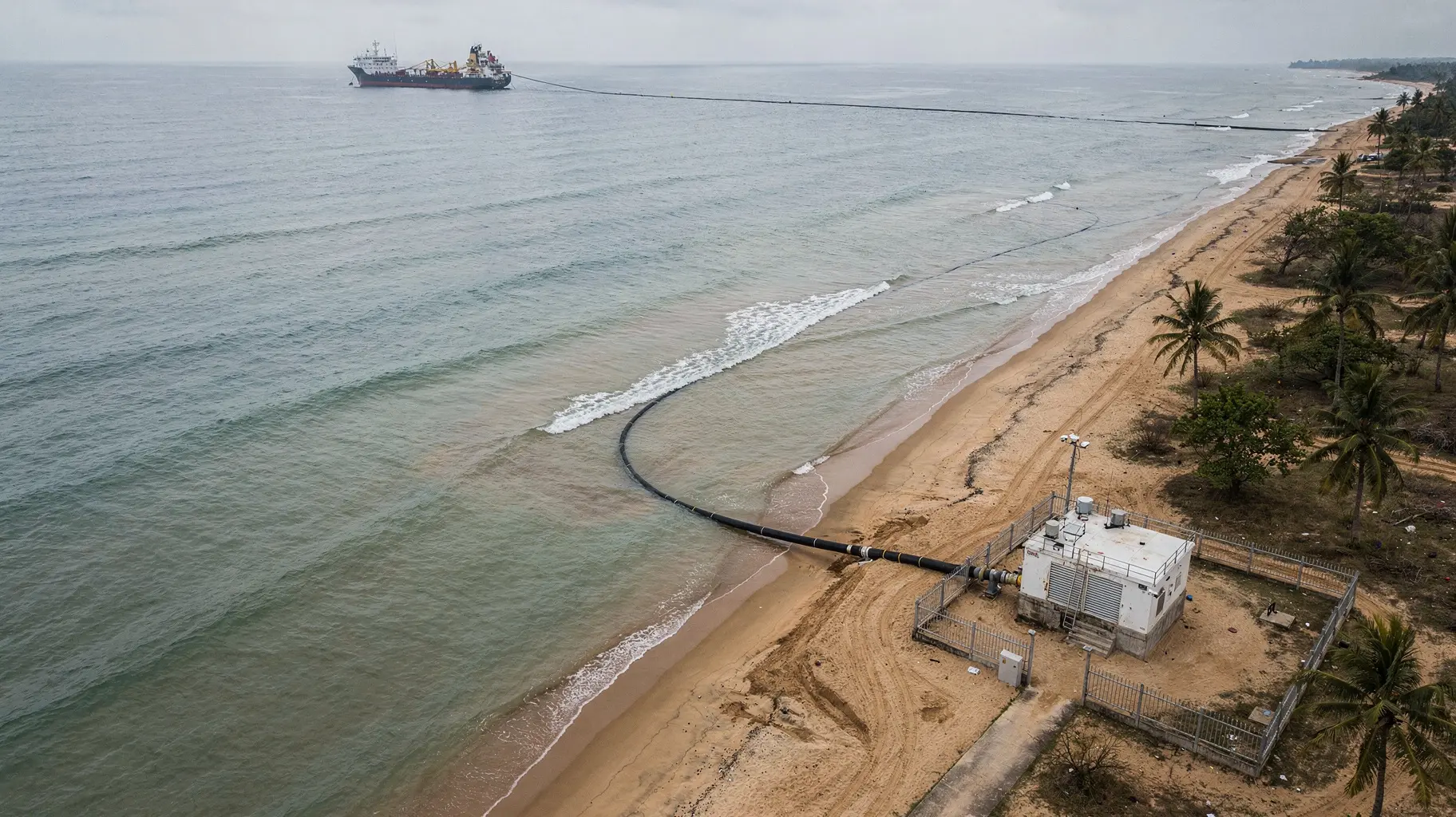
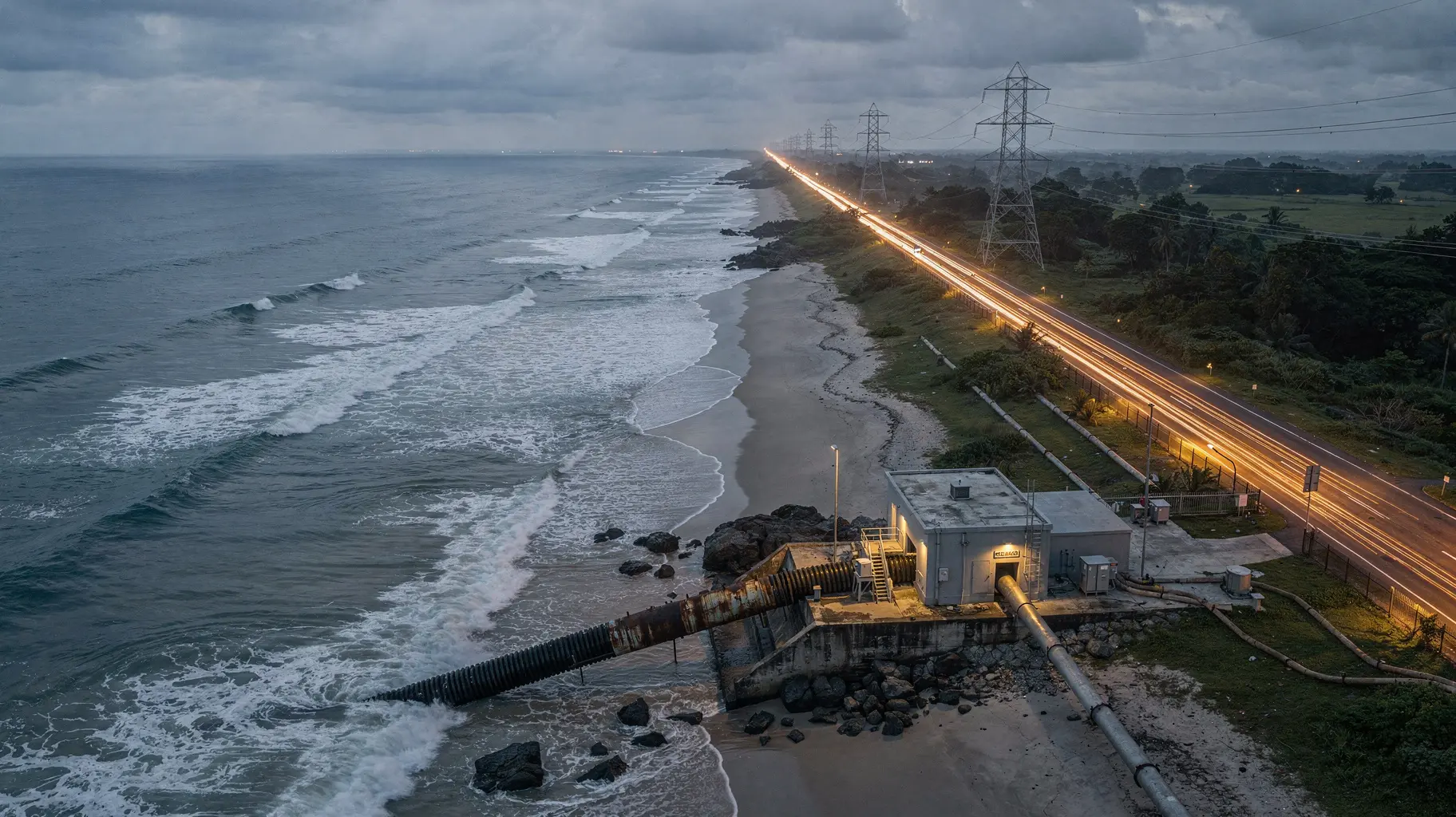
Landing geography is the part of this record that is thinnest. The operator's corporate site is cited for the arrangement — SEA-ME-WE-4 coming ashore at Cox's Bazar, SEA-ME-WE-5 at Kuakata, and the planned third system also landing in the Kuakata area, per the BSCPLC corporate website — but the retained snapshot carries claim candidates only, with no verbatim page text. The same limitation applies to the TBS News item on the SEA-ME-WE-6 consortium, which is also cited for discussion of whether the cables' physical paths remain distinct despite separate landing stations.
That question is the one worth holding open. Two landing stations are two stations; they are not automatically two independent paths, and neither is a third system that lands beside the second. No seabed route survey, cable route map or depth-separation record was obtained, so this briefing cannot say whether the systems diverge or share a corridor. The distinction matters because a single corridor concentrates risk no matter how many systems run through it, while genuinely separated routes dilute it — and the public record retained here does not settle which applies.
The four-day test
The only dated operational interruption in the record is planned, and it is instructive precisely because it was planned. Maintenance on SEA-ME-WE-5 was scheduled from 22:00 Bangladesh time on 9 April 2026 to 06:00 on 13 April 2026, four days, with slower speeds or partial disruption expected and circuits connected to Singapore particularly affected; the operator stated that services would continue through SEA-ME-WE-4, The Daily Star reported.
Read as a test, that window asked one question of the network: can the older system absorb the newer one's load, with the overland route already carrying the larger share? The record states the intent and the contingency. It does not state what actually happened. No post-maintenance measurement, latency series, throughput report or customer complaint record was obtained, and no fault or repair interval for any cable appears in the material read.
Whether the four days passed without visible degradation is therefore unknown from this evidence base — and that absence is itself the most useful finding in this section, because it is the same absence a buyer, a regulator or an insurer would encounter.
The dispute the numbers do not settle
The disagreement in the record is about risk, not measurement. Industry representatives argue, per Dhaka Tribune, that reliance on two submarine systems plus terrestrial links through India "leaves the country with fewer alternative international routes than regional competitors and could increase vulnerability when cables suffer faults or maintenance disruptions." The operator "strongly rejected warnings of an impending crisis," pointing to its available capacity.
Both positions are internally coherent, and neither is refuted by the other's facts. The operator is right that it holds unsold capacity on its own systems. Its critics are right that capacity held by one operator on two systems is not the same thing as route diversity for the country. The 3.2 Tbps figure is simultaneously the operator's evidence of adequacy and, on the arithmetic above, a measure of how much of the country's demand is being met somewhere else. A margin that large inside a monopoly is a commercial fact; it is not a resilience fact.
What this record does not contain
The boundaries are specific and worth stating plainly. No audited financial statement, annual report or regulatory filing from the operator was obtained as text; every capacity and consumption figure here is drawn from newspaper reporting of statements attributed to the operator or to industry representatives. No landing-party agreement, construction-and-maintenance agreement or consortium membership document was obtained.
No terrestrial transit agreement, India-side capacity contract, gateway licence or tariff schedule was obtained, so the price and contractual terms of the overland route — the route carrying the majority — are entirely unestablished. No published capacity or demand figure after September 2026 was obtained.
That last gap defines the article's expiry. The newest operational number is dated September 2026 and the newest measured split is dated March 2026. A single subsequent disclosure from the regulator or the operator could move either figure materially.
What would change the reading
Three observations would do it. A published statement from the operator or the regulator showing that the majority of national bandwidth arrives by submarine cable rather than overland would reverse the central reading outright. A terrestrial transit record showing multiple independent overland paths, rather than a corridor through one neighbouring country, would weaken the concentration finding without restoring the submarine share.
And evidence that the unsold 3.2 Tbps is contractually or technically unusable — reserved, unlit, or unsellable under gateway licensing — would convert the idle margin from a commercial outcome into a physical constraint, changing what the number means.
A fourth would cut the other way. A route map showing the two systems' paths diverge substantially before reaching the same region would strengthen, not weaken, the case that the landing pair buys real diversity — and would make the overland majority a story about price and licensing rather than about physics.
The bounded consequence
The useful conclusion is narrow. Bangladesh's international bandwidth is not, on the best dated public numbers available, primarily a submarine cable story. Roughly 4.2 Tbps arrived by sea in March 2026 against consumption above 10,000 Gbps, the operator's own systems held about 3.2 Tbps unsold in September, and the largest single dependency in the chain runs overland through one neighbour. The company's landing rights are real leverage over one layer of that chain. They are not leverage over the layer carrying most of the traffic, and the two should not be read as the same position.
Member Briefing
Deeper Profile Context
Sign in with the right membership level to unlock the full briefing and source notes.
Only for Strategic Circle
Strategic Circle
Open to all readers. Unlock profile briefings after joining and signing in.
Join Strategic CircleOnly for Leadership Alliance
Leadership Alliance
For qualified IP-asset owners and management; sign in to unlock alliance briefings.
Join Leadership Alliance