Summary
- A blind signature was meant to stop Mark Twain Bank from linking a particular spent eCash coin to the account withdrawal that funded it.
- The bank still authenticated accounts, issued dollar-denominated coins, checked deposits and converted merchants’ coins back into bank deposits.
On 23 October 1995, DigiCash announced that Mark Twain Bank was accepting applications for eCash accounts denominated in U.S. dollars. The awkwardly modern part was the cryptography. The recognizably old-fashioned part was the password: applicants could send forms online, by mail or fax, and the bank would send the password by mail. Digital cash had arrived with a postal dependency.
That detail is more than a punchline. It exposes the actual bargain. DigiCash wanted a payment token that behaved like cash in one narrow respect: the bank should not be able to trace a coin from the moment it left a customer’s account to the moment a seller deposited it. But the bank remained the institution that made the token spendable. Privacy sat inside a bank-run system, not outside it.
The bank signs without seeing the serial number
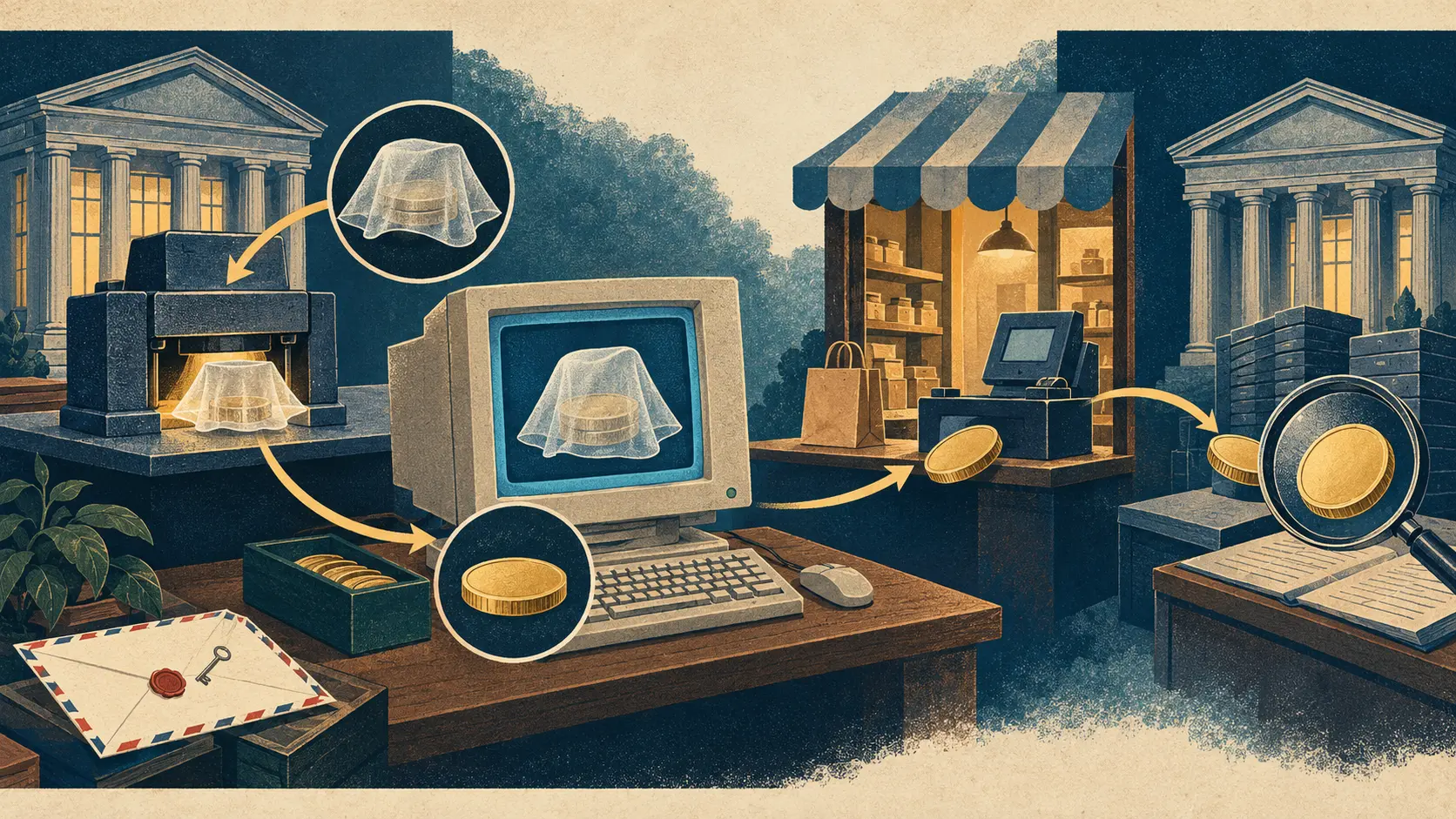
David Chaum’s 1982 blind-signature paper describes the mechanism behind that bargain. A customer creates a note with a random serial number and blinds it before asking the bank to sign. The bank debits the customer and signs the obscured note. The customer removes the blinding factor and gets a valid bank-signed coin whose serial the bank did not see at withdrawal.
At payment, the merchant receives the coin and deposits it with the bank. The bank verifies its signature, checks whether that serial has already been spent, records a cleared coin and credits the merchant. The serial number makes reuse detectable. The blind signature is meant to make the withdrawal-to-payment link unavailable to the signing bank. Chaum’s paper sets out that protocol logic; it is not an audit of Mark Twain Bank’s deployed software. Chaum’s 1982 paper
The distinction matters. A bank can know who withdrew money and still be unable to identify which withdrawal produced a particular coin later presented by a merchant. The privacy claim concerns that cryptographic association. It does not erase the customer’s account, the merchant’s deposit relationship or every trace a network might leave.
Cash-like spending, bank-shaped edges
DigiCash’s launch release described software on a customer’s personal computer choosing random coin serials, blinding the coins and sending them to the bank for signature. The customer could then pay a seller from that local wallet. The bank checked deposited serials so a coin already accepted could not be accepted again. DigiCash said the bank could not tie a spent coin to a particular withdrawal. DigiCash’s 23 October 1995 release
Yet “cash-like” did not mean “bankless.” Mark Twain Bank accepted the application, authenticated the account, signed the dollar value and stood at the redemption point. The U.S. General Accounting Office later described the bank’s liability as value was issued and the conversion when a merchant deposited eCash for a bank deposit. It also reported that Mark Twain was the U.S. bank offering eCash as of October 1996. GAO/GGD-97-73
The coin could hide a link while keeping an issuer. That is the design’s sharpest line: the customer’s spending history was not supposed to be readable from the bank’s withdrawal record, but the customer still depended on the bank to turn an account balance into signed tokens and a merchant’s tokens back into a deposit. DigiCash licensed the technology to Mark Twain Bank on a non-exclusive basis and said it intended to license systems to financial institutions rather than operate issuing systems itself. The institution was not decorative plumbing. It was the point where cryptographic privacy met financial liability.
A clever boundary, a narrow record
The public material documents the intended protocol and the bank’s reported role. It does not provide Mark Twain Bank’s operational signing-key custody records, transaction logs or a transaction count. Those missing records would change how one judges operational trust and the scale of use; they do not change the documented split between blind spending and bank issuance and redemption.
By September 1999, Federal Reserve Governor Edward Gramlich said DigiCash’s network-based system had been discontinued and described acceptance as sluggish. That is the official account of the outcome, not proof that one technical feature, the postal password or one business decision caused it. Gramlich, Federal Reserve, 17 September 1999
The revealing question is not whether eCash was “anonymous” in every sense. It is who could see which leg of a payment. The blind signature aimed to conceal the match between an authenticated withdrawal and a later coin. The bank still controlled the account, the signature and redemption. The password went through the post because the system’s privacy boundary could be more advanced than its onboarding.
Sources
- David Chaum, “Blind Signatures for Untraceable Payments,” CRYPTO ’82.
- DigiCash, “First Bank to Launch Electronic Cash,” 23 October 1995.
- U.S. General Accounting Office, Payments, Clearance, and Settlement: A Guide to the Systems, Risks, and Issues, GAO/GGD-97-73.
- Edward M. Gramlich, Federal Reserve, “Electronic Money in the United States,” 17 September 1999.
Member Briefing
Deeper Profile Context
Sign in with the right membership level to unlock the full briefing and source notes.
Only for Strategic Circle
Strategic Circle
Open to all readers. Unlock profile briefings after joining and signing in.
Join Strategic CircleOnly for Leadership Alliance
Leadership Alliance
For qualified IP-asset owners and management; sign in to unlock alliance briefings.
Join Leadership Alliance