
Primary Domain
Internet Infrastructure
Within the Primary Domain facet, Internet Infrastructure intelligence groups reporting by primary domain so readers can follow a focused area of internet infrastructure, governance, connectivity markets, or digital capital. The page brings together related articles, public evidence, institutions, companies, people, regional exposure, operating dependencies, and market context that may otherwise sit across separate category pages. It explains the domain, the likely actor class, the market or governance context, and the source material readers should use when comparing signals. Operators, analysts, and governance readers can see how the same domain appears across events, profiles, market shifts, public-source evidence, regional dependencies, and longer-cycle infrastructure decisions over time.

History
Honduras Opened Internet Service to ISPs, but Kept Leased-Line Sales
Hondutel said five internet service providers and four organisations were directly connected in March 1996. A year later, one provider said private firms could sell dial-up but not dedicated service—an opening shaped by who controlled the circuit.

Europe and Middle East Regional ISP
ASK4 Network Infrastructure Team: A UK Regional ISP Team Behind AS41230, Traced Through Public Records
ASK4 Network Infrastructure Team: A UK Regional ISP Team Behind AS41230, Traced Through Public Records intelligence summary explains the development, the public evidence available to readers, the organisations involved, the regional context, market exposure, and the…

History
Guyana’s University Email Stayed Online Through Storms and Voltage Failures
Before Guyana had a field of commercial providers, a university mail gateway linked users to Puerto Rico. Its reach depended on a local phone bill, scarce hardware and one lecturer who volunteered to keep the system working.

History
NIHERST Sent Research Email via Puerto Rico—and Allocated Costs by Volume
A research institute’s route to Puerto Rico ran through a head-office modem. In 1996, NIHERST said its Institute of Marine Affairs shared that path, with local phone costs allocated by the volume of mail sent and received.
History
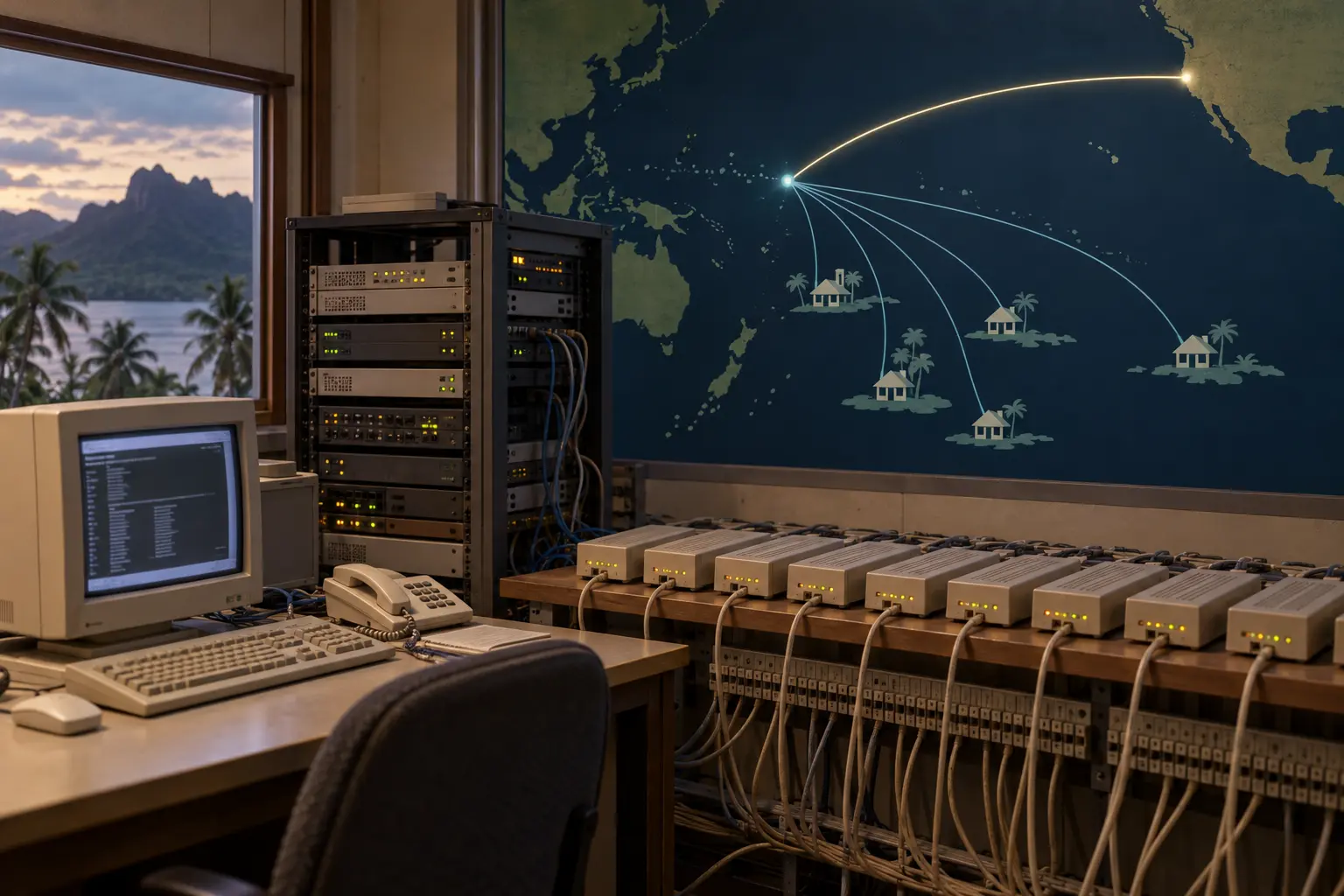
280 Customers, No Dedicated Line: FSM Telecom’s Internet in 1997
FSM Telecom reported 280 customers across the Federated States of Micronesia in February 1997, but said none had a direct connection. They dialled into a shared service carried over a 128 Kbps Sprint link from Pohnpei to California. The same report put a dedicated 64 Kbps line at…

History
One UK Traceroute Reached American Samoa Through Sacramento in 1997
Two PEACESAT messages described American Samoa as lacking a live link in 1995 and 1996. A year later, one UK operator traced a path to a Samoatelco server. The records mark a change in observable reachability, not a proven launch date or a map of who could connect.
History
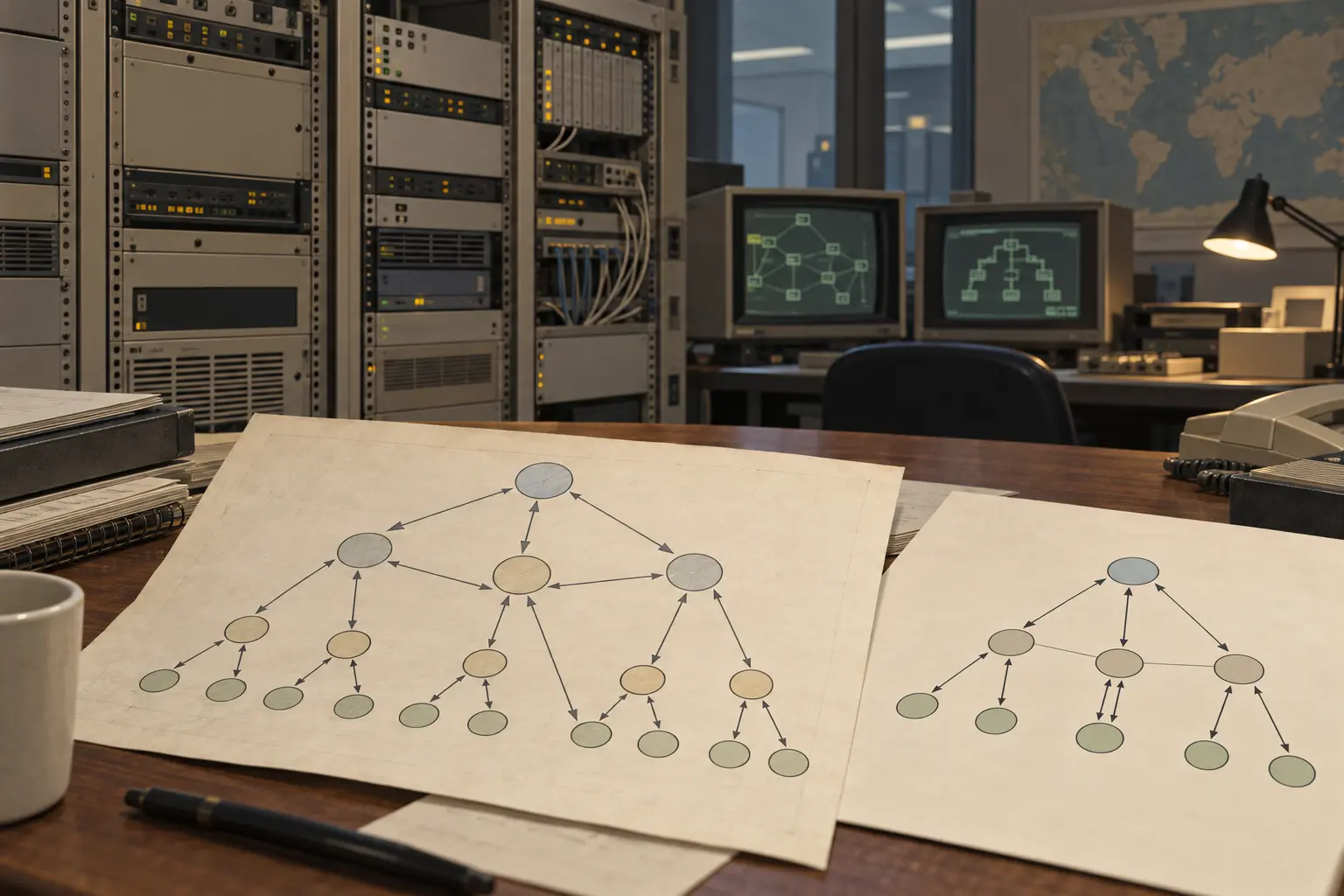
BGP Was Already Running in Cisco and NSFNET in 1989
By the time BGP appeared in an RFC, Cisco routers and NSFNET’s Nodal Switching Systems already had implementations. The June 1989 document captured a protocol still taking shape; a year later, its successor was a proposed standard that openly invited deployment experience to…

History
Two Exits, One X.25 Workaround: Ireland’s Internet Routes in 1991
In 1991, Trinity College Dublin and University College Dublin did not reach the Internet by the same route. One used a low-speed EUnet line through Britain and Amsterdam; the other carried IP across X.25 and IXI to an Amsterdam gateway.

History
A Stable Link Was Still Prohibitive: AUB’s Internet Route through Paris, 1992–95
At the American University of Beirut, a working Internet path did not mean an affordable service. A 9.6-kbps X.25 link could be described as stable while cost, bandwidth limits and a pending telephone-agreement kept access narrow.

History
A London Poll, a Washington Mail Run: Sierra Leone’s Two Email Routes, 1994–95
Before a browser could make the Internet feel continuous, Sierra Leone’s early users reached it through scheduled mail exchanges. Contemporary accounts describe several gateways with different operators, costs and operating states—not one national switch being turned on.

History
Four Plans, One Meter: BruNet’s 1995 Dial-Up Tariff
A December 1995 message from Brunei’s Telecommunications Department records four BruNet plans, each pairing a monthly subscription with a stated dollar value of “free traffic,” then charging extra use by the minute at different peak and off-peak rates.
History
Libya’s Internet Had More Than One Opening Date, 1998–2000
Libya’s Internet chronology changes with the threshold being measured: institutional connection, licensed service, eligibility to connect, and ordinary public use do not begin on the same day. Contemporary accounts disagree most sharply just as public venues started to appear.

Story
APNIC’s 41% RDAP Figure Measures a Moving Rank, Not One ASN’s Share
APNIC’s 41% RDAP Figure Measures a Moving Rank, Not One ASN’s Share intelligence summary explains the development, the public evidence available to readers, the organisations involved, the regional context, market exposure, and the infrastructure consequences that may follow. The…
History
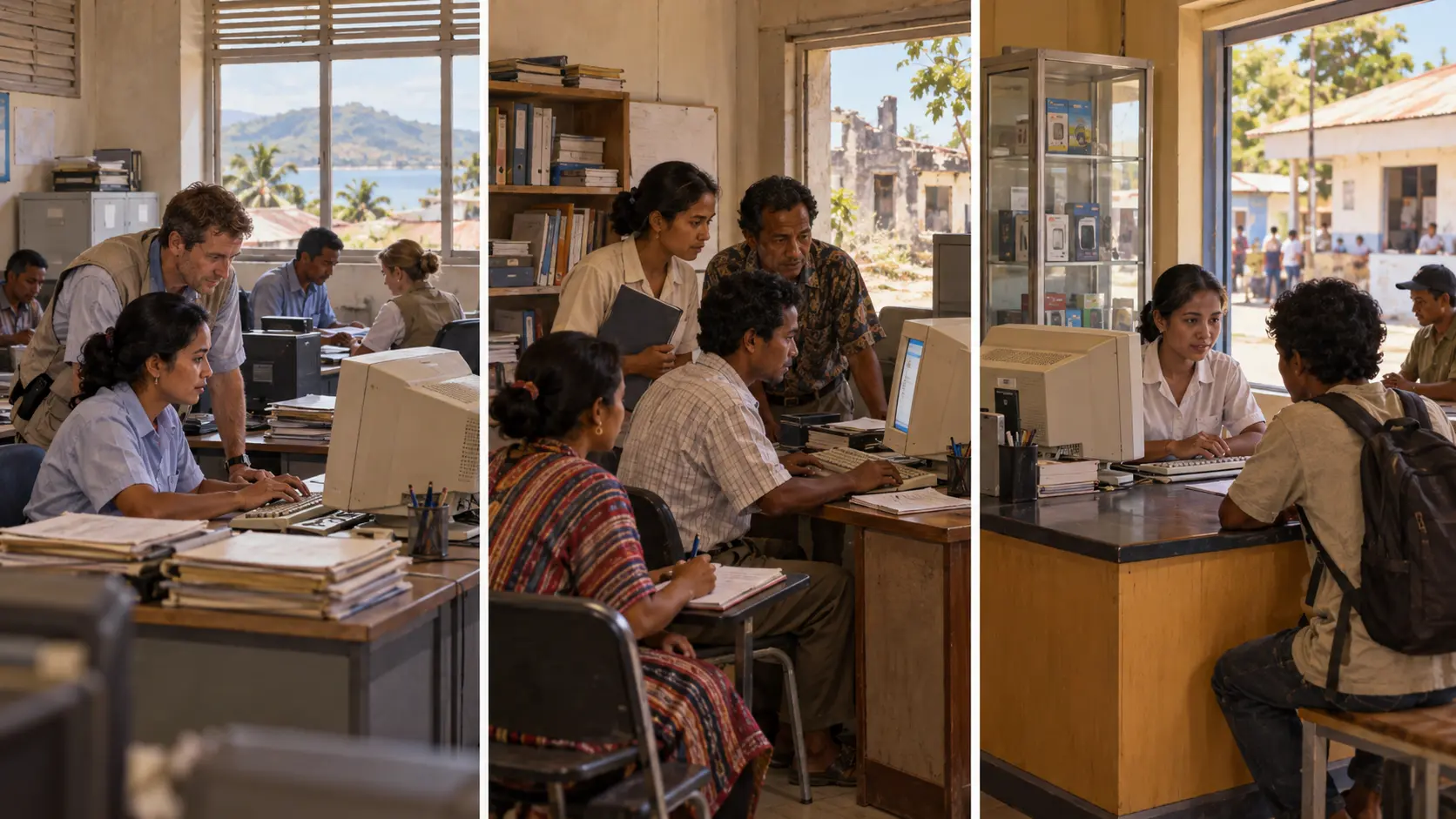
Three Gateways, Three Client Groups: Timor-Leste’s Internet, 2000–02
Timor-Leste’s early postwar Internet did not begin as one national service. From 2000 to mid-2002, three gateways served separate client groups, and only one—the Telstra gateway—operated commercially.

History
Public Dial-Up, UUNET by Satellite: Gulfnet Kuwait, 1994–97
Three messages from Gulfnet’s director trace two access layers: a satellite connection reported in 1994, public UNIX dial-up in 1995, and a 1997 account of satellite backhaul to UUNET/AlterNet beside domestic modem access. These are operator snapshots, not proof of a continuous…

History
AlterNex Turned ECO-92 into a Public Internet Gateway, 1989–92
Brazil’s first academic Internet links and AlterNex’s public-facing service mark different milestones. The 1992 Rio conference connected an NGO-run communications node to an RNP-operated international IP path, while the earlier AlterNex network had already moved civil-society…

Story
Timor-Leste’s 450 Starlink links are meant to hand over to fibre
The government says nearly 450 village headquarters have been connected through Starlink, but the programme was designed as a bridge: a planned public fibre network is expected to reach many of the same offices, after which the temporary satellite terminals are to be switched…

History
Burundi’s Internet Went Live Before Its Public Launch, 1997
In 1997, Burundi’s first Internet service did not have one clean launch date. CNI said it had tested free access from May, begun serving customers in Bujumbura on 1 August, and still planned a public launch later that month. A dispute over access to ONATEL’s earth station had…

IETF
The Model Passed Validation. RFC 10057 Still Awaited Approval.
The RFC Editor queue showed a clean YANG validation for revision 44, but the proposed RFC was still in final review with two author approvals unrecorded and a possible cluster hold.

History
Moldova’s Technical University Had E-Mail, but a Campus Web Had to Wait, 1997
A 1997 university paper called a 9.6 kbps line through Romania the first Internet connection for the `utm.md` domain. It carried dial-up e-mail, the authors said, but not serious Web browsing. The same paper described a separate 64 kbps satellite gateway and a campus network that…