
Summary
- The WELL opened on a leased VAX with twelve phone lines in April 1985; by June, its own timeline says users had Usenet and e-mail exchange with networked computers elsewhere.
- The same history dates Internet access to January 1992, when users could reach databases and other Internet systems. Earlier connectivity should not be collapsed into that later link.
Analysis
The WELL’s origin story has two dates that are easy to flatten into one: the dial-up system began in 1985, while its Internet connection came in 1992. The distinction matters because “online” described a user’s connection to a service; it did not by itself identify the networks or services that the system could reach.
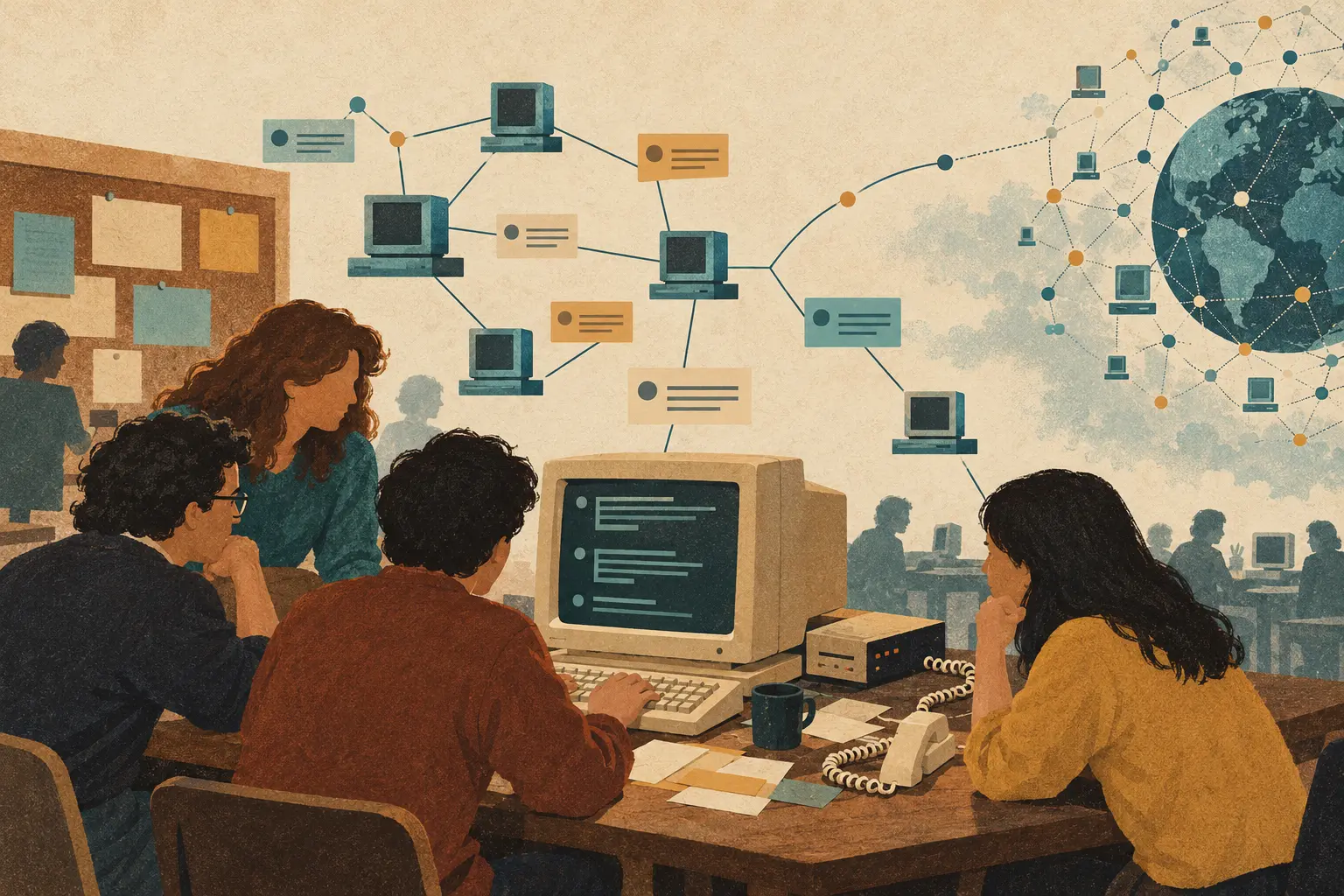
A 1995 anniversary timeline, assembled by Ron Pernick with assistance from WELL staff Cliff Figallo and Gail Ann Williams, says the computer booted in February 1985 and the service opened for paid registration on April 1. It lists a leased VAX 11/750, Unix, the Picospan conferencing program and twelve telephone lines. A surviving promotional leaflet makes that access model legible: a personal computer and modem called into numbered lines, then a user logged in and registered. The community’s first boundary was a dial tone and an account, not a browser or an Internet address. (WELL historical timeline; Computer History Museum leaflet)
The chronology moves beyond a closed local service quickly, but in distinct steps. In June 1985, the timeline says, The WELL made Usenet newsgroups available and began exchanging electronic mail with other networked computers around the world. In December, packet-switched connections through UniNet let customers reach The WELL over long distances at lower hourly cost. The system had therefore acquired wider communications and a cheaper way to reach its own host before the date its history assigns to Internet access. The records do not identify the 1985 mail path or protocol, so they cannot support a more specific routing story.
A later milestone is explicit: the same timeline dates The WELL’s Internet connection to January 1992. It says customers could then search databases and log into other Internet systems, while the new access widened participation beyond the service’s previous reach. Howard Rheingold, writing from his own experience as an early member, also describes the change after the 1992 link. This is evidence of a new capability and audience, not a precise engineering diagram or a day-by-day adoption count. (WELL historical timeline; Rheingold, The Virtual Community, chapter 2; chapter 3)
The gap reframes the history. The WELL was not simply offline until it joined the Internet, nor does early e-mail prove it already had the later Internet connection. It was a dial-up conferencing service that added networked features, then packet-switched access, and only later an Internet link. Each step changed what members could reach, how they reached it and who could join. The retrospective timeline is valuable precisely because it names these steps separately; its 1995 anniversary setting also means it should be read as a curated institutional memory, not a live operations log. (WELL Tales anniversary history)
Sources
Member Briefing
Deeper Profile Context
Sign in with the right membership level to unlock the full briefing and source notes.
Only for Strategic Circle
Strategic Circle
Open to all readers. Unlock profile briefings after joining and signing in.
Join Strategic CircleOnly for Leadership Alliance
Leadership Alliance
For qualified IP-asset owners and management; sign in to unlock alliance briefings.
Join Leadership Alliance