Summary
- In its 22 October tender answers, Switzerland's ComCom says potential bidders cannot discuss how they would coordinate use of frequencies allocated after the auction while the anti-collusion rule applies. Such talks can expose participation and bidding intentions.
- The auction rules prohibit direct or indirect contact or information exchange aimed at influencing the result from publication of the definitive tender. A bidder may be barred or excluded; a licence already granted may be revoked without compensation.
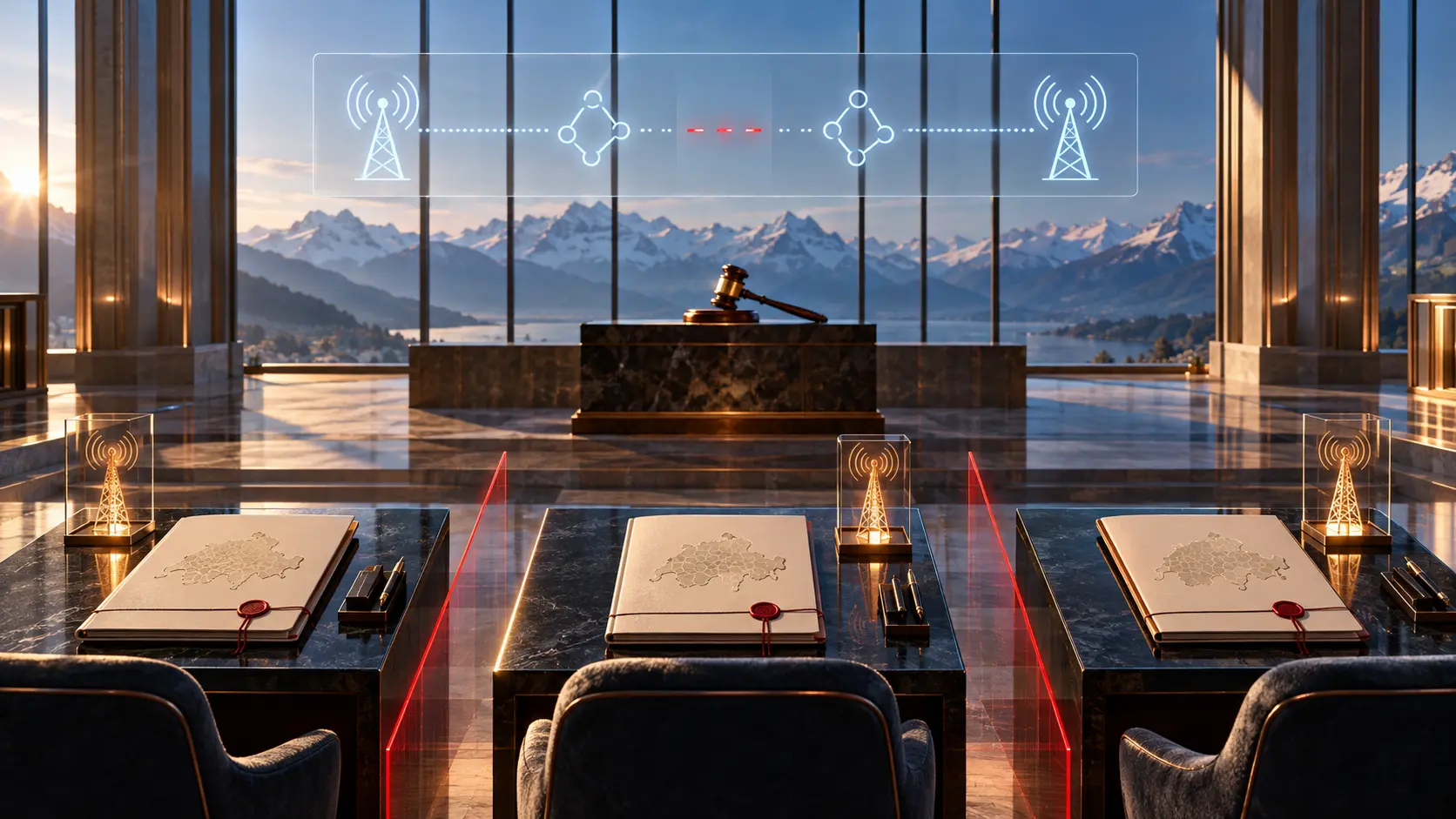
The most expensive meeting in Switzerland's next mobile-spectrum sale may be one that never reaches the calendar. A bidder asked whether prospective rivals could talk about future network sharing while the auction's collusion ban is running. ComCom and OFCOM answered on 22 October: when the discussion concerns coordination of the spectrum that the auction will allocate, it is prohibited during that period. An apparently practical engineering conversation can tell another bidder who plans to participate, what they need, and how they might bid.
The distinction matters because shared infrastructure can be a normal way to build a mobile network. But this is the bidding room, before anyone knows who receives which blocks. Frequency-use coordination at that stage reaches into the price-discovery mechanism. The Q&A does not accuse anyone of misconduct; it answers a boundary question while applications are being prepared. The OFCOM award page says the auction is expected in the second quarter of 2027 for frequencies available from 2029.
The auction rules, Annex II, put teeth behind the answer. Since the definitive tender appeared on 1 September, interested parties have been barred from direct or indirect contacts, including through intermediaries, or information exchanges aimed at affecting the result. Publishing presumed bidding strategies, concrete offers or other statements likely to influence another party's participation or bids is also forbidden. The ban follows the information, not the politeness of the invitation.
The possible consequences are sharper than a stern email. A colluding applicant may be refused admission or excluded, depending on the stage. The rules say an awarded licence can be revoked without compensation. For other rule breaches capable of harming rival bidders, the authority can exclude the offender and, if necessary, cancel and repeat affected rounds. Section 1.4 also allows a lesser path where an infringement has no effect on the outcome, with an administrative penalty still possible. These are rulebook options tied to facts and procedure, not automatic sentences for asking a question.
That makes the Q&A's real instruction unusually simple. Ask the regulator what the rules permit. Keep conversations with prospective rival bidders about post-auction spectrum coordination out of the pre-auction room. The network can be designed later; a compromised auction cannot be unspoken.
Sources
Member Briefing
Deeper Profile Context
Sign in with the right membership level to unlock the full briefing and source notes.
Only for Strategic Circle
Strategic Circle
Open to all readers. Unlock profile briefings after joining and signing in.
Join Strategic CircleOnly for Leadership Alliance
Leadership Alliance
For qualified IP-asset owners and management; sign in to unlock alliance briefings.
Join Leadership Alliance