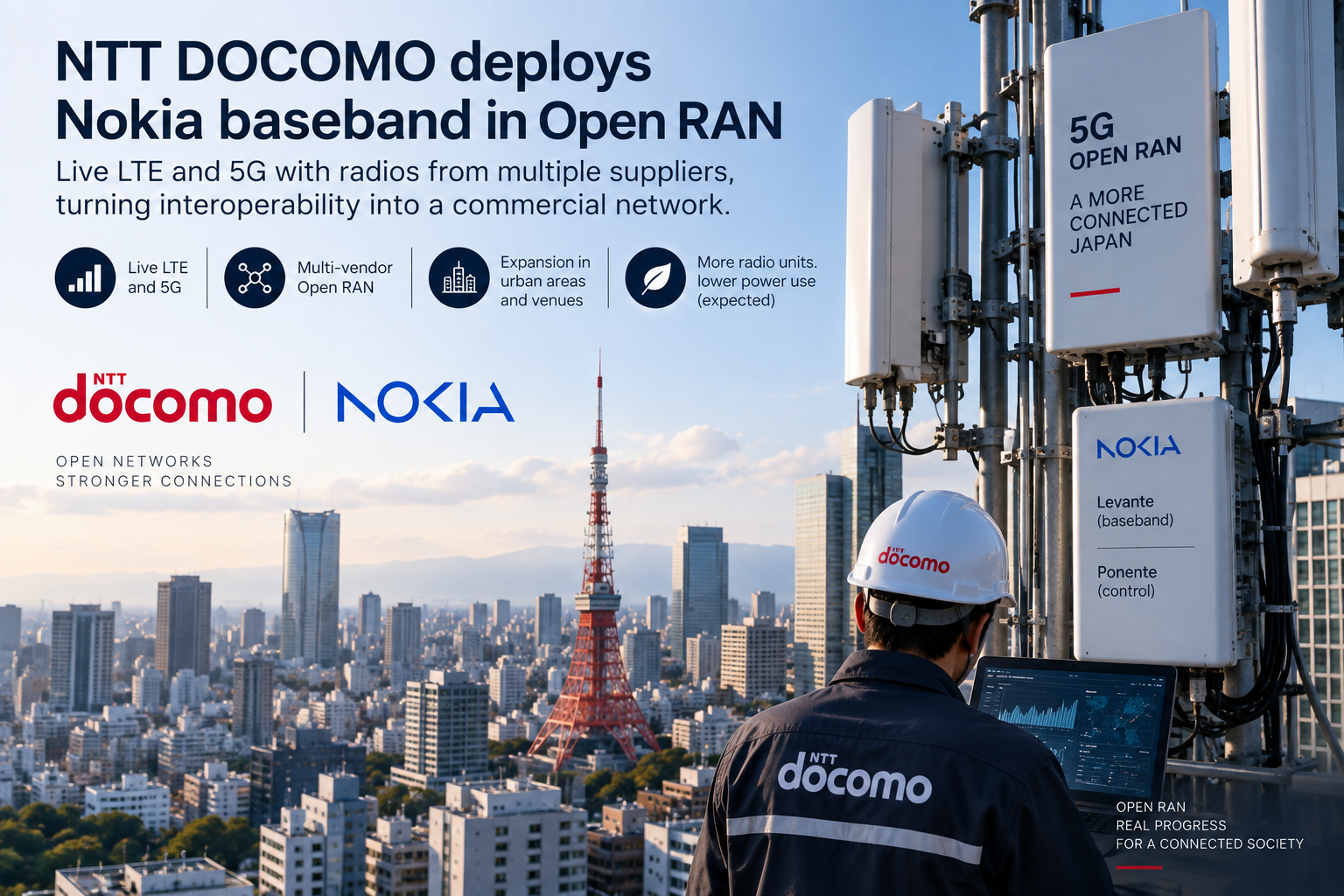
- NTT DOCOMO has put Nokia's latest baseband equipment into commercial service with radio units from multiple suppliers
- The LTE and 5G deployment moves multi-vendor Open RAN into day-to-day operations, where software upgrades and fault handling become the next tests
The fact
NTT DOCOMO has begun commercial operation of Nokia's latest base-station equipment in Japan, with the system entering service on 9 September. The deployment supports both LTE and 5G. DOCOMO is using Nokia's Levante data-processing and Ponente control cards with radio units from multiple suppliers connected through O-RAN interfaces. These standardised interfaces are designed to let operators combine compatible parts of a radio-access network from different vendors.
DOCOMO says the new equipment can support more radio units while using less power than the Nokia equipment it replaces, although it has not published network-wide measurements. The operator plans to extend the system into dense urban areas, stadiums and other busy event locations. The announcement confirms that the configuration is carrying commercial traffic. It does not establish that every radio supplier, software release or feature has already been qualified with the new Nokia baseband.
The assessment
DOCOMO has moved this particular multi-vendor combination out of testing and into a live network. Nokia's baseband can now operate with radios from other suppliers in commercial LTE and 5G service, giving the operator more freedom to mix equipment when it adds or upgrades sites.
That flexibility also gives DOCOMO more combinations to manage. A new radio or software release still has to work with the rest of the system, and a fault involving equipment from several suppliers can take longer to trace if responsibility is unclear. The challenge is therefore to make those combinations as routine to upgrade and support as a network supplied by one vendor.
For BTW readers, expansion into busy urban and venue networks will show whether DOCOMO can keep that integration work manageable at greater scale. Stable software upgrades, predictable fault resolution and measured power savings would provide stronger evidence that multi-vendor Open RAN is working as an everyday operating model.
What to watch
Watch how quickly DOCOMO expands the configuration and whether it publishes measured power savings or deployment results. Software upgrades will be particularly useful evidence: smooth releases across radios from different suppliers would show that interoperability continues after initial installation, not only when the equipment first enters service.
Member Briefing
Deeper Profile Context
Sign in with the right membership level to unlock the full briefing and source notes.
Only for Strategic Circle
Strategic Circle
Open to all readers. Unlock profile briefings after joining and signing in.
Join Strategic CircleOnly for Leadership Alliance
Leadership Alliance
For qualified IP-asset owners and management; sign in to unlock alliance briefings.
Join Leadership Alliance