Summary
- Beam-It checked that a listener possessed a CD; Instant Listening checked a purchase. MP3.com then made music available in an online locker without asking the listener to encode and store the tracks, according to its 2001 SEC filing.
- The company reported an April 2000 court ruling on copyright liability and disabled content without express permission on 10 May. Record-label and music-publisher licences determined what the locker could offer afterward.
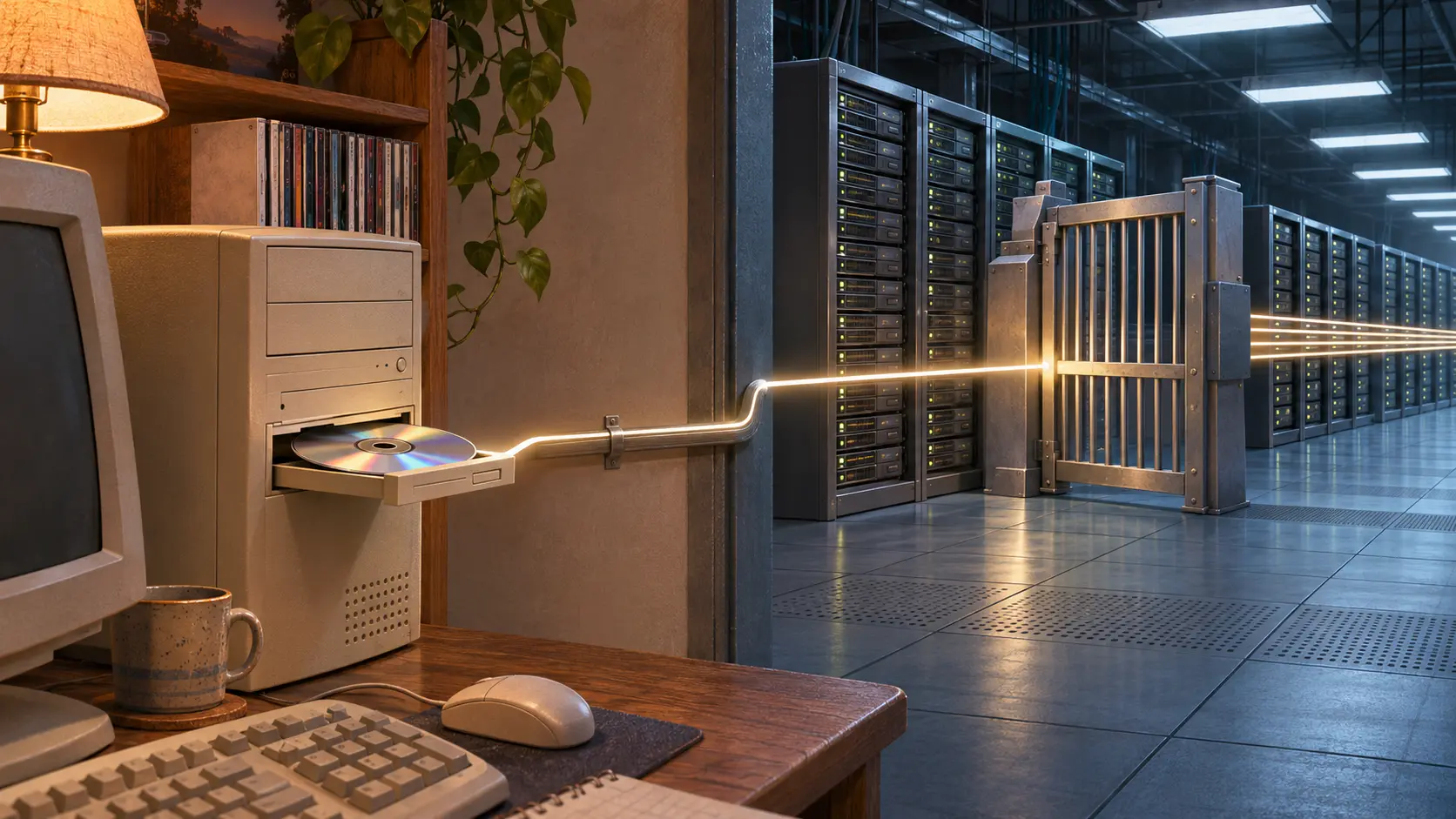
A compact disc sat in the tray. The computer read it, the service recognized it, and the listener's collection appeared to travel onto the Internet. That was the appeal of Beam-It, part of the My.MP3.com service launched in January 2000. The user did not have to spend an evening converting songs into files and uploading them. The company's March 2001 Form 10-Q described a simpler division of labor: Beam-It established possession of a CD; a separate Instant Listening route established a purchase through a cooperating retailer; MP3.com made the music available in the user's online locker.
The last step was the business. It was also the legal exposure. A possession check said something about the listener. It did not produce a licence for the platform's own copy and delivery. MP3.com had designed the locker so the company, rather than each customer, supplied much of the encoding, storage and delivery work. That design made a large catalogue convenient. It also concentrated the permission problem in one company.
Ten major recording companies sued on 21 January 2000. In MP3.com's June 2000 Form 10-Q, the company reported their allegation that it had made unauthorized copies of approximately 45,000 audio CDs. That number was the plaintiffs' claim. The same filing recorded the decisive dates: on 28 April the court held MP3.com liable for copyright infringement, and on 10 May the company disabled the plaintiffs' content in My.MP3.com. The March 2001 filing described the operational result even more plainly: the service disabled all content except material expressly authorized by copyright holders.
A CD still existed in the customer's house on 11 May. The product gate could still identify it. But the catalogue behind that gate had changed. An entitlement test at the edge of a system cannot keep the service running when the operator's right to supply the underlying content is missing. MP3.com had offered a shortcut around the user's upload chore. The ruling exposed the cost of that shortcut at the server.
The company then rebuilt permission piece by piece. From June through August 2000, it entered settlement and licence agreements with Warner Music Group, BMG Entertainment, Sony Music and Capitol Records, representing eight of the ten record-company plaintiffs. The remaining dispute with UMG produced a later judgment and a licence. MP3.com's 2001 filing says the resulting agreements allowed use of those companies' recordings in My.MP3 under conditions. The physical-disc check had not changed; the contractual basis for offering the recordings had.
There was another layer. A record company's permission over a sound recording did not settle every claim involving the musical composition. MP3.com also negotiated with music publishers. Its filing describes an agreement with the Harry Fox Agency, finalized in February 2001, under which a prospective licence charged one-quarter cent for each on-demand stream from a user's locker and a one-time fee for each track added. Those terms belonged to the HFA agreement. They priced distinct acts of adding and streaming music. They reveal how a product advertised as instant access turned into a ledger of permissions and uses.
In Senate testimony on 3 April 2001, MP3.com president Robin Richards described a specific failure: the company had recording rights and performance agreements for Jennifer Lopez’s J.Lo CD, but lacked publisher clearance through the Harry Fox Agency. He said the agency had told MP3.com that locating publishers and clearing at least some songs could take six to eight weeks after a request. Buyers could use neither Instant Listening nor Beam-It for those songs, even once the disc reached them. That was the company's account to Congress, and it showed a delay no faster CD reader could fix.
The two SEC filings show a rapid reversal of operating logic. In January, the company could present the CD scan as the key to an apparently portable personal collection. By May, express authorization decided which tracks the locker could open. By 2001, the service's reach depended on separate agreements with recording owners and publishers. The machine could verify a disc. It could not sign a licence for the company.
Original records
- MP3.com, Form 10-Q for the quarter ended 30 June 2000: lawsuit, April ruling and May disabling of content.
- MP3.com, Form 10-Q for the quarter ended 31 March 2001: Beam-It and Instant Listening operation, label agreements and publisher-licence terms.
- U.S. Senate Judiciary Committee, 3 April 2001 hearing: testimony of MP3.com president Robin Richards about Beam-It and J.Lo.
Member Briefing
Deeper Profile Context
Sign in with the right membership level to unlock the full briefing and source notes.
Only for Strategic Circle
Strategic Circle
Open to all readers. Unlock profile briefings after joining and signing in.
Join Strategic CircleOnly for Leadership Alliance
Leadership Alliance
For qualified IP-asset owners and management; sign in to unlock alliance briefings.
Join Leadership Alliance