
Summary
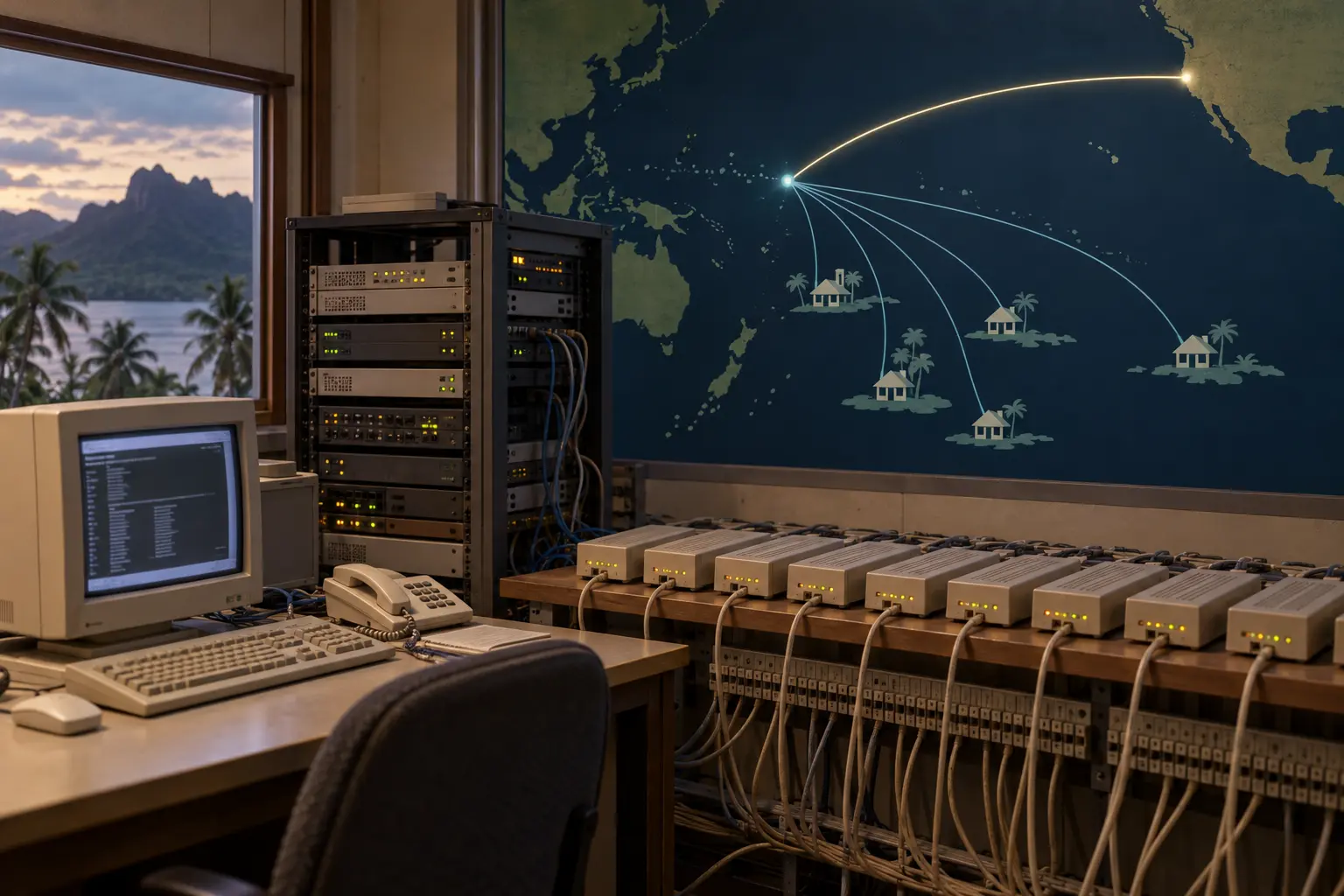
- FSM Telecom reported dial-up customers in Kosrae, Chuuk, Pohnpei and Yap, using a 128 Kbps Sprint link from Pohnpei to Stockton, California.
- In February 1997 it reported 280 customers but no direct-connect accounts; a dedicated 64 Kbps line was estimated at roughly $4,625 per month.
A national reach claim, delivered by dial-up
The 1997 account is unusually specific about the gap between backbone and customer access. FSM Telecom’s Robert H. Blissmer described Windows NT-based web, mail, DNS and newsgroup servers, with a 128 Kbps Sprint “pipe” to Stockton, California. Yet he said dial-up was the method of connection and that there were no direct-connect customers. The company’s November 1996 update had described dial-in customers in all four states—Kosrae, Chuuk, Pohnpei and Yap—and placed the Sprint link from Pohnpei to Stockton. These are the operator’s descriptions of its service footprint, not independent measurements of service quality on each island. November 1996 update; February 1997 status.
A contemporaneous route trace offers a second view. On 4 November 1996, Olivier MJ Crepin-Leblond reported a traceroute from the UK to www.telecom.fm, resolving to 206.49.89.8. Eighteen displayed hops reached the host. The path crossed JA.NET and the Internet Company of Network Providers before entering Sprint; the later hops included a Sprint router named for Stockton and a GSL router. Three reported destination probes took roughly 708–738 milliseconds. That is evidence that one host answered from one UK vantage on that date. It is not a measurement of latency for a user dialling from Yap, Kosrae, or anywhere else in the FSM. 4 November 1996 trace.
The host list adds a small but useful detail: the same update listed telecom.fm and www.telecom.fm among Micronesian hosts. The route trace thus reached a named host in the provider’s domain, but neither a hostname nor a successful route tells us how many people could get through the local dial-up system. Host-list update.
Two prices, two access models
As of 25 February 1997, Blissmer said the subscriber base stood at 280. The report listed a $19.95 start-up charge and a $19.95 monthly subscription that included five hours, followed by $1.95 for each additional hour. It also estimated that providing a dedicated 64 Kbps line would cost about $4,625 per month. The latter was an operator estimate in response to a question about line costs; the record does not specify its components or say that a customer paid exactly that amount.
The figures describe different products, not interchangeable bandwidth. The monthly dial-up plan bundled a small block of time for individual customers; the dedicated circuit was a continuously provisioned connection with a much higher monthly cost. The contrast helps explain why a 128 Kbps international pipe did not mean that households had direct 128 Kbps connections. Access depended on telephone dial-in and the provider’s shared service. The report does not give modem-port counts, call-blocking rates, hours of operation, user distribution or actual traffic.
This distinction is the story’s central point. FSM Telecom could report customers across widely separated states and a route to its server in California’s direction, while still having no direct-connect accounts. “The FSM had a 128 Kbps Internet connection” compresses several layers—the international link, the dial-up network, customer accounts and island-level service—into one headline number. The evidence supports the existence of each reported layer, not equal or continuous access everywhere.
The reported 280 customers are a useful scale marker, but they remain a provider count, not an audited measure of active users or household adoption. A subscriber could use the service little or often; the record does not say. Nor does the UK trace verify that each account could reach the host with the same performance. A careful history keeps the measures separate: an international route, a stated dial-up footprint, a tariff and a customer count.
Sources
Member Briefing
Deeper Profile Context
Sign in with the right membership level to unlock the full briefing and source notes.
Only for Strategic Circle
Strategic Circle
Open to all readers. Unlock profile briefings after joining and signing in.
Join Strategic CircleOnly for Leadership Alliance
Leadership Alliance
For qualified IP-asset owners and management; sign in to unlock alliance briefings.
Join Leadership Alliance