Summary
- The Wikimedia Foundation's December 2007 request asked the Free Software Foundation to make a GFDL-to-CC BY-SA move possible for mass collaborations, then promised a community vote before a final decision. GNU FDL 1.3 gave an eligible site's operator that option only before 1 August 2009.
- In the April–May 2009 vote, 13,242 of 17,462 certified voters supported the change. The Board then exercised the license option, effective 15 June; the implementation record says eligible wikis had changed by 29 June. CC BY-SA became the primary text license, with GFDL retained as a secondary license.
A library with too many authors to call
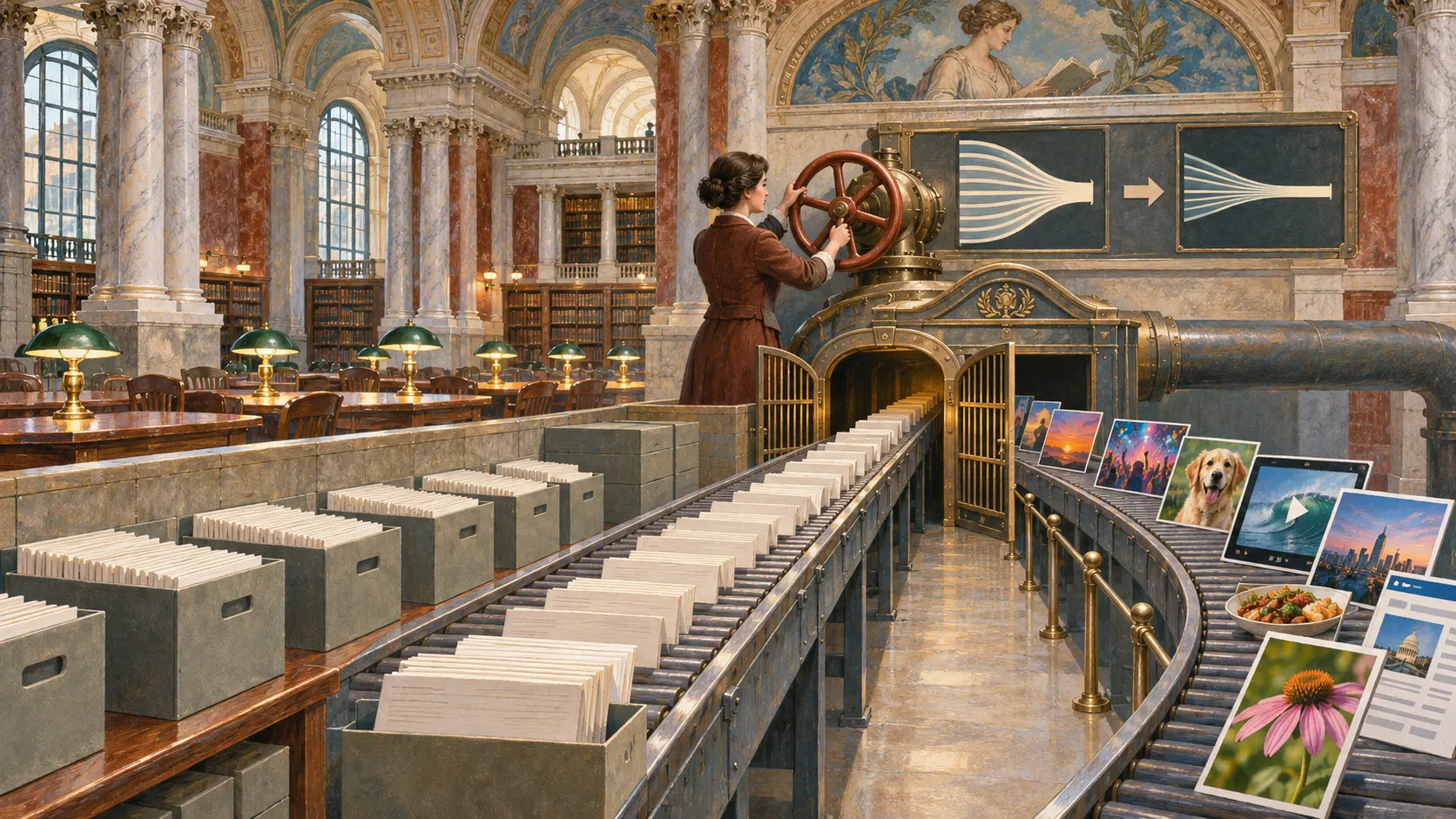
The problem was built into Wikipedia's achievement. Its pages were the accumulated work of countless contributors, each contributing under the GNU Free Documentation License. The project wanted its material to travel more easily alongside work under Creative Commons Attribution-ShareAlike. A site operator could change a footer in an afternoon. Changing the permissions attached to a mass of contributed text was a different act. Wikimedia needed a route through the license that its authors had already used.
The Board's 1 December 2007 resolution put the problem to the Free Software Foundation. It requested an amendment to the GFDL that would allow mass collaborative projects to migrate to CC BY-SA. The Board also promised discussion and voting before its final decision. This sequence matters. The Foundation was not asking its editors to write a new legal permission by ballot. It was asking the license steward to create a permission, then asking its community whether the Foundation should exercise it.
The FSF released GFDL version 1.3 on 3 November 2008. Section 11 defined a massive multiauthor collaboration site as a web server publishing copyrightable work with prominent facilities for anyone to edit it. A public wiki was the obvious example. For an eligible collaboration, the site operator could republish the work under CC BY-SA 3.0 on the same site. That sentence gave the Foundation an executable route through the authorship problem. The last words of the clause supplied its trap: the operator had to act before 1 August 2009.
The permission also drew a line around material brought in from elsewhere. Under section 11, an off-site work first published under the GFDL could be included in the eligible collaboration only if it had no cover texts or invariant sections and had been incorporated before 1 November 2008. The FSF's own explanation said that earlier cutoff prevented a late rush to feed outside GFDL works into a wiki just to move them to CC BY-SA. Its August 2009 deadline prevented the clause from becoming a permanent license-switching machine. The two dates did different jobs: one fixed the eligible input, the other closed the operator's action window.
The vote was a mandate, not the switch
Wikimedia's licensing vote ran from 12 April to 3 May 2009. It certified 17,462 votes: 13,242 yes, 1,829 no and 2,391 without an opinion. Support was 75.8% of all certified votes, or 87.9% when the no-opinion votes were removed. Those are two different denominators; neither needs decoration. Contributors had expressed a clear preference, while the legal power to use the new clause still sat with the eligible site's operator.
The Board unanimously approved the migration in May, with seven approvals. Its resolution explicitly exercised the GFDL 1.3 option for Wikimedia sites as massive multiauthor collaborations, effective 15 June 2009, and directed the Executive Director to update licensing terms. The implementation record says the change had reached all eligible wikis by 29 June. That is the difference between winning a vote, taking the legally relevant decision and making the changed terms appear where contributors and reusers work.
The outcome had a precise shape. Existing eligible text became available under CC BY-SA 3.0 as well as the GFDL. For text, CC BY-SA became primary and the GFDL secondary; new GFDL-only submissions were no longer accepted. The implementation page says eligible media files were still being processed when it recorded the wiki rollout. The story is therefore about a governed transition of eligible material, with different operational states for text and files, rather than a single magic button that converted every object on the servers.
Wikipedia's license change took three kinds of work. The FSF made a narrowly scoped permission possible. Contributors supplied a measured preference. The Board used the operator's option before it expired, and staff put the new terms into the site's working surfaces. Had the Foundation waited past the August deadline, section 11 would have offered it no such route. The encyclopedia that could edit a sentence in seconds had only one summer to move the permissions beneath its sentences.
Member Briefing
Deeper Profile Context
Sign in with the right membership level to unlock the full briefing and source notes.
Only for Strategic Circle
Strategic Circle
Open to all readers. Unlock profile briefings after joining and signing in.
Join Strategic CircleOnly for Leadership Alliance
Leadership Alliance
For qualified IP-asset owners and management; sign in to unlock alliance briefings.
Join Leadership Alliance