Summary
- The 16 December 2002 Creative Commons launch presented licenses as a plain-language deed, legal code and digital code that search engines and other software could read.
- The ccREL 1.0 paper of 8 April 2008 says the original recommendation placed RDF/XML metadata in HTML comments. It superseded that publishing method with a property model and default ways to embed it, including RDFa for web pages.
Three doors to one permission
A copyright holder can offer a work for reuse, but the offer does little good if a reader cannot understand it or a search tool cannot find it. The Creative Commons launch announcement sold one license in three formats. The Commons Deed summarized terms for people. Legal Code supplied the operative text. Digital Code let software identify the work by its terms of use. The ambition was economic as much as cultural: reduce the time spent locating the rightsholder and asking for permission already granted in advance.
That division of labor matters. Creative Commons' description of the layers identifies the legal code as the operative one. A machine-readable tag can describe a permission; it does not become the permission simply by being easy to parse. The tag still has a crucial job. A library, search service or publishing tool needs to know which work carries which license and where attribution should point. If the terms are written for humans but hidden from ordinary software, the cost of discovery returns through another door.
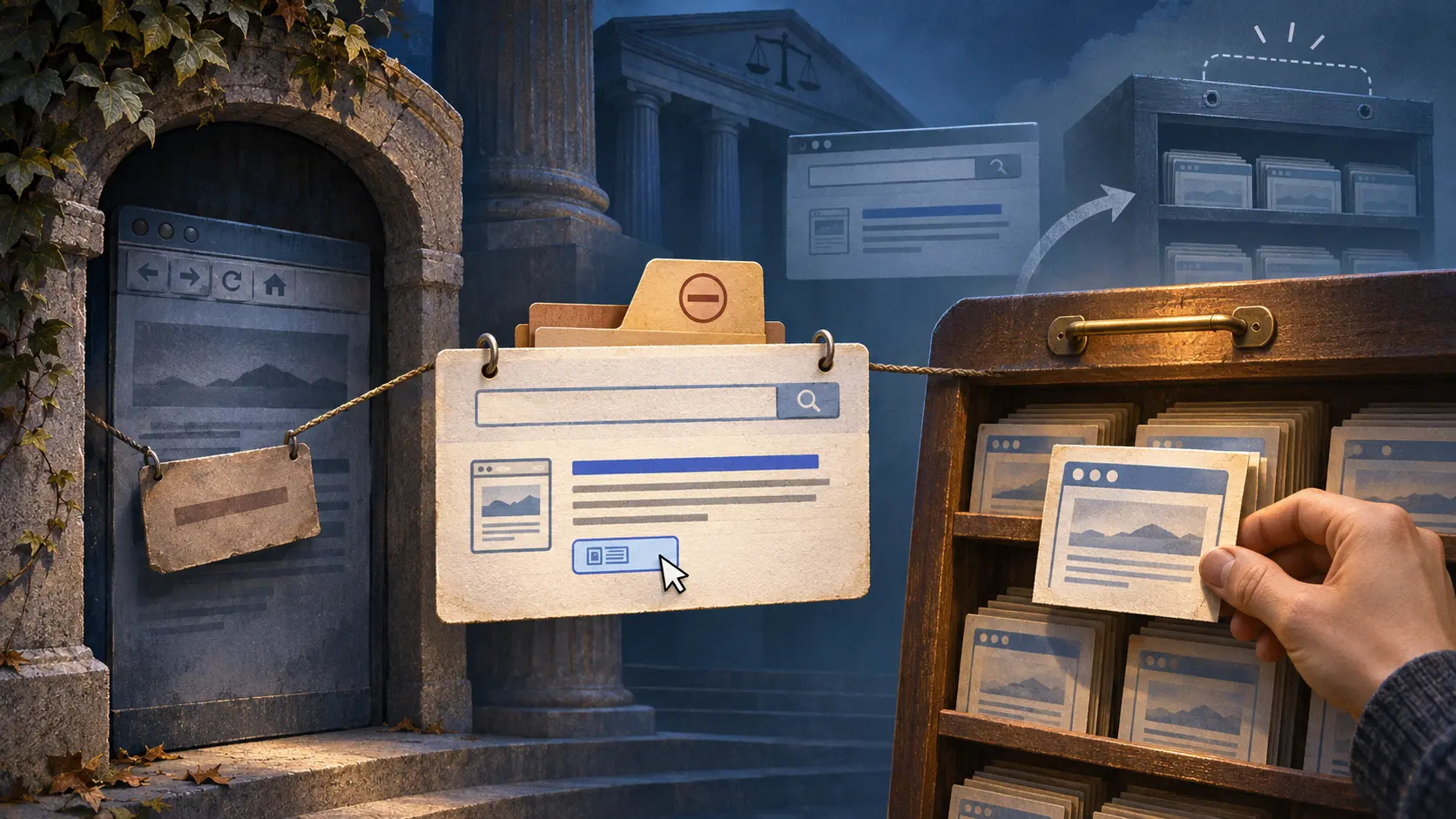
The first implementation was awkward. In the project's own 2008 account, the original web license generator gave publishers RDF/XML to paste into HTML comments. That was machine-readable in the narrow sense: a program could inspect page source and parse the data. It was not a clean, shared interface with the visible page. A comment lives outside the rendered text and must be located and associated with the right work. The authors of the ccREL paper say they knew the design was cumbersome when they chose it; at the time, RDF/XML was the available standard syntax and the web lacked a settled method for mixing structured data with ordinary HTML.
A license label needs an address
The 2008 paper describes what went wrong as Creative Commons use spread. Millions of pages carried licenses and metadata, but tool builders had no uniform, extensible way to retrieve those properties. Applications used their own extraction tricks. That is the kind of interoperability failure a visitor may never notice: the license badge can look obvious to a person while its data arrive as a scavenger hunt for software.
ccREL changed the contract. Its authors defined an extensible set of RDF properties for a work and for a license, rather than making one concrete syntax the whole standard. A publisher still had to make the extraction path discoverable. The paper recommended RDFa for HTML pages and XMP for standalone media as default embedding methods. In its HTML example, the license relationship and attribution information appear in attributes tied to visible elements. A tool can read the structure in the same place a person sees the claim. The W3C's 2008 RDFa Recommendation supplied the broader markup context for that approach.
The migration did not ask creators to choose a new legal bargain merely because the metadata wrapper improved. The ccREL authors explicitly superseded previous recommendations for expressing licensing metadata. Their first-generation license terms remained interpretable against the new property model, according to the same paper. The distinction is an important one: a document may keep its rights while the machinery that helps strangers discover those rights changes. Publishers and tool makers pay for that change in different ways. One must mark up the work; the other must build a reader that knows where to look.
A label is not a lock
Machine-readable rights can make a work easier to find and reuse on the terms its holder chose. They do not make a computer enforce those terms. In a 2009 clarification, Creative Commons described ccREL as rights expression rather than a monitoring or enforcement system. The distinction was visible in the 2002 design too: the legal text governed the offer, while digital code announced it to software. A better label could reduce search and interpretation costs without becoming a gate on the file.
The striking lesson of the 2002-to-2008 turn is that publishing a permission takes more than writing permission words. The web needs a reliable link between a specific work, its license and the attribution path. Creative Commons' first attempt put that link under a comment flap. ccREL moved it into a clearer public interface. The rightsholder's choice stayed the same kind of choice; the web learned a less expensive way to notice it.
Member Briefing
Deeper Profile Context
Sign in with the right membership level to unlock the full briefing and source notes.
Only for Strategic Circle
Strategic Circle
Open to all readers. Unlock profile briefings after joining and signing in.
Join Strategic CircleOnly for Leadership Alliance
Leadership Alliance
For qualified IP-asset owners and management; sign in to unlock alliance briefings.
Join Leadership Alliance