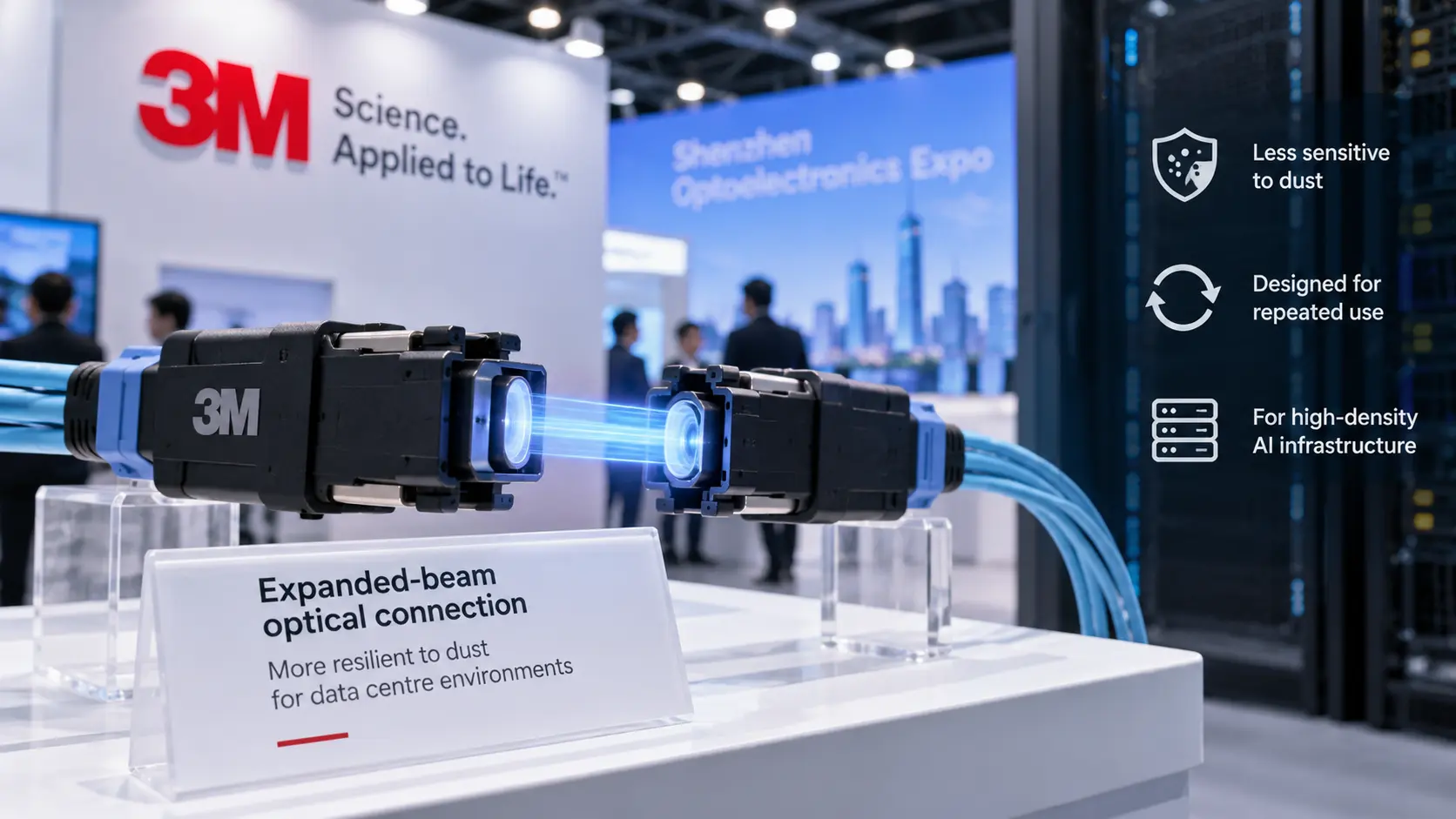
- 3M demonstrated expanded-beam optical connectors at the Shenzhen optical exhibition, focusing on maintenance in dense AI data-centre networks
- An internal test covered 1,000 connection cycles, but does not establish field lifespan or reductions in energy use or waste
The fact
3M demonstrated its expanded-beam optical connectors at the China International Optoelectronic Exposition in Shenzhen on 9 September. Trade interviews at the event focused on how the connectors could be installed and maintained in dense data-centre fibre networks.
Instead of requiring the fibre ends to make direct physical contact, the design sends an expanded beam of light across a small gap. 3M says this makes the connection less sensitive to small particles that can interfere with optical signals. The company showed 12- and 16-fibre versions and products designed for different fibre types.
3M also reported an internal test covering 1,000 connection cycles. It said the change in channel insertion loss remained below 0.1 decibels during the test. The figure describes how much the measured signal loss changed during those cycles; it does not establish how long the connector will last in a working data centre.
The products belong to an existing connector family rather than a technology first introduced at the Shenzhen exhibition. In May, 3M and other companies also announced work on common specifications for expanded-beam connectors. That effort is intended to improve compatibility, but it does not mean products from different suppliers are already interchangeable.
The assessment
3M is making a maintenance case rather than an energy-efficiency one. Fibre connections in a busy data centre may be handled repeatedly during installation, troubleshooting, and equipment changes. If the expanded-beam design is less affected by contamination and repeated reconnection, technicians could spend less time cleaning and reworking those links. The 1,000-cycle test supports further testing, but it does not show how the connectors will perform after prolonged use in a live facility.
A customer trial could provide a clearer answer by comparing how often different connectors need cleaning, reconnection or replacement to keep links working properly. It would also need to follow the complete link rather than the connector alone, because good performance at one connection does not guarantee the same result across the rest of the network.
For BTW readers, the buying decision comes down to whether easier maintenance can be demonstrated in normal operations. Compatibility and access to replacement parts will also matter if the connectors are installed across large numbers of links. The evidence so far supports durability under 3M's test conditions, but not claims of longer equipment life, lower data-centre power use or a measured reduction in waste.
What to watch
Watch for field results showing how often the connectors need cleaning, reconnection or replacement in operating data centres. Published interoperability specifications and tests between products from different suppliers would also show whether the technology can simplify long-term maintenance without tying operators to a narrow range of compatible equipment.
Member Briefing
Deeper Profile Context
Sign in with the right membership level to unlock the full briefing and source notes.
Only for Strategic Circle
Strategic Circle
Open to all readers. Unlock profile briefings after joining and signing in.
Join Strategic CircleOnly for Leadership Alliance
Leadership Alliance
For qualified IP-asset owners and management; sign in to unlock alliance briefings.
Join Leadership Alliance