
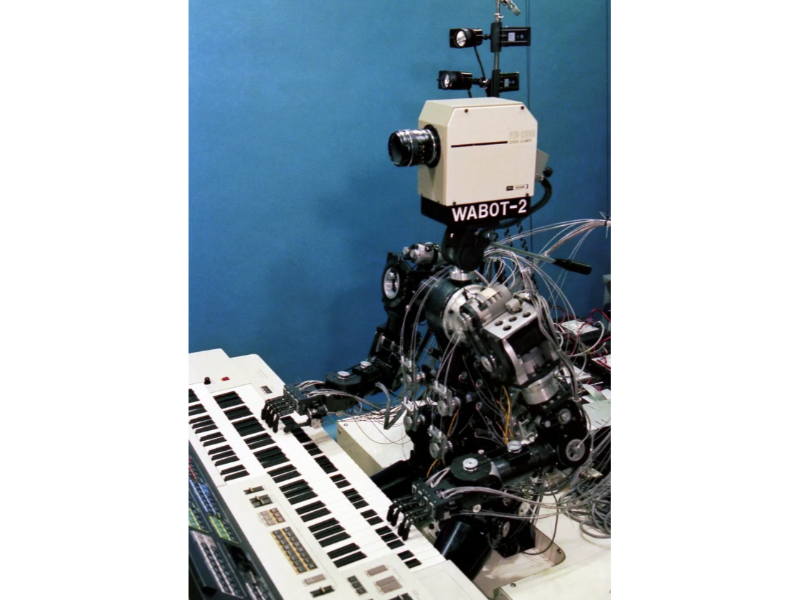
- The WABOT project of 1970 highlighted Waseda University’s pioneering role in the development of humanoid robots, beginning with the multifunctional WABOT-1 and evolving to the musically adept WABOT-2, marking significant advancements in the field of robotic engineering and artificial intelligence.
- Asimo, a humanoid robot developed by Honda since 1986, served as a pioneering ambassador for robotics, capable of human-like movements such as running, dancing, and playing soccer.
- ChatGPT Atlas, a bipedal humanoid robot developed by Boston Dynamics with DARPA funding, is designed to assist in search and rescue operations, equipped with advanced mobility and fine motor skills, drawing from technologies developed in earlier models like PETMAN.
The development of humanoid robots is an interdisciplinary and intergenerational history in the development of science and technology, which has involved many innovators, with each scientist or engineer contributing at different stages.
Also read: Tesla’s humanoid robot, Optimus, may debut in 2025
Waseda University initiates the WABOT project
Four laboratories in the School of Science & Engineering of Waseda University joined to set up “The Bio-engineering group” which started the WABOT project in 1970.
The WABOT-1 was the first fun-scale anthropomorphic robot developed in the world. It consisted of a limb-control system, a vision system, and a conversation system. The WABOT-1 was able to communicate with a person in Japanese and to measure distances and directions to entities using external receptors, artificial ears and eyes, and an artificial mouth. The WABOT-1 walked with his lower limbs and was able to grip and transport entities with hands that used tactile sensors. It was estimated that the WABOT-1 has the mental faculty of a one-and-half-year-old child.
WABOT-1 consisted of the WAM-4 (as its artificial hands) and the WL-5 (Its artificial legs).
In 1980, laboratories joined in a joint project again and commenced the WABOT-2 project. Playing a keyboard instrument was set up as an intelligent task that the WABOT-2 aimed to accomplish, since an artistic activity such as playing a keyboard instrument would require human-like intelligence and dexterity. Therefore, the WABOT-2 was defined as a “specialist robot” rather than a versatile robot like the WABOT-1.
The robot musician WABOT-2 can converse with a person, read a normal musical score with his eye, and play tunes of average difficulty on an electronic organ. The WABOT-2 is also able to accompany a person while he listens to the person singing. The WABOT-2 was the first milestone in developing a “personal robot”.
Also read: Automakers Magna to trial Sanctuary AI’s humanoid robots
Honda creates Asimo
Asimo is a humanoid robot designed to be a helper to people. It can run, dance, hop, and kick a soccer ball. It travels the world as an ambassador to robotkind, making humans excited about robotics.
Honda started developing humanoid robots in 1986. Over the next 15 years, the company would build about a dozen prototypes. Early robots (models E1 to E6) focused on legged locomotion. Next, Honda engineers added a head, torso, and arms to the robot to improve balance and add functionality.
In 1993, Honda unveiled its first humanoid, the P1, a rather large machine at 1.9 meters and 175 kg. The P1 was followed by the P2 in 1996 and the P3 in 1997. On 31 October 2000, Honda introduced its now-famous humanoid, Asimo. In 2004, Asimo was inducted into Carnegie Mellon’s Robot Hall of Fame as the first robot to demonstrate true human-like mobility. A second-generation Asimo debuted in 2005.
In November 2011, Honda unveiled an improved design, which it called “all-new Asimo.” With enhanced physical capabilities, the new Asimo was capable of running backward, continuously jumping up and down, and even hopping on one foot. In 2018, however, Honda said it was halting Asimo development in favor of working on robots with more practical applications, like robots for elder care and disaster relief. In early 2022, Honda announced it was retiring Asimo, bringing an end to four decades of impressive advances in robotics that inspired other engineers and captured the public’s imagination.
Boston Dynamics develops Atlas
Atlas is a bipedal humanoid robot primarily developed by the American robotics company Boston Dynamics with funding and oversight from the U.S. Defense Advanced Research Projects Agency (DARPA).
The design and production of Atlas were overseen by DARPA, an agency of the United States Department of Defense, in cooperation with Boston Dynamics. One of the robot’s hands was developed by Sandia National Laboratories, while the other was developed by iRobot.
In 2013, DARPA program manager Gill Pratt compared the prototype version of Atlas to a small child, saying that “a 1-year-old child can barely walk, a 1-year-old child falls down a lot … this is where we are right now”.
Atlas is based on Boston Dynamics’ earlier PETMAN humanoid robot and is illuminated with blue LEDs. Atlas is equipped with two vision systems – a laser rangefinder and stereo cameras, both controlled by an off-board computer – and has hands with fine motor skill capabilities. Its limbs possess a total of 28 degrees of freedom.
Atlas can navigate rough terrain and climb independently using its arms and legs, although the 2013 prototype version was tethered to an outside power supply.
Atlas is intended to aid emergency services in search and rescue operations, performing tasks such as shutting off valves, opening doors, and operating powered equipment in environments where humans could not survive. The Department of Defense stated in 2013 that it had no interest in using the robot for offensive or defensive warfare.