Summary
- Telxius's Marea product page, read on 12 November 2026, states 6,600 kilometres and 200 Tbps with no label saying which kind of capacity that figure describes. A Telxius statement dated 19 January 2019 called 160 Tbps the system's initial design capacity and recorded the cable reaching 200 Tbps six months after opening for business.
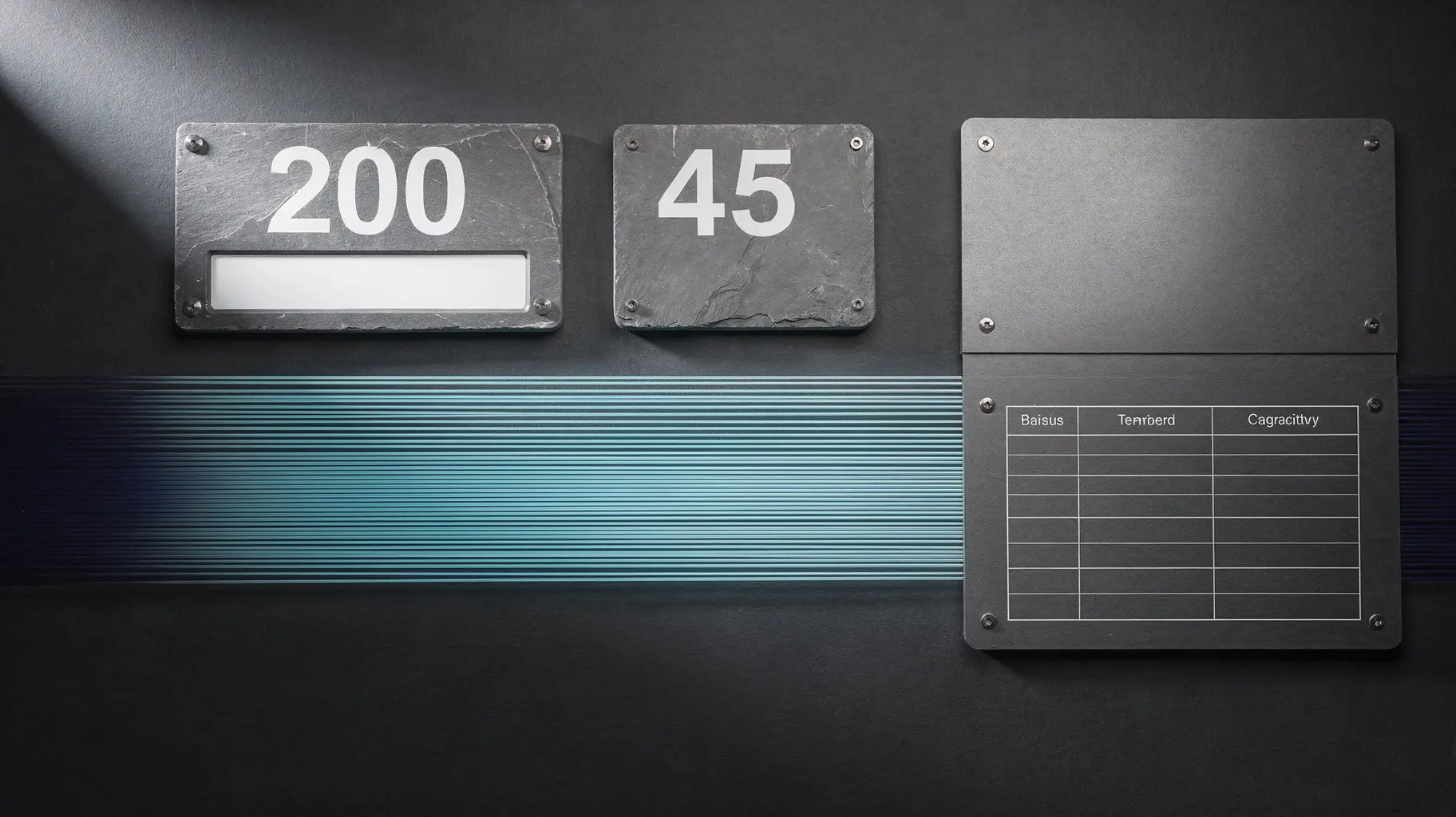
- The same operator publishes 20 Tbps for SAm-1 and 45 Tbps for PCCS. Adding the three published figures gives 265 Tbps, but that is BTW's arithmetic, not a Telxius total: no page inspected on 12 November 2026 states a fleet capacity figure in Tbps at all.
A capacity figure on a cable page looks like a specification. It is really a claim about which quantity has been counted, and submarine systems carry at least three that get called capacity. Design capacity is what the wet plant and its repeaters were engineered to carry. Equipped or lit capacity is what has actually been powered and turned up on the fibre pairs in service. Orderable capacity is the smaller slice a carrier will sell you on a given route for a given term. The first is a ceiling, the second is an installation, the third is a contract.
They are not interchangeable, and a buyer who cannot tell which one is printed on the page is guessing.
That is the small, specific thing worth checking at Telxius, because the operator used to make the distinction itself. The company's own record is the Telxius directory entry.
What the operator said when Marea was new
On its Marea page Telxius describes the system plainly: a submarine cable 6,600 kilometres long with 200 Tbps of capacity. No publication date appears on the page, and no words attach a basis to the number. It is a big figure, stated cleanly, and it is the sentence a network planner would put in a slide.
The January 2019 statement about the same system is more careful. It refers to an initial system design capacity of 160 Tbps, and then records that the cable reached 200 Tbps in only six months after it opened for business. The page carries a 19 January 2019 header while its own dateline reads 20 January; the one-day slip changes nothing about the capacity figures. What matters is that in 2019 Telxius named 160 Tbps as the design basis and 200 Tbps as a result achieved on top of it. By the time the product page was written, the result had become the specification.
The arithmetic, both ways
The gap between the two published figures is not a rounding artefact. Two hundred terabit per second minus 160 terabit per second is 40 terabit per second, and 40 divided by 160 is 0.25. Run it the other way to be sure: 160 multiplied by 1.25 is exactly 200. So the figure now presented as the cable's capacity sits a quarter above the design capacity the same operator published for the same system. Both numbers are Telxius's. Neither is wrong. They are answers to different questions, and the page kept only the larger one.
Now widen the frame. Telxius publishes a SAm-1 capacity of 20 Tbps and, on the same site, a PCCS capacity of 45 Tbps. Three cables, three figures, all in the same unit, which invites an obvious sum: 200 plus 20 plus 45 is 265 Tbps. Subtract them back and the total returns to 200, so the arithmetic is sound.
It is also meaningless as a statement about the company, and this is the point of the exercise. No Telxius page inspected on 12 November 2026 states a network capacity total in Tbps. There is no published denominator, so 265 Tbps is a number BTW built out of three separate disclosures, not a figure the operator asserts. The internal proportions are at least revealing: Marea alone carries 75.47% of that three-cable sum, and it is ten times the SAm-1 figure on the nose, since 200 divided by 20 is 10. Two hundred against the other two cables combined, 65 Tbps, is about 3.08 times.
A buyer who reads only Marea is reading three-quarters of the capacity that appears anywhere on the operator's cable pages.
Kilometres are not a capacity unit
The other half of the public picture is scaled in distance. The English homepage leads with kilometres of high-capacity submarine cable and terrestrial backhauls, and announces that the network is being brought to a new generation with 800G technology. That is a coherent way to describe reach, and 800G is a real engineering claim: it describes bits per second on a single wavelength. It is not a cable capacity figure. Converting it into one would need a wavelength count and an unambiguous assignment of those wavelengths to a system, and no page in the retained set supplies either. A homepage that says kilometres and 800G is advertising reach and line rate. It is not answering the buyer's question, which is how many terabits per second are available on which route, on what basis, for what period.
One further page belongs in the record precisely because it says nothing useful about capacity. The English homepage redirects to /en/inicio-en/, and the page served there on 12 November 2026 states no cable capacity figure at all. Reading six pages to find one silent page is not padding; it establishes which address a reader actually lands on.
What a buyer can and cannot do with this
The practical consequence is narrow and it does not require accusing anyone of anything. Telxius publishes per-cable capacity in the correct unit and publishes its own network in a different one. Where two figures exist for Marea, one of them is explicitly a design figure and the other is an achievement, and only the achievement survived onto the product page. So a procurement case that cites 200 Tbps is citing a measurement, not a specification, and the specification was 160.
That distinction has a cost when a route is sold on a design number. A contract sized against 160 Tbps leaves 40 Tbps of headroom that the operator has already demonstrated it can light. A contract sized against 200 Tbps has no headroom left in the published record and no statement that 200 is available to sell. The difference between those two positions is a quarter of the cable, and it sits entirely in which sentence you quote.
The three questions that close the gap are unglamorous and cheap to ask. Which basis does the figure use: design, equipped, lit or orderable? What is the aggregation unit: per fibre pair, per system, or across the network? Over what period does the operator commit to it? Telxius answers none of the three on the pages inspected here, which is why the number has to travel with its provenance rather than on its own.
On the evidence of six operator pages read on 12 November 2026, that is the state of the public ledger: capacity is published cable by cable, the network is published in kilometres, no basis label survives on the Marea product page, and no fleet total exists to check any of it against. The figures are available. The framework for comparing them is not.
Member Briefing
Deeper Trend Context
Sign in with the right membership level to unlock the full briefing and source notes.
Strategic Circle
A daily briefing in your language, built from changes we have verified.
Join for USD 20/monthCancel anytime.
Public reporting stays free. Member research, the daily briefing and the forum need a membership.