
Summary
- Boldyn's neutral-host architecture avoids four mobile operators duplicating civil work in a railway where engineers can work only a few hours at night. The saving is real in principle; no public source yet quantifies it against a credible alternative.
- The UK company used £67.7m in operations and £103.3m in investing during its 2025 financial year. £55m of new shares and £165m of related-party borrowing funded the build while revenue fell to £11.6m.
- Constructed infrastructure transfers to Transport for London. Boldyn's economic asset is the concession, operating knowledge and operator integration—not perpetual title to every cable. Its legitimacy depends on delivery, fair access, lifecycle cost and common-layer resilience.
One tunnel network, four retail networks
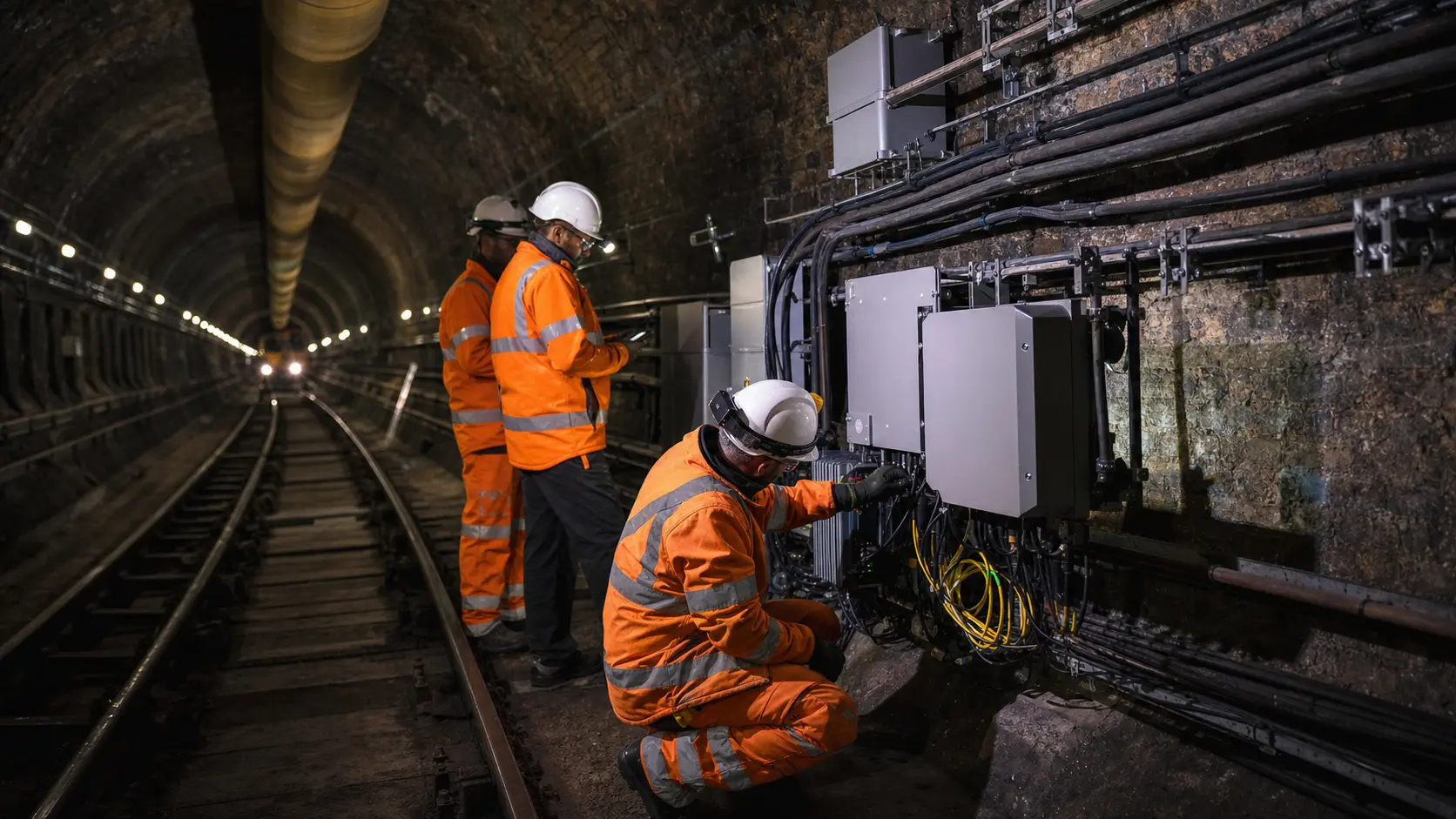
London Underground offers an unusually clean case for shared infrastructure. Three UK, EE, Vodafone and Virgin Media O2 all need licensed mobile coverage in the same narrow tunnels. The railway cannot sensibly host four independent night-time construction programmes, four sets of radio distribution and four competing claims on power, cooling and heritage approvals.
Boldyn supplies the common layer. Its public description identifies nine “base station hotels” where operators place equipment. Fibre runs from those facilities into stations and tunnels, with shared radio infrastructure carrying each operator's service. Operators retain spectrum and customer control. A station may therefore be physically ready before every operator has activated it.
This separation matters. “Network complete” can refer to installed passive assets, an accepted radio layer, one live operator, all four live operators, passenger coverage across a station, or continuous service through connecting tunnels. Combining those states produces excellent slides and poor accountability.
Transport for London awarded BAI Communications, since renamed Boldyn, a 20-year concession on 21 June 2021. TfL contributes access to tunnels, stations, ducts, lighting columns and other difficult assets. The shared system is also intended to host the Emergency Services Network, adding a public-safety dependency to the commercial one.
Boldyn says the broader London programme will involve more than £1bn of investment. A company executive said in late 2025 that roughly £1bn had already been invested and described a deployment spanning 137 stations and 217 tunnels. Those are group claims. The UK subsidiary's audited accounts offer the more useful view of how one operating perimeter is being financed.
The cash flow arrives before the utility economics
For the year to 30 June 2025, BOLDYN NETWORKS UK LIMITED reported £11.62m of revenue, down from £39.24m. The company attributed the 70% decline mainly to lower Emergency Services Network construction revenue. Its operating loss widened to £34.76m; loss before tax was £41.20m.
The cash statement is starker. Operations used £67.72m and investing used £103.25m. Cash purchases of property, plant and equipment were £103.66m. Financing supplied £213.19m, led by £55m of new shares and £165m of related-party borrowing.
The £165m facility came from Boldyn Networks PNE Holdings UK Limited and carried SONIA plus 4.23% through 1 July 2025. It is intragroup funding, but not free money. Interest, construction time and the cost of idle or partly live assets still belong in the project return.
At year-end the company had £686.37m of assets and £479.92m of liabilities. Net assets were £206.45m. Share capital of £304.94m sat against accumulated losses of £98.49m. Going-concern support relied on cash, expected operating receipts, debt facilities and a financial support letter from Boldyn Networks Global.
Sponsor support continued after the reporting date. The accounts record a further £50m intercompany facility in July 2025, £75m of equity contributions in October and November, and a £40m deposit in January 2026. Companies House filings show stated capital rising to £449.94m after a July 2026 allotment.
This is not evidence that the concession is failing. Long-lived infrastructure is supposed to consume capital before it produces steady access revenue. It is evidence that the investment case cannot be judged by the number of newly connected platforms alone. The test is eventual cash conversion after finance, leases, maintenance and upgrades.
The balance sheet shows who has leverage
Property, plant and equipment reached £407.18m. It included £170.52m of network assets and £236.26m of work in progress. Base-station-hotel right-of-use assets added £80.74m, while lease liabilities totalled £88.35m.
The customer side supplied funding too. Contract liabilities, largely advance billings to mobile operators, were £134.08m. Refund liabilities tied to delivery milestones were £47.48m. Six customers represented approximately all trade receivables and contract assets at year-end.
Those numbers expose a useful discipline. Operators do not simply arrive after construction and rent a finished utility. Their advance payments help finance delivery, while refund obligations give missed milestones a cash consequence. Customer concentration also gives a handful of buyers bargaining power over a supplier with large sunk costs.
TfL has leverage of a different kind. The accounts show £128m of remaining capital commitments with TfL and £17.24m of prepaid revenue share. More importantly, the service-concession note says ownership of the infrastructure transfers to TfL as it is constructed.
Boldyn therefore does not earn its return by accumulating an unrestricted tunnel-asset estate. It earns through access contracts, service operation and a difficult-to-replace position within the concession. That can be a durable business. It also makes renewal, step-in rights and end-of-term handover more important than the gross asset number.
A two-year timetable cannot be explained by one percentage
TfL's July 2021 commissioner report said all stations and tunnels were due to have mobile coverage by the end of 2024. In June 2026, TfL reported that around 60% of underground stations had coverage and targeted the whole Tube network by the end of 2026.
The obvious reading is a roughly two-year delay. It is directionally true and incomplete. TfL also documented a re-baselined programme that accelerated 5G and Elizabeth line work and added below-ground DLR and Overground scope. Its 2024 update expected about 80% of stations by year-end while acknowledging that some work would continue into 2025.
The audited accounts add another date: construction under the service concession was expected to complete in 2027. That may include passive, above-ground, ESN or other work beyond the passenger-facing Tube coverage promised for end-2026. The public record does not reconcile the scopes.
Accountability requires preserving all three facts: the original promise, the agreed scope changes and the current milestones. “On track” is meaningful only when the track has a stable definition.
The physical constraints are not inventions. Boldyn describes work windows of roughly midnight to 4am, no tool storage in stations, extensive assurance, heritage restrictions, heat and limited cooling space. TfL said more than 600 engineers were working overnight in 2026. Every shift must leave a safe operating railway for morning service.
That explains why construction is difficult. It does not answer whether the concession allocates delay cost efficiently. The £47.48m refund liability shows that some milestone remedies exist. The public cannot see the full price, penalty or relief mechanics.
Sharing saves duplication by creating a common dependency
Boldyn argues that one neutral-host system gives operators better service at a fraction of the go-it-alone cost. The civil-economics logic is persuasive. If access, safety and installation dominate cost, building one common layer should be cheaper than building four.
The public evidence stops short of an audited comparison. Operator prices, minimum commitments, lifecycle upgrade charges and savings against standalone builds are not disclosed. Nor are service availability, fault attribution, repair time or incidents caused by the shared layer.
The architecture changes the failure shape. Separate networks duplicate capital and may fail independently. One shared layer reduces capital and can fail across several operators at once. That does not make neutral hosting bad. It makes common-cause resilience part of the price.
Emergency-services use raises the bar. A fibre cut, power problem, cooling fault, software change or delayed radio upgrade can cross commercial and public-safety boundaries. Sensitive operational detail should remain protected, but aggregate availability and recovery evidence need not be secret.
Operator activation is another hidden dependency. Boldyn can build and pass infrastructure while an MNO controls its spectrum, configuration and retail launch. A fair scorecard should separate “ready for operator” from “live for operator” and name the reason for the gap without turning either party into a convenient universal excuse.
Who holds power, and who carries the bill
TfL holds the scarce physical right. It controls access windows, safety approval, standards and the concession. It also receives constructed assets and a revenue share. Its power comes from the railway estate, not from mobile spectrum.
Boldyn controls integration. It sequences work, builds the common facilities, coordinates operators and accumulates knowledge that a replacement provider would struggle to recreate. Its power comes from contract duration, installed systems and operational learning.
The MNOs control demand, spectrum and the retail relationship. Their concentration gives them purchasing leverage, although separate tunnel construction is not a credible threat in every negotiation. The Home Office and emergency services influence acceptance through ESN requirements.
CPP Investments is the ultimate controlling party identified in the UK accounts. CPP said it held 86% of Boldyn and had committed about C$3.5bn to the platform since 2009; AIMCo reported a 10% position, with Manulife holding a minority interest in US assets on behalf of clients.
Long-duration pension capital fits a 20-year concession. Canadian contributors and other institutional clients bear the upstream return risk. Operators pay for access. TfL contributes scarce access and receives infrastructure. Passengers and frontline responders receive the service—and absorb the time cost when it is late or unavailable.
The alternatives are imperfect, which is not the same as absent
Four standalone MNO networks would preserve more supplier diversity but multiply engineering, railway disruption, power use and scarce space. It is the simplest counterfactual to describe and probably the least attractive to build.
A stronger benchmark is a TfL-financed passive network with active radio and operations tendered in shorter modules. Public ownership would reduce end-of-term asset ambiguity and periodic competition could test operating price. TfL would also carry more funding, integration and technology risk.
Another option is to split neutral hosting by layer or line. Fibre, sites and power could remain common while active systems or geographic packages use more than one operator. Diversity would rise; coordination and duplication would rise with it.
Mandated active sharing or roaming could extend coverage through operator assets. Wi-Fi and surface small cells can cover selected places. Neither fully substitutes for seamless licensed mobile and ESN service across deep tunnels.
The correct comparison is not Boldyn versus an imaginary free network. It is the discounted cost, resilience, upgrade speed and exit risk of several expensive architectures. Neutral hosting should win that comparison. The concession needs evidence that it does.
What would falsify the efficiency claim
The thesis is straightforward: Boldyn deserves its 20-year position if common infrastructure delivers faster four-operator activation, lower lifecycle cost and equal or better availability than credible alternatives after financing and resilience costs.
Evidence could weaken the critical case. Audited operator savings, stable service availability, declining capital cost per new live area, short activation gaps, timely upgrades and positive operating cash after build-out would show that the shared layer converts scarcity into efficiency.
Evidence could strengthen it. Repeated sponsor injections without cash conversion, persistent milestone refunds, wide operator activation gaps, common outages, slow technology upgrades or another material re-baseline would suggest that avoided duplication has become dependence without adequate discipline.
The useful unit is not “percentage complete”. It is a matrix: station and tunnel section; passive-ready date; each operator's live date; service availability; incident cause; repair time; capital spent; and latest accepted baseline. Dry, comparable rows are less photogenic than a 5G icon. They are also what a twenty-year right should buy.
Sources and evidence boundary
The UK entity's finance and concession facts come from its Companies House record, filing history and audited accounts to 30 June 2025. Figures are not consolidated Boldyn group results.
The award and schedule record comes from TfL's July 2021 commissioner report, 2023 investment update, May 2024 progress report, June 2026 milestone and current project page.
Boldyn's London deployment account, concession case study and neutral-host argument are treated as first-party claims. Ownership percentages and group commitments come from the investor release.
Existing BTW rollout coverage supplies first-party editorial context. No reviewed source establishes unlawful procurement, intentional delay, audited MNO savings, a positive project return or responsibility for a specific outage. Those claims are excluded.
Member Briefing
Deeper Profile Context
Sign in with the right membership level to unlock the full briefing and source notes.
Only for Strategic Circle
Strategic Circle
Open to all readers. Unlock profile briefings after joining and signing in.
Join Strategic CircleOnly for Leadership Alliance
Leadership Alliance
For qualified IP-asset owners and management; sign in to unlock alliance briefings.
Join Leadership Alliance