
Summary
- NEXTDC's S7 proposal in Eastern Creek is designed for 612MW of operational capacity across three two-storey data-storage buildings, but its official status is still Prepare EIS.
- April planning material contemplated recycled sewage water for cooling; the proposal was abandoned because the area lacked the necessary infrastructure and planning permission for a pipeline.
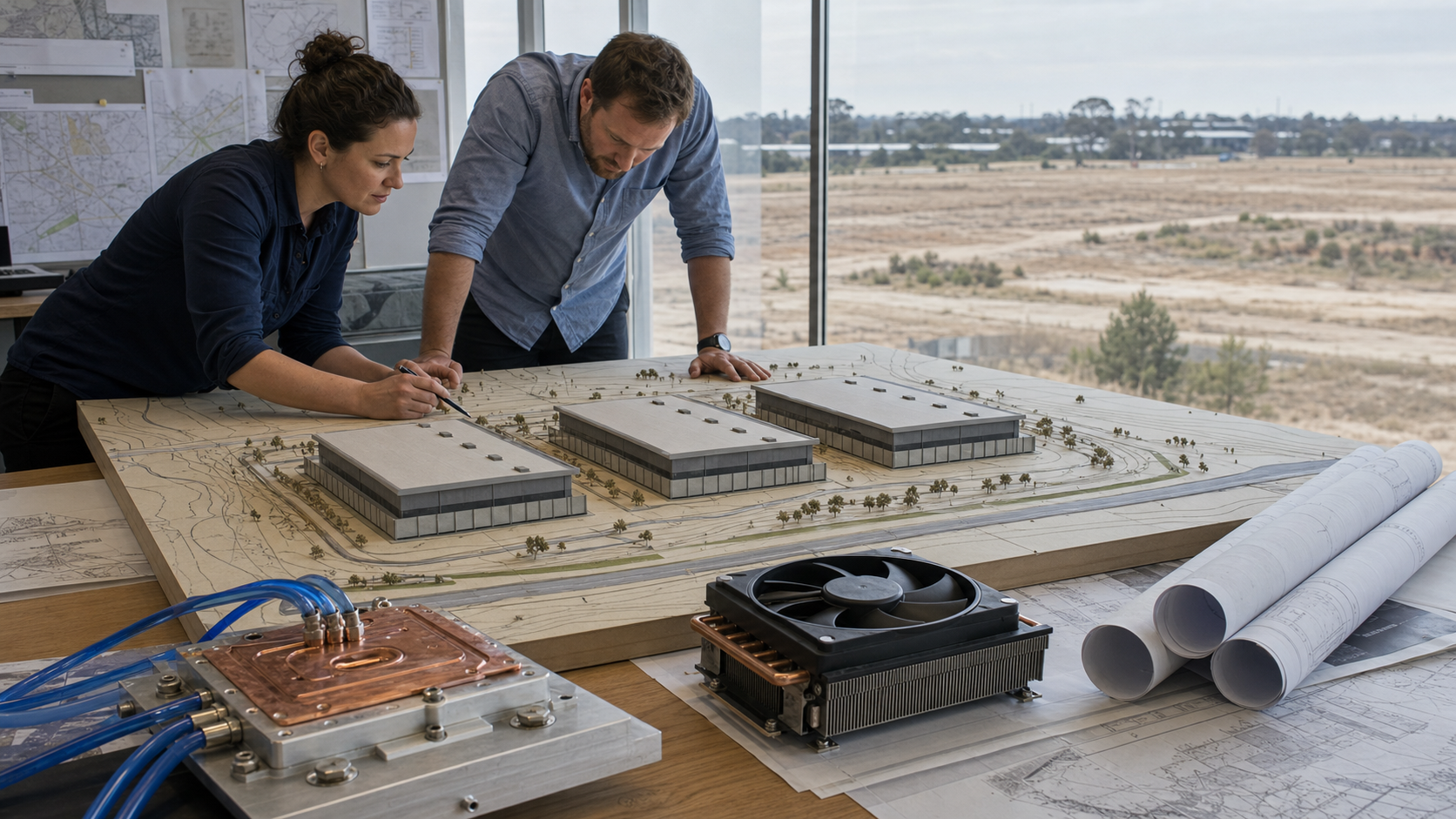
- The redesigned system uses liquid-on-chip cooling and fan-based heat rejection without water consumption in that rejection stage.
- Experts cited by Reuters said the alternative can be more energy-intensive, shifting part of the resource problem from water infrastructure to electricity.
- OpenAI and NEXTDC describe an infrastructure partnership, but S7 has not received planning approval, entered completed construction or become an operational computing load.
Cooling does not remove heat; it decides where the heat and the resource burden go. At S7, the first concept would have used recycled sewage water and depended on a new pipeline. When that route proved unavailable, the project did not eliminate the cooling requirement. It changed the system boundary.
The new proposal takes heat from chips with liquid and rejects it through fans without consuming water in that stage. That design can reduce pressure on potable or recycled-water supply and remove a difficult pipeline dependency. It can also require more electricity to move air and reject heat, especially under demanding ambient conditions.
A missing pipe can redesign a computing campus
Reuters reports that the recycled-water proposal was abandoned because the necessary infrastructure did not exist and planning permission for the pipeline was absent. That is not a minor procurement substitution. A pipeline crosses land, connects public systems and creates its own approval, construction and timing risks.
April planning documents had contemplated sewage recycling. Removing that approach before the environmental impact statement is final shows why early data-centre specifications are not fixed operating facts. Water sources, cooling equipment, grid connections, backup systems and building layout interact; a constraint in one layer can alter the burden in another.
For local water planning, the change may be helpful. A waterless heat-rejection stage avoids making the facility's cooling operation contingent on an undeveloped recycled-water route. But “waterless” should not be treated as “resource-free”. The relevant questions expand to fan energy, peak summer performance, heat-rejection efficiency and the source of the extra electricity.
The 612MW number is planned capacity
The New South Wales planning record describes a 612MW operational-capacity proposal with three two-storey data-storage buildings and 340 backup diesel generators. Those figures define the project being assessed. They do not describe a live campus.
The portal's status is Prepare EIS. S7 has not yet crossed the approval decision, construction and commissioning stages. NEXTDC and OpenAI can announce a partnership and intended infrastructure role without turning the proposal into an authorized or operating data centre.
This status boundary matters economically. Suppliers may compete for future equipment, utilities may study grid requirements and investors may model future capacity. None of those actions proves that 612MW is drawing power, that 340 generators are installed, or that customer workloads have started.
Electricity becomes part of the cooling approval case
The cooling change puts greater weight on the project's energy model. Reviewers need to understand not only the IT load but also the power-usage effectiveness of heat removal across temperatures and utilization levels. A design that saves water but increases electricity can still be preferable, but its trade-off must be visible rather than marketed as a pure resource reduction.
Backup generation adds another layer. The official proposal lists 340 diesel generators, a redundancy measure rather than a claim of routine generation. Environmental assessment must distinguish testing and outage operation from ordinary grid consumption while examining emissions, fuel storage and cumulative local effects.
For OpenAI, the attraction is sovereign Australian AI infrastructure. For NEXTDC, S7 would be a large platform with a major intended customer and unusually high power requirements. For the community and planners, the question is whether the design can secure electricity, reject heat and manage emergency generation without transferring hidden costs into the grid or local environment.
The next decisive evidence will be the environmental impact statement and agency response. They should quantify the changed cooling system, electricity penalty, water use, grid connection and backup-generator assumptions. Until approval follows, S7 is a large proposal whose resource architecture has changed—not a completed solution to Australia's AI-capacity demand.