Summary
- Linda Dunbar and four co-authors published RFC 10090 in November 2026 as an Informational account of how BGP can distribute SD-WAN overlay routes, WAN-port attributes, tunnel details and policy-constrained reachability.
- The RFC keeps the SD-WAN overlay BGP instance separate from the BGP processes governing each underlay. A logical Route Reflector may sit behind several physical controller instances, while their coordination and state synchronization remain outside the document.
- In a hybrid WAN, a client route and its WAN-port/tunnel properties are advertised separately and joined through a common loopback address and recursive next-hop resolution. A complete control plane still has to prove VPN membership, local flow policy, tunnel establishment, underlay choice and the return path.
A route is a statement, not a packet
The abstract sounds almost administrative. BGP distributes reachability, WAN-port details and underlay path information; operators avoid some manual provisioning; information that once crossed proprietary control planes can use a standards-based protocol. RFC 10090 then adds the clause every sales deck would rather keep at the bottom of the slide: BGP extensions are still needed.
The useful architecture begins with separation. SD-WAN is an overlay carrying IP packets over one or more underlays. The BGP instance steering the overlay is distinct from the BGP instances operating the private networks, public Internet paths and service-provider domains underneath. The overlay assumes one administrative domain even when several network service providers supply transport.
That assumption matters at the control boundary. A controller may distribute overlay state across underlays it does not administer. It can know which path policy wants. It cannot turn an outside provider's packet loss into a local route preference that the underlay will obey.
Dunbar, Ali Sajassi, John Drake, Basil Najem and Susan Hares make the Route Reflector the logical control point. The RR controls route distribution and policy enforcement. Controller and RR may be integrated or separate. Several RR instances may provide scale, resilience and geographic redundancy. Their state synchronization is outside RFC 10090.
The last sentence contains an entire operational program. “Distributed Route Reflectors” can sound like one service with several boxes. The RFC describes a logical control point whose physical implementation may be a coordinated system. The coordination protocol is not supplied here. An operator still needs proof that every controller instance agrees on membership, policy generation and the attributes attached to a route.
The policy is part of the topology
An edge advertises attached client routes and the properties another edge needs to build a tunnel: WAN-port addresses, loopback addresses and supported encryption details. Those properties are not public topology trivia. RFC 10090 says they must not reach unauthorized peers. The RR is told to propagate an edge's UPDATE only inside the same SD-WAN VPN.
Route Targets carry VPN membership in the BGP Extended Communities attribute defined by RFC 4360. RFC 4456 supplies route reflection. The security model therefore sits inside ordinary BGP policy work, with one large difference: the RR is also the central authority deciding which edge properties another edge may see.
That is convenient until policy drifts. A missing route denies service. A route sent to one extra peer reveals WAN ports, encryption capabilities or client reachability to a tenant that should never have seen them. The RFC states plainly that an error in RR policy or provisioning can have network-wide effects.
The control plane has changed who bears configuration risk. Thousands of edges no longer need the same hand-built peer matrix. One central matrix now decides what the edges can learn.
Two updates, one join, several ways to miss
RFC 10090's differential-encryption model gives the clearest packet of operational evidence. UPDATE 1 advertises client prefixes. UPDATE 2 advertises WAN-facing interface and tunnel information in the Tunnel Encapsulation Attribute, using semantics supplied by RFC 9012. Color values associate a route with an intended transport class.
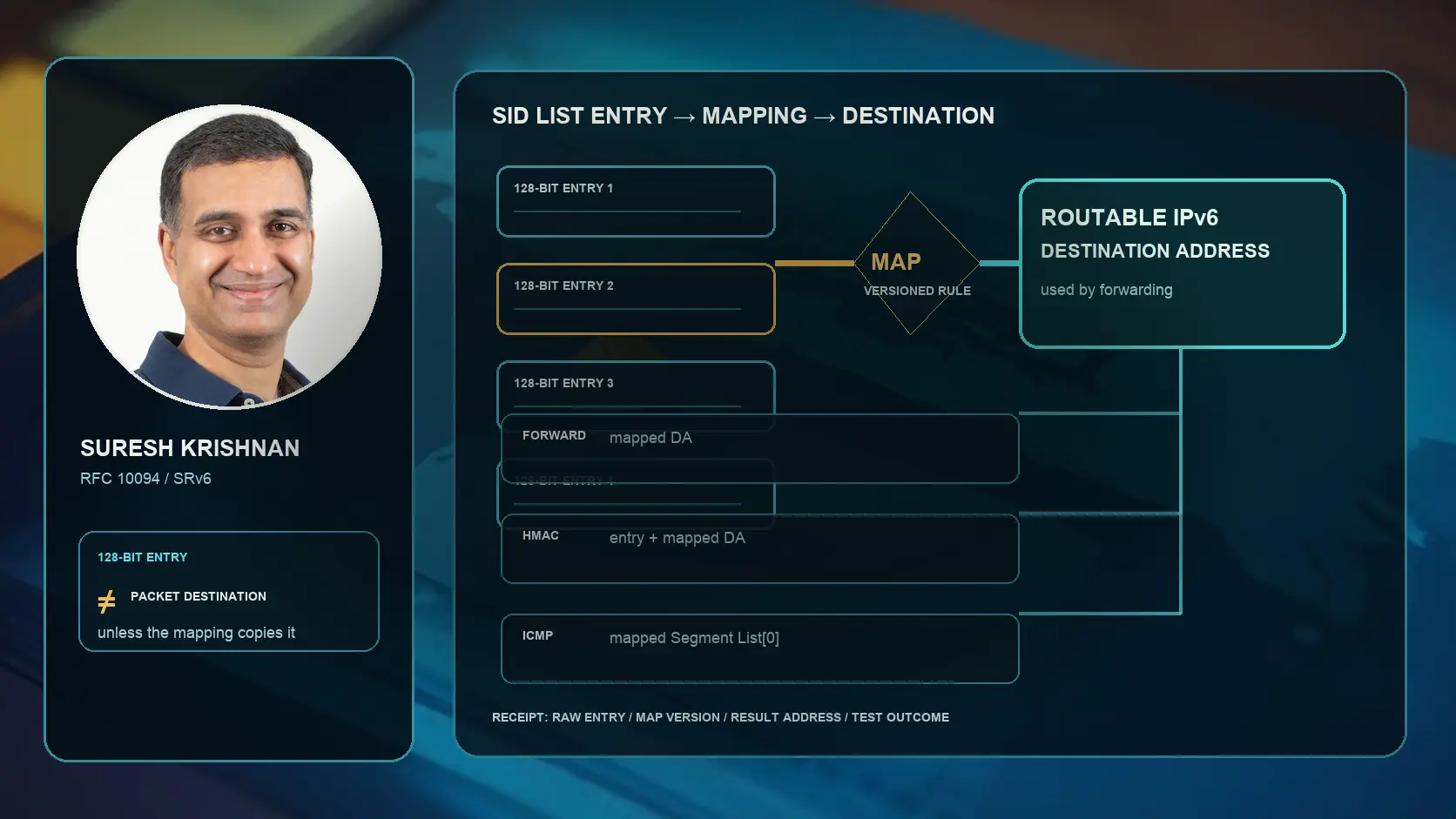
Receivers join the updates through the advertising edge's loopback address. The client route's next hop points to that loopback. The WAN-port advertisement carries the same loopback in its NLRI and adds tunnel parameters. Recursive next-hop resolution connects the route to the transport properties.
The split is sensible. Client routes and dynamic tunnel values do not change on the same clock. Multiple services can share an SA. The receiving edge can update tunnel state without rebuilding every client prefix.
It also creates a visible chain of dependencies. The prefix must match a VPN. The next hop must resolve to an edge. The edge must advertise a usable WAN port. The Tunnel Encapsulation Attribute and Color must map to an allowed path. A local IPsec traffic selector must accept the route. The selected underlay must carry the resulting packet. A reverse path must exist under its own policy.
A live BGP session proves the first conversation, not the whole chain.
The scenario makes asymmetry explicit. Traffic A-to-B may use a private VPN while B-to-A uses the Internet under IPsec because the policies are evaluated independently. An operations dashboard that checks one direction can certify half a working service.
The Internet-facing port is not a second trust domain by accident
Hybrid SD-WAN puts security policy into route selection. Some flows may use only a private VPN. Some may use either underlay, with IPsec on the public path. Internet-bound browsing may be handed off without another encryption layer. A private VPN PE may add Internet ports for temporary bandwidth expansion and offload MPLS-in-IP or GRE-in-IPsec into a public network.
Those ports create exposure. RFC 10090 warns that Internet-facing WAN ports can become targets for spoofing and denial of service, and that a misconfigured edge may learn untrusted Internet routes. Its rule is direct: the control plane must avoid learning routes from Internet-facing WAN ports. Anti-DDoS controls, ACLs and rate limiting are named while their details remain outside scope.
This is where a BGP table becomes a security artifact. “Session up” says a speaker answered. “Policy applied” says the RR intended a constrained set of peers. “WAN port usable” says an interface and tunnel attribute exist. None of those observations says the Internet-facing interface accepted only the routes it should have accepted.
The detailed fields for edge discovery and attribute distribution are assigned to SD-WAN-DISC. RFC 10090 is an architectural map, not the wire specification. It names no implementation, conformance test, deployment count, route leak, outage, convergence measurement or independent security evaluation. Claims about market support need evidence from outside this Informational RFC.
A receipt for the boundary
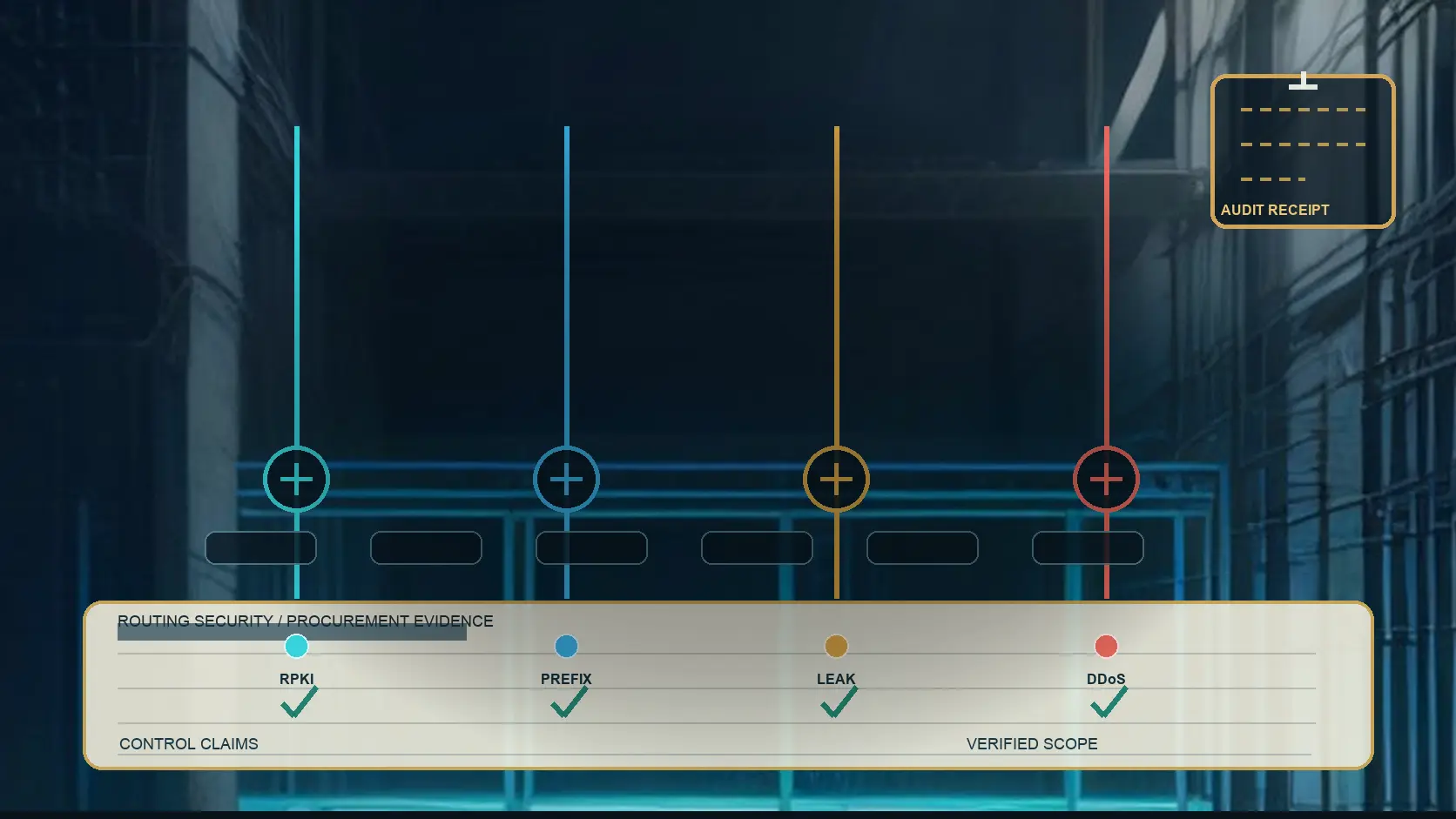
The practical response is to stop asking one system whether the SD-WAN is “up.” Preserve a route receipt with the client prefix, VPN or Route Target, advertising edge, common loopback, policy generation, WAN port, tunnel attribute, Color, IPsec SA or MPLS path and the local flow rule that selected it. Join that to the observed underlay and the return direction.
The receipt should contain hashes of the control-plane objects and timestamps for the forwarding observations. It should identify which controller/RR instance supplied the state and whether the receiving edge accepted or suppressed it. A change to any link in that chain becomes reviewable without pretending the whole network failed at the same instant.
The RFC gives engineers a common vocabulary. Its most valuable boundary is less flattering than “BGP replaces the proprietary controller.” BGP reduces repeated distribution work; the edge and its operator still have to prove that the distributed state became the packet path they intended.
Sources: RFC 10090; RFC 9012; RFC 4456; RFC 4360; RFC 4271; SD-WAN-DISC.
Member Briefing
Read the full trend briefing
Members read the full briefing with the source notes behind every finding.
Strategic Circle
A daily briefing in your language, built from changes we have verified.
Join for USD 20/monthCancel anytime.
Members also get the full research library, a daily briefing on the networks they follow and the private forum.