Summary
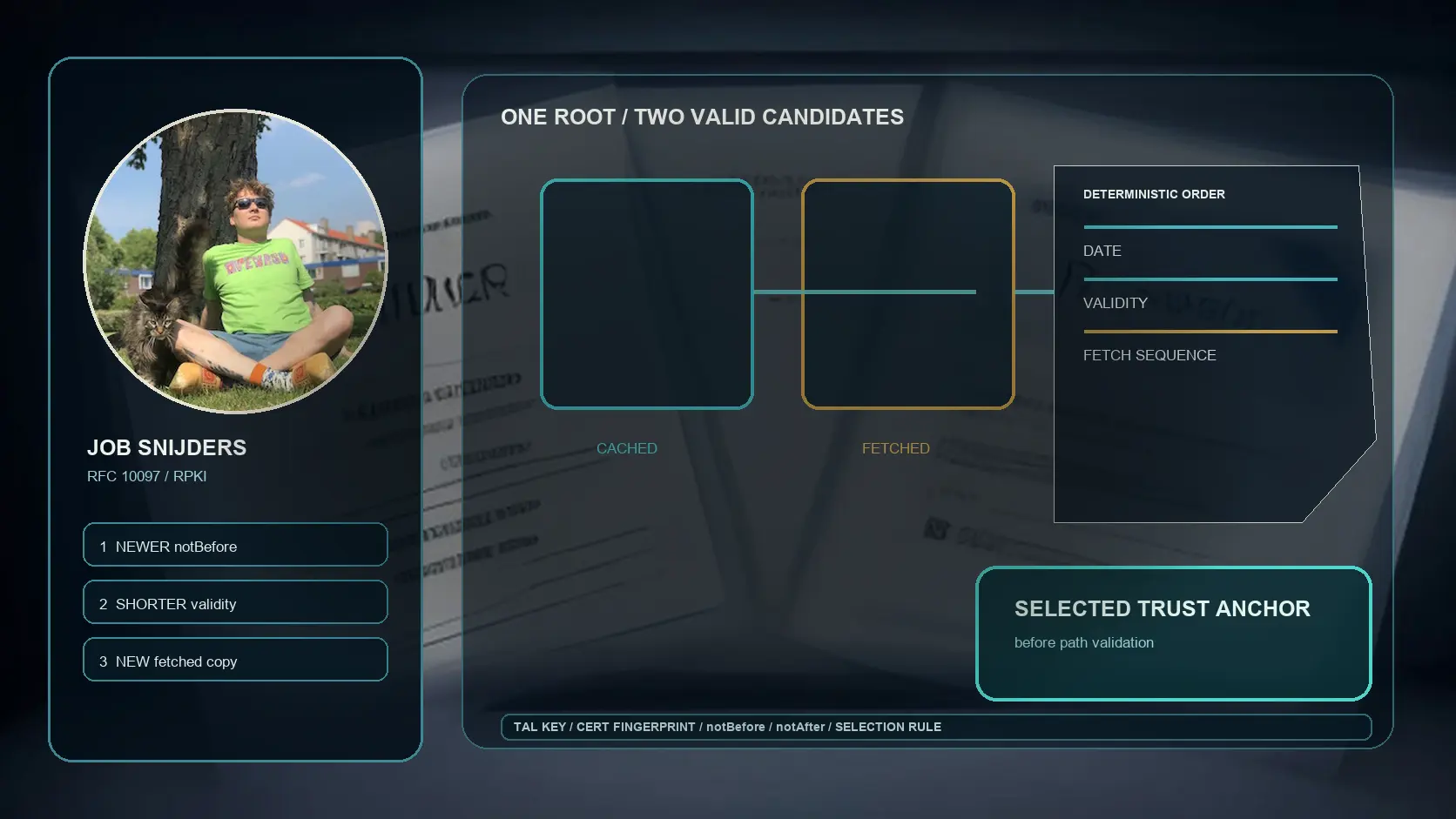
- Job Snijders, Theo Buehler and Ties de Kock authored RFC 10097, a November 2026 Standards Track update to RFC 8630. It fixes how an RPKI relying party chooses between multiple valid self-signed Trust Anchor certificates.
- Trust Anchor operators reissue these root certificates to change validity dates, repository locations, certificate policies and Internet Number Resource extensions. An older certificate can remain cryptographically valid because no ordinary CRL covers the Trust Anchor’s own scope.
- The required order is newer notBefore, then shorter validity when notBefore ties, then the newly fetched certificate when both dates tie. The RFC replaces local ambiguity with a deterministic selection before normal certification-path validation begins.
The root has nothing above it
RFC 8630 defines the Trust Anchor Locator. A TAL carries one or more HTTPS or rsync locations for a Trust Anchor certificate and the public key that the certificate must contain. The fetched object has to be a self-signed RPKI CA certificate shaped by RFC 6487.
The transport does not establish trust. A validator may fetch the certificate over an unauthenticated channel. It accepts the object because the self-signature verifies and the public key matches the TAL. The TAL supplies an anchor; ordinary Internet transport supplies a file.
That distinction matters when a Trust Anchor operator reissues the same anchor. RFC 5280 defines notBefore and notAfter. RFC 3779 carries the address and ASN delegations. An operator can issue a new certificate to update any of these fields, or the Subject Information Access and Certificate Policies extensions described by RFC 10097.
The old certificate may still sit in a cache. It may still be inside its validity interval. Its key may still match the TAL. A normal cryptographic check can therefore declare both the old and new certificate valid.
There is no conventional CRL covering the Trust Anchor’s own scope. The root cannot revoke an old self-signed certificate through the process it uses for a subordinate CA. RFC 10097 notes that some historical Trust Anchor certificates carried validity periods as long as a century. An on-path adversary or a caching network element can present the older instance while the operator intends validators to use the newer one.
The rule is an order, not another signature
RFC 10097 changes the old RFC 8630 “SHOULD” procedure into a sequence that a relying party “MUST” follow. It starts with retrieval and failure handling. If the fetch fails, the certificate is not a current valid self-signature, it misses the RFC 6487 profile, or its key does not match the TAL, the validator falls back to its locally cached Trust Anchor.
With two valid certificates and matching keys, the newest notBefore wins. If notBefore is identical, the certificate with the shorter validity period wins. If notBefore and validity period are identical but the certificates differ, the newly fetched instance wins.
The order carries a useful assumption: a Trust Anchor operator needs a way to issue a certificate that is preferred over every earlier certificate it issued. A timestamp handles most reissuances. The shorter-validity rule resolves same-start collisions. The fetched-copy rule closes the unlikely case where dates no longer distinguish two different objects.
This happens before ordinary certification-path validation. The selected Trust Anchor participates in the path that validates repository certificates and the ROAs beneath it. A different root candidate can therefore yield a different validation result without looking like a cache failure.
Validity is not the same as intended freshness
The RFC’s security section names validation failures and replay attacks among possible outcomes when a validator uses a different Trust Anchor instance than the operator intended. Those are categories of consequence, not a published incident count. The deterministic rule exists so an older signed object cannot win merely because it arrived first or because local software made an arbitrary comparison.
Implementations still need a reproducible receipt. Record the TAL identity without exposing private material, the selected certificate fingerprint, notBefore, notAfter, retrieval time, whether the object came from the TAL URI or cache, self-signature and TAL-key checks, the selection rule, and the final validation result.
That record makes a cache-versus-network dispute answerable. It also exposes the remaining implementation question: did the validator retain both candidates long enough to compare them, and did it actually apply the RFC’s order before path validation?
The RFC changes the root-selection algorithm. It does not prove that every RPKI implementation has been updated or that any operator’s current cache contains the intended certificate.
Snijders and his coauthors solved a small collision with large reach. When two roots are valid, “local policy” is just another name for a failover plan nobody wrote down.
Member Briefing
Read the full trend briefing
Members read the full briefing with the source notes behind every finding.
Strategic Circle
A daily briefing in your language, built from changes we have verified.
Join for USD 20/monthCancel anytime.
Members also get the full research library, a daily briefing on the networks they follow and the private forum.