Summary
- Suresh Krishnan and Adrian Farrel authored RFC 10094, a November 2026 Standards Track clarification of SRv6 Segment List processing.
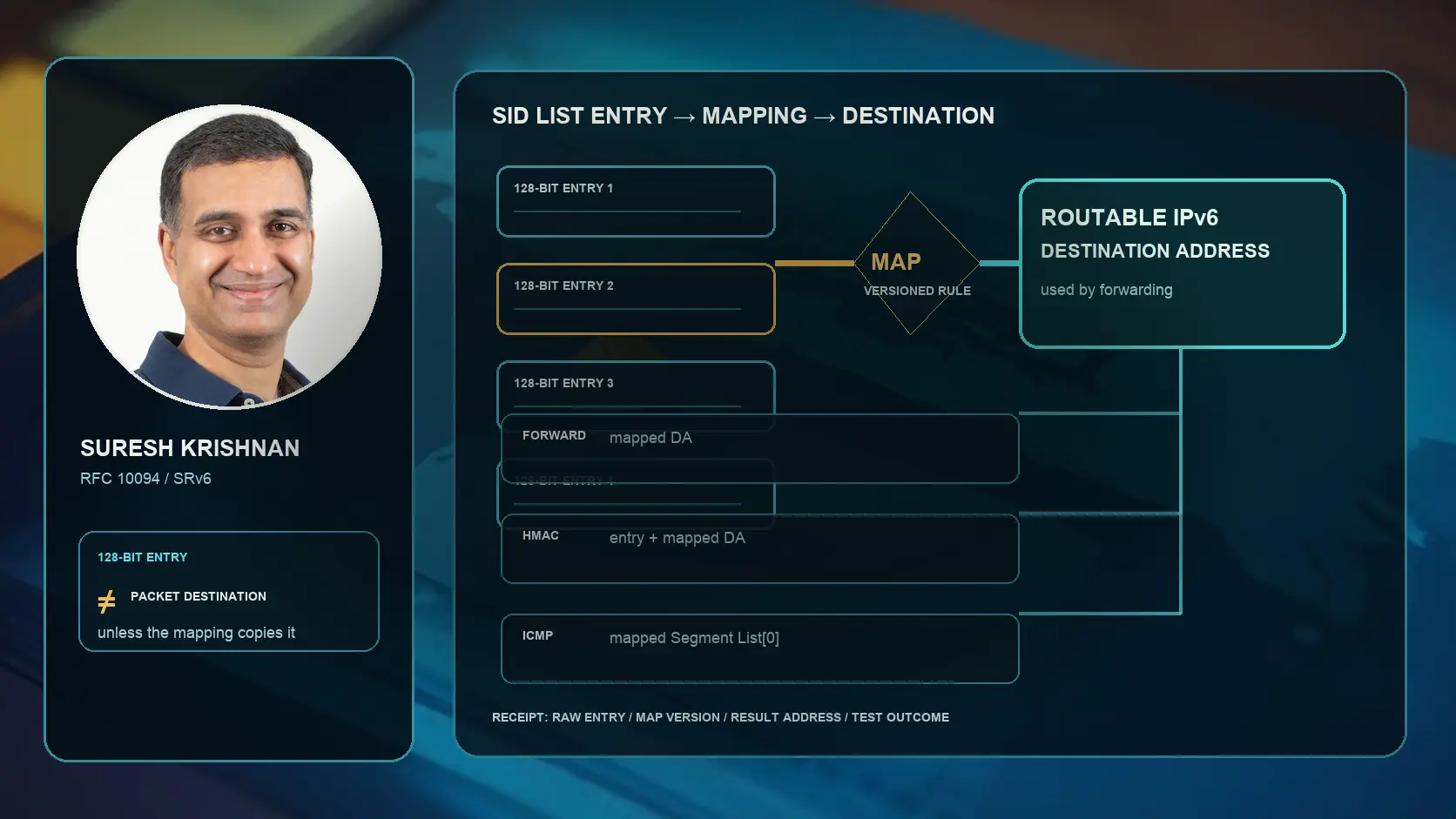
- A Segment List entry occupies 128 bits, but it is not necessarily a complete IPv6 address. The receiver maps the entry to the routable IPv6 Destination Address, directly or through a function such as compressed-SID expansion.
- The update also changes HMAC and ICMP wording to use the mapped address and treats the list as entries for integrity calculation. It gives packet-processing code and diagnostic tools one type boundary.
The instruction is not always the address
RFC 8402 defines the Segment Routing architecture. RFC 8754 defines the SRv6 Segment Routing Header. Its Segment List carries the ordered segments that guide packet processing.
The IPv6 header needs a routable Destination Address. RFC 8200 supplies that packet field. RFC 10094 states the material distinction: the next entry in the Segment List is mapped into the Destination Address. The map may copy the entry when it is an IPv6 address, or perform a more complex transformation.
RFC 9800 gives the compressed-SID example. A REPLACE-CSID container carries shared locator material; it expands into the address used for forwarding. RFC 10094 observes that RFC 9800 had to update RFC 8754 to permit this mapping and that the separate update would not have been needed if the mapping language had existed earlier.
The wording change is small and consequential. A Segment List entry is now a 128-bit entry representing a segment. It is not “a 128-bit IPv6 address” by definition. A direct-address deployment remains valid; compressed or otherwise transformed deployments no longer look like a contradiction in the base format.
The same rule reaches three places
The first place is forwarding. Segments Left identifies the number of unprocessed 128-bit entries. The SID-list entry selected by that counter is mapped to the Destination Address; the address is what the IPv6 forwarding path uses.
The second is HMAC. RFC 8754 previously said the packet destination must equal the selected Segment List entry. RFC 10094 changes that comparison to the address created by mapping the entry. The HMAC input likewise covers all Segment List entries, rather than assuming each one is an address.
The third is ICMP error handling. When a router derives the invoking packet’s destination, Segment List[0] may now be mapped. The error report follows the same representation as forwarding instead of treating the zeroth entry as a literal address.
That consistency matters because these are not decorative references to the SID list. They can change a validation result, the address placed in a response, and what a runner interprets from a packet.
A parser can produce a beautiful lie
Wireshark, router CLIs, telemetry and test tools often render a 128-bit field as an IPv6 address. The presentation is familiar. It can also be false.
An entry may expand into a different Destination Address. A tool that prints the raw 128 bits as the forwarding hop shows the encoded instruction, not the address selected by the receiver. A capture viewer may show a tunnel endpoint where the packet actually carried a compressed segment. An HMAC test may compare the wrong value.
RFC 10094 does not change SRv6 operational procedures or management tools. It says those tools need to understand the nature of the entries to explain packets clearly. The RFC establishes the semantic requirement; a release note is not proof that a decoder displays both raw entry and mapped address.
The receipt belongs at the boundary
A sound packet record keeps the raw 128-bit entry, mapping function and version, Segments Left, Last Entry, mapped Destination Address, HMAC input and verification result, ICMP derivation and final forwarding action in separate fields. That is the minimum chain from an instruction in the header to a routed packet.
The RFC publishes no named implementation mismatch, packet replay or deployment census. A conformance test should use an ordinary direct SID, a mapped compressed SID and an invalid mapping. Capture the parsed fields before and after mapping. Then compare router forwarding, HMAC acceptance and ICMP construction.
Krishnan and Farrel fixed a type error before it could masquerade as topology. In SRv6, “128-bit address field” is a storage size. It is not a promise that the instruction stored there is already the address the packet will follow.
Member Briefing
Read the full trend briefing
Members read the full briefing with the source notes behind every finding.
Strategic Circle
A daily briefing in your language, built from changes we have verified.
Join for USD 20/monthCancel anytime.
Members also get the full research library, a daily briefing on the networks they follow and the private forum.