Summary
- KDDI and Broadcom began a technical verification of co-packaged optics for inter-GPU networks in KDDI’s AI data centres on 22 October.
- KDDI says the test will examine power use, packet loss, congestion control and effective throughput under workloads modelled on distributed training and inference.
Analysis
An AI-network partnership usually arrives dressed for a launch stage: grand nouns, a photograph, and a future tense doing most of the lifting. KDDI’s 22 October announcement at least hands the engineers a clipboard.
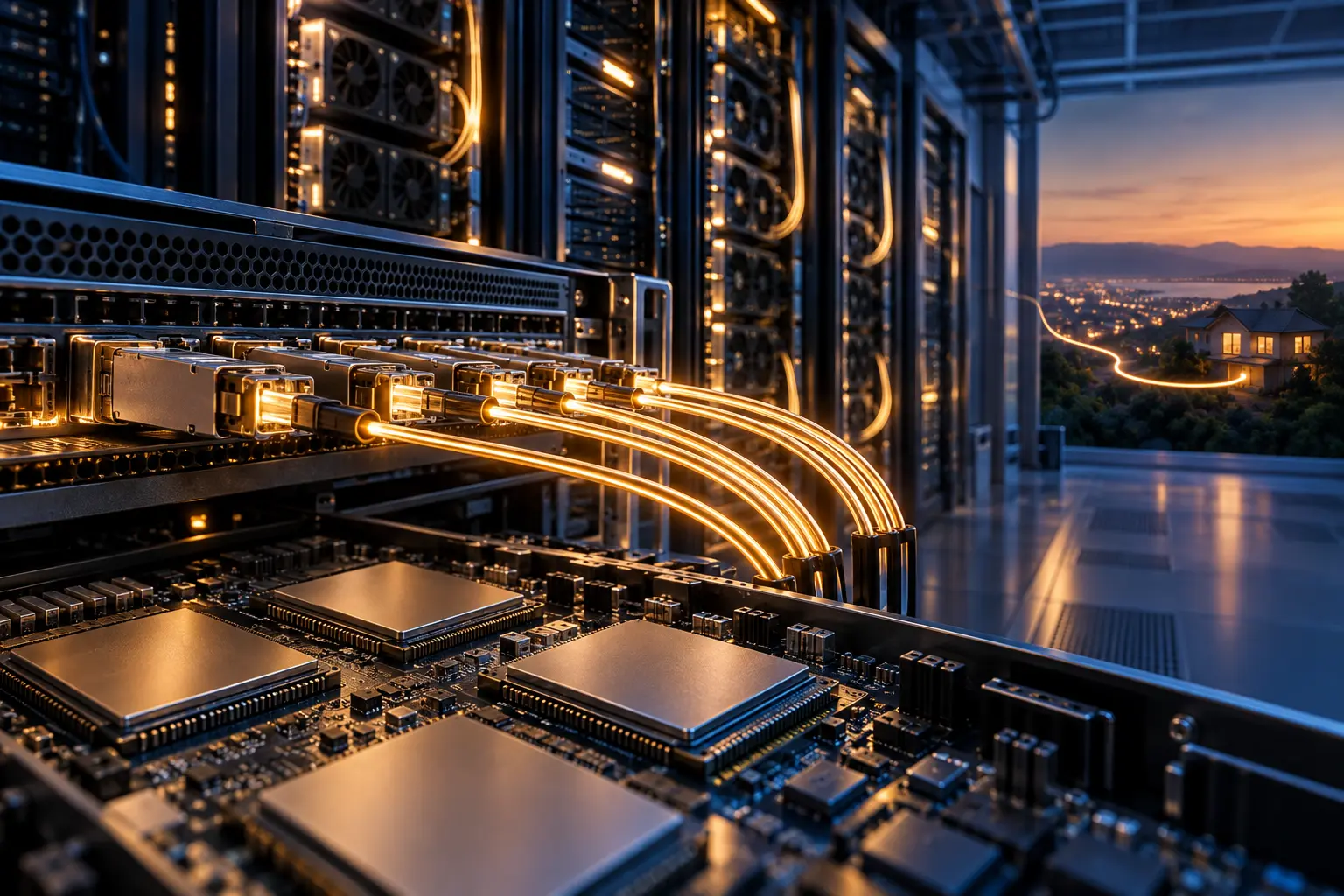
The company says it will build a test environment in one of its AI data centres and install a co-packaged-optics switch using Broadcom’s Tomahawk 6 Ethernet switch chip and Davisson optical engines. The teams will test whether bringing optical engines close to the switch chip can cut the electrical distance data must travel. Their stated scorecard includes power reduction, packet loss, congestion control and effective throughput while workloads simulate distributed AI training and inference.
That list matters because each item can spoil the others. A switch that uses less power but sheds packets under congestion has saved electricity by failing at its job. A high-throughput result achieved only under a light workload is a showroom number. Training and inference place different demands on a network, so naming both makes the test more useful than a single speed claim.
KDDI has published no baseline, target power reduction, test schedule or equipment budget; those records will determine whether the trial becomes a procurement case. For now, the announcement establishes a test design and named hardware, not a measured result.
There is a second track in the same release: the companies will explore next-generation fibre-to-the-home using Broadcom’s optoelectronic-conversion expertise. That is a separate study. CPO puts optics close to the switch silicon inside a data centre; FTTH carries the network toward a household. Combining them in one corporate story is KDDI’s strategic point: AI traffic has to move between compute, access networks and homes, and each boundary consumes power and engineering attention.
The economics hinge on the boundary KDDI controls. If the CPO configuration performs well, KDDI can use its data-centre operations to judge whether the switch is efficient under workloads it actually runs. The release does not say who will own integration, maintenance or upgrade costs, or whether a successful verification will lead to purchasing equipment. The home-fibre track has no deployment plan or timetable in the announcement.
KDDI will exhibit material related to the partnership at its summit on 27–28 October. A working demonstration can show that the pieces connect; the decisive evidence will be comparable power and network-performance measurements under sustained loads, followed by a production decision.
Sources
Member Briefing
Deeper Profile Context
Sign in with the right membership level to unlock the full briefing and source notes.
Only for Strategic Circle
Strategic Circle
Open to all readers. Unlock profile briefings after joining and signing in.
Join Strategic CircleOnly for Leadership Alliance
Leadership Alliance
For qualified IP-asset owners and management; sign in to unlock alliance briefings.
Join Leadership Alliance