Summary
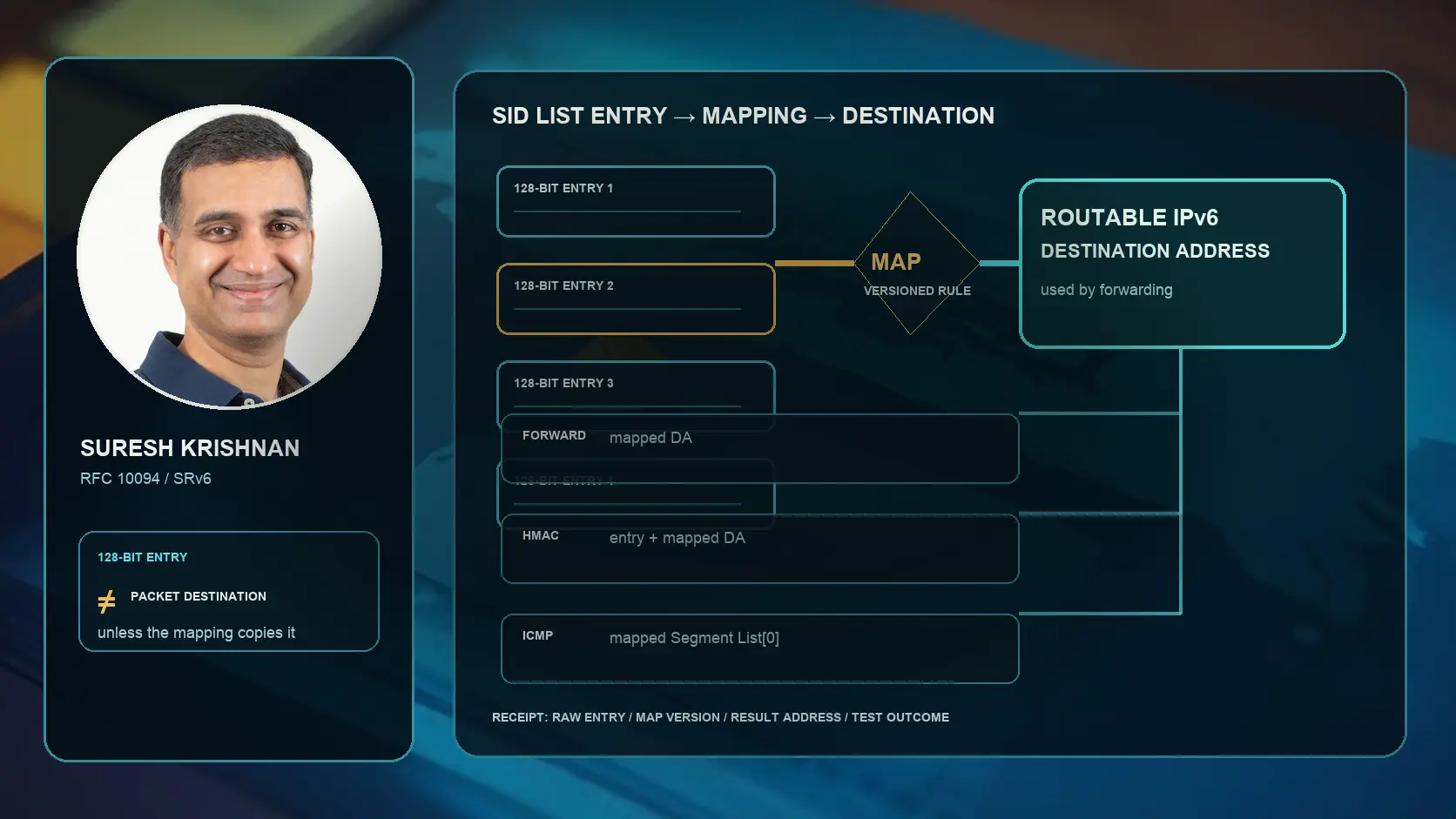
- Jiankang Yao, Hongtao Li, Man Zhang, Daniel Keathley and James Gould published RFC 10087 in November 2026. It maps EPP sessions to client-initiated bidirectional QUIC streams using the
EoQALPN. - One QUIC connection can support many independent EPP sessions. Each stream carries one EPP command and response at a time, preserves order inside that session, and becomes an EPP session only after a successful login.
- Multiplexing saves connection overhead while creating new limits to watch: streams per connection, one-message framing, oversized length fields, per-session idle policy, transport fallback and 0-RTT restricted to read-only queries.
The socket is a road, the stream is the session
EPP sits between domain registries and registrars. Many registrars keep hundreds or thousands of provisioning sessions open, and the original TCP transport gives each session a dedicated connection. RFC 10087 asks what changes when QUIC carries all those sessions over one encrypted connection while preserving ordered EPP transactions inside each one.
The answer begins with a hierarchy. QUIC establishes the connection. The client creates a bidirectional stream. A 24-octet EoQ Connection Start Packet creates the EPP connection on that stream. The server returns the EPP greeting. Only a successful EPP login turns that stream into an authenticated session.
Five states now share one network socket: transport connected, stream started, greeting received, login accepted and command completed. A TCP-era dashboard may collapse them into “port open.” A QUIC-era dashboard that collapses them into “socket connected” is no more accurate.
The RFC keeps EPP's state machine from RFC 5730. Login, query, transform and logout semantics remain EPP. The transport is new, and RFC 5734's TCP mapping remains the fallback or peer service. The protocol underneath changed the multiplexing unit, not the business object that a successful transform can alter.
Many sessions, one exhaustion surface
A single QUIC connection may allow many streams. Each stream maps to one EoQ session, and the server can accept them concurrently. This is the design's economy: one handshake and one persistent transport can support work that previously required many TCP connections.
It also concentrates capacity. The server should enforce a maximum number of streams per connection based on load. Without that limit, one client can fill the server with sessions even while the QUIC connection looks healthy. RFC 10087 connects this directly to resource exhaustion in RFC 9000.
The ordering rule needs equal care. QUIC orders bytes within a stream. The RFC does not turn that into one global order across all sessions. Commands on a stream are independently processed in the order sent, and pipelining is permitted. Session A can pause at a query while Session B commits a fast transform. No shared queue across registrar accounts should be inferred from the shared socket.
Each EPP data unit carries one message and begins with a 32-bit total length in network byte order. Batch bundling is forbidden. The field can encode nearly four gigabytes, so the receiver must compare the declared length with a local maximum before allocation. A QUIC multiplexer that validates the connection but allocates memory from an untrusted frame length has moved the denial-of-service target without removing it.
The greeting is not the login, and the login is not the transaction
The EoQ start packet is a fixed 24-octet signal. If it is malformed, the server closes the stream. A valid start packet produces the greeting on the same stream. The client then sends login. Authentication inherits the EPP-over-TLS practices of RFC 5734 while running through the QUIC TLS handshake.
Only after successful login does an EoQ connection become an EoQ session. That word matters when operators reconcile counts. A server can have one QUIC connection, ten open streams, eight greetings, six authenticated sessions and four idle sessions. Every number can be correct.
Logout ends the session. Closing the stream also ends it. Servers may set idle and lifetime limits; the client and server must not use QUIC's non-zero max_idle_timeout to replace the EPP limits. A stream can disappear for a transport reason, an EPP logout or a server policy decision.
If a stream closes after the server processes a command but before the response reaches the client, the server may try to undo the effect. EPP commands are idempotent, so repeating a command produces the same net repository effect. A production log still needs the original command, the response state and the observed object state; idempotence explains retry safety, not which response window failed.
0-RTT is for questions, not changes
QUIC session resumption can let a client send before a full round trip. RFC 10087 makes the permission narrow. Only read-only EPP query commands may use 0-RTT STREAM frames. Session-management and transform commands are prohibited.
Clients should use resumption tickets once, and servers should apply anti-replay controls from RFC 9846. The performance gain belongs to the replay-safe part of EPP. A domain creation, renewal, transfer or contact change gets no shortcut from an earlier authenticated handshake.
This is the point where an implementation can look modern and behave recklessly. A generic QUIC client may expose early data without knowing whether the framed XML is a query or a transform. The EPP layer must classify the command before the transport decides what to send in zero round trips.
Discovery happens outside the protocol
RFC 10087 defines no in-band announcement that a server supports EoQ. Operators distribute that through provisioning, service metadata or SDK configuration. There is also no in-band negotiation that aligns stream caps, idle time and command-processing timeouts. Client limits should be lower than server limits so closure is graceful.
Fallback follows local policy. If EoQ fails, the client may open EPP over TCP. That creates a cross-transport incident record: an EoQ connection that never started, a fallback that succeeded and a transform that eventually ran are different outcomes.
The RFC updates the existing UDP/700 assignment to mean EPP over QUIC and registers the EoQ ALPN bytes. It reports no live registrar deployment, capacity benchmark, fallback rate or interoperability result. Market claims belong to implementation tests.
A session-level receipt
The minimum operational record contains QUIC connection ID or stable observation key, negotiated EoQ ALPN, stream identifier, start-packet result, greeting, login state, command sequence, EPP result code, repository object state, response delivery and stream closure reason. It should include the configured stream and timeout limits, fallback decision, 0-RTT classification and anti-replay outcome.
At the connection level, record capacity and lifecycle. At the session level, record authentication and EPP state. At the command level, record the repository transaction. The three records can share identifiers, but they cannot share one boolean.
Yao and his co-authors replaced a connection per EPP session with a stream per session. The operator now needs to replace a socket-per-session inventory with a stream-aware one. Otherwise the network transport gets more efficient while the incident review gets less truthful.
Sources: RFC 10087; RFC 5730; RFC 5734; RFC 9000; RFC 9846; IANA port registry.
Member Briefing
Read the full trend briefing
Members read the full briefing with the source notes behind every finding.
Strategic Circle
A daily briefing in your language, built from changes we have verified.
Join for USD 20/monthCancel anytime.
Members also get the full research library, a daily briefing on the networks they follow and the private forum.