
Summary
- IPS set the public-offer price at ¥3,346 on 14 October, with settlement scheduled for 20 October; the company’s combined net-proceeds estimate, including a possible later allotment, is capped at ¥4.581bn.
- The roughly ¥23bn figure is a preliminary total project estimate, not IPS’s own funding obligation. A subsidy recipient selection is not a final grant decision, and the public notices do not disclose partner contributions or an anchor customer.
A price is not a project close
IPS set the public-offer price at ¥3,346 a share on 14 October. The 1,263,500-share offer was priced at ¥4.228bn in aggregate; the underwriting payment to the issuer was ¥4.010bn. The scheduled subscription window ran from 15 to 16 October. As of 18 October, the issuer’s cash settlement was still scheduled for 20 October and delivery for 21 October. A separate third-party allotment of up to 189,500 shares is scheduled for a November application and payment. Its maximum value at the stated payment price is ¥601.4m. IPS estimates combined net proceeds from the public offer and that possible allotment at no more than ¥4.581bn.
That is a financing plan, not cash already received or proof that every share will be issued.
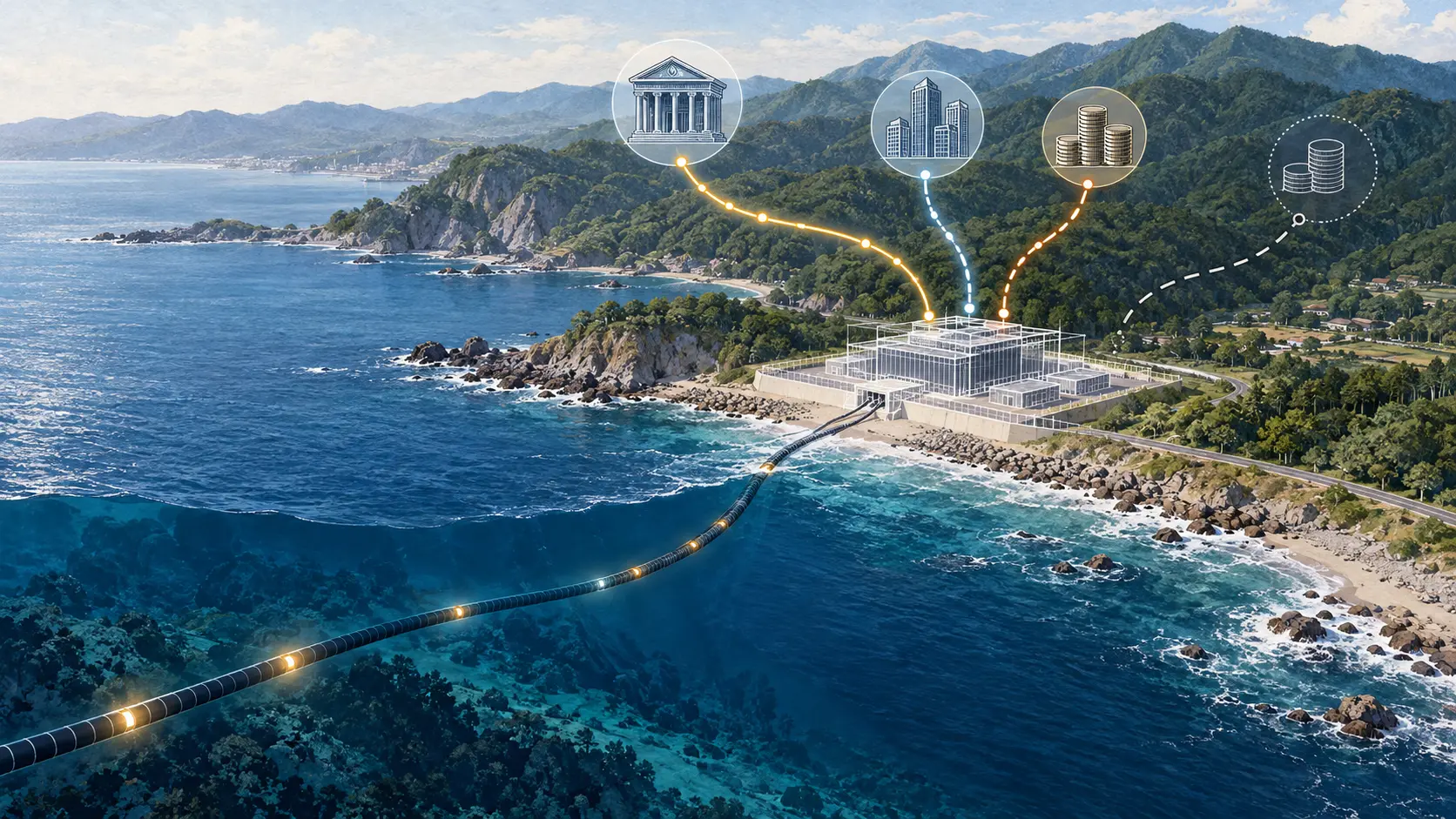
The destination is the Wakayama project: an international submarine-cable branch and a landing station. IPS and subsidiary IPS Pro were selected on 9 October in a CIAJ-run indirect-subsidy programme. The selection does not itself set a grant amount. IPS said it would apply for the grant after selection and await a formal decision. CIAJ’s list names four selected recipients and locations, including IPS offshore Wakayama and IPS Pro in the city, but gives no individual award amount.
The denominator is still moving
IPS’s notices put the project’s current total investment estimate at roughly ¥23bn and say it remains under review. The company explicitly says this is the whole project’s scale, not its own final contribution. It is still discussing partners, public schemes and customer arrangements. The company has not published the amount of a final grant, partner capital, a final IPS funding share or a complete financing waterfall. Comparing the ¥4.581bn upper limit with ¥23bn gives a rough ratio of one fifth; it does not identify a ¥18.4bn funding gap. Subsidy eligibility, partner capital, scope and timing could all change the amount IPS must fund.
The company describes a neutral, open-access landing station to be operated by IPS Pro. It expects capacity sales, backhaul and related network services to create revenue. These are plans, not operating evidence: the notices do not establish that the facility is built, that capacity is lit, or that a customer has signed a binding volume commitment. IPS also says route, landing-point, equipment and construction-schedule discussions remain under way. For investors and prospective users, the value case therefore depends on what the station can connect, on what terms, and when customers can use it—not on the project estimate alone.
The near-term market test is the conversion of priced equity into settled funds and a disclosed financing structure. The next tests are a formal grant decision, partner commitments, an executable route and construction plan, and customer contracts tied to usable capacity. Until those arrive, the issue price is the clearest financing fact; the allocation of project risk remains open.
Sources and filings
Member Briefing
Deeper Profile Context
Sign in with the right membership level to unlock the full briefing and source notes.
Only for Strategic Circle
Strategic Circle
Open to all readers. Unlock profile briefings after joining and signing in.
Join Strategic CircleOnly for Leadership Alliance
Leadership Alliance
For qualified IP-asset owners and management; sign in to unlock alliance briefings.
Join Leadership Alliance