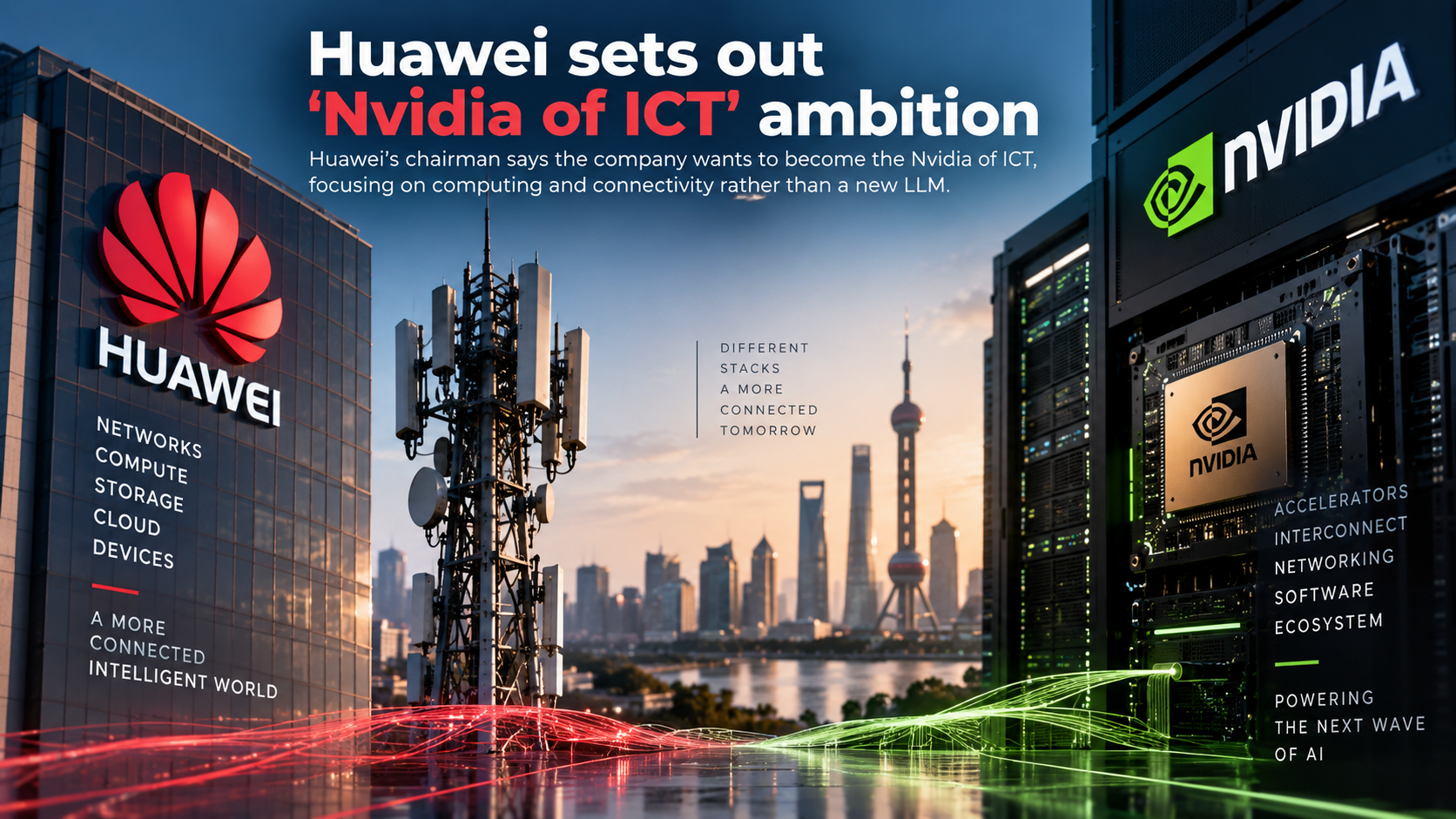
- Huawei chairman Guo Ping says the company wants to become the "Nvidia of ICT"
- The ambition centres on computing and connectivity rather than building another general-purpose large language model
The fact
Huawei chairman Guo Ping told new employees that the company's ambition is to become the "Nvidia of ICT" as it strengthens its computing and connectivity businesses. The remarks were published on Huawei's internal bulletin board and reported by Light Reading on 16 September.
Guo said Huawei sees AI as its biggest opportunity but does not plan to expand into unrelated businesses. He argued that Huawei's advantage should come from infrastructure capable of running different AI models, citing products including Ascend and Kunpeng, rather than competing primarily through its own general-purpose large language model. Huawei Cloud, devices and autonomous-driving products may still develop models where their businesses require them.
The statement sets a strategic direction rather than a new product roadmap. Huawei did not give a timetable, revenue target or market-share goal for becoming an Nvidia-like infrastructure platform.
The assessment
The Nvidia comparison is useful because it describes a business model built around several connected layers rather than a single product. Nvidia combines accelerators with networking, interconnects and a software ecosystem. Huawei already operates across telecom equipment, cloud infrastructure, computing hardware and chip design, giving it several layers that can be sold together.
China also gives the comparison an unusual market context. Nvidia told investors that, by the end of its second quarter of fiscal 2027, US export controls and restrictions imposed by Chinese authorities had effectively prevented it from competing broadly in China's data-centre compute market. That does not establish Huawei's technical competitiveness, but it means domestic competition is being shaped by policy as well as product performance.
For BTW readers, the consequence is greater stack concentration if customers adopt several Huawei layers together: integration may become simpler, while replacing one part later can require changes elsewhere in the network or computing environment.
What to watch
Watch whether Huawei turns the comparison into measurable customer deployments combining Ascend or Kunpeng compute with its networking, cloud and management software. Independent performance results and support for third-party interfaces will show how easily buyers can mix Huawei infrastructure with other vendors rather than adopting the stack as one package.
Member Briefing
Deeper Profile Context
Sign in with the right membership level to unlock the full briefing and source notes.
Only for Strategic Circle
Strategic Circle
Open to all readers. Unlock profile briefings after joining and signing in.
Join Strategic CircleOnly for Leadership Alliance
Leadership Alliance
For qualified IP-asset owners and management; sign in to unlock alliance briefings.
Join Leadership Alliance