Summary
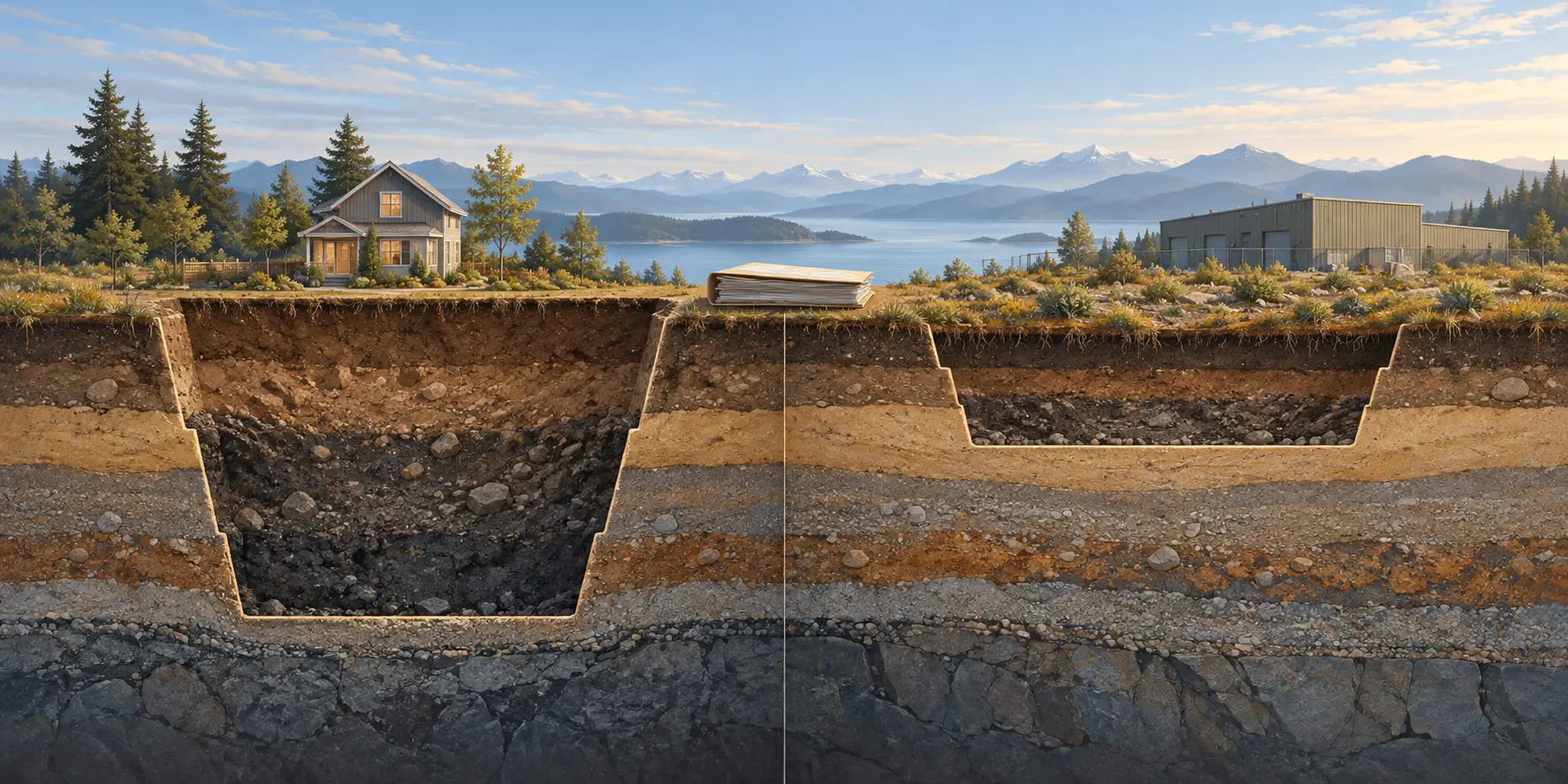
- EPA chose a future-residential assumption for Hanford's 618-10 burial ground; DOE's record of decision expected industrial use. DOE excavated waste and contaminated soil to 36 feet in 2018 and met a standard that allows residential use.
- DOE officials told GAO the cleanup cost $276.5 million from 2006 to 2018. The 2013 feasibility study and final decision did not price other future-use assumptions, so that figure is not the residential premium.
Analysis
A future house is a powerful engineering instruction. Put one into a risk assessment and the ground may need to be cleaned to a standard that permits people to live there. Put an industrial worker, a wildlife refuge or a conservation area into the same decision and the exposure assumptions change. The line in the planning file becomes the depth of the excavation.
At Hanford Site's 7.5-acre 618-10 burial ground, that line shifted. The site received radioactive waste from the 300 Area laboratories and reactor-fuel development facilities between 1954 and 1963. The record of decision expected industrial use. EPA instead selected residential use as the assumed future land use; DOE agreed. In 2018, DOE finished excavating waste and contaminated soil down to 36 feet and met the residential-allowing standard. The result is more protective and supports many uses beyond industry, including a future residential use if one ever becomes realistic.
The awkward part sits in the account of how the remedy was chosen. DOE reported spending $276.5 million from 2006 through 2018 to clean 618-10 to that standard. GAO found that the 2013 feasibility study and final record of decision did not evaluate other cleanup approaches or their costs under different future-use assumptions. The $276.5 million is the reported cost of the selected cleanup. It is not a calculation of what the residential assumption added. DOE officials told GAO that the difference is now difficult to work out because the alternative was never developed and priced.
That missing counterfactual matters more than a tidy “waste versus savings” headline. Residential cleanup can leave a parcel usable for industry and other purposes. EPA officials told GAO that it may also avoid ongoing maintenance and inspection, although they knew of no comparison that set those future savings against cleanup costs. A more restrictive cleanup could therefore buy real protection and flexibility. The public record cannot show what that option cost relative to an industrial remedy, what schedule it would have required, or what long-term obligations the less stringent choice would have left behind.
The decision also sits inside a wider mismatch. DOE's 1999 comprehensive land-use plan followed public outreach and identified conservation, preservation and industrial uses for Hanford areas. The plan informed later choices; GAO says such plans do not bind the assumptions regulators and DOE use when selecting a remedy. Across nearly one-third of Hanford's 586 square miles, cleanup standards allow residential use even though GAO says that future is unlikely. The figure concerns a large site, not every acre or a prediction that homes will be built there.
This is a governance question with a shovel attached. The plans residents discuss can shape expectations without controlling the cleanup assumption that becomes physical work. At 618-10, the final decision carries a clear industrial expectation while the selected cleanup follows the residential scenario. When no second path is costed before excavation, later officials inherit a finished remedy and a blank column where the comparison should be. The useful discipline is plain: put realistic future uses, cleanup scope, cost, schedule, maintenance and restrictions side by side before the decision becomes dirt in a truck.
Sources
- U.S. Government Accountability Office, GAO-27-107791, Nuclear Waste: Addressing Legal and Regulatory Barriers Could Accelerate Cleanup and Reduce Costs; report page.
- U.S. Government Accountability Office, GAO-27-108063, Nuclear Waste: Future Land Use Planning at Selected DOE Cleanup Sites.
- Hanford Site, 618-10 Burial Grounds; 618-10 Burial Ground Project Fact Sheet, August 2021.
Member Briefing
Deeper Profile Context
Sign in with the right membership level to unlock the full briefing and source notes.
Only for Strategic Circle
Strategic Circle
Open to all readers. Unlock profile briefings after joining and signing in.
Join Strategic CircleOnly for Leadership Alliance
Leadership Alliance
For qualified IP-asset owners and management; sign in to unlock alliance briefings.
Join Leadership Alliance