
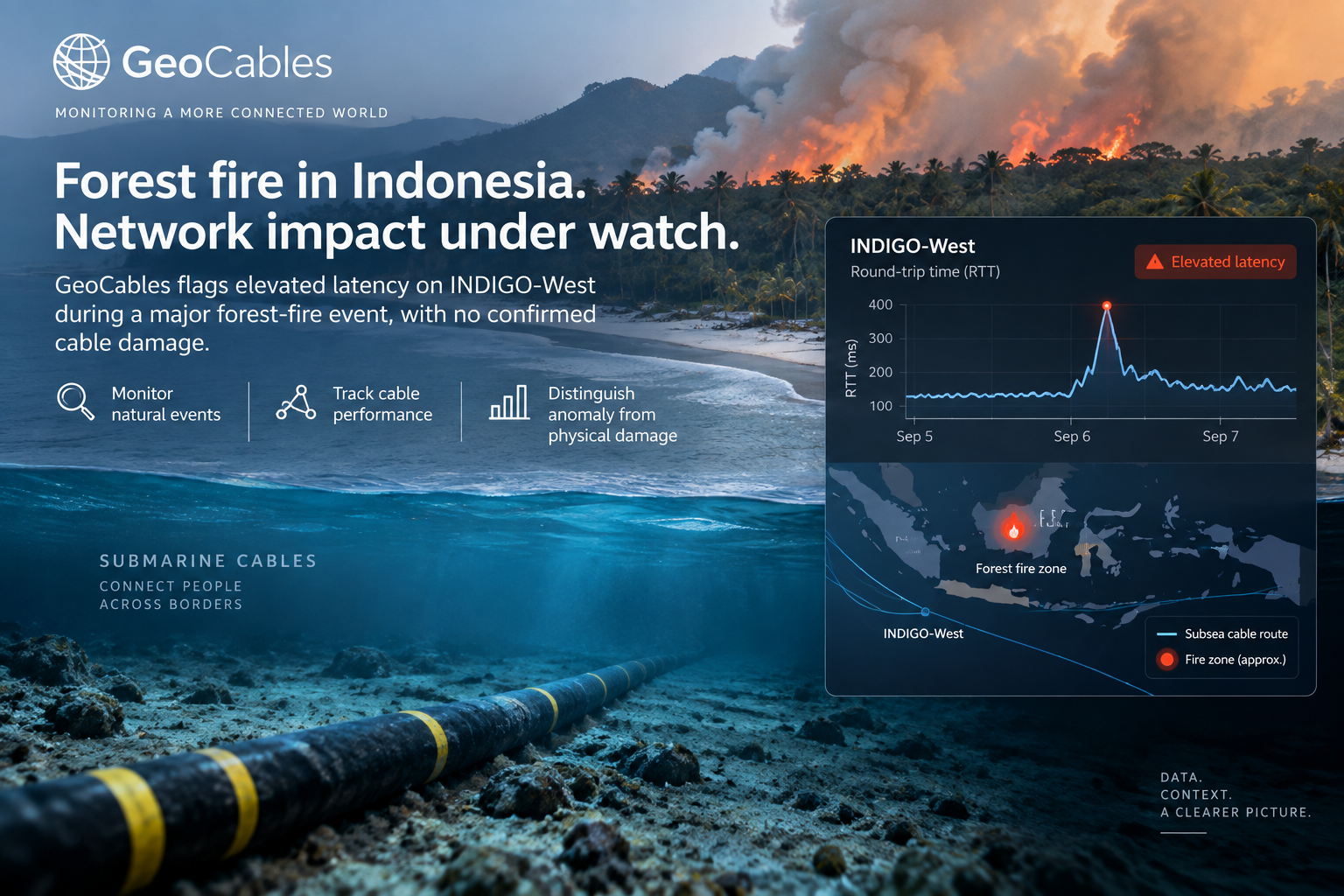
- GeoCables recorded a sharp increase in round-trip time on INDIGO-West while monitoring an Indonesian forest fire near international cable routes
- The measurements showed a network anomaly, but did not establish physical damage to the subsea cable or a need for marine repair
The fact
GeoCables published a monitoring alert on 6 September after a major forest fire in Indonesia was reported near the geography of several international cable systems. Its measurements showed higher round-trip time, or RTT, on INDIGO-West during the observation period. GeoCables also continued monitoring other cable systems in the area.
Higher latency does not by itself show that a submarine cable has been damaged. A change in routing, congestion, landing-station systems or terrestrial connections can also increase the time traffic takes to travel between two points. The available evidence therefore shows an INDIGO-West latency anomaly during the event. GeoCables did not report a confirmed break in the subsea cable or evidence that a marine repair was required.
The assessment
A latency spike is enough to prompt an investigation, but not enough to diagnose a cable fault. If traffic suddenly takes longer to make a round trip, engineers still need to work out where that delay entered the path. That is important here because the fire and the network anomaly occurred in the same broad area, but proximity does not establish cause. The problem could be related to routing, congestion, a landing station or a terrestrial connection while the undersea fibre remains intact.
GeoCables' measurement gives operators something specific to check without turning the environmental event into an unsupported cable-damage claim. For BTW readers, the next step is to compare the latency data with operator notices and other network measurements. If the delay persists or wider connectivity problems appear, there is more reason to investigate the cable path. If it returns to normal without repair activity, a physical break becomes less likely.
What to watch
Watch whether INDIGO-West latency returns to normal, whether operators issue any fault or maintenance notice and whether landing-station or terrestrial networks report disruption. A sustained anomaly across multiple measurements would justify closer investigation, while a return to baseline without repair activity would make a physical cable break less likely.
Member Briefing
Deeper Profile Context
Sign in with the right membership level to unlock the full briefing and source notes.
Only for Strategic Circle
Strategic Circle
Open to all readers. Unlock profile briefings after joining and signing in.
Join Strategic CircleOnly for Leadership Alliance
Leadership Alliance
For qualified IP-asset owners and management; sign in to unlock alliance briefings.
Join Leadership Alliance