Summary
- A proxy built to hold work for the genx.net effort became a coordinator when that effort ended in March 1997.
- Buffers, work records and contribution statistics supported the volunteer search; the winning desktop was one piece of a larger operating job.
The volunteers had computers. The computers had work to do. Then the server responsible for keeping the operation together disappeared. A collection of willing processors had acquired an awkward resemblance to an office whose receptionist had taken the filing cabinet home.
The task was an authorised RSA Labs challenge: find the secret key by testing candidates. The RC5 project account describes servers handing out blocks of work to participating programs. The useful contribution was a completed portion of the search, something the rest of the effort could recognise and build upon.
A temporary fix gets promoted
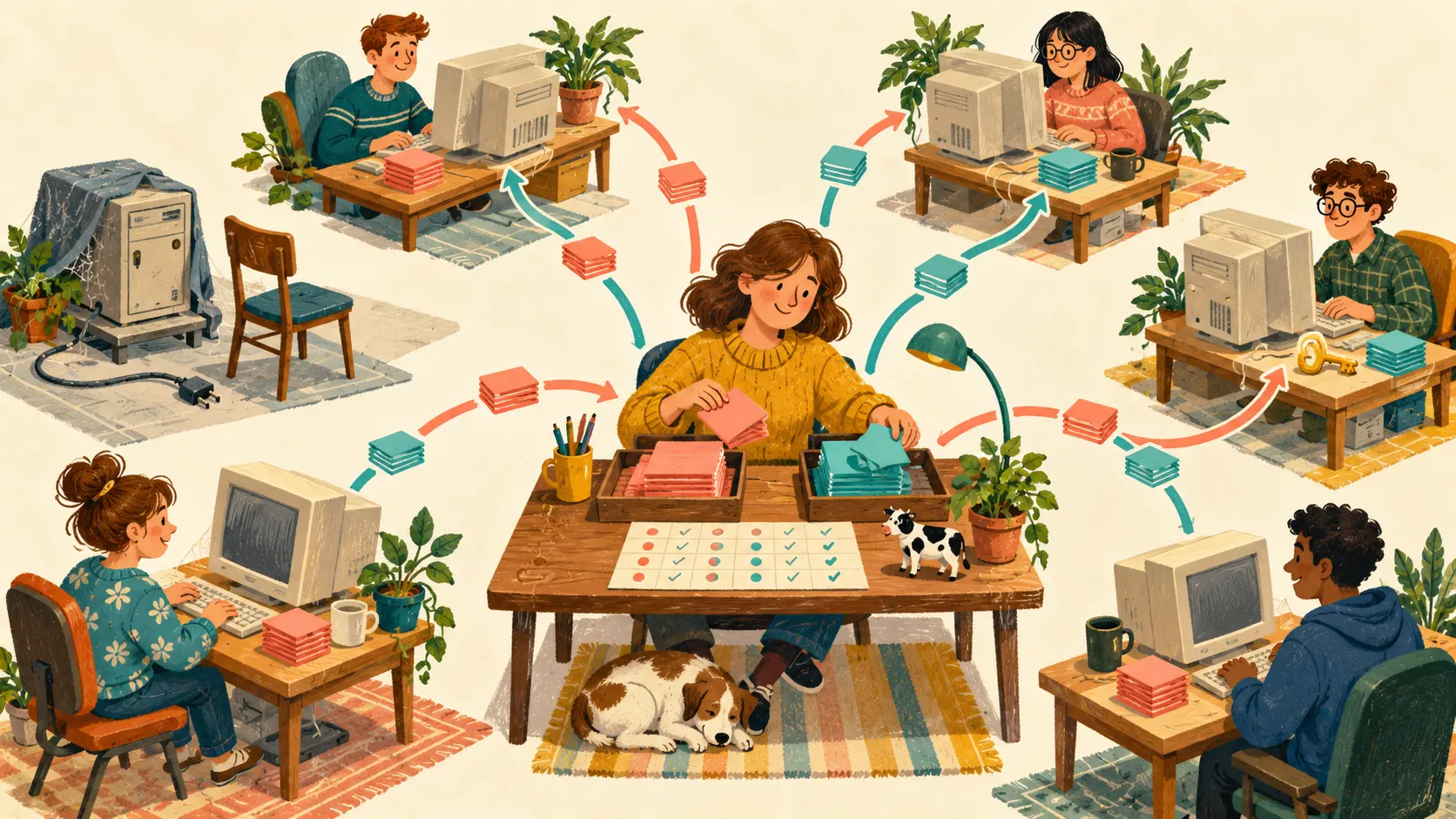
Jeff Lawson had built a proxy to buffer work while the earlier genx.net server was unavailable. The original intention, according to the project’s account of its beginnings, was to keep completed work until the upstream service returned. The temporary helper ended up getting the permanent job.
The project timeline dates the keyserver’s disappearance to 18 March 1997. On 24 March, organisers received confirmation that the earlier effort would stop. The replacement proxy network became public, and Lawson’s proxy began assigning work systematically and tracking checked keys. That was the decisive promotion: a waiting room became the office that decided what happened next.
A dispersed computer needs this sort of bookkeeping. Someone must know which work has been handed out and which results have come back. Without that shared memory, an impressive pile of processors can spend its time being impressively repetitive. The handover gave the volunteers’ effort a place to accumulate.
Let the desktop keep going
The same history lists a July client release with room to buffer up to 50 work blocks, the ability to suspend midway through a block on termination signals, and automatic searching for another proxy when one failed. These were practical concessions to machines that had ordinary lives between their contributions to a grand experiment.
Counting the work grew into a job too. Separate operators had their own statistics in April; project-wide statistics appeared in May. By September, the history records the keymaster needing more bandwidth than a 128K ISDN connection could supply. Processing could be spread across many desks while coordination still put pressure on a particular connection.
One desktop gets the applause
The official announcement of 22 October 1997 reported that the key had been found on 19 October and confirmed by RSA Labs. Peter Stuer’s Pentium Pro 200, running Windows NT Workstation, had found it for the STARLab Bovine Team in Brussels.
Team coordinator Jo Hermans supplied a wonderfully human footnote: he wished a Macintosh had won, since Macs supplied the largest share of his team’s computing power, and saw excellent beer-buying potential in the prize. The announcement allocated $1,000 for the winners’ celebration, $8,000 to Project Gutenberg and $1,000 to distributed.net. Electronic books received the largest slice of a cryptographic victory.
The winning computer is easy to remember. The March handover explains how it got a useful turn. Somebody had kept the assignments, results and next batch moving. The internet’s spare processors could do the arithmetic; the work list made them a team.
Member Briefing
Deeper Profile Context
Sign in with the right membership level to unlock the full briefing and source notes.
Only for Strategic Circle
Strategic Circle
Open to all readers. Unlock profile briefings after joining and signing in.
Join Strategic CircleOnly for Leadership Alliance
Leadership Alliance
For qualified IP-asset owners and management; sign in to unlock alliance briefings.
Join Leadership Alliance