
Summary
- Chennai 01 is still a development project. CapitaLand’s 15 October unveiling set out a target, not an operating handover or a signed Chennai lease.
- CLINT’s 53% pre-leasing figure covered three data-centre projects and was announced with a Navi Mumbai Tower 2 agreement; it cannot be used as Chennai’s lease coverage.
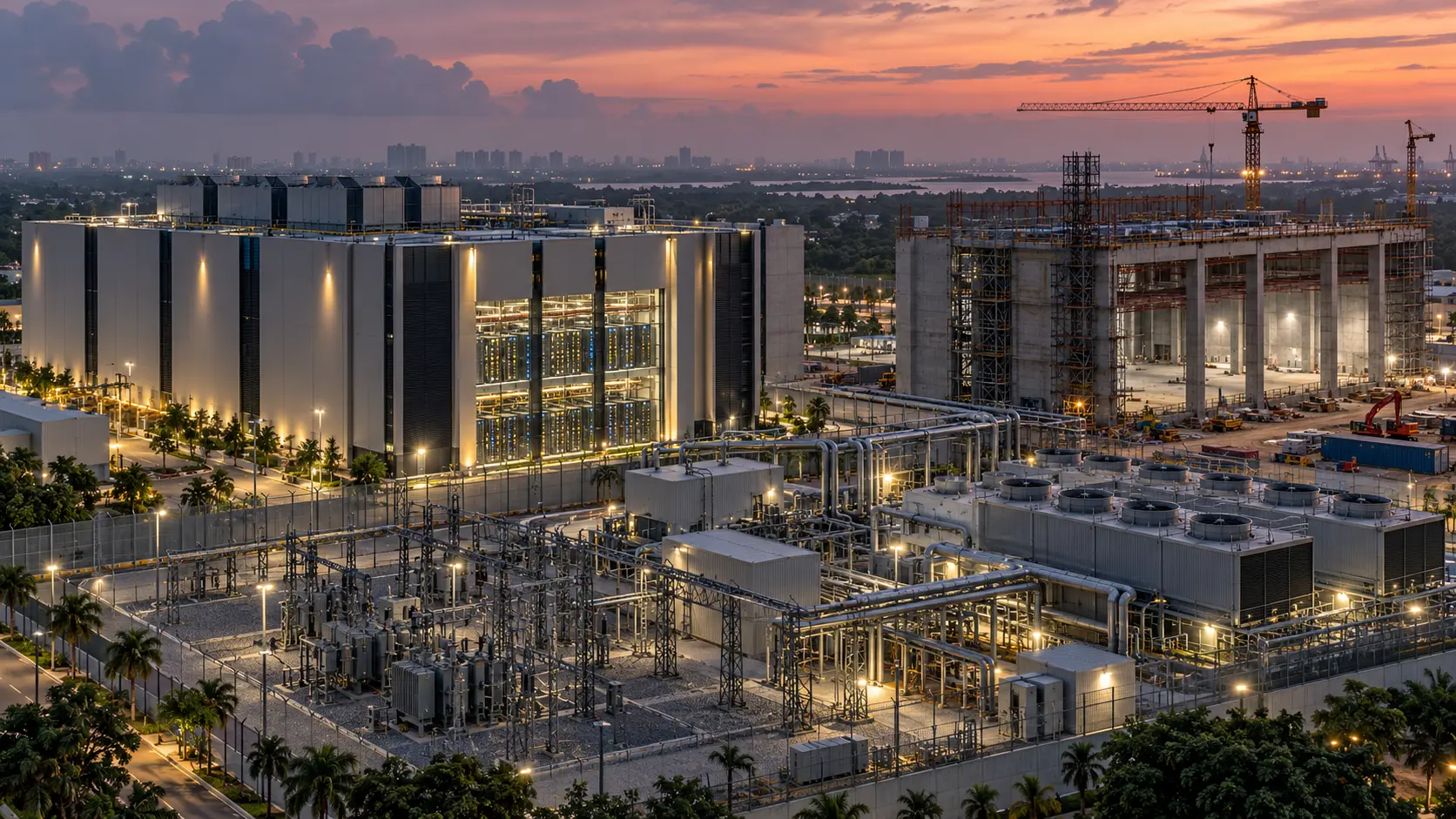
The ceremony in Ambattur had the scale of a strategic announcement: a Singapore deputy prime minister and Tamil Nadu’s chief minister unveiled CapitaLand Data Centre Chennai 01, the first data-centre development in the state on CapitaLand India Trust’s listed-fund platform. The commercial record is more conditional. The facility remains under development, with completion targeted by the end of 2026. CapitaLand Investment puts the planned investment at about INR 1,940 crore and the design at 53 MW of gross power, 34 MW of IT load, 13 data halls and a dedicated 110 kV substation.
Those figures describe an asset being built; they do not yet describe rent.
The distinction between gross power and IT load is central to reading the project. The two numbers measure different parts of the facility, not a 19 MW efficiency loss. Gross capacity describes the wider power envelope. IT load is the capacity available to customer equipment and is closer to the unit around which a tenant’s demand is assessed. A project can therefore carry a large gross-power headline while still needing to prove how much customer-facing load will be leased and when it can be delivered.
CapitaLand says Chennai 01 is designed for high-density and liquid-cooled deployments, with carrier-neutral connectivity. These features widen the types of workload the facility could serve, but they remain design claims. A customer still needs to choose the site, agree to capacity and commercial terms, and take service once the relevant halls and power systems are ready. The public materials reviewed here do not disclose a Chennai tenant, committed IT megawatts, lease duration, rent or customer contribution to fit-out.
The financing story is also broader than Chennai alone. In December 2025, CLINT agreed to sell 20.2% stakes in three data-centre investments—the Navi Mumbai facility (Towers 1 and 2), Chennai, and Hyderabad—to CapitaLand India Data Centre Fund. The estimated aggregate consideration was INR 7.02 billion, based on an enterprise value of INR 51.97 billion for the three-investment portfolio. That value exceeded the stated independent valuation of INR 45.70 billion, but the price remained subject to adjustments for liabilities, working capital, capital expenditure and post-completion items.
CLINT confirmed the divestment completed in February 2026.
The transaction shows a route for recycling development capital while retaining exposure: CLINT remains invested, with the earlier transaction announcement describing a 79.8% interest in the data-centre portfolio. But the INR 7.02 billion is not Chennai’s sale proceeds. It covers all three projects, and no project-level allocation was published. Nor does the portfolio valuation disclose what the Chennai facility alone is worth. Using the bundle price as a shortcut for Chennai’s capital recovery would make the evidence say more than it does.
The same caution applies to leasing. In January 2026, CLINT said 53% of gross power capacity across its three data-centre developments was pre-leased after announcing a second long-term hyperscaler agreement, for Navi Mumbai Tower 2. The 53% was a portfolio statistic, not a Chennai statistic. Using the capacities disclosed around that announcement—50 MW and 55 MW for the two Navi Mumbai towers, 53 MW for Chennai and 42 MW for Hyderabad—the portfolio totals 200 MW. The two Mumbai towers’ 105 MW equal 52.5% of that total.
The arithmetic nearly reproduces the headline, which is a useful warning against treating the aggregate as evidence of Chennai demand. It is a cross-check, not a lease-by-lease schedule; the issuer did not publish the individual breakdown.
CLINT’s next project-specific disclosure was clearer. In its July first-half update, it described active leasing discussions and site visits with prospective customers for both Chennai and Hyderabad. That is a real commercial pipeline, but it is not an executed agreement. The same release reported that the trust completed the 20.2% divestment and said the remaining data centres were on track for end-2026 completion. Its reported 91% portfolio occupancy explicitly excluded data centres and logistics, so it cannot be used to imply that Chennai is already filling.
There is also a small but relevant recordkeeping question. CapitaLand’s 15 October release states 53 MW gross and 34 MW IT for Chennai 01; its current property page lists 54 MW and still labels the facility “Under Development.” An older transaction disclosure uses 53 MW gross. A one-megawatt difference may be rounding or a specification change, but the public record does not reconcile it. The latest dated announcement is the appropriate reference for the launch, while an investor assessing contracted capacity should wait for a dated, consistent asset schedule.
Chennai 01 therefore arrives with two kinds of progress: capital has been shared with a private fund, and prospective leasing conversations are under way. Neither substitutes for the other. The sale reduces CLINT’s ownership share but can free capital for its wider pipeline; it does not turn a development into an income-producing asset. The 53 MW headline signals scale; it does not tell investors how much of the 34 MW IT load has a paying customer.
The next evidence that matters is project-specific: an executed lease with committed IT load and delivery conditions, followed by commissioning and the start of recognized income. Until then, Chennai 01 is best read as a financed development with a plausible demand funnel—not as a 53 MW operating business or as proof that capital recycling has already produced recurring returns.
Sources: CapitaLand Investment’s 15 October unveiling; CLINT’s 1H 2026 results; the 20.2% stake-sale terms; the January leasing announcement; CapitaLand’s live Chennai property page.
Member Briefing
Deeper Profile Context
Sign in with the right membership level to unlock the full briefing and source notes.
Only for Strategic Circle
Strategic Circle
Open to all readers. Unlock profile briefings after joining and signing in.
Join Strategic CircleOnly for Leadership Alliance
Leadership Alliance
For qualified IP-asset owners and management; sign in to unlock alliance briefings.
Join Leadership Alliance