
Summary
- RFC 1770's Selective Directed Broadcast Mode combined a network-directed broadcast destination with an IPv4 option listing up to nine intended hosts.
- It avoided separate group-control traffic by moving selection into every UDP datagram, but relied on last-hop behavior and directed broadcasts that later standards disabled by default.
RFC 1770 appeared in March 1995 as an Informational memo, not an Internet standard. Its target was a peculiar one-to-many problem: sparse groups on severely bandwidth-constrained tactical military networks, where maintaining a conventional group through extra control traffic could consume resources the network did not have. SDBM offered unreliable UDP delivery; if an application needed reliability, acknowledgements belonged above IP.
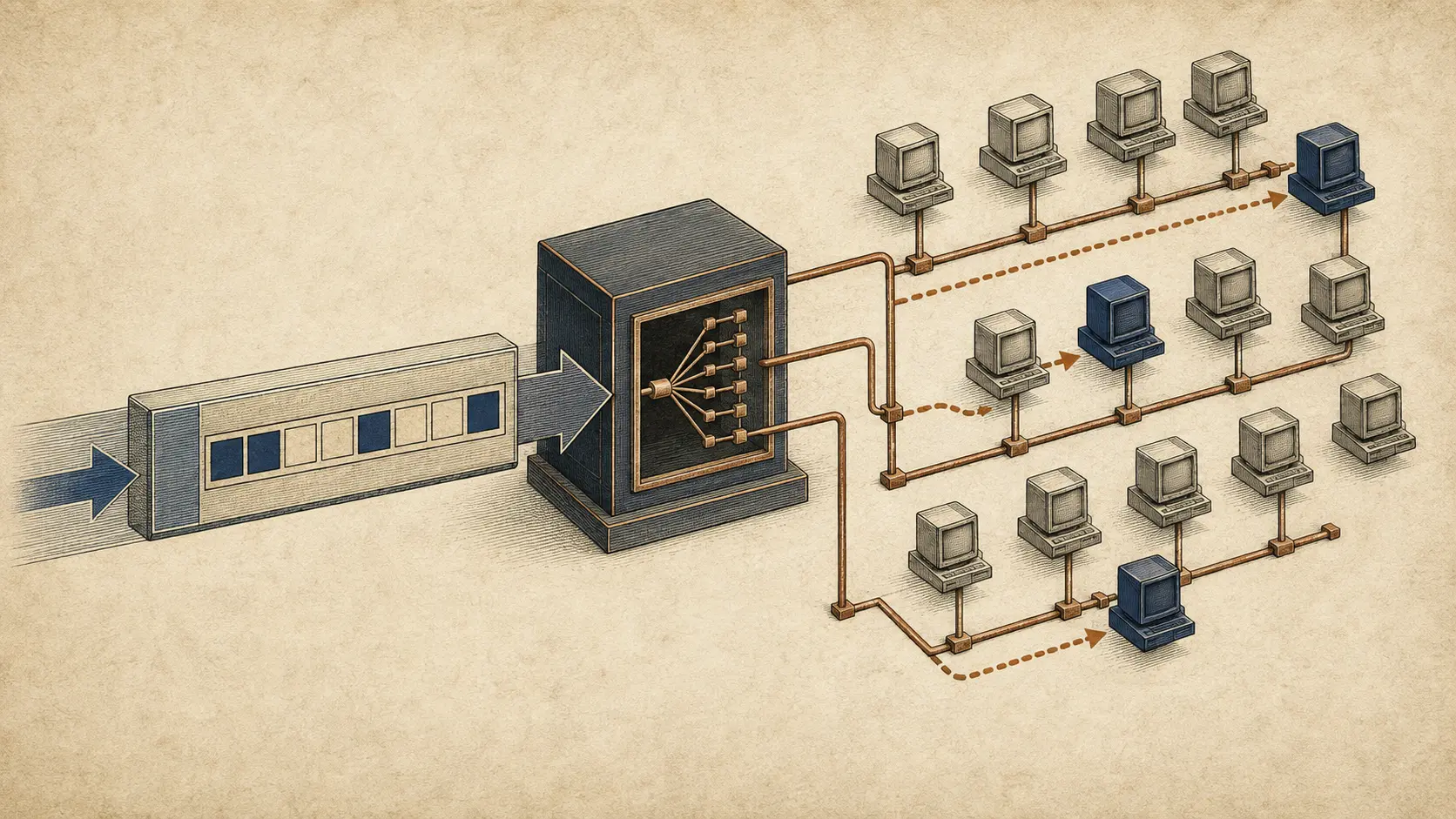
The sender first grouped recipients by network identifier. For each network it built at least one datagram whose ordinary IPv4 destination was that network's directed-broadcast address. The option then named the actual recipients with complete four-octet IP addresses. If one network held more than nine recipients, the sender had to issue multiple datagrams.
Nine was not a policy choice. IPv4's header-length field left no more than 40 octets for options. SDBM spent two on Type and Length, then four per address: Length = 2 + 4 × addresses. Its Type set the copy bit to one, class to zero and option number to 21, producing decimal value 149. Because the address list defined delivery, it had to be copied into every fragment.
Transit routers did nothing special beyond normal IPv4 processing. The decision arrived at the router directly attached to the destination network. On a broadcast-capable link, that router could broadcast once and let every host inspect the option. On a link without broadcast, it could form one local packet for each listed host. A network with reliable layer-two multi-address delivery could instead build one multi-address frame.
The receiving rule completed the mechanism: a host continued processing only if its own address appeared in the option. The outer address invited the subnet; the inner list decided who was admitted. That construction also fixed the transport boundary. RFC 1770 allowed UDP because the destination was a broadcast address, but excluded TCP and its point-to-point connection model.
SDBM removed a standing membership conversation, not state or cost. The guest list was repeated in data packets, the sender had to partition it by network and size, the destination router had to translate it into local-media behavior, and hosts might still receive a link broadcast merely to reject it. Those are inferences from the specified procedures; RFC 1770 did not quantify the trade. It also stated that security issues were not discussed.
The surrounding Internet changed the premise. RFC 2644 made receipt and forwarding of network-directed broadcasts disabled by default in 1999, citing their use as Smurf amplifiers while retaining ingress filtering as an important defence. That does not prove this change alone ended SDBM. The firmer endpoint comes from RFC 6814: in 2012 it said the option had never been widely deployed, called the approach abandoned, formally deprecated value 149 and moved RFC 1770 to Historic.
SDBM remains a compact lesson in control placement. A protocol can eliminate one kind of coordination by writing the decision into each packet, but the decision still has to be trusted, transported and executed somewhere.
Sources
Member Briefing
Deeper Profile Context
Sign in with the right membership level to unlock the full briefing and source notes.
Only for Strategic Circle
Strategic Circle
Open to all readers. Unlock profile briefings after joining and signing in.
Join Strategic CircleOnly for Leadership Alliance
Leadership Alliance
For qualified IP-asset owners and management; sign in to unlock alliance briefings.
Join Leadership Alliance