
Summary
- BolNET began as a university-centred data-network effort, with a project origin often dated to 1989 and a written ENTEL–UMSA understanding dated 15 August 1990. Those dates describe different stages, not a contradiction that can be resolved by pretending they are the same event.
- The 1996 decree recognized BolNET as a technically, administratively and financially autonomous CONACYT special project and authorized it to provide domestic and international value-added data transmission under its cooperation agreement with ENTEL.
- A retrospective history says the network’s links reached every university in the Bolivian Academic University Network by 1999. The same account says it lacks precise information about who could access those connections.
Analysis
A project date is not a service date
The United Nations Development Programme now describes 1989 as the year its technical cooperation with the Universidad Mayor de San Andrés (UMSA) implemented BOLNet and established Bolivia’s first Internet connection. A later account in Bolivia digital similarly places the first connection and project in 1989, led from UMSA’s electronics engineering course in La Paz. That is useful institutional memory, but it compresses a longer transition into one date.
The legal record begins its account one year later. Supreme Decree 24385 says ENTEL’s training institute and UMSA’s electronics engineering course signed an understanding on 15 August 1990 to develop a noncommercial data communications network, with UNDP assistance. The distinction matters: a project could be under way before the specific written agreement cited in the decree. Neither source alone is a log of continuous public Internet service.
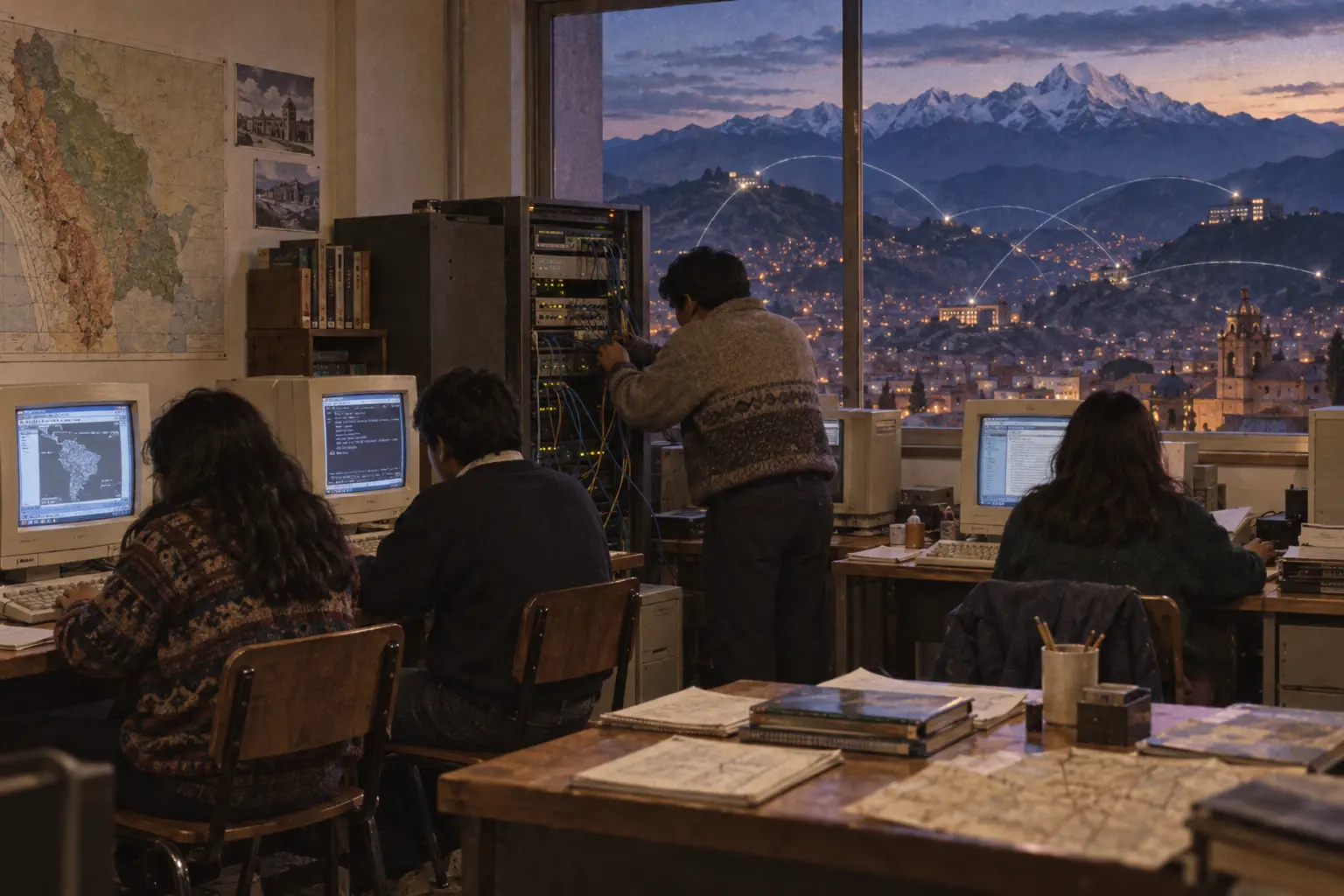
The network also had intermediate forms. Bolivia digital describes email use during the early years and a 200-computer network by 1993, with ENTEL supplying a telephone line for data transport and UMSA taking responsibility for BolNET’s physical and logical network. These are different layers: a campus network, a transport circuit and access to services beyond Bolivia were connected problems, but not the same thing.
A contemporaneous July 1995 report in the Network Startup Resource Center’s provider archive gives a useful check on the phrase “full Internet.” It records a traceroute reaching utama.bolnet.bo and says not all hosts worked yet. This is evidence of routable connectivity and of unfinished operation on that date—not a national uptime measure, a user count or proof that every institution had usable service. The ITU’s 2001 Bolivia case study places the commercial service and the December 1995 satellite link within the subsequent expansion, further separating early academic connection from general availability.
The 1996 settlement joined roles instead of replacing one network with another
BolNET did not simply hand the Internet to ENTEL in a clean transfer. A cooperation agreement between CONACYT and ENTEL, signed on 29 February 1996, set up joint Internet services. Decree 24385, issued on 15 October, put BolNET inside CONACYT as a special project with technical, administrative and financial autonomy. Article 3 authorized domestic and international value-added data-transmission services under the agreement and in accordance with telecommunications law; Article 4 let BolNET administer revenue from service sales.
That legal design joined distinct capabilities. The university-linked project had built expertise and a network; ENTEL controlled important transport capacity and could operate at a different scale. In the later interviews collected by Bolivia digital, Clifford Paravicini argued that an academic unit would struggle to become a commercial provider and that the university could not shoulder the necessary equipment investment. Marco Antonio Vargas disagreed: he said the engineering course had already invested and questioned why the operating project should be transferred into a joint arrangement. The disagreement is evidence about contested institutional choices, not a settled finding about motive.
The surrounding market change should also be described narrowly. ENTEL was capitalized in November 1995, when ETI-STET International acquired a 50 per cent stake and management, according to the retrospective’s account. Law 1632 limited ENTEL’s six-year exclusivity to national and international long-distance telephone service. That provision did not make ENTEL the exclusive provider of every Internet service. BolNET’s decree separately tied its data-transmission authority to the ENTEL–CONACYT agreement.
A campus link could exist while access stayed uncertain
The retrospective says BolNET staff trained ENTEL staff in network management and ENTEL supplied free links to universities in the academic network. It records new nodes in Santa Cruz and Cochabamba in 1995 and says connections to all participating universities were completed by 1999. This is a meaningful infrastructure milestone: geography and institutional reach changed beyond La Paz.
But a link on a university network diagram does not tell us which building it reached, whether capacity was adequate, who had credentials, what hours a lab opened, or whether students outside technical departments could use it. The author explicitly says the available information cannot identify who had access. A separate university recollection in the same chapter illustrates the gap: at one private university, the connection was formally open to all staff, but the reported users were students and teachers in systems engineering.
That example cannot stand in for every institution; it shows why institutional connection and lived access need separate evidence.
The most defensible endpoint is therefore not “Bolivia was online” or “all students were connected.” It is narrower: a university-originated project became an authorized, jointly provided data service; its academic network expanded across cities and participating universities; the records stop short of showing how broadly people could use it. That unresolved last mile is part of the history, not a reason to erase the network’s achievement.
Sources
- Bolivia, Supreme Decree 24385 (15 October 1996), reproduced legal text; see recitals and Articles 1–4.
- Noelia Gómez Téllez, “Historia de Internet en Bolivia,” in Bolivia digital (2016), especially pp. 34–38 and notes 17–19. This chapter records interviews conducted in 2014–15 and flags uncertainty about access.
- NSRC report, “Gossip BO – Bolivia with Full Internet” (26 July 1995), including “Gossip BO – Bolivia with Full Internet,” 26 July 1995; the contemporary report says not all hosts were working.
- ITU, The Internet in the Andes: Bolivia Case Study (2001), consulted as a retrospective industry case study.
- UNDP Bolivia, “1989 – Precursores de la llegada del internet a Bolivia”, an institutional anniversary account of the project’s origin.
- Bolivia, Telecommunications Law 1632, Article 32, defining the six-year exclusivity limitation for national and international long-distance service.
Evidence limits
The origin year comes from later institutional histories; the 1990 date is the written understanding named in the 1996 decree. The 1995 NSRC trace is a dated observation, not a nationwide service audit. The 1999 completion and access caveat come from a later chapter based partly on interviews. No cited source establishes countrywide uptime, individual adoption totals, or equal access across universities.
Member Briefing
Deeper Profile Context
Sign in with the right membership level to unlock the full briefing and source notes.
Only for Strategic Circle
Strategic Circle
Open to all readers. Unlock profile briefings after joining and signing in.
Join Strategic CircleOnly for Leadership Alliance
Leadership Alliance
For qualified IP-asset owners and management; sign in to unlock alliance briefings.
Join Leadership Alliance