Summary
- The 2002 implementation fetched neighbouring wikis’ page names overnight and used matching names to offer links between separate sites.
- A visit still began locally, giving the reader a choice of destinations and the author a chance to create a page at home.
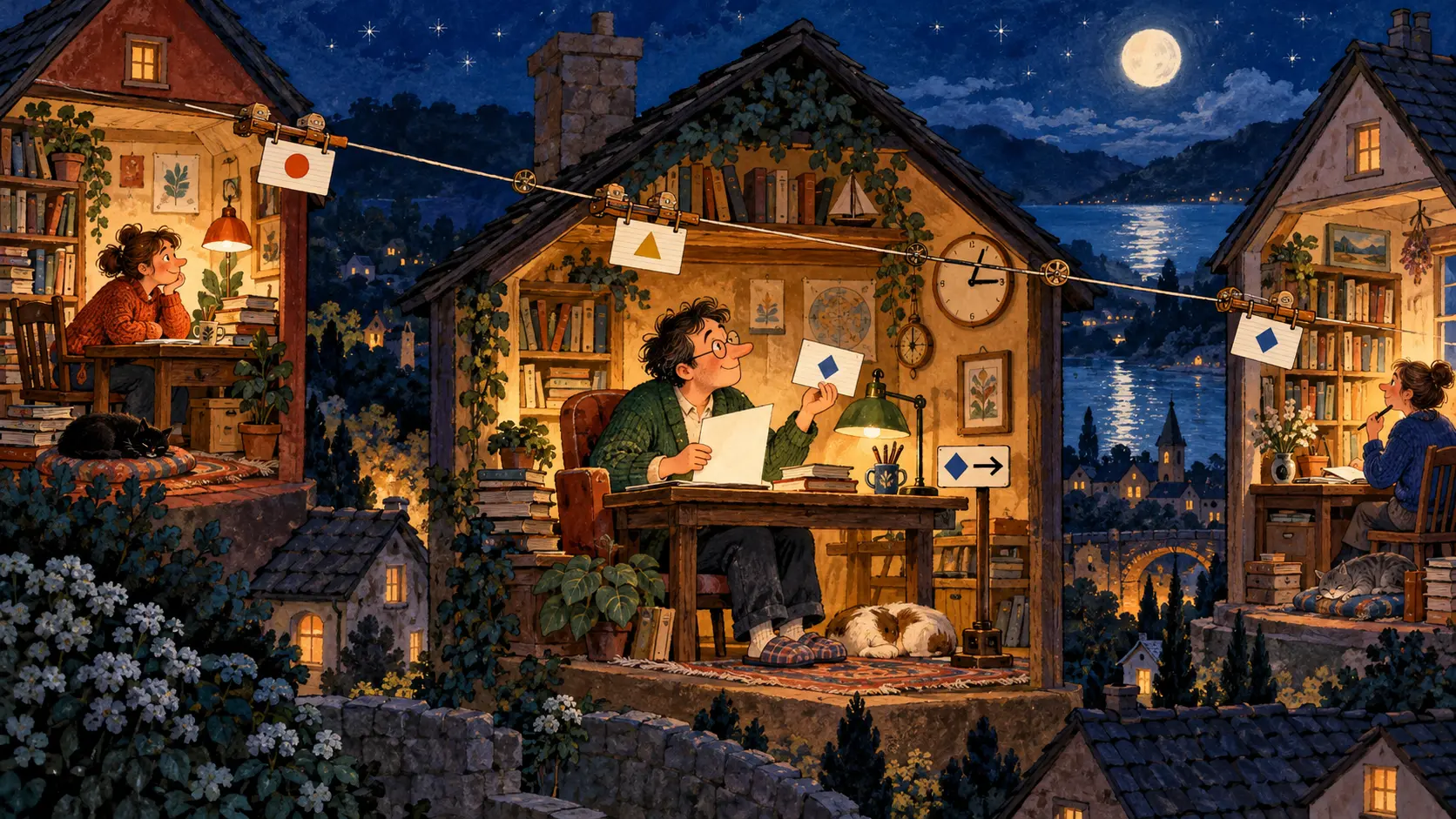
At 1:15 a.m., the names went visiting. The pages stayed home. In the implementation Ward Cunningham described in September 2002, a scheduled job collected page-name lists from neighbouring wikis. By morning, a familiar name could point a reader towards a conversation elsewhere. The books had acquired a social life through their catalogues.
His coding notes set out three chores for a sister-site operator: keep track of the neighbour’s names, cite a neighbour with a matching page, and make a name clickable when a page existed only over there. The remote entries could be represented by empty files named after those pages. This was a remarkably light travelling bag: a name, a destination pattern and an icon.
The interesting choice came after the click. A name known only on another wiki still took the reader to a local page. Cunningham had considered sending visitors straight to the remote destination. He kept the local stop so that an author could start a page of the same name at home. If several sisters had one, the reader could choose which to visit. A missing page had become a small junction with an editing desk.
That junction needed decent signs. The document’s example shows an absent local Extreme Programming page offering a sister-site icon and an Edit button. An earlier version had displayed the usual invitation to describe the topic. Cunningham reported that this prominent instruction drew readers away from the much quieter sister links. The software knew about the neighbour; the page still had to persuade a human to notice.
The sister-site guide preserved in 2003 accordingly directed visitors to icons at the bottoms of pages. Behind those little signs sat a selective neighbourhood. In the archived discussion of the scheme, which credits Steven Black’s proposal, Cunningham said the then-selected sisters had grown out of the wiki with his cooperation. He welcomed other possible policies. His reason for connecting particular communities was the prospect of useful collisions between their vocabularies.
Someone also had to keep the visiting list current. A new page could miss the latest poll, an offered list could be incomplete, or a name could fail the local naming rules. The discussion listed unreachable sites and local bugs among the other explanations for a missing link. In the printed loader, an empty result caused a warning and an early return, leaving the previous names in place. The nightly job could send its owner an error email; persistent trouble called for a conversation with the other operator.
Sisterhood therefore involved a calendar, a contact and a choice of neighbours. The appealing part was how much room remained for difference. A shared name could lead to another community’s account while the local Edit button waited patiently. The neighbour had written something. You were still allowed to have a thought.
Member Briefing
Deeper Profile Context
Sign in with the right membership level to unlock the full briefing and source notes.
Only for Strategic Circle
Strategic Circle
Open to all readers. Unlock profile briefings after joining and signing in.
Join Strategic CircleOnly for Leadership Alliance
Leadership Alliance
For qualified IP-asset owners and management; sign in to unlock alliance briefings.
Join Leadership Alliance