
Summary
- Veronica searched Gopher menu titles and returned selectable Gopher items; it did not search the contents of the files behind them.
- By 1994, data collection at Nevada and query serving at eight public sites had become separate functions, with the index copied outward.
- That design expanded discovery while leaving coverage, naming quality, refresh timing and local exclusion in the hands of operators and publishers.
A search could return thousands of results and still never have read a single document. That was the bargain Veronica offered Gopher users in the early 1990s: it searched the titles printed in server menus, then handed back a menu of the matching items. A reader could select one and reach the source. The index made the network easier to find without moving the files into one central store.
Steve Foster’s launch announcement on 17 November 1992 called Veronica an experimental answer to a discovery bottleneck in the expanding Gopher web. It indexed 258 Gopher servers and had discovered more than 500. Foster expected the service to outgrow its first machine and said the developers planned to distribute it. The announcement described the central constraint honestly: Veronica indexed menu titles, not the full text at each site. Its result entries were useful because they were still Gopher items, not a list of hostnames a reader had to visit separately.
That distinction was built into the surrounding protocol. RFC 1436, published in March 1993, describes Gopher’s type-7 search transaction: a client sends a selector and search words, and the server returns a menu. The RFC calls it a full-text search transaction because Gopher servers could implement content indexes. That generic label does not describe Veronica’s own index. By 1994, the contemporary guide and Veronica’s operator documents were explicit that its ordinary search matched words in item titles. A directory title, file title or image label could be found; the document’s prose could not be searched unless another service indexed it.
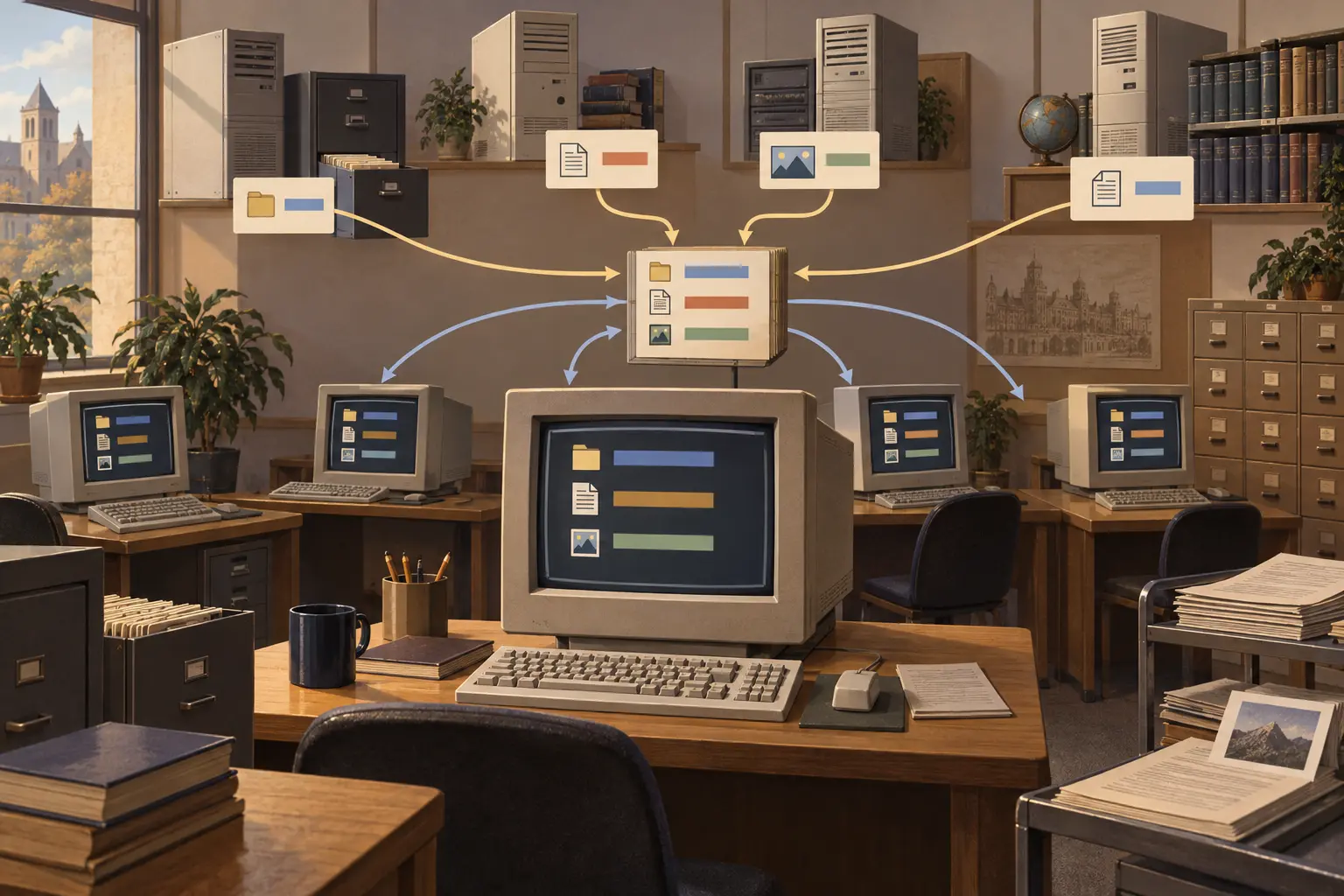
The small shared interface concealed a two-part service. A data collector walked accessible Gopher menus, prepared an index, and distributed datasets. Query servers answered type-7 requests from Gopher clients. In February 1994, the status report edited by Veronica developer Steven Foster said collection and preparation occurred at the University of Nevada, while datasets were served from other sites. Eight public servers had operated since July 1993, supported by research networks and institutions in the United States and Europe.
The same report estimated that public servers handled 1.2 million queries in February; it said most were resolved in under twenty seconds. Those are period estimates, not independently audited traffic counts.
Scale grew quickly. The 1994 report counted more than 3,200 Gopher servers on roughly 2,500 Internet hosts. Foster’s FAQ later reported about 10 million indexed items from approximately 5,500 Gopher servers in June 1994, and around 15 million items by November. In January 1995 it listed 5,057 Gopher servers plus roughly 5,000 other services referenced from Gopher menus, including Web servers and Telnet services. The counts describe different dates and categories; they should not be added into one total. They show that a title index attached to Gopher menus could expose pointers to resources beyond Gopher itself.
The index did not make every item equally findable. The FAQ says new servers could miss a monthly collection cycle; outages or access restrictions could keep a server out. A site administrator could exclude the whole server or let Veronica index only selected menus through a control file. This mattered for privacy and local choice, but it also meant “not found” could mean “not harvested,” “not reachable,” or “not titled with the words the searcher chose.” Veronica’s query guide recommended specific words and let users narrow by item type or Boolean operators. By default, a server returned only the first 200 matches.
A popular word could turn a broad index into a second navigation problem.
Replication also introduced timing differences. Foster’s query guide said that, ideally, any Veronica server would return the same answers. In practice, servers updated at different times, so results could differ; load and network traffic changed response speed. Distributed query capacity did not eliminate a central dependency: the Nevada team still prepared the shared dataset. Nor did a central index command every Gopher publisher. It followed the links it could reach, worked from names publishers supplied and respected exclusion controls.
That balance is the historical point. Veronica added a network-wide discovery layer without pretending to own the underlying information. A tiny common request could produce a result assembled from many institutions, while local servers retained their files and some control over whether their menus were indexed. Note 64 offers a useful later lens for asking where the shared specification ended and local operation began; it is not evidence about Veronica and was written decades afterward. The contemporary record instead shows the concrete trade: a searchable label, a distributed copy of the index, and a live route back to the publisher.
The system could find only what its collection and its titles made visible—and that limit was part of its architecture, not a defect hidden behind a promise of full-text search.
Sources: Foster’s 17 November 1992 announcement; RFC 1436; RFC 1580; RFC 1689 / FYI 25; RFC 1739; Veronica FAQ, part 1; Veronica FAQ, part 2.
Member Briefing
Deeper Profile Context
Sign in with the right membership level to unlock the full briefing and source notes.
Only for Strategic Circle
Strategic Circle
Open to all readers. Unlock profile briefings after joining and signing in.
Join Strategic CircleOnly for Leadership Alliance
Leadership Alliance
For qualified IP-asset owners and management; sign in to unlock alliance briefings.
Join Leadership Alliance